Showing posts with label teaching technology. Show all posts

Saturday, 7 November 2015

ECOO15 1: Making Frustrations

Back from ECOO15 and, as usually, my head is full.  After a rough year of politics around Ontario Education it's nice to attend a conference made by teachers for teachers about... teaching!  Not a politician in sight, though attendance was wounded at this volunteer run conference by them.


ECOO may have been the site
of the first ever 3d photobomb!
I spent Wednesday with my robotics teacher showing people how to make 3d models using a Structure Sensor - a 3d laser scanner that is cheaper than the ipad it connects to.  It's one of those game changing bits of engineering that suddenly opens up the complex world of 3d modelling to pretty much anyone.

We put the scanner into hundreds of hands and Katy was on there to show them how our 3d printers took those models and made them tangible.  For many who have heard of the maker movement, 3d modelling and printing but had never seen it in action, it was a seminal moment.  I'm hoping it also means people start considering how we can move toward a maker mentality, because it's about as far removed from what we do in formal education as you can get.


Buddha Tim by tking on Sketchfab - @banana29's first 3d model, nicely done!

The next day, the opening keynote by Silvia Martinez was an overview of makerspaces and how they create a genuine learning environment.  Unfortunately, and like so many other educational books capitalizing on a trend, the keynote sold the concept of Making based on the fantastic contraptions shown at world class Maker Faires.  This is akin to saying everyone should play soccer like this, and then showing them the World Cup.


Education teaches students to expect success if they do what
they're told.  Engineering demands mastery, creativity and
resilience; reality is a demanding teacher.
As I said in the conference, making involves frustration and failure.  More often than not it results in a prototype that doesn't work.  I find that the grade nine students I am introducing this process to are greatly aggravated by the inflexible demands of reality.  They are quick to blame and even quicker to give up.  The most common comment is, "just tell me how to do it."  The sub-text is, 'I've learned to do what I'm told in order to show I'm learning.  Why aren't you doing that?'

Students are used to the education system jigging things to ensure success.  The process of invention doesn't do this and reality has no interest in modifying how it works so that students can feel good about their effort.  I don't teach 'I tried real hard' or 'guaranteed success'.  What I do teach is how computers and electronics work, and I expect students to develop skills sufficient to be able to work this these inflexible devices.  Once the mastery is managed, play can begin.  Shakespeare wasn't writing plays while he was still learning to write.


This was posted by Bre Pettis way back in 2009.
This kind of radical engagement isn't the managed

and directed engagement teachers are looking for.

If you want to build with electronics and digital technology (which are what are empowering much of the maker movement), you need to have something more than boundless enthusiasm.  Using digital technology isn't effortless despite the marketing.  There is mastery learning required before you are cranking out 3d prints of gears and building your own robot out of garbage.  Many of the people creating the things you see at a maker faire are trained engineers.  I'll bet that the kids shown at these Maker Faires are relying on some engineering expertise at home as well.  It's nice to see their creativity, but it isn't the only thing, or even the main thing, that is enabling these builds.  It's like watching the child of a scientist presenting a surprisingly fantastic science fair project.

My concern is that Ontario Education will rush into this exciting and trendy fad, buying stacks of Arduinos, Raspberry Pis and 3d printers which will then gather dust when teachers realize that this equipment isn't Lego, it doesn't build itself with enthusiasm.  Your code has to be flawless and your wiring exact for even basic things to happen, and even when you've done everything right it might not work anyway because the LED you used happens to be defective.  You can't simply lower expectations and then see results.  These are complex systems being created.

I struggle each year to get high school students to develop resiliency and master skills in electronics and digital technology so I would ABSOLUTELY LOVE to see the maker movement and its attendant philosophies infect Ontario's classrooms.  The kids are more than capable of developing this resiliency and expertise, but I suspect that the vast majority of educators (many of which I help to plug in their desktops each day) aren't.


The maker movement pushes back against vapid consumerism.  I'm a big fan of intimately knowing the machines I use.  The motorcycle I ride I restored after finding it in a field, the computers I use I build from scratch, but it took me years to build my mechanical and digital skills to this level.  Most people aren't that patient, or curious.  Most people want immediate satisfaction, which is why they drive their cookie cutter SUVs to shopping malls.

Most teachers are no different.  If it isn't their curriculum, it's of no interest. Trying to push maker tools into that kind of classroom is a disaster waiting to happen.  If you've never used Linux, let alone installed an OS onto an SD card, what makes you think you will make magical use of Raspberry Pis?


Tuesday, 4 November 2014

Infecting The System

If the internet is the nervous system for a new global
culture, should it be artificially limited by human
self interest?
Cory Doctorow ended a harrowing editorial on artificially limited computing in WIRED this month with the observation that the internet isn't simply an information medium but has, in fact, become the nervous system of the Twenty First Century.

Doctorow begins by questioning why we shackle computers with controls that users can't overpower, and in many cases don't even know exist.  He uses the example of the Sony rootkit, that would install viral software on machines whenever a consumer would run one of their music CDs.  The idea was to curb pirating, the result was creating a blind spot in millions of customer's machines that immediately got exploited by hackers.

Whenever we build a computer that is subservient to anything other than the user, we're creating blind spots that hackers can exploit.  Whenever our software or hardware is artificially limited to satisfy human values, whether they be government or business or even educationally motivated, we are creating a machine that is flawed.

There is a simple honesty to computing that I find very appealing.  When we're building a circuit or working with a computer or coding, students will often say that they didn't change anything but got a different output, or that they did everything exactly right and it doesn't work.  The subtext is always that computer is up to something.  Whatever the computer is up to, you put it up to it.  Computers don't make mistakes, humans do.  This is why it's vital that computers are not controlled by remote interests.  When remote interests dictate computer outputs, you end up with confused users who start to blame the machine.


... because someone programmed HAL to kill.
Machines don't make mistakes, unless people tell them to.
I've long said that computers are merely a tool, but many people see them as intelligent entities with hidden agendas.  If we allow institutions to hard code their interests into our computers then we are intentionally allowing our flaws to infect one of the most honest expressions of human ingenuity.  We're also creating that confusion around computers as entities with evil intent (we provide the intent).

What goes for our personal devices also goes for our networks.  Unless we are going to continually battle for net neutrality and efficiency over self interest, we're going to find ourselves with hobbled machines on near sighted networks, seeing only what vested interests want us to see.  In that environment computers and the internet can very quickly move from democratizing force to Orwellian control.  Keeping computers free of human influence is vital to human well being.

I've been uneasy about the nature of the modern internet as distraction engine as well as the branding of edtech.  Both examples reek of the infected human influence that Doctorow refers to in his editorial.  Wouldn't it be ironic if we, as a species, were on the verge of building a more perfect machine that allows us to move beyond our short-sighted selves, but instead of building that wonder we infect it with our own shortcomings and end up using it to create a kind of subservience never before imagined?

I see it every day in machines so locked down that they barely function as computers, with limitations on virtually everything they do.  This is done for ease of management, to satisfy legal paranoia and, ultimately, to ease the burden of digitally illiterate educators, but this approach has me watching whole generations growing up in an increasingly technology driven world having no idea what is is or how it works.  As a computer technology teacher this is difficult to swallow.

The only restriction on a computer should be the laws of physics and the state of the art.  Efficiency and user empowerment should be the machine's and our only focus.  Everything should be up to the user otherwise these magical machines aren't empowering us, they're being used to create dangerous fictions.  Is it difficult to teach students how to use computers like this?  Perhaps, but at least we'd be teaching them a genuine understanding of what digital technology is, and how to wield that power responsibly.  All we're doing now in education is feeding the infection.

Saturday, 5 April 2014

Ronin

The Google Apps for Education (GAFE) 'Summit' is this weekend.  I'm not there and I'm comfortable with that.  There is nothing in Google that I haven't been able to figure out on my own and I use Google extensively, they make good products.


Last week's Elearning Ontario Presentation
Last week I presented at elearning Ontario on how to create a diverse digital learning ecosystem.  You'd think that educators would want to get their hands on as wide a variety of tools as possible in order to not only provide the best possible digital learning support for their students but to also increase their own comfort zone in educational technology.  In the mad rush to digitize the vast majority of people want as little expertise to accompany it as possible, they would much rather find a closed ecosystem in which they can develop a false sense of mastery.

If you hyper focus on one thing you tend to get an inflated sense of your abilities.  I wouldn't trust a mechanic who can only work on Ford brakes or a teacher who can only work out of Pearson textbooks, I'd have to assume they've learned by rote rather than developed mastery.  I know it's hard work, but becoming fluent in digital tools requires some time, some curiosity and some humility and that's ok.


A colleague showed me this last year and it has been
on my mind ever since.
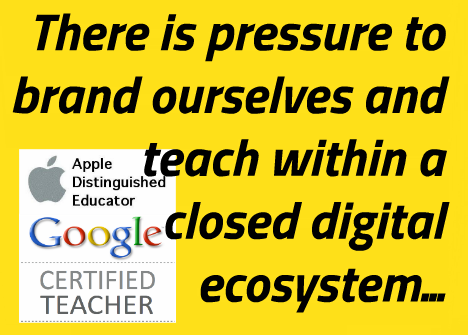
The idea that you get a qualification under a single brand and have somehow become a master of digital learning is misleading.  But the limits of evangelizing a single digital learning ecosystem go well beyond questionable professional practices around branding teachers with private company logos.  There is also the question of how these technologies are mining education for profit.  

If you live within a monopolistic education technology environment you can never be sure what they are doing with the data they are managing for you 'for free'.  That data is worth a lot of money.  Even if it's being stripped of names, the ethics of exchanging student marketing data for a 'free' digital learning environment has to be questioned.  In a monopolistic situation that questioning doesn't happen.  Only an open, fair digital learning environment allows us to demand higher standards from companies who are otherwise singularly focused on making money in any way that they can.


Wouldn't an opensource hardware model that allows us
to teach all technology platforms be a nice idea?  The Learnbook
Some links to consider:
http://blogs.edweek.org/edweek/DigitalEducation/2014/04/google_amends_its_terms_on_sca.html
"Google would not answer questions about whether its data-mining practices support the creation of profiles on student users.

Google also confirmed to Education Week that its general terms of service and privacy policy apply to student users of Apps for Education, a stance contrary to the company's earlier public statements."


http://www.osapac.org/cms/sites/default/files/Memo%20-%20Contract%20Addendums.pdf
OSAPAC has worked out a deal that doesn't sell off Ontario Students' data, but it's a secret,
and each board has to implement it themselves.  The mysteries of information in the information age...
https://twitter.com/search?q=%23gafesummit&src=typd&mode=users
Tweets on this weekend's GAFE summit in Kitchener/Waterloo... the koolaid tastes good.


ro·nin
ˈrōnən/
noun

historical
  1. 1.
    (in feudal Japan) a wandering samurai who had no lord or master.

Sunday, 2 February 2014

Student Driven Curriculum

One of the nice things about teaching computer technology is that you tend to get a lot of fanboys in the class.  They're already giddy about the subject and keen to explore it (something sadly missing from many English students).  I'm hoping to harness that experience and energy this semester in senior computer engineering.


Ontario Comp-Tech, everything from programming to robotics!
Last summer I took my final, senior computer technology AQ, and we did a fair bit of focusing on curriculum expectations.  Those expectations are so broad that finding a teacher who is an expert in all of them would be pretty much impossible.  Fortunately for me I love being taught by my students (I'm as giddy and curious about comp-tech as they are).

Rather than present yet another linear, teacher-centric semester plan, we're going to have a con-fab and talk about how to address the curriculum expectations.  They are trapped in the prehistoric tree sap of Ontario Ministry of Education documents which, at best, make for dry, inaccessible reading for students.  To make it accessible I summarized the key points in a prezi.  When the semester starts tomorrow we're going to self organize around what we need and how we're going to reach the remarkably diverse goals of the computer technology curriculum.

Hopefully the prezi format will make the goals of the course more accessible and allow us to plan out an approach that gets to all the expectations while allowing students to self direct their learning - a vital skill in an engineer.

There are threads in the course that run through the many diverse fields found in the curriculum document.  The design process is one of those keys to engineering that will serve us well while we plan out how to approach our learning.


The engineering design process is basically a forced feed-back loop that self corrects, leading to a solution.  It would work on everything from essay design to project management - it also leads to successful engineering projects.


If it works for NASA, it'll work for us!
In our case we're going to apply it to the curriculum of our courses.  Based on the time we have, access to equipment and experience in the class, we're going to create a customized, student driven curriculum plan that (I hope) will also encourage student buy in.

I want to make our lab into a maker space, so my focus is going to be on facilitating equipment in order to feed hands on engineering projects.  As long as students are effectively exploring computer technology and expanding both their interests and the breadth of their knowledge, then I'm happy with the process.  My role will be to amplify their learning rather than direct it, and I hope to start that process with a self directed semester plan that we generate together next week.

While I'm at it, I'll also get some feedback on my expansion plans to computer technology.  Who better to ask than my target audience?


Sunday, 19 January 2014

Straddling the Divide

I usually blog here to work out my thinking on a variety of education and technology situations I come across.  This one is no different.  I just read a series of suggestions for dismantling computer studies at our school.  I'm honestly curious as to the intention behind these suggestions, but in the meantime I'm trying to get the bees out of my head on this subject...


My school is odd in that it has a computer studies department.  This department is a combination of technology focused computer engineering credits (ICE/TEJ) and theoretical/math focused computer science (ICS) credits.  That our school combined these two very different disciplines into a single department has been both challenging and very forward thinking.

There is a push on now to align our headships with those of other schools.  Since the idea of a department that combines all aspects of computer technology under a single headship hasn't happened anywhere else, the urge is to dismantle computer studies.  The thinking behind this doesn't show a great understanding of what the computer subjects are (it was suggested the whole department just get put into business studies - a department that neither side of computer studies has anything to do with).  WIth so few people understanding what the fundamental computer subjects are, it makes it challenging to explain how things might evolve.  Ignorance drives many management decisions around digital technology education.

Trying to run computer studies has been a tricky ride.  Our computer science teacher only comes to our school for a semester, so the courses only run in the second half of the year.  On top of that other teachers aren't lining up to teach comp-sci.  Computer science would be better served in our school by being placed in our mathematics department and being taught by a variety of teachers, but then those teachers qualified in it should want to teach it and I get the sense that very few do.  

Computer science has been held captive by some strange teacher scheduling.  Attaching it to a larger department would be healthy for it.  I've tried to make moves in how and who teaches it, but nothing seems to have worked.  I'm frustrated and ready to hand it off.

Computer engineering is a hands-on technology course, much like auto-shop or manufacturing programs.  This course of study focuses on electronics and information technology.  Compared to computer science it's much more of a hands-on building and experimentally focused subject; it would logically belong with other technology credits.

The argument that we should re-align our headships with other schools feels like a step backwards to me though.  In five or ten years would our students be better served by a strong, comprehensive computer department, or by a traditional and arbitrary split in the subject?  Unfortunately, combining abstract mathematically focused computer programming with real-world engineering isn't easy, especially with how Ontario has handled teacher qualification in the subject.

Up until the past decade, computer science was the only computer qualification.  Like the guys in Big Bang Theory, the vast majority of computer science teachers have very strong theoretical backgrounds in the mathematics behind programming, but little experience in actually making computers work.  When computer studies was established as a technology course those theoretical computer science teachers were grand-fathered in as computer engineering teachers, though many of them had never installed a CPU in their lives and would have no idea where to even begin.  Asking them to provide onsite information technology support would be an impossibility for many of them.


That tech-ed certification took a mountain-load of paperwork
including industry certifications and proof of years of industry
experience.  If you were comp-sci when they brought it in, you
just got the certification...
So here we are in 2014 with many computer studies teachers who actually have little or no experience with the mechanical side of computing, though they have been given the OK to teach it.  This will eventually go away as those grand-fathered comp-sci teachers retire and future teachers will be expected to actually have an industry technology background in computers if they want to teach engineering.  In the meantime we've further muddied an emergent subject area that holds the key to producing  technologically fluent students who can function in the modern workplace.

What I suspect will happen with our forward thinking computer studies department is that it will be split and sent to math (comp-sci) and technology (comp-eng), and the onsite fix-it teacher role will not be considered a headship even though it manages just as much budget and far more equipment than any single department head.  This might be better for comp-sci, which has been dead-ended in our school as far as scheduling goes.  I don't think comp-eng will be hurt by moving to the tech department, so the splitting of the subjects into other areas doesn't really bother me, though it does make me wonder if we're moving in a direction opposite to social expectation.

I've been thinking about computer studies in terms of a specialization as well as a general fluency.  Perhaps future computer studies streams will include general technology fluency credits as well as specializations in engineering and coding, but I doubt it.  With computer fluency being a school (society?) wide expectation as well as the traditional fracture between computer science and computer mechanics, I fear that management energy will be spent on dividing and diminishing a subject that should instead be taking a central place as an integrated, adaptive department that produces 21st Century fluent graduates.


Wednesday, 1 January 2014

Machines That Challenge

Tim's Motorcycle Diaries
I've been taking a break from writing on work over the holiday and have instead been writing about my new love: motorbikes.  In the last post I wrote about mechanical empathy and how a machine that challenges you can also encourage growth; this resonates with technology and how we use and teach it.

Using technology without understanding it is what we aim for in school because we have so many other important things to get to, I think this is a fundamental mistake.  Using a tool in ignorance means you're never really using the tool effectively.  I'm not suggesting that everyone needs to be a computer engineer in order to use computers, but there is a fundamental level of familiarity you need in order to use any machine, including a computer, effectively.

A machine that does too much for you, even to the point of making decisions for you, is a dangerous machine indeed.  An education system that caters to this kind of thinking is equally dangerous.  Our use of technology should never be founded on ignorance.

"That a machine should place demands on us isn't a bad thing, especially if it leads to a nuanced awareness of our own limitations.  The machine that can overextend you, challenge you, stress you, is a machine that can teach you something.  We fool ourselves into stagnation when we design machines that do more and ask less from us."


There is a consumerist drive to produce machines that appear to be our servants, that will do what we want, sometimes without us evening knowing that we want it.  This kind of magical thinking might sell units but it doesn't offer any room for growth. That educators are willing to cater to this approach isn't very flattering.

I'd originally written on this from the point of view of motorcycling, which makes extreme demands on the rider.  Compared to driving a car, especially a modern car that shifts, brakes and even parks for you, riding a motorcycle is a physical and mental challenge.  In that challenge lies a great deal of risk and reward.  The opportunity to amplify your thoughts and actions through a complex, nuanced, challenging machine is a growth medium.  Growth in our students is what we should always be aiming at, even in using the tools we hand them.

In extreme cases machines take over decision making for us, reducing us to irrelevance.  Teachers need to be especially vigilant about how students use technology.  It's very easy for the tech to take over (it only wants to help!)  and the human being it's supposed to be assisting becomes a passenger.

When we use a machine to amplify ourselves it not only magnifies our achievements, it also subtly changes how we create.  Any teacher who has observed the digitization of student work in the past ten years has noticed how cookie-cutter the material has become.  Plagiarism is just one aspect of the cut and paste nature of modern student work.

Even in a scenario where the machine is a responsive tool, it will colour how you create.  Some technology is even predicated on this thinking.  Your degree of technical understanding minimizes this influence and allows you to side-step homogenized technological presentation.  If you don't care that what you are producing has been cookie-cuttered into a template that looks like everyone else's, then what does that say about what you're learning?  If you're using technology to do something else you need to understand the technology in order to realize how it's colouring your learning.

It's a shame that so many of us prefer machines that will do it all for us rather than taking up the slack ourselves.  There are two ways we can integrate with machines, I'll always go for the road less travelled and ask for a machine that offers me more opportunity, even if it also demands more expertise.

Sunday, 29 September 2013

ECOO 2013 Cometh

Last year I was getting primed for ECOO 2012 by constructing a process for transitioning from school provided, generic educational technology to a bring-your-own-device learning situation.  The idea was to assist this evolution toward personalized technology following some sort of pedagogical imperative rather than what appears to be a financially motivated top down drive to minimize school purchased tech.

Digital technology is intensely personal because it interacts with our
most personal selves, our minds...
Critically examining how we make use of technology has always been at the core of my teaching.  As I transitioned from academically focused English to technology orientated computer engineering my willingness to look for easy answers in educational technology has dried up.

Since the last ECOO a couple of events have made me question the branded nature of #edtech.  It began with the Google Education Summit in Kitchener in the spring, and then culminated with the Pearson Summit a week later.  As educators it is incumbent upon us to be technologically agnostic, this is getting more and more difficult as cash strapped teachers and boards look for financial advantage courtesy of corporate offers.  I've been battling my own understanding of this all year.

Can you imagine if your chalk board had a 'courtesy of Crayola' sign in the top corner?  Or the paper you hand out to students had a 'brought to you by Hilroy' on it?  Yet we don't think twice about branding the digital technology.  A student can't get on to a school machine without getting Delled, BenQed, Microsoft'd, Jinged and Googled, and we actually enjoy that branding, we encourage it.

In only a few weeks I'm talking about our digital selves at ECOO 13.  I'm excited about going to ECOO, doing Minds On Media for the first time (nurture your inner hacker, I'll show you how to code a microcontroller and become your own I.T. support!)  My worry is that I'm finding edtech increasingly owned, controlled and not focused on developing student (and educator) fluency.

I'm still being haunted by Matt Crawford's Shopclass as Soulcraft.  Crawford's description of the consumer as a victim of their own technological ignorance resonates:

"Since the standards of craftsmanship issue from the logic of things rather than the art of persuasion, practiced submission to them perhaps gives the craftsman some psychic ground to stand on against fantastic hopes aroused by demagogues, whether commercial or political."

The scattered, distracted 21st Century human being seems more a victim of digital technology than empowered by it.  When I realize that the 'I'm tech-savvy' high school student doesn't know what a disk partition or an IP address is, or how to boot to external media, I realize that what little expertise they've gained is almost entirely at the hands of commercial or political persuasion, and teachers are no different.  This kind of fluency doesn't suit corporate interests who would rather be able to sell you on marketing rather than engineering.  The kind of ignorance this brews is staggering.

I want to produce a constructive solution to hard pedagogical questions around technology use.  I'm finding this increasingly difficult as edu-tech becomes a managed, mainstream expectation rather than an experimental, fringe element.  The urge to simplify with dictated systems that encourage ignorance has me wondering how education will prevent rather than produce more dysfunctional digital natives.

The perfect platform for teaching students effective use of technology is an open source system that they build from scratch and have to maintain themselves.  The more you do for them, the less necessary fluency becomes.  Technology literacy is a 21st Century fluency that we should be teaching curriculum wide, much like literacy or numeracy.

That ideal technology learning platform is agnostic, varied and offers redundancy and resilience.  Students should never be in a position where the network technology is broken, but the hands on technology shouldn't be done for them.  What I'm seeing in educational technology is completely backwards; everything is locked down and done for students, and it seldom works.  This is a recipe for ignorance and about as far from pedagogically useful as we can get.

There is precious little open source software used in education, mostly because it demands competence and
Don't you wish there were a shared,open source
option for educational technology
?  There is,
but there is no money in it and it requires
competence.
responsibility.  Buying a corporate system offers you turn key technology.  We could offer cheap, debranded technology with open source, shared development software, but we don't because we'd rather be consumers than makers.  This is a result of teacher indifference as much as anything else.  Basic fluencies should be attended to and you'd have to be obtuse to think that effective use of digital tools isn't going to be as important as literacy and numeracy in the 21st Century.

I'm still not sure where I'm going with ECOO13...

Saturday, 16 March 2013

Digital House of Mirrors

The digital house of mirrors we all live in.
It's early days, ECOO isn't until next October, and I'm reticent to say what I'm going to present on months ahead of time.  The digital learning landscape can change quite significantly in eight months.

My previous ECOO presentations have followed an interesting arc, from philosophy to specific action.  My first go with Dancing in the Datasphere talked about fundamental changes happening to us as we transition to a data driven world.  The mini-lab followed a year later, the idea there being that we diversify technology in order to develop true digital fluency in students.  Last year the final step was to work toward a digital skills continuum.  Only by integrating a developing skill set into curriculum will we begin producing students who have the technical skills necessary to survive and thrive in the digital age.

That trajectory, no doubt pushed by my transition to computer studies from English, had me looking at developing greater student familiarity with computing tools because I see a great deal of ignorance in the 'digital natives' I'm teaching every day, but that focus was technically biased.

For those of us who have lived as adults through the last twenty years of technological revolution, we sometimes forget where we've come from because we're so engrossed with where we are.  For ECOO this time round I'm thinking about what technology is demanding of us as people. Our selves are being stretched and amplified in ways they never have before.  Nick Carr's The Shallows puts us on a pretty stark trajectory towards idiocy with what is happening to us.  The digitization of the self stretches us flat, making continuity of thought impossible and turning us all into distracted, simplistic cogs in a consumerist machine designed to turn us all into the lowest common denominator; none of us any smarter than our smartphones.

With the advent of social media we suddenly find ourselves existing in multiple places at once.  Our self is no longer geographically focused.  Our influence spreads across the internet. We are able to affect change in people and places formerly unconnected to us.  The people we communicate with (albeit in a minimalist way) are far flung and many.  The people we spend deep, attentive time with are fewer and diminished.  

Our digital selves are perceived in many different ways.  The aforementioned digital native tends to not differentiate between online and real world action.  They often consider social media as just another conversation they are having, and are then shocked when something said publicly is responded to by the public.  The generation of kids (our students) growing up in this ongoing social experiment never look at privacy settings, have little idea of the differences between social networks and tend to broadcast online what is on their minds in much the same way they would while hanging out with friends.  The veil between the physical and the digital, between public and private is all but non existent to them.  


Digital Footprints & Always On Teacher Faces
A more professional approach to managing the online self is to adopt marketing theory and develop your online brand.  Companies and celebrities approach social media in this manner, often using marketing firms to manage and run their social media presence.  I can't help but think that this lack of genuine presence games the system and ultimately fails.  It's exhausting to maintain if  you can't hire marketing monkeys to run it for you, and ultimately, it's fake.  I'd much rather read my favourite author's tweets from his own fingers than follow what someone trying to sell me something thinks I should be seeing.  Many teachers fall into this trap when tentatively stepping into online presences.  Spending your weeknights and weekends being mister or missus Teacher is nothing more than working all the time, forever.


The Cult of Done
If there is a positive future to a digitally enhanced self I'd hope it is through a genuine sense of self expression.  We should be aware of what the tools are and how they work, and then we should use them to empower our access to information, our ability to mine deeply into details, to collaborate and develop community, to share our own creativity, interests and sense of discovery.  The technology should not only allow us to do these things, it should be pushing us to maximize our effectiveness as thinkers and doers.  Any technology that produces distracted idiots will doom the people using it.  Evolution should still be eliminating the irrelevant, even in the digital realm.

It's early days in this sea change of how we deal with a digitally enhanced self.  In the future the hybrid intelligence of a digitized human will evolve toward a higher order of effectiveness.  Those made useless by digital tools will, much like those weakened by an inability to read, become marginalized.  Those able to harness information literacy will enjoy those advantages.  Those who ignore it will find themselves increasingly unable to compete.

What that effective digital self looks like in students, in teachers, in people in general is where I'm currently thinking about pushing my research this year. How we adapt to these changes now will establish effective habits as the technology rapidly spins out of its infancy and into maturity.  There is no better time to consider what a digitally enhanced human being should look like than now, when we're in the process of inventing the very idea.

The idea of Web3.0, or intelligent/self organizing information suggests that the future of digitized humanity will inherently push toward greater effectiveness.  The opportunity to be passive or stupid in a digital context will actually work against what the data wants to do for you; you'll learn in spite of yourself, you'll know what you need to know when you need to know it - the data itself will ensure this.  It would be interesting to show the evolution of digital humanity over the past three decades, and where it might be going in the next twenty years.

The era of stupid/passive information is ending. The people that it has created will have to adapt to technology that demands more of them, or risk being made irrelevant by it.

Wednesday, 10 October 2012

Between a rock and a hard place

Imagine you're the head of the English department at a high school.  Your job is to support the English teachers in your department, help develop consistent and meaningful curriculum, buy department supplies and act as your teachers' voice at school directions team meetings.  It's one of the biggest departments in the school, you may have up to a dozen teachers, some teaching English full time and some part time, all of them with clear qualifications in their field.  You have the benefit of all those varied opinions, but you also have to try and get them moving in roughly the same direction too.  You've got your school's library of novels and other texts to maintain, all the time knowing that every student in the school is going through your program which teaches vital literacy skills.  Students cannot graduate without demonstrating those literacy skills.  Your job isn't an easy one, but its importance is self evident.

I am the head of computer studies at my high school.  I'm a department of one, which makes developing consistent and meaningful curriculum for my subject area rather difficult (and lonely).  I don't have a collection of professionals to bounce ideas off.  I have to maintain text books, and equipment, but for vanishingly few students - computers just aren't on the must-take list at my school (there's no future in them?).

There's a twist to this headship though: when you're the head of computers, you're not just the head of a small, unimportant department, you're also responsible for your subject area school-wide, and it's a growing, vital piece of modern educational practice.  Internet failures now begin to look a lot like power failures in the last century.

***

Imagine you're that head of English again, except now you're not just responsible for your department, but for English usage in the entire building.

Every time a student or teacher makes a grammar mistake or needs some reading material or writing stationary, you're the one they turn to.  You've got your department to run, but you've also got to oversee the execution of your discipline throughout the entire building.  You spend your time correcting people's reading, buying them pens and paper, and proofreading and correcting their mistakes.

They don't hand this to you because they want to be illiterate, they do it because the school board wants to retain control of their stationary - which means its better to read and write everything for people than it is to let them learn how to become literate themselves; control is more important than learning.

The school population is capable of learning how to read and write, but remain illiterate because their employer finds that easier to manage.  In that building of illiterate people, your ability to read and write raises you to otherworldly status, people seek you out to do the impossible and read the printed page.

This isn't entirely without historical context.  There was a time when reading and writing was a mystery of the learned class, a means of separating knowledge from the proles.  Whole alphabets were conceived around the idea of making it more difficult for commoners to become literate, churches kept literacy from the masses.  Knowledge is power and literacy is the key to knowledge.

I fear something similar is happening with computers now.  There is little doubt that they are becoming intrinsic to the functioning of modern life, but a smaller and smaller group is able to grok computing.  Overcoming intellectual barriers like this should be the primary directive of public education, yet we're falling into the gap between the digerati and the rest.

***

It sounds ridiculous, but enforcing enforced ignorance is what I'm facing as the Computer Studies head.  I have almost no time to actually nurture the anemic department I've inherited because I'm looking after the people who have been taught to be helpless by their employer.  I spend most of my time managing the budget of school IT, ordering equipment and repairing or passing along problems to board tech support.  My own department is an afterthought, the actual teaching of computers to students is an echo of what I experienced in the 1980s when we barely had any computers.  My time is spent supporting a system that encourages ignorance, and it's a system that is insinuating itself into education practice more completely every day.

This is a headship like no other.

I was thinking about this as I was doing my weekly 'fair share' of extra duties and covering the library so the librarian could go to lunch.  I haven't had an uninterrupted lunch since school began.  I haven't had an uninterrupted prep period since school began.

***

I'm feeling pretty down on the job, but it's more a matter of appreciation for the work involved than it is the work itself.  I genuinely enjoy technology.  I've had my hands in computers since I was a child, it was one of my first serious hobbies.  When people say things like, "computers are making people stupid" or, "computers are making people autistic" I get angry.  Ignorance injures people, tools are only helpful in skilled hands, otherwise they can injure as easily as assist.

Computers are one of the most powerful tools we've invented, up there with harnessing electricity as a means of empowering us.  How we teach computers directly influences how well we're able to grasp a better future, I honestly believe this.

Watching the taught helplessness of the school computer lab makes me fear for that future.  Just as we teach drivers the responsibility of operating an automobile, so we should be teaching both teachers and students how to grasp and manage the powerful computing tools we now have at our disposal.  We all need to be responsible for the technology we wield.

Fire can save you, or burn you...
Students (and educators, and education systems) who view computers as a distraction instead of an empowerment, who enforce simplistic, habitual use instead of exercising human/computer potential are more than a tragedy, they are the genuine threat that Nick Carr suggests.

It's a tough situation, being trapped between what appears to be an increasingly vital skillset and an education system intent on not teaching it.

The frustration at not having your work recognized is one thing, but when that work only reinforces a system founded on spreading ignorance, the whole thing gets quite unbearable.

I hope one day we wake up and change how we use computers in schools.  I guess my way forward is to keep pushing for what I think should be a self evident truth: if you don't learn how to use the technology, the technology will learn how to use you.

Thursday, 20 September 2012

The Lab That Isn't A Lab


I'm teaching Computer Engineering in a school computer lab.   It's the nicest lab in the school, and I don't want it any more.

I recently described it to my principal as, "trying to teach auto mechanics in a new car show room where you can't touch anything."

Computer engineering in school underlines everything I don't like about school computer labs (and that list is long).  I don't think school computer labs teach students anything helpful about computers.  In fact, I think they are specifically designed to be out of date, glitchy, inaccessible and frustrating - hardly the mindset you want to put students in when you're teaching them how to learn effective operation of an extremely powerful learning tool.

Essentially, what we try to do in school computer labs is teach students how to ride a bicycle by having a professional bike rider come in when they aren't there, maintain and ride an old bike, then leave it there for them.  We then tell the students to get on it and ride with no hands on experience, practice, training or intent.  We then get angry with them when they fall off and damage the bike, or ride it pointlessly in circles.

Whether it's media arts labs, or school computer labs in general, I'm not a fan.  The fact that they haven't changed significantly in form or function since I graduated from high school in 1989 should bother people, but the real bee in my bonnet is the lack of ownership in our understanding of technology.

If you want to use technology in your classroom (and in 2012 you'd have to bury your head pretty deep in the sand to not want to), then you the teacher need to understand how it works, and you need to teach this to your students.  The willful ignorance I meet in staff is sometimes good for my ego, but never productive in developing technical literacy in our students.

With our old tech, people are familiar enough to know what they are doing:
... but not so much with our new technology.  We need to address that.  Until we're all familiar enough with the digital tools we're expected to be literate in that their use is second nature, we need to spend time, especially in the classroom, learning what they are, and you can't do that in a school board IT straight jacket.

I'm not advocating for a ground up build your own computer when you want to type out an English paper (that's what computer engineering is for), but I am advocating for an open, author-able, stable, up to date system that allows teachers and students to become familiar with the options and customization available on this equipment (something impossible in our board, locked down, forget-everything-when-you-log-off terminals).

Back to the lab that isn't a lab.

When I was doing my AQ for computer engineering in the summer, our instructor showed us his new classroom in his new school.  It was fantastic.  Work benches filled it, fabrication tools and a few tables for the odd sit down talk.  It looked like a room where making happened.  There wasn't a single board computer in there.

Later in the summer, when I was picking up computers from a school in Guelph (a teacher, working in the summer?  Evidently), I saw their lab and it was the same idea: workbenches and stacks and stacks of parts; a room where hands-on learning happens.

I'm not entirely sure why we feel that computer engineering should be happening in a computer lab at my school.  My seniors don't use the school computers at all, and my juniors are only on them because they are there.  I'd much rather they be hands on with machines, except there isn't enough room in a lab full of school computers to make another network.

What do I want?  One of the de-labbed classrooms where there are plenty of electrical drops.  I'd be willing to evacuate the much in demand lab if I could get a room that let me store my equipment and set it up as I need; a room that was truly a lab where experimentation and hands-on discovery happens.

Saturday, 1 September 2012

Looking Forward to Teaching Technology

The other night Alanna noted that I seem much more intent on presenting my best work during my computer engineering qualification than I have in others.  This stirred up a whole pile of history for me.

I completed my honours BA in English and philosophy from the University of Guelph in 1995.  I staggered out of my four year program elated, dissolussioned and fairly determined not to wade back into academics again.  I found a subset of professors (the young up and coming type usually) close minded, aggressive and cliquey.  Many of the post grads I met were intellectually cannibalistic, competitive and cruel.  That feeling kept me away from Teacher's College for many years, and still has me firmly refusing to consider a Master's program.  The arbitrary, cliquey nature of academics was alienating.

In university I approached liberal arts liberally, trying one of each subject area in my first year.  One of the reasons I cottoned on to English was that I was good at it.  Being drilled in reading and writing let me resolve a skill; I improved in noticeable ways.  My profs were hard but the skills continuum was pretty clear.

Where I got into muddy water was in philosophy.  The vast majority of my profs were older and tended to approach it in a friendly hands-off manner; I remember those profs fondly.  The younger ones, as mentioned above, seemed intent on discouraging interrogative learning and appeared constantly in a state of dismissive negativity, unless undergrads were fawning idiots.   Philosophy seemed to be about collecting disciples rather than understanding some of the greatest thinking in history.  Being an older student, I tended to be of an age with many of these life long academics, though having come from a school of sweaty warehouses and machine shops.

Ironically, many of the best teachers I had growing up weren't teachers at all, but rather senior mechanics who were willing to take time to help along a young apprentice.  It was a learn fast or get caught on fire kind of environment, but learn I did, and the power structure was never arbitrary.  You either knew what you were doing, or your work spoke for you.  It was never a matter of how much money my parents had spent on tuition or what your academic pedigree was that dictated relationships.

Taking my first tech-qualification this year as a teacher feels like coming home.  I'm going to miss teaching English, but I'm not going to miss the sweatshop approach to English and literacy in high school where every class is at cap and the rooms are filled with students being forced into a mandatory subject.  I love English.  The reading, the writing, Shakespeare...  Watching how it's made into work, overfilled and underfunded is depressing, I won't miss that.


So here I go into the tech classroom where I think I'm going to channel my apprenticeship experiences over my academic experiences.  What we're learning isn't easily politicized, or easily based on classism or culty academia.  Teaching tech includes an element of objective quality, it works or it doesn't, you know how to do it or you don't.  I'm looking forward to that solid ground.