Showing posts with label teaching. Show all posts

Sunday, 21 November 2021

Imitation Isn't That Flattering

Yoda didn't say that in a vacuum, he was an
attentive and differentiating instructor!
Over the past couple of years I suddenly find myself considered a 'senior teacher'.  You might think this comes with all sorts of resources like extra time to work on training other teachers where you can show them the tricks of the trade, but this is public education so you just do it for free.  You might think that it would result in a curriculum support role where you can prompt system-wide improvements based on your decades of classroom experience and pioneering curriculum development, but those jobs are all full-time permanent gigs for very specific people with criteria for admission that I don't evidently possess.

A previous principal told me that my classes are too difficult and I need to turn them down.  When I pointed out that no one had failed any of my courses since he'd arrived for his stint in our community, that held no weight with him; some students and parents want daycare, not education.  I have no interest in providing daycare so I simply ignored his misguided observation.  I get where it's coming from though, daycare is much cheaper to provide than education.

One of the things we do in my program is get into Arduino microcontrollers in grade 9.  Arduinos offer a tactile introduction to basic electronics circuit prototyping with breadboards and electronics components as well as a coding connection through the C++ based language that runs the microcontrollers.  I've been doing this long enough and in such a brutally honest reflective practice stance that I've gotten pretty good at it.  One of the things that less experienced teachers (which includes many admin) fixate on is the placement of responsibility for engaging with this hands-on learning on the student.  To the unaided eye this looks like I'm chucking them in the deep end and watching them drown, but nothing could be further from the truth.

Pulling apart tech to show students how it
works is a core learning tool in my computer
engineering program. Tech isn't magic!
I present this introduction to circuit building in a remarkably structured environment.  I build the first couple of circuits in front of the students, repeatedly reminding them how the electricity is passing around the circuit which also has the added benefit of showing them the stochastic nature of what we're doing.  Sometimes you do it all right but the part you're using is broken, so you have to approach everything critically, iteratively and with sensitivity and patience.  I then leave those working 3d examples in front of them to look at.  Modelling the work establishes with them that I know what I'm doing and encourages them to ask questions.  I also show them a pulled apart breadboard so they can begin wrapping their heads around how this new-to-them (though they spend their whole social lives on it these days) technology works.

It's that cognitive breakthrough that I'm actually looking for (the hands-on skills are just muscle memory practice).  Some students with strong tactile skills and good visual reasoning are able to imitate the circuits without understanding how they work.  This becomes a problem when they get into more complex circuits later in the unit.  When a student finally begins to see how the electrons are flowing, that's when they begin understanding basic circuit building in our applied technology class.  If you're not a teacher reading this, are you beginning to get a feel for the yawning gap between education and daycare?  Could you email the Ontario Minister of Education and fill him in on it too?

To support that hidden cognitive focus I'm on (metaphorical - health and safety would never go for it) roller-skates when I'm teaching grade 9s in the first day of circuit building.  Alanna knows these introduction to circuit building days are one of the toughest teaching days of my semester because I'm not focused on chucking everyone in the deep end and seeing how many fail, I'm focused on getting everyone from misplaced developmentally delayed students to the previously experienced and gifted (all dropped into the same open level tech course) over this challenging cognitive realization.

Some students require one on one support, some figure it out immediately. Some are able to imitate understanding through mimicry but then run into problems later.  I'm keeping a running tally of all of that in my head as I'm running round and round the room helping those who need it.  I'm doing all this by leveraging technical skills that took decades to hone along with teaching skills that have also taken decades to develop.  I understand that recognition is difficult for many, but just because you don't understand it doesn't mean you should simplify it so you can.

The sink-or-swim misunderstanding creeps back in when less experienced teachers watch me interact with students who aren't engaging with the material.  When the system-trained giver-upper waves me over and tells me they don't know what to do (after extensive set up and support), I don't cater to their apathy inspired edu-hack (ask the teacher to do it for them).  I'm often left wondering how they got 9 years into the system without anyone calling them on this weak move, but many 'teachers' are all about systemic success at all costs - it makes for good statistics and happy management.  I'm in this for the teaching - which is why I'll never find myself with the power to make system wide improvements.  For those edu-hacker students who have learned that helplessness gives them a free pass, I'll often prompt them quite roughly with something like, "you haven't even opened up the how-to webpage or attempted to build the circuit.  I'll come back when you decide to make an effort."

This often knocks them back on their heels.  A teacher expecting them to participate in their learning?  How dare they!  I'm going to get my mom to call the principal and tell him this needs to be easier (code: daycare).  Strangely enough, many of these reticent students end up gaining a great deal of confidence as they come to understand how to build circuits in in my thunderdome - it's the first chance they've had to experience a genuine sense of achievement.  No one learns anything from having other people do it for them, no matter how much cheaper that is at a systemic level.  It's a frustration that this myopia has infected people without enough classroom experience (or common sense) to know that it's nonsense.

https://twitter.com/JohnNosta/status/1462448960753352710
Fail fast only works if you have enough
skill to realize why you're failing. Failing
fast and clueless is both expensive & pointless.
Over the past couple of years I've watched several teachers imitate my approach and it ends up feeling like a rather embarrassing caricature drawing (my nose isn't that big - actually it is).  They see what looks like a rough approach that mulches students in order to look for talent, but this isn't that.  What's happening is that I'm creating a very structured situation for learning something hands-on and difficult (reality is a cruel teacher) while also placing the responsibility for engaging with it clearly where it belongs: on the student.

Another of the many supports in place are the GREEN BRICKS OF DOOM (!!!).  This is a spreadsheet that is put up on the projector showing who has completed what circuits (you get a greened out block in the spreadsheet when you show a working circuit).  It very quickly becomes apparent that some students are quicker than others, but I don't consider that a secret, I use it as a learning support.  If you're sitting next to the girl who has already done the circuit you're struggling with, ask them what's going wrong.  This also has the benefit of showing me those students who are faking an understanding rather than building their circuits based on deeper knowledge.  I've been told that slower students would find this mean, but they generally lean into the information as it helps them.  That is also recognizes students who are engaged and working it out is something I have no problem with.

I once used the term 'pedagogy' in context with a new administrator and she replied with, "pedagogy? what does that even mean anyway?"  I found this response frustrating though unsurprising from someone aimed at system management where you often have to enforce cost cutting measures that cause harm in order to do the job (something I'd be bad at and another reason why I'm never likely to have any system reach).  But wouldn't it be something if pedagogical best practices drove everything we did instead of being dismissed?  Perhaps then more people would have a better idea of what I'm doing in my classroom.

Teaching complex, technical skills is challenging, but you can provide supports without
taking away the immediacy of experiential learning. Some will struggle to understand it though.


Saturday, 7 March 2020

It's Time For You To Go

The ZPD: something all those people critical of
teaching have never heard of, but it's where
teachers live all day every day.
If your teacher-craft is good you are a natural differentiator, going to great lengths to provide each student with what they need.  Teachers are the pressure point between a system trying to do things as cheaply and generically as possible and individual students all learning from their own context.  That stretch is why replacing teachers with elearning systems or creating enormous classrooms will result in a substantial drop in pedagogical effectiveness.  You need a trained professional to attempt to bridge this enormous gap in a reasonably sized class, at least if you want it done well.

In an optional course like computer engineering this is stretched to extremes.  In the same class I will have functionally illiterate students who verge on being developmentally delayed sitting next to gifted students who so aggressively pursue the work that they are operating well beyond the expectations of the grade or even the curriculum.  I'm the mechanism that tries to make sure both those students (and the other twenty-two in the room) are all in their zone of proximal development, and yes, it's exhausting at the best of times.

On top of that, because I'm teaching high school students I get to attempt this stunt with kids whose brains haven't yet developed the ability to forecast the consequences of their actions.  When their amygdalas finally develop in their early 20s their executive functions will come online and their post-secondary instructors will get to enjoy a more complete human being, but we never see them in high school.  Most of the general public are also oblivious to the brain research teachers keep up on.


Because all of that isn't enough, Ontario also likes to Victory Lap students, allowing graduates who have already finished to come back for another year at great public expense.  The system used to enjoy the extra financial injection that these students brought with them, but cuts have meant that schools aren't being funded completely to support these students properly any more.  This week I'm spending more attention on two victory lappers than I am on my other 70 odd students who are actually supposed to be there.

I've had mixed experience with Victory Lappers.  In some cases that extra year was just what they needed in terms of maturity to prepare them for post-secondary life, but too many times it's a privileged kid enjoying an easy year in a fish tank they've outgrown instead of taking the big step into the unknown.  That this is now happening in an unfunded and overly stretched system is causing stress cracks to appear where they didn't before.  Maybe a way forward in this is to only allow students with individual education plans (those who need special supports) the opportunity to victory lap, but whatever we do, it needs to have been done several years ago.  If we could stop playing politics and actually manage Ontario's education system effectively, we could find cost savings in something like this immediately.

Wednesday, 4 December 2019

Easy Money

Superpower...  and then gave it away.

There is a strong undercurrent of animosity about what teachers get paid and a lot of misinformation about teacher average pay. Like anything, it's more complicated than it appears. Here's my stab at trying to explain how Ontario teacher pay works, though the people complaining about it probably aren't interested in any facts:

The latest Ontario secondary teacher salary grid from my board:
http://www.d18.osstf.ca/-/media/districts/d18-staging/ugdsb-occasionals/2017_2/central-agreement/1-electronic-collective-agreement-signed.ashx?la=en-CA
To get your foot in the door on this grid you need to have spent 4 years in an undergraduate degree and then another 2 years getting your bachelor of education. If you've ever had any trouble with the law you're already out of contention. You need to have a clean criminal record to be a teacher.

Your average cost for a university degree in Canada these days is about $6500 a year.
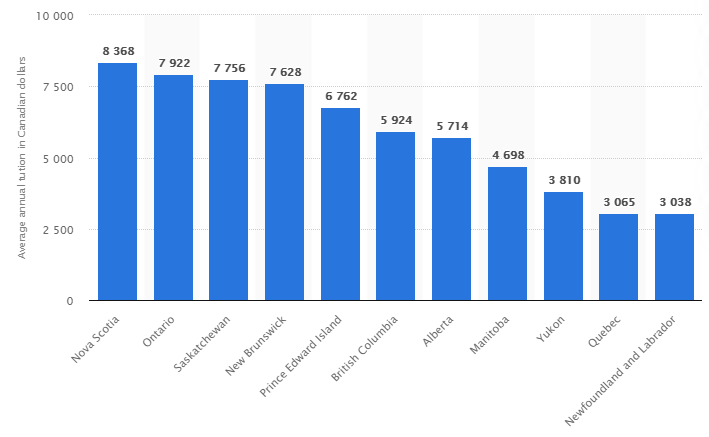
So you’re about $40,000 in debt before you even get a whiff of that ‘super’ teacher pay. Ontario is (of course) one of the most expensive places in Canada to get your post-secondary education:


https://www.statista.com/statistics/733512/tuition-fee-for-full-time-canadian-undergraduates-by-province/

So that $6500 Canadian average turns into almost $8000 a year and your Ontario teacher is typically sitting under about fifty grand in debt to get onto the grid.

Six contract sections don’t exist for new teachers these days. From what I've seen, you’d be hard pressed to find any Ontario teacher under 30 years old who has six contract sections (full time equivalence - six sections is a full year of work). It’s fair to expect most teachers to take 5-6 years to get to full contract these days, many give up on the process. There are a number of teachers who, for various reasons, never get to six contract sections and are part time throughout their career.

It takes the typical Canadian
student 10 years
 to get out
from under student loan debt,
so I put that in too - but didn't
count the ongoing debt required
to pay for your teacher training.
Remember that salary grid? To get up the sharp end of it you need to have an honours degree in what you’re teaching and then take additional qualification (AQ) courses after teaching experience to earn your ‘honours specialist’ and get into the top ‘level 4’ section of the salary grid.

A number of teachers never get there because they don’t have the university background or aren’t willing or able to spend thousands more dollars when they aren’t teaching to get additional qualifications. You can look up any teacher on OCT to see what their qualifications are and whether they’ve spent more of their own time and money to get additional qualifications:  
https://www.oct.ca/Home/FindATeacher

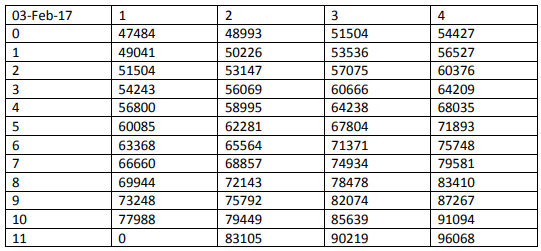
So, to get up to the top end of the teacher’s salary, currently $96,068 in my board, you need to have dropped at least fifty grand on university degrees plus another couple of thousand on honours specialist additional qualifications. Most teachers don’t stop there and get other AQs in other specializations as well (I have 2 other subjects I've AQ'd in as well as my honours specialist).

Because of all these variables, calculating what the actual average teacher salary is in Ontario is a tricky business, which is why no one has bothered, but I'll give it a go:

Your first year you're teaching as an occassional teacher at the bottom of the grid. Let's be wildly optimistic and say you're teaching six sections (full time) on a short term contract, but many aren't. From years 2-6 let's say you're getting one contract section a year and are still able to fill up the rest of your time table with short term contract jobs (again, many aren't). Let's assume you've got an honours degree in what you're teaching. In your third year you drop another couple of thousand bucks on getting your honours specialist and move up to level four on the salary grid and keep climbing year over year.
 

That eighty-three grand average is mighty optimistic.  It ignores the endemic under-employment in new teachers these days.  It also ignores maternity leaves and any other family or medical leaves that happen in people's lives as well as the fact that a sizable portion of teachers never get to that level four on the grid.  I'd estimate that the average Ontario teacher is making something more like seventy grand a year, with many making substantially less.

Wild eyed conservative leaning reporters will bleat on and on about how the average Ontarian should rise up against these overpaid teachers, but when you look into statistics around pay and education level, the typical degree carrying Ontarian makes about $85,000 a year. Your average teacher salary is significantly less than that:

https://www12.statcan.gc.ca/census-recensement/2016/as-sa/98-200-x/2016024/98-200-x2016024-eng.cfm
Playing that rhetorical game and equating people who have spent years of their lives and tens of thousand so their own dollars to earn a qualification with people who haven't is a nasty bit of neo-con politics.  The people playing that game are trying to sell you on equality when they're actually selling the opposite.  We live in a society that rewards dilligence, competence and effort, don't we?  We want our dentists to be able to fix teeth, our mechanics fix cars and our teachers teach our children the skills they need to survive in an increasingly competitive world facing some very big challenges.  Professionalism matters, doesn't it?  Maybe it doesn't in our new, blue, Ontario.

The benefits and pension piece are another angle that gets a lot of air play.  I pay almost eight hundred bucks a month into my pension.  If everyone paid that much into a pension plan, they too would have a good one waiting for them.  The only difference between teachers and everyone else is that we're forced to do it.  My take home pay as a teacher only equalled my take home pay as a millwright from 1991 in 2015, after eleven years in the classroom and tens of thousands of dollars spent on training and qualifications.  I'll have a better pension when I retire as a teacher than I would have as a millwright (though National Grocer's millwrights were well looked after until they broke the union and fired them all in the late '90s).

There is another side to these conservative attacks on teaching that often goes unnoticed.  I'm always left with the vague feeling that there is some good old fashioned sexism implicit in the politics levelled against educators.  Almost 70% of teachers in Canada are women, and there is no glass ceiling in it because we're paid equally for the work we do.  I imagine this grates on the nerves of the manly conservative men who are looking for reasons to hate on the job and the unions that enabled this equity, but I gotta tell ya, most of those dudes wouldn't last five minutes in a classroom.

If you're able to handle the crushing student debt, the hatred of people who couldn't or wouldn't do what it takes to do the same job and have the resiliency to survive in classrooms (stats show that typically about 30% of people who do the degree work drop out of teaching), then teaching is a rewarding profession, and one of the few remaining that let you lead a middle class life.

If you think you can handle all that and don't mind being attacked and belittled publiclly by the very government you work for while producing educational outcomes that are envied the world over, then go for it, but don't ever assume it's easy money.  

I just spent most of the day making no money and walking the picket lines
for better learning conditions for my students while we all struggle under
an almost psychotically vindictive provincial government who seem intent
on hurting the most vulnerable students in our system.

Some stats to consider:

There has been a lot of mis-information around Ontario teachers making the highest salary in Canada.  That’s not true either:  www.narcity.com/life/these-are-the-highest-and-lowest-paying-canadian-cities-for-teachers
Toronto is 4th out of 8 on this 2018 list.  Teachers get paid more in Nunavut, Alberta and Manitoba, and only make a couple of grand more than teachers in Nova Scotia and Saskatchewan.  I’m sure you can quickly figure out the difference in housing costs between Toronto and Halifax or Toronto and Saskatchewan…
Ontario pays less per student for education than most other provinces while producing results that raise us into the top 10 world wide - but this is Ontario so expect to be attacked for that.
         
Canada is close to the world average in terms of education spending as a percentage of government spending.  Again, Ontario is the largest single system in the country, so we wag that dog too, but expect to be attacked for it.
In terms of cost we're pretty much neck and neck with the USA, but Canada is top 10 in the world, the US isn't in the top 30.  If you want to be acknowledged and rewarded for a job well done don't teach in Ontario.

What Finland is really doing to improve its acclaimed schools:
https://www.washingtonpost.com/education/2019/08/30/what-finland-is-really-doing-improve-its-acclaimed-schools/
"We have learned a lot about why some education systems — such as Alberta, Ontario, Japan and Finland — perform better year after year than others in terms of quality and equity of student outcomes. We also understand now better why some other education systems — for example, England, Australia, the United States and Sweden — have not been able to improve their school systems regardless of politicians’ promises, large-scale reforms and truckloads of money spent on haphazard efforts to change schools during the past two decades.

Among these important lessons are:

  • Education systems and schools shouldn’t be managed like business corporations where tough competition, measurement-based accountability and performance-determined pay are common principles. Instead, successful education systems rely on collaboration, trust, and collegial responsibility in and between schools.
  • The teaching profession shouldn’t be perceived as a technical, temporary craft that anyone with a little guidance can do. Successful education systems rely on continuous professionalization of teaching and school leadership that requires advanced academic education, solid scientific and practical knowledge, and continuous on-the-job training.
  • The quality of education shouldn’t be judged by the level of literacy and numeracy test scores alone. Successful education systems are designed to emphasize whole-child development, equity of education outcomes, well being, and arts, music, drama and physical education as important elements of curriculum."


Still want to earn that easy teacher money?  Jump on in, the water's tepid.


Saturday, 19 September 2015

The Ebb & Flow of Pedagogy in Education

The intention of Dusty World is to work through ideas I'm having around teaching.  Since I'm a technology teacher, a lot of those ideas are tech-focused.  This week, after years of forced contracts and an unbelievably rough round of negotiation, my union has voted to accept an austerity contract that was bargained virtually at gun-point.  Since our last bargained contract we've been wage reduced, had benefits striped and work load increased.  By the end of this contract we'll be looking at more than a 10% reduction in take home income when inflation is considered.


The politics of the agreement aside, what does something like this do to my work environment?  Instead of focusing on pedagogy and excellence in learning, I find myself performing damage limitation.  Knowing that my employer focuses on finances rather than pedagogy is difficult to hear, but when the school board association walks into negotiations demanding dictatorial control over teacher time, stripped benefits and wage reductions, you can't help but come to that conclusion.

Teaching is a human activity, and I am the human face at the end of a large, faceless, increasingly politically driven bureaucracy.  I'm supposed to be teaching my students how to manage digital technology so it doesn't manage them, but increasingly I find my time being spent trying to protect my students from a system intent on doing less for less.  When I'm cobbling together 8 year old computers just to give students a chance at hands on learning, or trying to calm agoraphobic students in overcrowded spaces, or sourcing fans to keep the classroom temperature from boiling because we have thirty two old machines huffing away in there, quality of instruction is obviously not the goal.

The education system goes through changes in focus all the time, and the effectiveness of learning waxes and wanes depending on the political climate. I began teaching in Ontario in 2004 and my early years were in a system in recovery from Mike Harris' "unprecedented disinvestment in public education, which destroyed a historical competitive advantage in the space of a decade."

Ontario's public education system, under reasonable management, saw huge steps forward in terms of effectiveness.  Before the cuts began in 2012, Ontario's education system was top 5... in the world, and, with BC, led Canada up the charts.  You can imagine how satisfying it must have been to work in an environment like that.  I'd often find myself developing lessons or reading about teaching techniques on a Saturday night.  I didn't take a summer off in my first eight years of teaching, taking many additional qualifications (at my own expense) and teaching online to expand my skills.  With the amount of time I spent at it, I was probably dancing with minimal hourly wage, but I didn't care because I threw myself into my profession and my profession looked after and encouraged me.

That sort of intensity appeals to me, I enjoy the challenge and get a lot of satisfaction out of doing a difficult thing well, but it depends on support.  Anyone doing anything well does it because they have good support around them.  If you don't believe me watch any professional sport.  When you suddenly find yourself losing common sense arguments around class sizes based on safety and access to tools, you start to wonder whether going all in is that productive, or healthy for you.
One of the best bits of advice I got at teacher's college was,
"always be ready to go to work again tomorrow."  I didn't
used to get frazzled running hard, but now I do.

It was nice to start my career in a time of such positive pedagogically driven education.  I got to do that because the teachers before me suffered through a decade of cheap nastiness.  We've swung back to the cheap nastiness now, but rather than fight it we vote for it.  I was willing to fight for better, but the vast majority of secondary public teachers are ok with less.  How will that translate to their work in the classroom?

I'm going to have to reconsider my survival strategies.  If I throw myself all in and then get slew footed by a lack of support, I tend to get emotional about it.  Rather than do that, perhaps a little distance is the better way; a less passionate, more circumspect approach to the classroom.  How do you think that will play with students?

If I want to test myself by finding excellence in what I do, the Ontario classroom isn't where that's going to happen.  In 2015 it has become a political wasteland of compromise and an excuse to do things cheaply for political gain.  I'll do what I can to protect the students I am given, but the goal isn't excellence in learning any more, it's do less with less.

Fortunately, I have a lot of hobbies.  I'll find other aspects of my life to throw myself into with abandon.

Sunday, 19 April 2015

What is Professionalism?

A long, contemplative ride
on the road less travelled to
self directed PD.
I attended Edcamp Hamilton this past weekend.  On a Saturday morning what did almost one hundred teachers and administrators do on the eve of a strike?  They spent their own time and money to travel to Ancaster to direct their own professional development.

Discussions ranged from technology integration to how to most effectively assess student learning (along with dozens of other topics).  What is magical about the edcamp experience is that teachers direct their own research and reflection.  There is no top down directive or education consultant being paid to sell an idea.  No one is paid to be there, no one is expected to be there, yet the room was full at 8:30 on a Saturday morning.

I've long thought that self-direction is the key element in professional development.  I'd actually argue that PD isn't PD unless it is self directed.  When you're sat in a room being indoctrinated by a talking head it isn't professional or development, it would be better described as mediocre training.  Lecturing a group of people implies that they lack knowledge and need to be informed.  It implies that they aren't professionals but unskilled employees who need direction.

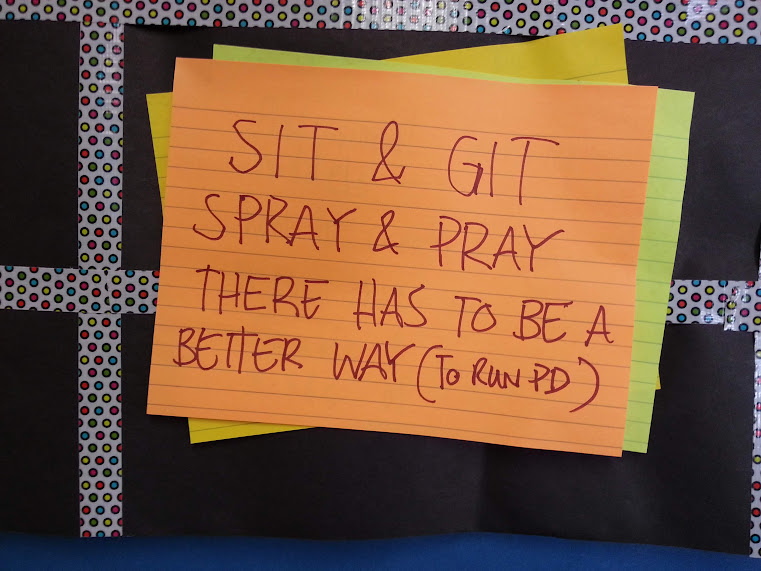
I've got PD coming up this week.  PD often involves a paid consultant earnestly exhorting you to differentiate your teaching practice, but they do it in a completely undifferentiated, university style lecture.  If student centred differentiation is what you're selling, selling it in a lecture is either incredibly lazy or ignorant.  In any case it suggests a lack of integrity.


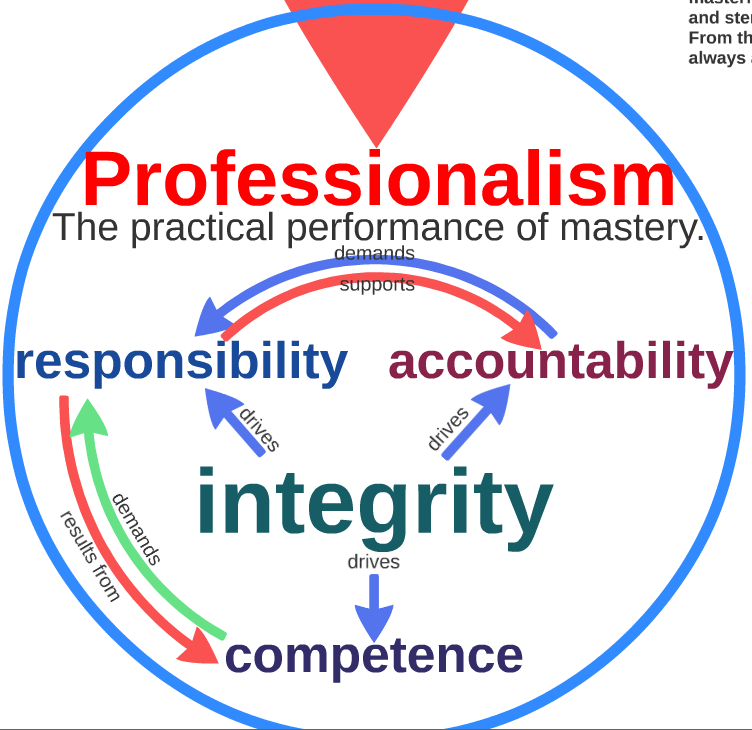
I'm trying to work out what professionalism
is in a Prezi mindmap
The professional is, at their core, self directed.  You don't become an expert in something without being able to self assess and improve your own practice.  Integrity should drive this self directed improvement by demanding competence.  That competence naturally creates a sense of responsibility that a professional is more than happy to be accountable for.  Self direction and the integrity that drives it creates a professionally responsible environment that accepts stringent accountability.

In order to develop professional standards, professionals need only be left to their own devices, and perhaps given the time and space by management to focus on excellence.  Edcamps encourage this kind of professional development, in fact they can't happen without it.  PLCs also facilitate professional development by leaving the professional to develop their own means of improvement.  I've been involved in learning fairs, unconferences and other teacher centred/teacher presented learning opportunities that have been invaluable as well as empowering.

The difference between a talented amateur and a professional is that the professional is committed to improvement and is thus willing to be accountable to their profession.  The professional abides by the practices and standards of their profession and actively works to raise them.  In this way a professional has a social responsibility to their profession that a dilettante doesn't, no matter how talented they might be.  The professional isn't a one trick pony who acts solely on talent, but a talented individual who begins with natural inclination and then works to develop it into a much wider skill-set that acknowledges the full complexity of their discipline.  Some secondary teachers fall into thinking that they are a subject expert before they are a teacher.  Being a subject expert isn't what they are being paid (professionally) to do, it's teaching.  Teaching is the professional practice we (especially at the secondary level) sometimes forget.

Accountability is where professional development with teachers seems to fall apart.  Management fears that if left to their own devices some teachers will not actively work to improve their professional standards.  In some cases this may in fact be true.  It would be a fairly simple task to itemize the professional development opportunities teachers pursue and account for who is attempting to improve their professional practice and who isn't, but we don't do that in teaching.


You can usually tell which teachers take time to attend to
their professional practice...
The teachers who go out of their way to attend (or speak!) at conferences, who expand their professional qualifications, who attend edcamps, or work in their subject councils, or participate in online communities, these teachers have made quantifiable efforts to improve their profession.  The teacher who rolls his eyes at another board run PD which he is only attending because he is being paid to be there is simply not professional in the same sense.  They are the ones who 'professional development' is aimed at.

Instead of only looking at years in the classroom it would be nice if we accepted that some teachers take on a more professional approach to teaching.  It would be easy enough to quantify that approach.  How many subject areas have they become qualified in?  Do they demonstrate continuous improvement?  How many self directed PD opportunities do they take?  Do they take on positions of extra responsibility? What do they do to support their subject area?  The profession of teaching in general?  Until we accept that not all teachers are created equal, we ignore both integrity and responsibility and are unable to accurately apply accountability to our profession.

Is teaching a job that requires management to take attendance and force simplistic PD down people's throats?  Evidently, in which case it isn't really a professional activity.  Is teaching a profession that demands self directed development through stringent accountability?  If it was it would be driven by teachers' professionalism rather than by attendance rolls and tell-me-don't-show-me lectures.

At the core of professional practice is the self directed development of your expertise.  I've got a PD day (the only one this semester) next Friday.  It will be interesting to see how this board run day will compare to the dynamic and responsive urgency of the edcamp I just attended.  I imagine I'll see differences in the first few moments when teachers I never see doing self-directed PD are whining about why they have to be there (because they're being paid to do it).  Then they will take attendance and the differences will only get more obvious.

Professionalism Resources:

http://www.mindtools.com/pages/article/professionalism.htm


http://www.med.uottawa.ca/students/md/professionalism/eng/about.html


#edcampham discussion suggestion
http://www.ascd.org/publications/books/100047/chapters/Professionalism,_Teacher_Efficacy,_and_Standards-Based_Education.aspx

http://education.und.edu/field-placement/files/docs/professionalism.pdf

http://www.slideshare.net/jazzmichelepasaribu/professionalism-in-education

http://www.sciencedirect.com/science/article/pii/S1877042810025498


Saturday, 14 February 2015

Assessment NOT for learning

Exams are in the bag and I'm wondering what the point was.  Knowledgeable, capable students did well, incompetent students didn't, but neither have the opportunity to learn from their exams.  It begs the question: what is the point of an exam?

By high school most students think that education is something being done to them.  The write-an-exam-get-a-mark approach only confirms this in their minds.  If assessment isn't for learning, what is it for?  Beaurocracy?  To maintain the teacher as the final arbiter in the classroom?  Neither paperwork, nor maintaining hierarchical classroom structures hold much interest for me.

We're currently being told that if we don't make formal exams for all classes we'll lose formal exam days.  Good riddance I say!  The end of a semester should include a debrief and a chance to review your summatives and assess the state of your own knowledge in terms of course expectations.  This would provide a valuable pedagogical bridge between courses and empower students to take responsibility for their own learning.

From a teaching perspective, the debrief would mean that all the heavy, end of course summative assessment actually serves a purpose.  It isn't supposed to be punitive, and your grade in a class shouldn't be a mystery to you.  Assessment should be transparent and functional.  Most importantly assessment should provide you with an opportunity to improve your learning; formal exams are none of those things, they are the black hole that learning falls into at the end of a course.

At the end of this course I'm going to get you
to write a high stakes, stressful exam that
is the same for all of you regardless
 of your lea
rning styles.  It's going to assume
you all have the same writing abilities.  I'm
then going to surprise you with the results!
I would love to ask the student who left half his exam blank, why did you do that?  I'd like to understand where in his thought process he thought doing nothing was the way forward.  I'd love to question the student who ignored obvious clues in a text and completely misunderstood its intent.  I'm curious to see if, with a nudge, they are capable of seeing what was in front of them the whole time.  I'd like to congratulate and confirm for the student who wrote a fantastic final that, yes, you really know this stuff.

There is a time and place in learning to ask the hard question: do you know what you're doing?  The end of course summative could be this reflexive learning opportunity, but not when it's cloaked in formal exam tradition.

Instead of considering transparent, reflexive course summatives that provide assessment as learning, we're clinging to formal exam models from the early 1900s designed to produce secretive, teacher dominated results that serve no learning purpose.  If the organizational structure of a school schedule isn't serving learning, what is it serving?

Sunday, 11 January 2015

Metacognition Missteps


What Mr. Cleese is so eloquently describing above is the Dunning-Kruger Effect, something that didn't receive a moment of notice in the metacognitive PD we recently received.  Metacognition is often seen as a way to encourage student directed learning, and I'm generally a fan of the idea, but this bias deserves some consideration, especially if we're trying to improve student learning.


In trying to break this down I came up with the Venn diagram to the right in hopes of understanding what should be a process toward enlightenment rather than a barrier to it.

There is a degree of stupidity so intense that it is self-consuming.  People trapped in that tend to reinforce their own ignorance and simply can't hear alternative points of view, even if they are self evident.  These people tend to wallow in limited, habitual action.  If you want to see it happening watch most digital natives on a computer.  In that kind of stupidity you're going to be hard pressed to learn anything, let alone expect any kind of accurate self assessment.

Ignorance is bliss, you're going to be happy if you think you know everything.  Anyone who lives in an Earth centred universe and thinks their species the darling of creation is that kind of certain-happy.  People like this make a point of surrounding themselves with like minded people.

If you can begin to take in evidence from around you, certain self-evident truths will begin to make you question your beliefs.  That would get you out of the stupid vortex and into ignorance.  The more you realize you don't know, the more rapidly you're able to move toward knowledge.  Humility is a vital component in this process, and where metacognition could begin to help.

In the realm of knowledge you may know many things but your experience with them is limited, so while you know theory you are unable to successfully interact with it in reality - this is one of the reasons I enjoy teaching tech so much (reality doesn't coddle you in your learning).  You've read about riding a bicycle but you've never done the deed.  The final step is to do as well as know, only then do you graduate from talking head to doer.


Metacognition is a valuable tool in creating the kind of self-aware humility that can move you from ignorance to knowledge, but applying it too early will push you in the wrong direction.  At the early stages of learning you are incapable of knowing what you don't know, so you'll think you're better at something than you are.  This appears especially true in mind based, academic work because your math equation doesn't burst into flames when you do it wrong.

At no point did our metacognitive training suggest that there was a threshold where you should (carefully) begin to implement self-analysis of learning, rather, it was suggested that we do this continually and throughout, which appears to be just what you shouldn't do if you want to get somewhere with it.


I like the DIY motive here, but getting to "learning to self correct" is a tricky step
that can push you the wrong way if you do it too soon.

Sunday, 14 September 2014

More Than A Book

I've got a nine year old son who is a big fan of the Teenage Mutant Ninja Turtles series on Nickelodeon.  It's a huge improvement over his Spongebob period and a very intelligently written series.  I am guilty of watching it over his shoulder from time to time.

This Splinter was once a man who grew up in a family
clan of ninjas who benefited from a lifetime of rich,
traditional learning.  The action movie one read a book.
In the cartoon Splinter, the turtles' surrogate father and sensei, is the descendent of a ninja clan.  He had been trained as a martial artist his entire life.  When he was mutated into a rat, he used this deep mastery to train the turtles.  Splinter is a master who is both funny, approachable and very strict.  His relationship with the turtles is deep and nuanced.

Because of this fixation with TMNT I found myself sitting in a movie theatre with my son watching Michael Bay's 'live' action movie this summer.  The Splinter in the film is actually a rat.  When he got mutated (into a bigger rat) he found a book on ninjitsu and trained the turtles.  That the kids watching this film think that this is a viable avenue into mastering martial arts points to a lot of things wrong with the world today.  A lot of that thinking is driven by the ease of access to information championed by digital technology.  But information isn't knowledge and it certainly isn't mastery.

***
I like the concept, it's empowering, but even the best self
directed learning is going to pale in comparison to what
you'll develop in a rich social context.
Computers have been a hobby for me since I was ten.  I did a lot of learning on my own out of books and magazines, but the process of taking courses and certifications to become a qualified technician pushed me well out of my comfort zone and forced me to become familiar with aspects of computers that I otherwise would have stayed away from because I find them difficult.  Working with experts also let me see how they fill in the massive spaces between information.  How we manifest knowledge is more important than the knowledge itself.

I've always been interested in writing and philosophy, but taking degrees that oversaw skills development and demanded ongoing demonstration of my improvement with a variety of experts created something that no number of books could.
Knowledge is the start of the process, not the end.

The idea of mastery learning implies that a master passes it on to you.  My professors and mentors did a lot more for me than simply pass on information, they also showed me how it might manifest itself.  Modelling is a mighty powerful means of passing on knowledge, and you get none of it out of text.

If someone told me that I could get the same thing my degree gave me out of a book I'd call them a fool, though many people call higher education a waste of time purely on those grounds.  Information is accessible and cheap, so teach yourself!  You'll only be as effective as your teacher, but hey, it's inexpensive.  This feeds modern value theory that devalues human capital in favour of machine capital, in this case championing information over experience.

Mastery learning requires something more than a book.  I'm not surprised that the team of writers for that movie didn't get that though, looking at the quality of their script.

Wednesday, 27 August 2014

Do What You're Paid For: the distance between the mediocrity of work and the goals of education

The majority seem to follow the science.
The Weather Network had an interesting poll today.  The American Academy of Pediatrics suggested that later start times for adolescents would allow them to function better with their funky circadian rhythms.

It's a fact of our biology that our sleep patterns change during adolescence.  Being a teacher I've been aware of this for a long time because my job isn't to punish students but rather to develop their best expression of skill and ability.

The comments on this poll are your typical internet nonsense.  It makes me wonder how most people think (or don't).  The most vocal opponents (a minority in this poll) seem to think school should be about forcing students into alignment with adult expectations, however mediocre, biology be damned.


Some pretty nasty assumptions in these acerbic comments...

Is school about 'commitment, dedication' and the benefits you get from these values?  Of course it is, but it is also seeking your best work.  Unlike the 'adult' world where showing up and doing what you're paid for is the expectation, school is (should be?) about excellence.  I don't want a forced effort and I'm not looking for a pass, though many of my students are.  I wonder where they learn those values?

There are jobs and companies that do embrace excellence, but they are a minority.  If you're working for a pay cheque (and the vast majority are), you're an advocate of the show up on time-do what you're paid for-and-grow up school of adulthood.  For a lot of students school is the last place where they are encouraged to seek their best effort.  The rest of their lives are spent venting their spleen and dragging everyone down on internet comment forums.


Top performance isn't only a matter of effort.  I hear a lot of students tell me, "I'll put in an effort in senior years and get the grades I need to get into university."  They get to grade 12 and suddenly realize what squandering years of foundational skill building really costs.  I have that Incompetence poster up in my class.  It's not meant to be cruel, it's meant to remind students that I'm not there to waste their time or hold them in room for a certain amount of time (like most jobs they'll have when they graduate).  I'm looking for optimal skills building for each student (they're all different).

One of the reasons so many people enjoy watching professional sports is because you're seeing people performing at their very best.  A pro athlete isn't just putting in an effort, they are maximizing their anatomy with diet, sleep and hours upon hours of training and practice.  You're seeing their excellence as the tip of a massive iceberg of commitment.  The doing of unpalatable things isn't the point, excellence is, and you don't reach it by ignoring basic facts of biology.

I worked in private business for fifteen years before I became a teacher.  With very few exceptions, work involved being there on time and doing what you're told.  When I attempted to display initiative it was considered difficult to manage.  One of the reasons I became a teacher is because I have the professional latitude to produce my best work.  I don't just work to a clock, I work to a higher goal.  Rather than aim students at the lowered expectations of the working world, perhaps it's time to embrace excellence.

A few months ago I read an interesting article on the conflict between capitalism (read: neo-liberal devaluation of human capital) and education systems.  These Weather Network poll responses are firmly in that neo-liberal mindset of reduced human capital.  You're a cog in the machine: do what you're told, be consistent, show up on time... if that's what education becomes then we truly are lost.