Showing posts with label ECOO13. Show all posts

Tuesday, 5 November 2013

ECOO13: soaking in the future

When you see this in the morning, it's hard not to be inspired!
ECOO13 was bigger better, and better located that any of the ECOOs I've previously attended.  If you believe in ley lines then putting ECOO on the edge of a natural wonder captured some wonderfully thunderous energy.

I'm told that back in the day ECOO was enormous, much bigger, but those early immigrants were following a huge first wave of personal computing.  Since then computers have insinuated themselves into so many aspects of life that they often feel like just more work.

Informational democracy courtesy of computer networking on social media is a slow burn and is still building.  Instead of feeling disenfranchised by machines more and more people are recognizing them as an enabling influence, allowing individuals a voice where only mainstream media and large organizations once broadcast their influence.  ECOO has been building on this new wave of social media democratization every year since I've been attending.  It's always in peril of being spun by the powers that be, but I still hold out hope that places like ECOO will allow people to realize how powerful they are in our new, flattened mediascape.


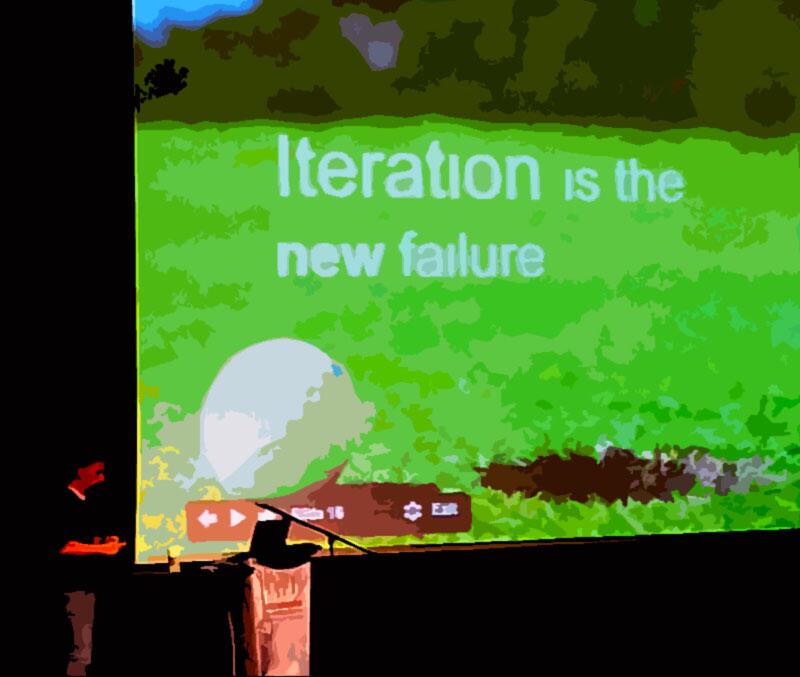
How to think in a new era? ECOO asking some big questions with Jaime Casap.
On a personal level I've been finding it difficult to engage with educational technology in the past few months.  Between a new infatuation and a year of difficult technology events (GAFE summit. Pearson Social Media Event), I've been finding the business of education to be politically charged and inexplicably restrictive.  The cavalier and simplistic manner in which technology is rolled out frustrates me.  In a difficult year I've been finding personal growth in other areas.

I'd signed up for an ECOO presentation without any really clear sense of direction. The past two years were pretty easy, I knew what I wanted to say and went after it, but after developing a digital skills continuum around pedagogy rather than cost cutting, and instead watching monopolistic corporate buy in, I'm not feeling overly engaged.  Sometimes rolling the rock up the hill just gets too heavy.


They ain't kiddin!
It was with this sense of unease that I went to ECOO, but quickly found my happy place again.  From the conversations I had with intelligent, interrogative educators to the fantastically chosen keynotes that went straight after the larger questions around the information revolution we are living through, ECOO does indeed tackle tough issues.

I really enjoyed all three keynotes and they didn't shy away from asking what education isn't doing to help our students get ready for a world most of us have no idea is coming.  

Wired caught up with our ECOO keynotes in their latest issue. Coming back to the 19th Century, factory designed education system hasn't been easy after soaking in the future for a few days.  ECOO is what education could be like if there wasn't all the friction from dinosaurs.

If nothing else, ECOO reminded me that change is inevitable and not to give in to the pessimism of bureaucratic thinking.  Being an agent of change is difficult.  There are a lot of entrenched educational interests that have no interest in adapting to change.  After being at ECOO for a few days surrounded by educators who have already made steps into the future I realize I'm not alone in this, and I'm on the right side of history.

Sunday, 6 October 2013

ECOO 2013 Presentation: Harness your nerdist ways

Still thinking about ECOO in a couple of weeks.  I've already taken a run at on Dusty World once.  There is a lot in this, I'm still curious to see how it will unfold.


http://lanyrd.com/2013/ecoo13/schpzd/
We live in a time of profound change. The very definition of who and where we are is constantly changing. Never before in history have people been as connected to so many different people and places as they are now. Trends suggest it will only intensify. Are we doomed to a half existence in many places, constantly distracted, unable to complete a thought? Or will the person on the other side of this technological adolescence be multi-dimensional in ways we can't currently imagine?


Come with me on an examination of recent history and future trends. How can we integrate or separate technology to better facilitate learning? How can we prepare students for the strange world they are about to graduate into? How can we survive and thrive in these times of profound change ourselves?

What started this line of thinking was a post in Dusty World in the spring called Digital House of Mirrors.  In that post I was trying to describe how digital technology is changing our sense of self:

"Our selves are being stretched and amplified in ways they never have before.  Nick Carr's The Shallows puts us on a pretty stark trajectory towards idiocy with what is happening to us.  The digitization of the self stretches us flat, making continuity of thought impossible and turning us all into distracted, simplistic cogs in a consumerist machine designed to turn us all into the lowest common denominator; none of us any smarter than our smartphones."

http://www.robinsloan.com/epic/
Way back in 2006 a student showed me the video on the right.  That it was made so long ago is quite prescient.  They didn't have the future exactly right, but they come surprisingly close in many ways.  The part that stuck with me the most is this quote: 

“At it’s best, edited for the most savvy readers, EPIC is a summary of the world, deeper, broader, and more nuanced than anything ever available before. But at it’s worst, and for too many, EPIC is merely a collection of trivia, much of it untrue, all of it narrow, shallow, and sensational.”
If that doesn't describe the experience of most 'digital natives' online, then I don't know what does.  This is exactly the kind of habitual ignorance I find in technology use.  Children who have been immersed in digital technology have only learned to do what pleases them and know nothing about the technology itself, they aren't generally literate.  They are like self-taught readers who have memorized a single comic book.

Whereas digital immigrant ignorance arises out of fear or pride, though they do still have some sense of what they don't know.  The digital native is blissfully ignorant of what they don't know, though they spend most of their lives now in that virtual world they know nothing about. 

That technology could retard our ability to think is a dangerous consideration that a number of people are concerned about.  I don't doubt that digital tools can enhance us as human beings, I'm writing this and you're able to read it entirely due to digital technology.  Digital tech lets people work around authoritarian governments and democratize media.

I occasionally see people who are able to harness technology as a personal amplifier, but for far too many it is a source of distraction, habitual time wasting and a net loss for them.


A book I half read a while back was The Nerdist Way by Chris Hardwick.  I wasn't able to get through the self help bit at the back, but the first half was an interesting autobiography of a guy immersed in technology to such a degree that it derailed him.  His philosophical change allowed him to regain control of his career and put what he describes as his nerdist ways to productive use.   Rather than spending eight hours a day playing World of Warcraft, Chris chose to focus his nerdly powers of concentration on productive activities.  He describes a nerd as someone who is able to hyper focus on minutia that fascinates them.  He broke his habitual use of technology by demanding that his fixations serve him instead of the other way around.  If it can work for a nerd (and we're all nerds according to that definition) then it'll work for everyone.

Is always on exhausting or exhilerating?  Is it functionally better to be connected?  What is the golden ratio for communicating f2f or remotely?  How could technology itself assist us in optimizing our presence both physically and virtually?  How can we highlight ineffective use of technology, analyze it and resolve it?


I suspect this is going to become a timeline.  With a bit of perspective I might be able to make some reasonably accurate predictions about where we going, because this is one big weird rabbit hole we're all going down together and a lot of people are getting lost in it.

Sunday, 29 September 2013

ECOO 2013 Cometh

Last year I was getting primed for ECOO 2012 by constructing a process for transitioning from school provided, generic educational technology to a bring-your-own-device learning situation.  The idea was to assist this evolution toward personalized technology following some sort of pedagogical imperative rather than what appears to be a financially motivated top down drive to minimize school purchased tech.

Digital technology is intensely personal because it interacts with our
most personal selves, our minds...
Critically examining how we make use of technology has always been at the core of my teaching.  As I transitioned from academically focused English to technology orientated computer engineering my willingness to look for easy answers in educational technology has dried up.

Since the last ECOO a couple of events have made me question the branded nature of #edtech.  It began with the Google Education Summit in Kitchener in the spring, and then culminated with the Pearson Summit a week later.  As educators it is incumbent upon us to be technologically agnostic, this is getting more and more difficult as cash strapped teachers and boards look for financial advantage courtesy of corporate offers.  I've been battling my own understanding of this all year.

Can you imagine if your chalk board had a 'courtesy of Crayola' sign in the top corner?  Or the paper you hand out to students had a 'brought to you by Hilroy' on it?  Yet we don't think twice about branding the digital technology.  A student can't get on to a school machine without getting Delled, BenQed, Microsoft'd, Jinged and Googled, and we actually enjoy that branding, we encourage it.

In only a few weeks I'm talking about our digital selves at ECOO 13.  I'm excited about going to ECOO, doing Minds On Media for the first time (nurture your inner hacker, I'll show you how to code a microcontroller and become your own I.T. support!)  My worry is that I'm finding edtech increasingly owned, controlled and not focused on developing student (and educator) fluency.

I'm still being haunted by Matt Crawford's Shopclass as Soulcraft.  Crawford's description of the consumer as a victim of their own technological ignorance resonates:

"Since the standards of craftsmanship issue from the logic of things rather than the art of persuasion, practiced submission to them perhaps gives the craftsman some psychic ground to stand on against fantastic hopes aroused by demagogues, whether commercial or political."

The scattered, distracted 21st Century human being seems more a victim of digital technology than empowered by it.  When I realize that the 'I'm tech-savvy' high school student doesn't know what a disk partition or an IP address is, or how to boot to external media, I realize that what little expertise they've gained is almost entirely at the hands of commercial or political persuasion, and teachers are no different.  This kind of fluency doesn't suit corporate interests who would rather be able to sell you on marketing rather than engineering.  The kind of ignorance this brews is staggering.

I want to produce a constructive solution to hard pedagogical questions around technology use.  I'm finding this increasingly difficult as edu-tech becomes a managed, mainstream expectation rather than an experimental, fringe element.  The urge to simplify with dictated systems that encourage ignorance has me wondering how education will prevent rather than produce more dysfunctional digital natives.

The perfect platform for teaching students effective use of technology is an open source system that they build from scratch and have to maintain themselves.  The more you do for them, the less necessary fluency becomes.  Technology literacy is a 21st Century fluency that we should be teaching curriculum wide, much like literacy or numeracy.

That ideal technology learning platform is agnostic, varied and offers redundancy and resilience.  Students should never be in a position where the network technology is broken, but the hands on technology shouldn't be done for them.  What I'm seeing in educational technology is completely backwards; everything is locked down and done for students, and it seldom works.  This is a recipe for ignorance and about as far from pedagogically useful as we can get.

There is precious little open source software used in education, mostly because it demands competence and
Don't you wish there were a shared,open source
option for educational technology
?  There is,
but there is no money in it and it requires
competence.
responsibility.  Buying a corporate system offers you turn key technology.  We could offer cheap, debranded technology with open source, shared development software, but we don't because we'd rather be consumers than makers.  This is a result of teacher indifference as much as anything else.  Basic fluencies should be attended to and you'd have to be obtuse to think that effective use of digital tools isn't going to be as important as literacy and numeracy in the 21st Century.

I'm still not sure where I'm going with ECOO13...