I came from the relative security and certainty of teaching English onto the thin ice of an optional subject area. Now it's an optional subject area that I think is vital to student success in the 21st Century, but it's optional none-the-less.
Why did I spend north of four grand to get qualified in computer technology? Because it has been a part of my life for so long and I wanted to acknowledge that by teaching it. By recognizing my industry experience I feel like getting qualified in computer technology has honoured the work I did before I was a teacher. It also opens up the door to students gaining real world technology experience before becoming swamped in it. I'm passionate about teaching technology expertise to both staff and students.
Teaching a subject like this is perilous. You've spent a lot of money and time to get the qualification and then you suddenly find the ground has shifted and you aren't teaching it. This happened to me before with visual art. I took the AQ hoping to teach it and suddenly the door closed and someone is transferred in. That might have been a one off, but it happened again with computers, so I'm twice bitten twice shy.
Today I staggered out of a heads' meeting that offered three future headship structures, my job as computer head didn't exist in any of them. I attempted to argue my case, and a number of heads kindly spoke for me, but when administration presents your choices and what you do isn't on any of them, you have to wonder if what you're doing is considered valuable, or even helpful.
There was a lot of talk about what the future holds for our school and how our headship structure should support that future. Apparently computers and a supportive technology environment don't have a place in our school's future. That is only slightly less exhausting than the idea that what I've been doing in the school has hurt rather than helped. It was suggested that everyone should wait months for support, even in cases where I could get things going in moments. This is the future we're aiming for because we don't want a headship centred around computers?
Technology use isn't decreasing in our school, and how we're making use of technology isn't nearly as monolithic as it once was; the variety of tech in our school has exploded. Ten years ago we had a single kind of printer in our building, now we have more than thirty different kinds. Ten years ago the board used to take care of things like network cables and lab setup, not any more. In a proliferate, increasingly complex and less centrally supported technology environment, we balk at localized support?
The role of computer support in our school is onerous, but one of the things it does for me (sometimes, when I'm not getting bumped for a colleague from another school), is to ensure that I'll be teaching at least some computer technology classes. Seeing the work I've done as a head given no future has left me wondering if I've asked my family to spend thousands of dollars on qualifications that I won't be able to exercise in the future. That is frustrating on a lot of levels.
There are a lot of ups and downs in teaching. The political ground on which you stand is often not what it appears to be, and while many people seem to act out of a sense of certainty, what we are asked to teach is actually very perilous and subject to the whims of others.
It's a cold Monday night in February and I'm finding the extra energy I've thrown into my profession over the past several years to be in question. It's not the kind of place you do your best work from.

Showing posts with label computer technology. Show all posts
Showing posts with label computer technology. Show all posts
Monday, 3 February 2014
Sunday, 2 February 2014
Student Driven Curriculum
One of the nice things about teaching computer technology is that you tend to get a lot of fanboys in the class. They're already giddy about the subject and keen to explore it (something sadly missing from many English students). I'm hoping to harness that experience and energy this semester in senior computer engineering.
Last summer I took my final, senior computer technology AQ, and we did a fair bit of focusing on curriculum expectations. Those expectations are so broad that finding a teacher who is an expert in all of them would be pretty much impossible. Fortunately for me I love being taught by my students (I'm as giddy and curious about comp-tech as they are).
Rather than present yet another linear, teacher-centric semester plan, we're going to have a con-fab and talk about how to address the curriculum expectations. They are trapped in the prehistoric tree sap of Ontario Ministry of Education documents which, at best, make for dry, inaccessible reading for students. To make it accessible I summarized the key points in a prezi. When the semester starts tomorrow we're going to self organize around what we need and how we're going to reach the remarkably diverse goals of the computer technology curriculum.
 Hopefully the prezi format will make the goals of the course more accessible and allow us to plan out an approach that gets to all the expectations while allowing students to self direct their learning - a vital skill in an engineer.

There are threads in the course that run through the many diverse fields found in the curriculum document. The design process is one of those keys to engineering that will serve us well while we plan out how to approach our learning.
The engineering design process is basically a forced feed-back loop that self corrects, leading to a solution. It would work on everything from essay design to project management - it also leads to successful engineering projects.
In our case we're going to apply it to the curriculum of our courses. Based on the time we have, access to equipment and experience in the class, we're going to create a customized, student driven curriculum plan that (I hope) will also encourage student buy in.
I want to make our lab into a maker space, so my focus is going to be on facilitating equipment in order to feed hands on engineering projects. As long as students are effectively exploring computer technology and expanding both their interests and the breadth of their knowledge, then I'm happy with the process. My role will be to amplify their learning rather than direct it, and I hope to start that process with a self directed semester plan that we generate together next week.
While I'm at it, I'll also get some feedback on my expansion plans to computer technology. Who better to ask than my target audience?

 |
| Ontario Comp-Tech, everything from programming to robotics! |
Rather than present yet another linear, teacher-centric semester plan, we're going to have a con-fab and talk about how to address the curriculum expectations. They are trapped in the prehistoric tree sap of Ontario Ministry of Education documents which, at best, make for dry, inaccessible reading for students. To make it accessible I summarized the key points in a prezi. When the semester starts tomorrow we're going to self organize around what we need and how we're going to reach the remarkably diverse goals of the computer technology curriculum.
Hopefully the prezi format will make the goals of the course more accessible and allow us to plan out an approach that gets to all the expectations while allowing students to self direct their learning - a vital skill in an engineer.There are threads in the course that run through the many diverse fields found in the curriculum document. The design process is one of those keys to engineering that will serve us well while we plan out how to approach our learning.
The engineering design process is basically a forced feed-back loop that self corrects, leading to a solution. It would work on everything from essay design to project management - it also leads to successful engineering projects.
 |
| If it works for NASA, it'll work for us! |
I want to make our lab into a maker space, so my focus is going to be on facilitating equipment in order to feed hands on engineering projects. As long as students are effectively exploring computer technology and expanding both their interests and the breadth of their knowledge, then I'm happy with the process. My role will be to amplify their learning rather than direct it, and I hope to start that process with a self directed semester plan that we generate together next week.
While I'm at it, I'll also get some feedback on my expansion plans to computer technology. Who better to ask than my target audience?

Sunday, 26 January 2014
Rebranding & Refocusing on Applied Computer Technology

After learning about the messy history of computer studies in Ontario, I've been catching up on our school's history. The computer studies department was created just prior to the new computer curriculum in order to create a headship for a computer science teacher who has since moved on. The headship consolidated computer technology, computer science and the school IT support role all in one place.
When computer studies (actually computer science) became its own area of study independent from the rest of computer technology in 2009, our departmental divisions minimized that damage by keeping the now separated computer studies/technology (what's the difference? It's hard to tell with the vague titles) together.
Was it a good idea to keep computer studies and computer technology (two apparently completely different courses of study) together? I'd argue that it's a pointless distinction based on a prejudice deeply ingrained in Ontario education. Computer science teachers, like the majority of teachers, come from university/academic backgrounds. These teachers are catered to in Ontario education with easier access to high pay grades (it's much easier for an academic teacher to gain level 4/honours specialist). Many technology teachers who come into teaching through industry experience and apprenticeships (many of which are as long or longer than university programs) never achieve the highest pay grades in teaching. Teaching in Ontario is inherently geared toward academics.
When computer science was amalgamated into computer technology (as a technology course), many comp-sci teachers thought it a demotion into 'tech'. It took them eight years to get their academic subject back.
In a perfect world computer studies would be just that - computer studies, meaning a curriculum that addresses the subject completely from the most academic/theoretical side (computer-science) to the most applied/immediately useful (information technology, computer repair). As in science (biology, chemistry, etc), we could have teachers with different backgrounds and training teaching complimentary subjects and collaborating within the same department. It happens throughout the school (arts, science, tech), but apparently it can't happen in computer studies. I believe this is because it attempts to straddle that academic/applied divide.
Between the political history of Ontario's computer studies and my own school's focus on consolidating heads, it looks like our computer studies headship will go away and computer science and computer technology will fly apart. Personally, this is a relief. Trying to give students access to coding through a computer science department that does more photocopying than English and clings to Turing as the be-all and end-all of programming languages has been a continuing frustration. Being able to refocus around the more open technology curriculum in comp-tech would allow me to develop real world computing skills for students, something that I think 'computer studies' has failed to do.
If applied computing is the focus of computer-technology, then I don't intend to leave coding to computer science. They can have the theoretical end of it all, and teach to university bound students interested in advanced mathematics, but I've long contended that coding is a universal skill that everyone should at least have a passing knowledge of, especially in the 21st Century. To that end I've been remapping our course offerings in Computer Technology (as well as rebranding my subject area, because that is apparently - and sadly - what we have to do in Ontario).
 |
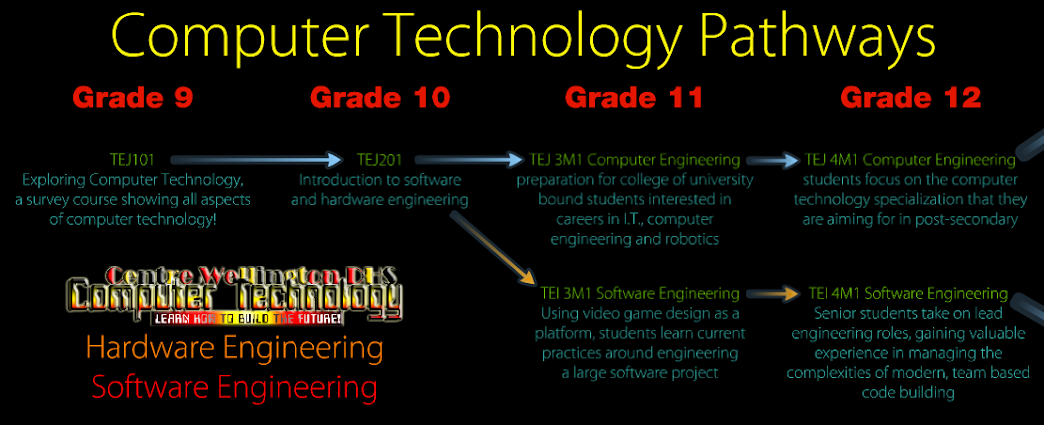
| A grade 9-12 curriculum of applied computer technology study using current technologies that would give students immediately applicable skills. A student who took this path would be literate in information technology, computer repair, networking and coding, as well as have an understanding of industry practices in all those fields. |
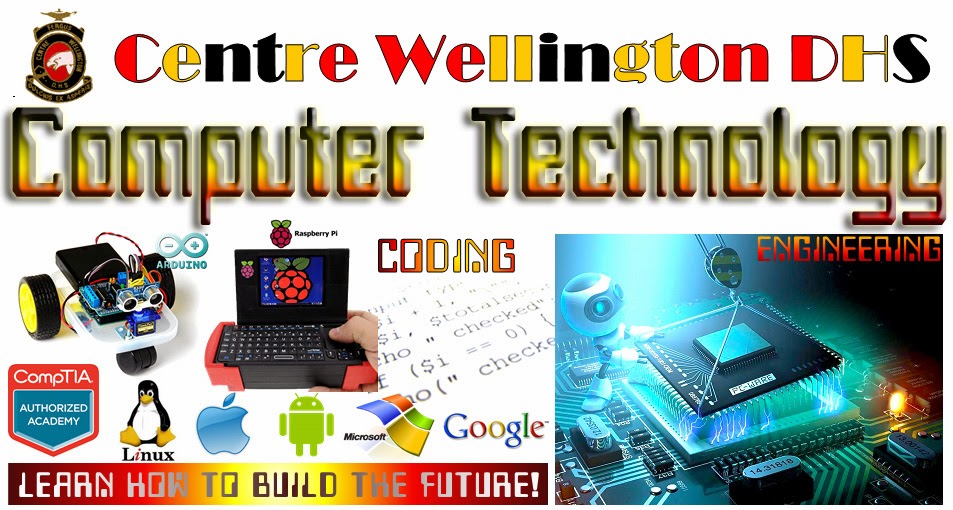 |
| Rebranding computer studies to computer technology, because that matters to people in Ontario Education (though it causes a lot of confusion for everyone else). It'd be nice if pedagogy instead of prejudice dictated our computer studies curriculums. |
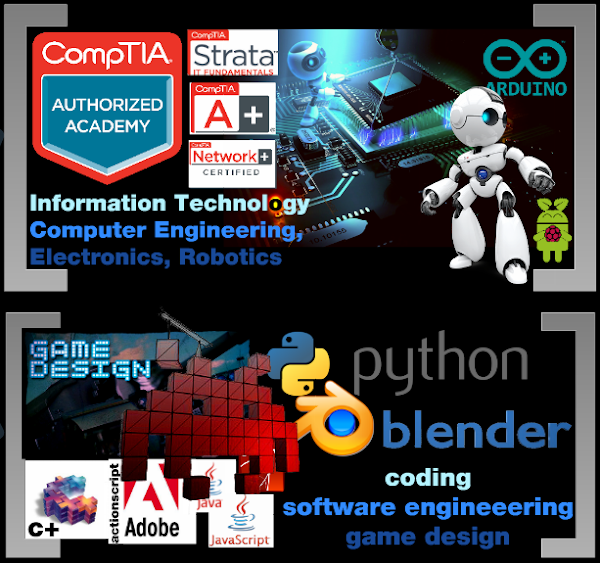
Here are some other pieces created for the rebranding:

 |
| Taken from code.org's fantastic array of promotional material and ICTC's Canada specific technology industry research. And yes, I cut out the word science after computer because that apparently causes confusion in Ontario. Is this really how we do computer studies in Ontario? Yes, yes it is. |

Here is the post on the computer technology graphics.
Here is the post from grade 8 parent's night, where computer studies was still a subject headship, that's all gone now.
The computer studies prezi: showing parents a coherent focus on computer studies (comp-sci included)
The computer technology prezi: showing parents a coherent focus on applied computer technology (no comp-sci in sight).
Other Reading:
Straddling The Divide: the end of computer studies at CWDHS.Do You Teach Computer Studies or Computer Studies?: where Tim stumbles into the political distinctions in Ontario's computer curriculum.
Subscribe to:
Posts (Atom)