Showing posts with label google certified educator. Show all posts

Saturday, 5 April 2014

Ronin

The Google Apps for Education (GAFE) 'Summit' is this weekend.  I'm not there and I'm comfortable with that.  There is nothing in Google that I haven't been able to figure out on my own and I use Google extensively, they make good products.


Last week's Elearning Ontario Presentation
Last week I presented at elearning Ontario on how to create a diverse digital learning ecosystem.  You'd think that educators would want to get their hands on as wide a variety of tools as possible in order to not only provide the best possible digital learning support for their students but to also increase their own comfort zone in educational technology.  In the mad rush to digitize the vast majority of people want as little expertise to accompany it as possible, they would much rather find a closed ecosystem in which they can develop a false sense of mastery.

If you hyper focus on one thing you tend to get an inflated sense of your abilities.  I wouldn't trust a mechanic who can only work on Ford brakes or a teacher who can only work out of Pearson textbooks, I'd have to assume they've learned by rote rather than developed mastery.  I know it's hard work, but becoming fluent in digital tools requires some time, some curiosity and some humility and that's ok.


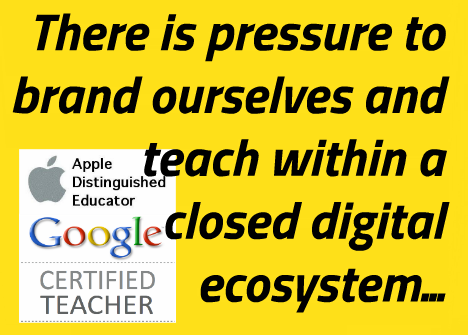
A colleague showed me this last year and it has been
on my mind ever since.
The idea that you get a qualification under a single brand and have somehow become a master of digital learning is misleading.  But the limits of evangelizing a single digital learning ecosystem go well beyond questionable professional practices around branding teachers with private company logos.  There is also the question of how these technologies are mining education for profit.  

If you live within a monopolistic education technology environment you can never be sure what they are doing with the data they are managing for you 'for free'.  That data is worth a lot of money.  Even if it's being stripped of names, the ethics of exchanging student marketing data for a 'free' digital learning environment has to be questioned.  In a monopolistic situation that questioning doesn't happen.  Only an open, fair digital learning environment allows us to demand higher standards from companies who are otherwise singularly focused on making money in any way that they can.


Wouldn't an opensource hardware model that allows us
to teach all technology platforms be a nice idea?  The Learnbook
Some links to consider:
http://blogs.edweek.org/edweek/DigitalEducation/2014/04/google_amends_its_terms_on_sca.html
"Google would not answer questions about whether its data-mining practices support the creation of profiles on student users.

Google also confirmed to Education Week that its general terms of service and privacy policy apply to student users of Apps for Education, a stance contrary to the company's earlier public statements."


http://www.osapac.org/cms/sites/default/files/Memo%20-%20Contract%20Addendums.pdf
OSAPAC has worked out a deal that doesn't sell off Ontario Students' data, but it's a secret,
and each board has to implement it themselves.  The mysteries of information in the information age...
https://twitter.com/search?q=%23gafesummit&src=typd&mode=users
Tweets on this weekend's GAFE summit in Kitchener/Waterloo... the koolaid tastes good.


ro·nin
ˈrōnən/
noun

historical
  1. 1.
    (in feudal Japan) a wandering samurai who had no lord or master.

Wednesday, 30 October 2013

Free Range Computing

I'd initially gone into this with pi in the sky (sic) daydreams of students working entirely on open source hardware and software that they have assembled and coded themselves, free from the evil influences of corporations.  After attending ECOO this year I'm less on the hippy open source bandwagon and more on the inclusivity bandwagon.  It isn't an educator's job to ignore corporate technology, but it is their responsibility not to indoctrinate students in only one particular company's technology because it is easier or cheaper for them.  Student digital fluency has to drive technology access, not corporate carrots or teacher laziness.

I've noticed a real move toward the branding of education (and teachers) by technology interests.  This is almost always done to ensure their own monopolistic dominance rather than offering students the widest range of technology experience.  In order to indoctrinate students in a single means of access (in order to later capture them as consumers), many boards are locking students into company specific technology, usually because some kind of discount being offered.  Selling out student technological fluency in order to appear more cost effective isn't very pedagogically sound.


...but I'm certified with screwdrivers!
Would you trust the literacy teacher who only uses one publishing company and brandishes the logo like a qualification?   Does this not call a balanced approach to their discipline into question?  How can the same thing not be said for Google Certified or Apple Distinguished? 

It's one thing to get a professional certification from an platform agnostic professional organization that has no interested in monetizing you, it's another to brand yourself with the name of a profit driven company that is intent on turning you and your students into revenue streams while limiting access to alternatives.


My knee jerk reaction to this is what had me storming off into the woods and getting all back to nature with open source hardware and software:


***


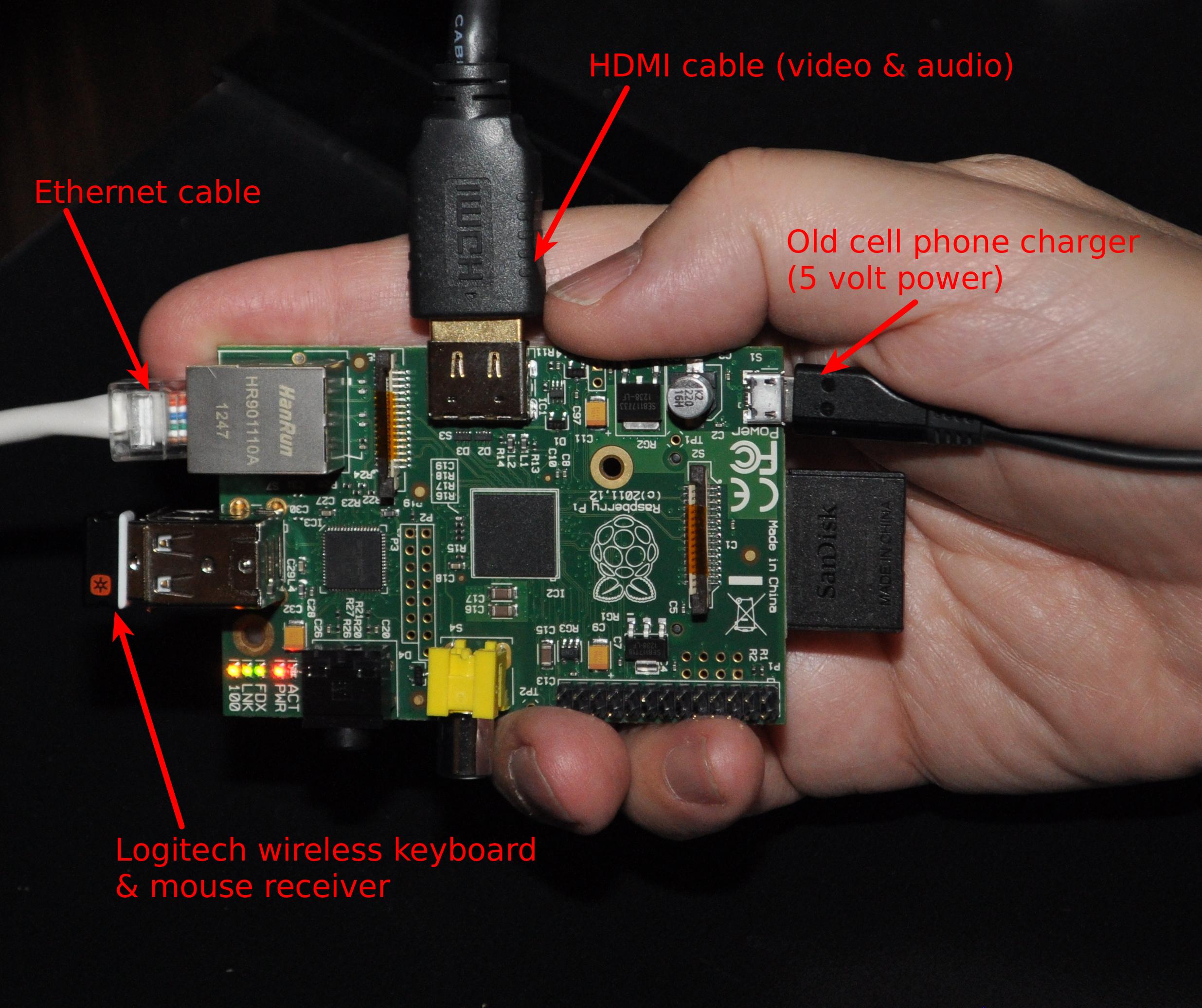
Raspberry Pi, almost fits in your wallet!
I've been thinking about the open source technology classroom I wish I could run.  Engineering based rather than brand based hardware with accessible, open software.  Hardware that could run free, crowd-sourced software.

Raspberry Pi is an obvious starting point.  As a way of showing students the basics of computing cheaply (it'll run a full GUI OS with internet for about thirty bucks per student), it's something that they can use to get familiar with how software and hardware work with each other.

I wish they'd come up with a Raspberry Pi à la mode, a 1 ghz 2 core unit with a gig of ram, hdmi and 2 usb 3.0 ports.  They can toss the video in and separate audio 3.5 jack out (hdmi has audio built in anyway).  If they could pull that off and keep it close to the same size I'd think twice about stepping up from the Pi.


***

It's beyond the Pi that open source hasn't developed enough high level hardware to take on more advanced learning environments, though having students build digital tools from a variety of components has its own value.  

There are plenty of software options, but ready made agnostic hardware is thin on the ground.  This is when I started to think about systems that, while branded and corporately developed, might be focused on access to a variety of technology rather than the tyranny of one:


***


In the meantime, from the Pi how do you create a free range system that lets students experience a variety of operating systems and software?  The recent nano-desktop round of computers offer some interesting options.


Intel NUC
The NUC (next unit of computing) by Intel is an engineering platform that crams an astonishing amount of processing power into a package the size of a paperback novel.  With an i5 processor and up to 16 gigs (!) of ram, this thing is a monster.  It would handily outperform any desktop in our school right now.

If we could get a NUC sorted out in some kind of student-proof Otterbox type enclosure we'd have a tough, durable, wickedly fast, open computer that would offer students a totally customizable platform for just over $400.  Presumably we could whittle that down to cost (maybe ~$300?).

Having a dock in labs that would allow students to plug their own PCs (personal again!) in would be one means of accessing the box.  Offering a plug in touch screen peripheral that could do the job of a screen/mouse/keyboard would be another avenue that would create a very powerful laptop/tablet option.  Pica-projectors would be another way to produce screens out of thin air, and they are rapidly becoming smaller and less energy consuming.

The nicest thing about the NUC is that it could work with pretty much any operating system you could want.  Students could come to class with a paperback sized computer that could boot into Apple OSx, the Windows flavour of your choice or any of a number of Linux distros (including Chromium).  You wouldn't have Mac labs, or Windows labs, you'd have whatever you wanted/needed to boot into.  

A truly agnostic hardware platform that would offer you access to any software on any operating system.
Foxconn Nano PC

Another (cheaper) option is the Foxconn Nano PC, which retails for substantially less (only $219 retail vs. the $420 NUC).  The Foxconn unit runs on an AMD processor (not Apple friendly) but offers strong graphics performance from its (Canadian!) graphics subsidiary ATI.

It would still run any flavor of Windows or Linux you could throw at it (including Chromium) and is as svelte as the Intel option.  Education purchasing could probably get these down into the $150 range.

***

The real goal would be to create opensourceedtech.org and have educators themselves crowdsource an open, upgradeable, accessible hardware system that is designed to teach students about technology in all its various forms.

The chance to develop personalized learning technology would take us away from the ignorance and learned helplessness we peddle today in education and offer all technology companies a level playing field on which to ply their wares.  Our students would experience a wide range of operating environments and software as well as being aware of how hardware impacts those systems.

Thoughts on mastery learning in digital spaces
(from my ECOO13 presentation)

Imagine high school graduates who have worked on a variety of operating systems that they have installed and maintained themselves.  


Imagine graduates who understand how memory, processor and storage work with software because they've experienced hands on changes in this hardware.  


Imagine graduates who are able to problem solve and resolve their own technological problems because the breadth of their familiarity with technology is such that any new digital tool they lay their hands on isn't a mystery to them.


Imagine students and educators who go to the tool they need to get the job done instead of having the tool dictate the job.


Imagine students who have enough familiarity with code that they can appreciate the complexity of the world we're living instead of being baffled by it.


I was having doubts about putting corporate logos on my office windows, but I don't any more.  Instead of taking down the Google stickers I've added Apple, Microsoft, Linux, Toshiba, Dell, Asus, IBM, Lenovo, Arduino, Raspberry Pi and will continue to add others.  The point isn't to run off into the woods and live in vegan austerity on open source hardware, it's to make all technology available to students so they can appreciate the astonishing variety of systems we're immersed in, and not be made helpless by it.