Showing posts with label #onted. Show all posts

Sunday, 13 February 2022

Gasping For Breath: the lost art of pedagogy in Ontario schools

Written Feb, 2022:

Horses usually get put down when they break a leg.  They get euthanized because a three legged horse can't stand on its own and ends up developing consequent health problems.  Keeping a lame horse alive is simply extending its misery.  These days, Dusty World feels like a lame horse.  I started this blog in 2010 after having attended my first ECOO conference and found it a valuable way to share my own ABL (always be learning) approach to teaching and learning effectively while navigating an information revolution.

Dancing in the Datasphere: thoughts on digital pedagogy from way back in 2011.

I'm sitting here looking at a dozen posts I haven't published on Dusty World in the past year because I think there is no point.  It has been years since we focused on pedagogical best practices in Ontario education.  My reflections on this blog have always been focused on that slippery and often ignored concept.  Even at the best of times, getting our education system to focus on pedagogical best practices has proven problematic, and we're very far away from the best of times here in early 2022.

I've used pedagogical best practices to direct my teaching throughout my career, even when it made me unpopular with management, my union and even colleagues and students (many are happy to do less - learning is hard work).  In my mind, pedagogy means I'm focusing on maximizing student learning to the exclusion of all else.  The past two years have made so many educational workers (and students, and parents) disinterested in pedagogy to the point where I may be one of the only people left who gives it any thought.  Many weren't into it in the first place, others have bailed for their own survival, and some have even actively attacked the idea of learning as a focus in schools, usually for their own political ends.

Pedagogy in Ontario public education has been set back decades since 2018.  These days we're reduced to focussing on student wellness (usually while being driven to destroy our own) rather than teaching, but good pedagogy leads to student success which also brings with it meaningful (rather than proscriptive) wellness, though that is much more difficult to do than simply tossing learning out the window in favour of proscriptive wellness.  I didn't became a teacher to provide daycare or be an emotional councillor, I got into teaching to teach.  In an attempt to survive this ongoing disaster, Ontario education has given up on teaching and learning and has fallen back to wellness as a last raison d'ĂȘtre.

Pedagogical best practices have always struggled to survive in our educational bureaucracy.  I'd honestly hoped that a change in government in Ontario would create efficiencies and opportunities in a system too long under single party control, but the new guys are just as (if not more) duplicitous and manipulative as the old guys, and obviously not focused on pedagogy.  This loss of faith in our provincial education system is what had me daydreaming about a student bill of rights for all Canadian students.  Unfortunately, Canada's colonial history tends to systemically abuse disenfranchised people (like students under 18), leaving me worried for the safety and efficacy of learning for our children.

For me, the point of Dusty World is to allow me to transparently reflect on my teaching practice in order to improve it.  I have always done this publicly in the hopes that other people might find it useful, but the unpublished posts I'm looking at feel more like hopelessness than they do constructive reflective practice.  Every time I post something I get blowback from exhausted people who are trying to make nonsensical system-think work in practice.  The best thing I seem able to do as one of the few people left in the system actually interested in effective teaching and learning is to not publish reflections on it, which breaks my heart.  We seem to have lost the plot entirely.

***

Systemic Pedagogical Failures Continue...

Not posting doesn't mean there aren't still major problems in our system.  So far this year I've had graduates tell me they are in real trouble in post-secondary maths classes.  How an A+ high school student can suddenly find themselves failing in post secondary raises very concerning questions about how we are teaching and learning.  Other students are able to use their maths like a toolbox to solve problems, but our grads struggle with rote learning that renders them ineffective.  My son had a senior maths class last year where the entire class failed unit 5.  The teacher said it's ok, everyone fails unit 5.  If we were focusing on pedagogy we'd be trying to solve this.

This past year I had prominent STEM educators tell me that only academic/white collar courses matter.  When I suggested we create content for non-academic technology courses, I was told that they don't matter because barely any schools teach them.  This STEM is more just S & M thinking is ongoing and obviously inequitable.  This is one of those things I'd hoped a change in government might address, but blue collar subjects (and students) are still an afterthought in our degree fixated system.  Were we considering pedagogy on a systemic level, this kind of thing wouldn't come up in conversation.

I'm currently teaching over 70 students in grades 10-12 in computer technology and engineering, four of them are girls and there are no girls in my senior class.  Sexism and genderism is still a major problem in our system.  My partner had one of our local students in elearning last quadmester and she told the story of how when she expressed concern about her course selections she was told, "you're so pretty, you don't need to worry about that kind of thing."  I want to have trouble believing that this was said, but then I look at how genderized our course selections continue to be and wonder how this kind of systemic genderism can still be happening.

I'm one of the few that has tried to keep extracurriculars alive in our aimless wander through COVID and have had many difficult experiences and observations about how student performance is affected by long term trauma, but that too can't be publicly reflected on because it doesn't matter anymore, and doing so only seems to aggravate the situation.  Having an opportunity to reflect, share and talk to other professional educators about my practice has been a valuable 'breathing' process for my teaching, but like trying to teach through a mask every day, I'm left gasping for breath.

My current situation (massive classes while trying to teach hands-on engineering skills without the space needed to do it) has always been an issue where I teach, but nothing changes because I'm expected to hurt myself making it work every year, at least until there is an injury then it'll be my fault.  I recently had a student in my post-secondary bound senior computer engineering class (capped at 31, like an advanced calculus class) who is credit poor, essential level/DD and has a history of violence.  When I asked guidance why this student was directed into our class I was told that he had selected my course, which begs the question: who is being guided?  We have resources set aside for students like this, but when we don't guide them into those programs we reduce the efficacy of everyone else's learning.

Speaking as a parent as well as a teacher, I'd like our education system to focus on teaching and learning best practices, which should include gender unprejudiced and level appropriate guidance.  I suspect the dearth of maths skills in our grads is also a result of the 'pick-what-you-like' (unless you're female) approach.  It's hard to cover pathway appropriate curriculum when a significant portion of every class has neither the inclination nor background to engage with it.  If pedagogy mattered we'd be resolving these problems instead of ignoring them.

The world has many problems and I feel that pedagogically focused public education is the answer to many of them, but because of politics and circumstance, schools in Ontario aren't focused on being schools anymore.

Meanwhile, the digital information revolution is, if anything, accelerating, and we've thrown hundreds of thousands of staff and students into the digital divide in an attempt to weather the pandemic, all with no time or training to tackle any of it with pedagogy in mind.

I'm rejigging my entire curriculum again for the 3rd major change in scheduling in the past 18 months (with no time given).  It's like trying to build a plane while it's in the air... again, all while trying to find storage for nearly 100 technology students' hands-on work in one standard classroom.

2021/2 is just the same...

Inconsistencies have poked so many holes in the fiction that is our public education system that many people are now questioning it in ways they wouldn't have before.  The one-two punch of a vindictive, populist government and this never-ending pandemic has left our schools angry and confused.  That loss of faith is hard to recover from.  Trying to honestly reflect on pedagogical best practices in this void only seems to aggravate the situation.  It might be time to send Dusty World on sabbatical for a while and focus on something where I can give it 100% without other people constantly telling me to do less.  I didn't get into teaching to do it at low intensity, the kids deserve more, but that's where we're at.

Wednesday, 29 December 2021

The DIGITAL LENS: How Education Has Ignored A Third Foundational Fluency During The Information Revolution

I've been battling against digital illiteracy in Ontario's public education system for going on a decade now and I'm frustrated at the slow rate of change.  I've applied for multiple positions at the board and ministry levels and watched as future administrators get moved into these positions and fail to move the needle before they evaporate off into management.  Perhaps my mistake is that I want to take on a curriculum enhancement role not to escape the classroom but to actually improve system response to an ongoing crisis that everyone else seems to want to sweep under the rug.

Considering Ontario's current state of affairs, I'll probably have to wait until after June 2nd for us to get any traction with this.  When Ontario comes to its senses (if it doesn't, I think we're moving), I'd really like to see us address digital illiteracy, but not just for the societal benefits it would provide - my actual interest is in developing a cyber-awareness curriculum that improves Canada's ability to survive and thrive in a networked world while also clarifying this hidden cyber-pathway for students capable and interested in pursuing it.

Unfortunately, cyber and information security aren't foundational digital abilities, they are advanced, complex skillsets that are developed on top of more simple fluencies.  An academic comparison would be writing a complex essay of a challenging piece of writing in English class.  In order to tackle the dreaded Hamlet essay, a student would need advanced reading skills with the ability to tackle complex vocabulary and grammar that includes an understanding of both poetic syntax and the chronological difficulties inherent in reading something over four hundred years old.  This contextual challenge alone would stress most people's language skills.  On top of all that, the writing itself is a complex set of skills developed on top of simpler abilities.  Students would need to understand spelling and grammar, and sentence construction and paragraph construction and argumentative theme development across the entire paper - it's a staggeringly complex ask that we can only attempt in high school because we've placed literacy as a foundational skillset in our education system.

That was in 2010 - over a decade later Schmidt is still
trying to get people to understand the digital
revolution
that is happening around them.
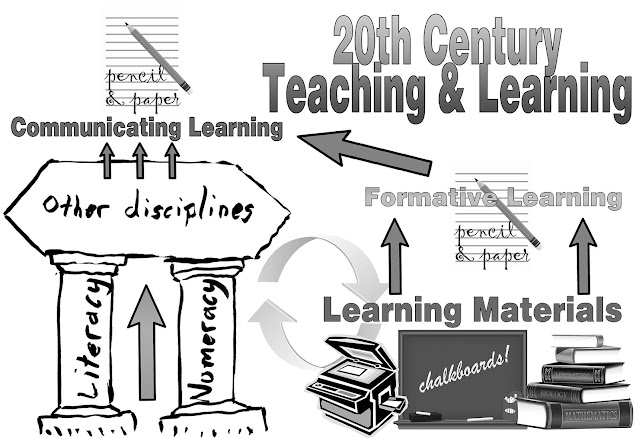
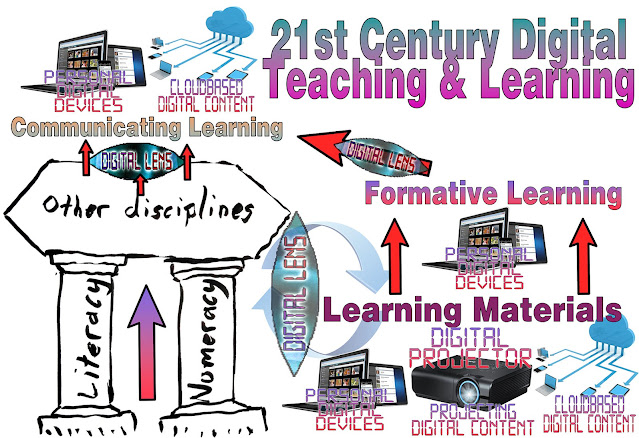
With that perspective in mind, I thought I'd try and take a run at infographicking how our analogue education system has digitized over the past twenty years.  This digitization of education has ramped up dramatically in the past decade - much of what I've written in Dusty World has orbited around this sea-change in digital teaching and learning.

The suddenness of this change has left many people behind.  There are administrators and 'curriculum experts' in our system who have never used the cloud-based learning systems we're now required to use in every lesson.  I'm up the pointy end of digitally fluent educators in the province.  I applied for a system IT support role last year and didn't get it - I suspect mainly because the system is incapable of understanding and appreciating digital fluency on anything but a puerile level; it's a case of illiterate people failing to value and understand what literacy looks like; I'd really like to change that.

If we consider the education system I grew up in 1980s Ontario, it was a very analogue place.  Teachers hand-wrote notes on a chalkboard which we copied by hand onto paper (which many students promptly lost, assuming they made the notes in the first place).  I can remember vindictive teachers doing a whole 76 minute period of note taking to 'ready us for university'.  Nothing prepares you for university like claw hand!  These 'lessons' weren't about how to take quality hand-written notes, they were about how to copy everything that was on the board as exactly and quickly as possible.  In retrospect, they did nothing to prepare me for university, but they were an example of the entrenched lessons we all experienced around creating analogue content; we never had a problem with teaching analogue skills because they hadn't changed for generations.  In the past two decades we've revolutionized information recording and access, but we've also all but ignored learning best practices in these new mediums for both teachers and students.

Analogue learning materials, analogue formative note taking leading to analogue communication of learning - and we drilled students on how to do each of these analogue exercises in order to create these skillsets.  We assume the same skills in digital spaces rather than teaching them.

My generation has been described as 'digital immigrants' as we arrived at the current state of affairs from a time that would seem completely alien to anyone currently under forty years old.  Along with the framing of us as digital immigrants comes the absurd framing of kids who have grown up in digital abundance as 'digital natives'.  If you've read Dusty World before you know what I think of this concept (it's absurd - just because I grew up in a time with cars didn't mean I magically knew how to drive!).  What this lazy observation did was absolve education of the responsibility for teaching digital communications as a foundational skill, even as it became the basis for how we teach and learn.  When I tried to replicate the 20th Century Teaching & Learning above with how 21st Century Teaching & Learning has become digitized, it quickly becomes apparent that digital skills aren't just needed to communicate your learning (it's even how we run the literacy test now!), the digital lens is also present in the learning materials you receive and the formative documentation of your learning.  Many parents struggle with the new digital means of communications from their schools (online reporting and such) because of their own digital illiteracy.  If you aren't digitally fluent you aren't capable of learning effectively in an Ontario classroom in 2022.  You aren't capable of teaching in one either, though that's the new expectation in our on again off again emergency remote and hybrid classrooms.


Learning materials are now almost entirely digital.  Even if a textbook is used it's often digitized first so that the information in it can be shared more fluidly in digital spaces.  Staff and students need to know how to research and find information online (including curating their own which many can't or don't do). Formative learning is documented (when it's documented at all) on digital notes taken in cloud based documents, though more often than not it doesn't happen at all because we've lost note taking as a skill during the digital devolution revolution.

Communicating learning is now also digital with most students incapable of writing by hand legibly (part of what has killed off formative note taking).  We've replaced all those lessons about analogue skills development with INFORMATION, because information is so readily available to us (though apparently only a minority can critically assess its value).


That digital lens is now between everything we do in education, including the traditional foundational skills of literacy and numeracy.  If you require digital fluency to teach and learn literacy and numeracy in a 2022 classroom, doesn't that make digital fluency itself a foundational skill?  Perhaps you're curious as to how many mandatory digital fluency programs Ontario teachers have to take?  None.  Know how many mandatory digital fluency classes there are in Ontario high schools?  None.  Know how many classes you need digital fluency in to best teach and learn?  All of them.

That is how messed up things are as 2021 ends in an ongoing pandemic that has pushed us into fully digital emergency remote learning for months at a time.  Fluency is but one part of this equation.  The digital divide also includes equity issues around bandwidth and device access at home, but we only talk about equity when it doesn't cost us anything.  Our ignoring of digital fluency has been a socio-economic/equity issue from the start (kids with access to tech and connectivity are obviously going to be more comfortable with it).  You might say that our lack of movement on digital fluency is simply a way to hide inequity behind something complex and difficult to deal with while still spouting about how equitable we have become.

I'm live in hope that our education system is put back on the rails and a we stop our oblivious approach to digital skills development in both teaching and learning.  If we're going to use networked digital tools like we are (ie: everywhere, including sharing private/personal data online), it is incumbent on every teacher to become fluent enough with it to teach best practices in order to protect both themselves and their students.  Our networked world is not a particularly safe place.  Our blind leading the blind approach isn't viable or safe and never should have happened in the first place.  Had we been working on this like we should have in the decade leading up to the pandemic, the desperate lunge into emergency remote learning could have been much more equitable and functional and would have gone a long way in reducing the strain on families being mulched by the pandemic.

When that hope is realized I want to go after the most challenging aspect of this in-the-land-of-the-blind skillset: cybersecurity.  CyberSec assumes advanced ICT (information & communication technology) hardware and software skills and then, like that Hamlet essay, goes after complex, esoteric skills far beyond where most people will operate.  I want Ontario to develop a cyber-awareness curriculum that brings all users of networked technology (that's pretty much everyone in the province) up to a point where their digital illiteracy is no longer a detriment to the province.  Illiterate users are still the biggest threat in cybersecurity, so I'd like to get everyone to the point where they aren't oblivious to how the networked world they're living in works.  If we can get to a level of digital literacy where the majority can teach and learn fluency online, we can also make Ontario education more hack-proof.

I'd also like to clear away the obstructions our digitally oblivious education system has placed in front of the most digitally adept students and create pathways into jobs in critical ICT infrastructure, most especially in cybersecurity.  If we don't take steps to secure our digital infrastructure, everything else fails (electricity, water & gas all depend on IT).

We should be producing graduates with the digital fluency needed to confidently make their way in our brave new world while also clarifying pathways for those students willing and able to protect everyone else from an increasingly threatening global, cyber-threatscape.

HOW TO ENGAGE EDUCATION WITH CYBERSECURITY

https://prezi.com/view/7pqMzlLdfOFltD78ILP6/

Over the past couple of years I've done a fair bit of writing for various provincial and national agencies around cyber-education.  In every case they seemed to be looking for an in-and-out, short duration of work online course they could post that teachers and students would magically flock to.  Having presented on cybersecurity education in the classroom both face to face pre-pandemic and online once it kicked off, I became aware of just how fearful most staff are in engaging with this subject that jumps up and down on their digital doubts while also threatening them with horrible outcomes that they don't understand.  Throwing up an online course isn't going to bridge this fear/ignorance gap.

Having worked with CyberTitan and Field Effect (an Ottawa based cybersecurity provider) on a joint federal government/private enterprise/public education presentation at the NICE K-12 Cybersecurity Education Conference this past December, we presented on how with industry expertise, federal vision and provincial public education community outreach we could make cyber-pathways available to all interested students while also offering immersive and meaningful cloud-based simulations that are equitably available to all.  Field Effect's cloud based immersive simulations are accessible and VERY engaging.

ICTC did an ICT Teacher Champion Day pre-COVID where they provided interested and engaged teachers with resources and support.  I think this approach is how you work through the fear and get staff and students to engage with scary-cyber on a basic fluency level.  It would also present competition opportunities that clarify pathways for the most cyber-interested.  By finding local champions who are willing/able to engage others in cyber-skills development, we could connect and walk people through some of that dormant online material and actually produce a change in how we're doing things.  This requires boots on the ground and a longer term commitment than throwing together an online course.

As digital fluency becomes a mandatory part of our public school experience and we begin producing more digitally fluent teachers and students, we can up our game in advanced digital skills like cybersecurity and emerging technologies like machine learning and 3d modelling and create digitally skilled graduates who aren't self-taught, potentially dangerous young adults who put our economy and communities at risk.

There is much to do.  I'm looking forward to being part of an Ontario that is ready to take on this challenging future even as it continues to hatch around us.

Saturday, 13 March 2021

Refocusing Ontario Education on Student Learning and Equity Through Artificial Intelligence

I've spent almost 20 years in public school classrooms fighting for better student learning outcomes, often while facing bureaucracy that pushes back in order to retain a status quo that supports their privilege. I don't have an office hang on to, my classroom is my office and my interests have always aligned with making that learning environment as effective as I can make it.

The pandemic has cast a harsh light on this lack of focus on pedagogy in our education system.  This past year could have been a huge step forward for Ontario education in terms of leveraging technology to produce better learning outcomes, but instead of a Bill Davis style, rational, progressive conservative clean up of an education system steeped in almost two decades of liberal 'vision', we got the Ford circus.  Ontario really deserves better politicians than it gets.

In my time in Ontario classrooms I've seen #edtech evolve at a fantastic rate and I've always kept up with it.  #Onted is a traditionalist organization with many stake holders (unions, boards, ministries, colleges and many other hangers-on too numerous to mention) who are more interested in playing politics in order to justify their role in an increasingly bloated and outdated system.  The pandemic has made it clear to me that most of these groups are focused on doing whatever it takes to keep their office jobs no matter how cruel or harmful to students the plan is.  My union just sent me another email about how we need to start another political fight over EQAO.  That this arrives in a year of historic workplace abuse in the system shows just how tone deaf my union has become.  No one seems to be focused on what matters anymore (student learning outcomes, remember?). 

Dr Sasha Noukhovitch, a fellow CyberTitan coach and colleague, shared an interesting while paper from The Canadian Commission for UNESCO on how artificial intelligence can revolutionize education.  This nuanced look at how AI could provide differentiation and support for all students regardless of their socio-economic situation (assuming we ever make a serious effort to permanently close the digital divide) represents a better understanding of the technology than that shown by the 'robots will take our jobs!' crowd and suggests a pathway toward a future where technology works to provide equity rather than what we're doing with it now.

In a year where everyone likes to talk about equity while doing the exact opposite setting up hugely inequitable pandemic learning schedules, the idea that a an apolitical, rational and student needs focused system could be brought to bear is thrilling.  It's an ongoing frustration that focusing our classrooms on pedagogy feels more and more alien; everyone in Ontario education has lost the plot and left it to exhausted and under-supported classroom teachers to make their inequitable planning work.

Artificial Intelligence offers the kind of individual support specific to student needs that the system has always struggled to provide.  I've been dreaming about it for ten years.  Our low-resolution bureaucracy does an adequate job of managing a mythically average student but doesn't like to treat students like people because that costs money.  AI could do a lot to address that inability to address equity, but rather than explore this emerging technology you can bet the privileged/political stake holders will do all they can to block it in order to maintain their status quo benefits.

This is about the UK but
the conservative playbook
looks the same everywhere.

The second article from The Guardian
about British schools offers some worrying details about how behind the curve they are in terms of technology adoption (lots of schools don't have wifi yet?  C'mon UKed!).  It also suggests a way to improve student learning outcomes that has become apparent from asynchronous online learning: "One way to tackle the achievement gap is surely in-school lessons followed by more personalised online learning, either at home or in after-school clubs."  Of course, in Ontario we rush to apply technology to force synchronous learning (recreating the inequities of the classroom) for political ends while further crushing students whose families can't provide the infrastructure.

Combine the concept of immanent personalized virtual learning AIs that will tirelessly support students right where they need it and the idea that school can happen both in class synchronously and out of class virtually and at the student's own pace and you have a recipe for a quality of pedagogy that we simply can't produce in our status-quo, politically charged bureaucracy intent on retaining all the infrastructure (schools, board offices, union offices, educational hangers-on...) and the jobs needed to run it.  A leaner burning Ontario education system focused on student learning might have a similar number of people working in it but almost all of them would be actually involved in teaching.

The thought of a rational, politics free AI focused entirely on maximizing learning outcomes has me dreaming of an education system free of messy human politics and the self-serving political organizations that feed off it.  Decisions would be data driven, transparent and then held to accountability through more transparent data collection that would be ongoing and everywhere rather than centred in a questionable and expensive organization run by a failed politician.

I'm in my final decade of teaching and I've lost faith in my union and doubt the intentions of educational management all the way through the system.  The 'support' organizations that also feed off the education system seem to have completely lost the plot in the political haze of education in 2021 Ontario.  Spending my final years in the system making student supported AI learning tools a reality and watching them burn the status quo to the ground would be a satisfying conclusion  to a career spent focused on student learning.  I've long hoped to leave the system in better shape than I found it.  I think the route to that goal is through adapting emerging artificial intelligence and other digital learning tools through a ruthlessly pedagogical focus.  If that burns our bloated bureaucracy to the ground in the process then I'll have achieved my goal of a more equitable and effective public education system that serves student needs first.


WANT TO DIG INTO AI IN EDUCATION FURTHER?


Read that UNESCO white paper on AI in education if you haven't yet, it's worth a read.

ISTE also has primers on AI and how it will change education here.

Sunday, 22 November 2020

Surveillance Capitalism and Educational Technology

I'm currently finishing Matt Crawford's third book, Why We Drive.  His first book, Shop Class As Soulcraft arrived just when I was transitioning out of years of academic classrooms into technology teaching and it helped me reframe my understanding of my manual skills that are generally seen  as less-than by the education system I work in.

Why We Drive looks at how we're automating human agency under the veil of safety, ease of use and efficiency.  But in examining the work of the technology companies providing this technology, Crawford ends up uncovering a nasty new version of voracious surveillance capitalism at work in the background.

In an education system that can't get into bed with the masters of surveillance capitalism quickly enough (we're a 'Google Board' full of 'Google Teachers'), this makes for particularly uncomfortable reading.  Crawford makes persuasive, well researched arguments for why we shouldn't be leaping into Google's brave new world.  Meanwhile I'm watching public education indoctrinate children into feeding the cult of Google.

Crawford comes at this from the point of view of driving because Google and the other attention merchants are very excited about moving us to driverless cars in the near future, and Crawford is skeptical about their motivations for doing this.  From Shop Class As Soul Craft to The World Beyond Your Head and now in Why We Drive, Crawford has always advocated for human agency over automation, especially when that automation is designed to simplify and ease life to the point where it's obvious we're heading for a Wall-E like future of indolent incompetence in the caring embrace of an all-powerful corporation.

Situated intelligence is a recurring theme in Crawford's thinking and he sees it as one of the pinnacles of human achievement.  He makes strong arguments for why surveillance capitalists aren't remotely interested in human agency and the situated intelligence it leads to, and he fears that this will ultimately damage human capacity.  Among the many examples he gives is that of London taxi drivers:


Google isn't the only target in this book.  Tesla's misleading manipulation of crash data in self driving cars and Uber's manipulation of markets using its capitalization to dismantle existing industries that were providing a service within market forces are also targets.  Uber and Tesla's goals align with feeding the Google engine more human experience (that's where the money is), though this is often hidden behind marketing around safety, ease of use and efficiency closely tied to unarguable issues like climate change .  The quote above describes the difference between a London cabbie who has to commit to years of 'deep cognitive accomplishment' in order to become a driver in the city.  Uber's thinly veiled attack on an otherwise viable career by using untrained, underpaid and ultimately disposable drivers to break that livelihood before replacing them with automation is damning.  What 'tech' companies say seldom aligns with what they do.

'Free' means something different in surveillance
capitalism.  Note the accessibility and simplicity,
a common idea in edtech marketing, because
learning digital tools doesn't mean understanding
them, it means learning to consume on them.
I can't help but see parallels with educational technology.  We recently had another technology committee meeting where it was decided that once again we would buy hundreds of Google Chromebooks: "simple yet powerful devices with built-in accessibility and security features to deepen classroom connections and keep user information safe"   Notice the hard sell on safety and security, like something out of Tesla and Uber's misinformation marketing plans.  The reason your student data is safe is because Google is very protective of 'its' data, and make no mistake, once you're in Google's ecosystem, your data IS their data.

These plug in to our 'walled garden' of Google Education products that keep iterating to do more and more for students and staff until they're sending emails no human wrote and generating digital media automatically, all while saving every aspect of user input.  Board IT and myself argued for a diversity of technology in order to meet more advanced digital learning needs, but advanced digital learning isn't what we're about, even though we're a school.  Digital tools now mean ease of use and cost savings (though this is questionable), they are no longer a tool for learning as they increasingly do the work for us.

As Crawford suggests, the intention of these tools is ultimately to automate our actions and direct us towards a purchase.  That fact that we're dropping millions of dollars in public funding at best familiarizing students with their future consumer relationship with technology is astonishing.  As big tech gains access to increasingly personal information, like your geographic location, patterns of movement and even how you ergonomically interact with a machine, personal data gets harder to anonymize.  The push is to get into all aspects of life in order to collect data that will serve the core business... 


Crawford offers example after example of technology companies that offer ease of use and accessibility under the unassailable blanket of safety, ease of use and efficiency.  This too has crept into education technology, where instead of taking personal responsibility for our use of technology we surrender that critical effort to the inscrutable powers that be.  One of the intentions of the new normal is to produce people that do not question authority because a remote, cloud based authority is unquestionable.


From Shop Class forward Crawford has been critical of the 'peculiarly chancy and fluid' character of management thinking, which also falls easily into the safety/automation argument being provided by the richest multi-nationals in the world.  That system managers fit in well with system think shouldn't be a surprise, but for anyone left in the education system who is still trying to focus on developing situated intelligence, it's a completely contrary and damaging evolution.  I shouldn't be surprised that the people running things want to cut out the complexity in favour of safety and ease of use (even if that isn't what's really being offered), but any teacher thus focused has lost the plot.

Google and the rest don't 'give' software to education any more than they 'give' software to the general public.  All of their instruments 'serve its core business of advertising'.  Andrew Campbell has long had an eye on this, not that any critical analysis has stopped Ontario's educational management from hopping into bed with Google and the rest as quickly as it can.


And how do you automate people?  Get them in the system as soon as possible and make it familiar.  Forcing children to learn corporation specific tools instead of offering them platform agnostic access to educational technology is a good starting point.

There are still questions around how student data is used by Google. Crawford highlights how location data can't be anonymized (it's like a finger print and very individually specific), so even if your corporate overlord isn't putting a name on a data set, they can still tell whose data it is.  Location data is a very rich vein of personal information to tap if you're an advertising company, which is why Google is interested in developing self-driving cars and getting everyone into convenient maps.  Unless you're feeding their data gathering system they don't lift a finger.


Towards the end of the book Crawford leans heavily on Shoshana Zuboff's (Harvard Business School Professor Emeritus in case you're questioning the validity of this research)  Surveillance Capitalism, which came out in 2019.   Zuboff makes multiple appearances in Netflix's The Social Dilemma, which explains how surveillance capitalism has developed as a cancer immune to society's protective processes because it goes after something that has no legal protections:  our digital/cloud based data.  As an economic weapon, a US law from the late nineties that absolved social media companies from responsibility for what appears on their sites under the name of 'internet freedom' has done untold damage around the world.

Crawford goes so far as to describe this as a new kind of colonialism that we're all under the yoke of, but passive analysis isn't the end goal.  He shows experiments like Pokemon Go (created by Google) as a test in active manipulation.  The goal isn't to create a new level of advertisement based on predictive algorithms, it's to build an adaptive system that can sublty manipulate user responses without them even realizing it.  In doing so he also explains why so many people are feeling so disenfranchised and are making otherwise inexplicable, populist political decisions:


Google's mapping projects are situated in colonialist intent (empires make maps in order to control remote regions).  By mapping the world and giving everyone easy access to everywhere, local knowledge becomes worthless and a remote standard of control becomes a possibility.  Smart cities are shown in this light.  The language around all 'smart' initiatives from edtech to smart cities all follow the same ease of use/efficiency/safety/organizational marketing language.  This language is unassailable (are you saying you don't want efficiency, safety, ease of use and organisation?)  This thinking is so ubiquitous that even trying to think beyond it is becoming impossible.  Though tech-marketing suggests that ease/efficiency/safety is the intent, the actual point is data collection to feed emerging markets of predictive and influencer marketing; digital marketing is Big Brother.  Orwell was right, but he couldn't imagine a greater power than centralized government in the Twentieth Century.  The Twenty-First Century produced the first world governments, but they are corporations driven by technology enabled mass data gathering that are neither by nor for the people.

There is no way out of the endless cage Google is constructing.  Self-driving cars and driving itself are the mechanism by which Crawford uncovers an unflattering and insidious form of capitalism that has already damaged our political landscape and looks set to damage human agency for decades to come under the guise of safety, efficiency, ease of use and security.

Any criticism of this is in violation of the cartel that supports and is supported by it and results in a sense of alienation that leads to anger and populist resentment.  Governments, including public education, can't tap into this 'free' technology fast enough, but of course it isn't free at all, and what we're giving up in the pursuit of easy, efficient and safe is at odds with the freedom of action it takes from us.

I've long held that understanding technology allows you to author it instead of it authoring you.  In the detailed Guardian surveillance capitalism article by John Naughton, Zuboff makes a point of stating that digital communications are not inherently monopolistic in intent which is something Matt hasn't done in Why We Drive (I get the sense that he doesn't like digital technology in any capacity):

"While it is impossible to imagine surveillance capitalism without the digital, it is easy to imagine the digital without surveillance capitalism. The point cannot be emphasised enough: surveillance capitalism is not technology. Digital technologies can take many forms and have many effects, depending upon the social and economic logics that bring them to life. Surveillance capitalism relies on algorithms and sensors, machine intelligence and platforms, but it is not the same as any of those."

There was a time when digital technology wasn't being driven by advertising.  The early internet wasn't the orderly, safe and sanitized place it is becoming, but it was a powerful change in how we worked together as a species.  I don't know that I buy in to all of Matt's arguments in Why We Drive, but his fundamental belief that we should be using technology to enhance human ability rather than replacing it is something I can't help but agree with, and any teacher focused on pedagogy should feel the same way.

Why We Drive is the latest in a series of books and media that is, after years of political and psychological abuse, looking to provide society with a white blood cell response to surveillance capitalism.  Rather than taking some of the most powerful technology we've ever created and aiming it at making a few psychopaths rich while enfeebling everyone else, my great hope is that our understanding of this nasty process will give us the ability to take back control of digital technologies and develop them as tools to enhance human capabilities instead.  We need to do that sooner than later because the next century is going to decide the viability of the human race for the long term and we need to get past this greed and short sightedness in order to focus on the bigger problems that face us.  We could start in education by taking back responsibility for how we use and teach our children about digital technologies.


***


I've long been raging against the corporate invasion of educational technology:


Saturday, 21 November 2020

Thankless Jobs and Crooked Paths

Top to bottom in education. There's a
workplace stream 'beneath' vocational,
but that isn't worth mentioning?
The prejudice against manual skill is ongoing in Ontario education.  I was chatting with one of our auto-shop teachers the other day and we were both lamenting the abuse of our manual skills in the halls of academia.  A teacher who was musing on why students 'waste their time' taking tech courses the week before was begging this same auto-shop teacher to change her snow tires a week later, even though she knew he had no students available to do it.  He is a qualified automotive technician, but he isn't paid to be one when he's at school, he's paid to teach, but that doesn't stop people who only operate in the rarified realm of ideas to expect free access to the hard earned, hands-on skills he has taken years to develop.  He talked about how he was often at school hours after everyone else had left finishing automotive repair jobs for people who pay for his time and expertise with their earnest thanks and little else. He's still expected to do the make-work extra duties that the academics have worked out for themselves.

I'm in the same boat in terms of information technology skills. I spent years of my life and my own money becoming qualified as a technician.  I can fix pretty much anything, but that's not what I'm being paid for when I'm at school.  I've opened up access to in-school IT support because it gives my students an opportunity to develop genuine, experientially driven skills that widen the scope of their learning.  Last year, in spite of  my making numerous suggestions that would have kept computer science alive in the building (it's since been cancelled on-site) as well as keeping a senior computer engineering class available in each semester to provide needed in-school IT support, one of my senior sections got cancelled.  This hasn't stopped the expectation that I provide IT support in the school even when I'm being double doubled by an absurd schedule.  I'm able to help and the last thing I want to see is a colleague in distress because their tech isn't working, but asking for that effort  to be recognized is a step too far.

Now that I'm out of that cruel always on in two places at once schedule I asked if my hours of extra support work (I was the only teacher in the building still doing their usual extra duties) be acknowledged and was told they wouldn't - I get to do the same make-work as all the academics, just like our auto-teacher who is here for hours doing work for the school 'community' of which we are clearly not equal members.  The logic for this is that my extra duty work is equal to another teacher standing in the cafeteria watching teenagers eat lunch (what most teachers do as extra duty).  What I'm doing took years of training and numerous professional qualifications, what they're doing requires a pulse - except they aren't even doing that because no one is eating lunch in school at the moment, though everyone has doubled down on tech use and the support it requires.  Why is this the outcome?  Because in the minds of graduate degree educational management manual skills are treated as next to worthless.  This is a value theory decision.  Ignoring the value of expertise means you can treat it as a free expectation.

This happens to many technology teachers.  They get paid less because teacher pay is wrapped around academic/university achievement that the vast majority of the people running the system are products of.  My own experience in trying to apply my vocational experience even while already an academic teacher demonstrated this prejudice in startling clarity.  The College of Teachers can understand a degree with little effort, but show them a decade of industry qualification and experience and you can expect it to be dismissed out of hand.  Tech teachers make less but are expected give away the skills that make them qualified to do what they do in a way that other teachers simply aren't.  We go so far as to invent meaningless make-work extra duties (like cafeteria duty) so the academics can top up their time with minimal effort (and no chance of getting their hands dirty).

A few weeks ago my IT qualifications got dismissed by another administrator who equated years of training, experience and multiple industry certifications with watching a few hours of video and writing a multiple choice test.  Academic prejudice is real and everywhere.

I fired a Statistics Canada research piece on Canada's poor handling of women in STEM and particularly in engineering and computer science to our SHSM, guidance and administration, which prompted a good talk with our local SHSM head.  My argument was that academically focused girls are directed out of engineering and technology pathways toward more 'gender appropropriate' pathways (that are also usually far less lucrative) by peer pressure.  My experience at last year's CAN-CWiC Conference repeatedly told the story of women who regretted not pursuing technology related pathways in high school and having to expensively pivot later in life.  Sexism, under the guise of peer pressure and student choice, play a big part in this, but it also reflects a lack of appreciation for alternative pathways inherent to our academically prejudiced education system.

A teacher who got straight A's in high school, went straight to university and got straight A's there too and then went straight into teacher's college (straight A's again) before being deposited into yet another classroom for the next twenty-five years of their lives are going to carry academic prejudices with them because they know of no other experience.  Any student not on that straight and narrow path of 'excellence' is less than.

I frequently see the system make aggressive resource grabs to ensure academic courses run.  University bound sciences will run at less than 50% capacity while workplace and applied courses are frequently bundled together or cancelled and non-academic students are just dropped into academic sections because they are all that's available.  An example of academic protectionism are french immersion courses where academic students are protected in classes that are often a fraction of what they should load to because those students are special.  Everyone else has less to ensure system resources are focused on the academic streams even though these students are frequently the ones most capable of doing more with less.  My own school sports a higher than 50% graduation into the workplace statistic while spending the vast majority of its resources protecting university pathways.

Our SHSM head said a colleague of hers once described the route that students not on the straight and narrow academic route take as the 'crooked path'.  I've walked this path, unlike the majority of teachers.  I dropped out of grade 13, worked in an apprenticeship as a millwright, attended college then dropped out and then went back into summer school and high school in my early twenties to graduate before going on to attend university.  I then worked in the world for over a decade before becoming a classroom teacher - a job I never thought I'd be doing after my own negative experiences as a student in the same system.

That crooked path is seen as less-than by academics.  Students who would benefit from my M (college/university - essential doesn't run because it would mean reducing the number of students they can stuff into my shop) technology program are told not to 'waste their time' taking tech when they could take three sciences they don't need because they are more credible when applying to university.  That's backed up by backwards universities demanding irrelevant but 'difficult' courses to access their STEM program, ignoring TE even when it's a TE program!  Academic prejudices learned in universities trickle down.

Tactile skills training has always had trouble fitting into academic education.  The extra costs and safety concerns make rows of robots, I mean students, doing 'academic' (white collar office) work much cheaper - it's also cheaper to apply digital technology too as our recent school decision to buy nothing but Chromebooks even as board IT and I suggested differentiating our technology to meet specific needs (again - we've bought nothing but Chromebooks for years).  Whether you want to look at resource allocation, guidance direction or even just how teacher duties are assigned, the prejudice against hands-on skills is systemic.