Showing posts with label professional development. Show all posts

Friday, 4 September 2020

#ECOOcampON 2020 Virtual Conference Reflections

ECOOcamp Ontario happened in Peterborough last year and was the usual mix of keen people getting together to improve their technical skills and launch another year of teaching in an avant garde style.  Had you asked anyone there what the summer of 2020's ECOOcamp would look like, a virtual online conference during a pandemic wouldn't have been the obvious guess, but ECOO managed to pull off #ECOOcampON, a virtual conference using tech most people hadn't used before, with astonishing fidelity.

As you'd expect there were technical issues, but what ECOO does a good job of spreading is the idea that teachers can become digitally fluent enough to resolve these problems themselves.  Early on link issues stopped the conference in its tracks, but the tech-savvy educators running the event iterated at high speed through troubleshooting and within twenty minutes everything was back on track again.

Digital fluency has been cast in a stark light this year with Ontario's sudden move to emergency remote learning, so you'd think that more educators have technical proficiency at front of mind as the first school year in a century kicks off in an ongoing pandemic.  ECOOcampON managed over 500 registrations this summer, which goes to show you just how resilient some Ontario educators can be in trying to get literate teaching in a still new(ish) digital medium, though only 0.3% of teachers attended in Ontario and I'd guess that 70% of them need it.  In a better world this conference would have drawn over one hundred thousand educators looking to raise their digital fluency in order to prepare for the inevitable next round of remote teaching.

What follows are some personal reflections prompted by the event.

Krista Sarginson and I presented on CyberTitan, the Canadian Student Cybersecurity Competition on the first day of the conference.  Krista's CyberLions rocked a 2nd place finish in the middle school division in her first year coaching in 2019.  I'd been looking for a brave teacher to leap into this and help me advocate for it.  Krista is fierce and fearless and did a great job encouraging other elementary panelists to consider giving it a try.

Secondary teachers tend to be more reticent about participating in things they can't show intellectual dominance in.  I'm hoping that Krista's influence engages more elementary Ontario teachers in participating in this competition.  It's a great way to raise awareness around information security and opens up an entire industry to students who might otherwise have no idea it exists.  It's a tough year to encourage extracurriculars, but something like CyberTitan could become the basis for a cybersecurity course, which is something Ontario is way behind the curve on.  Here's our presentation if you're curious:


The round table discussion that night talked about resilience and how we frame challenges.  This past year seems like almost infinite challenges.  From a vindictive government intent on attacking our profession and diminishing public education to a worldwide pandemic, it's been a burning dumpster fire of a year for educators in Ontario, with no end in site.  The new mix is the vindictive government using the pandemic to physically threaten staff and students.  It's not understatement to say that I've never seen colleagues so scared and uncertain about teaching in a few weeks.  How can we be in poorly ventilated classrooms that ignore the rules we've been told to follow for the past six months and feel safe?  Our doughty premier is frustrated at the response (usually framed as an attack on unions), but no other front line workers are being forced to ignore public health rules in their workplaces.


In this context I found the roundtable discussion difficult to navigate, though they gave it a good try.  One of the speakers was a big fan of nature, but it was a romanticized view of nature where people should just find themselves at their ease in natural surroundings.  That park-setting idea of nature is very much dependent on a manicured and managed environment.  I love being out in nature, but I enjoy it because it's relentless in its expectations of competence.  Being happy in nature is as simple as not being hungry or cold, or avoiding being eaten.  Few people have been face to face with that kind of nature.


Disney's romanticized version of nature,
in reality this is a great way to get rabies.
Austin Vince has a documentary on riding into the Sahara Desert called Mondo Sahara.  In it he talks to an off-road expert who has spent a lot of time in the deep desert.  He makes a clear distinction on what your focus should be: always make sure you're dictating what is happening because the moment the desert is in charge things fall apart quickly.

Survival training was like that too, especially the winter stuff.  Our instructors were insistent on the exhausting job of managing cold and wet to ward off the ever present fear of hypothermia.  Nature isn't only beautiful, it's also so immersive and demanding that you can quite easily drown in it.  Most people have never been in a survival situation like that.  Society does everything it can to ensure you don't have to keep yourself alive in nature, it'll do it for you - usually while killing nature in the process.  If most people got driven into the wilderness and dropped off they'd be dead in a week.  That is terribly beautiful, but that isn't how nature was presented.  Being demanding is what makes nature teach resilience, but we try and weed harsh lessons like that out of education wherever we can.

I've recently had trouble with how our return to face to face classrooms was being framed.  We were initially told that relationships are all that matter and that we shouldn't even worry about curriculum.  There is a place where that is the case, it's a daycare centre, but I didn't go through the long and difficult task of becoming a teacher so I could provide daycare.  Yet in the greatest social crisis we've seen in recent years, instead of focusing on being resilient and holding everyone to higher standards, the reflex is to do whatever it takes to make people more comfortable.  You can learn a lot by being uncomfortable.  A good place to realize that is in nature.

The other side of the roundtable focused on happiness, which is much more complicated because we're more than happy to destroy nature just to ensure our own short-term comfort, future generations be damned.  If we want to consider nature it's as a form of entertainment.  Living in nature is nasty, brutish and short, to paraphrase Hobbes, and too much like hard work unless you think nature is pulling your RV into a campground.  Look no further than our response to COVID19 (which is nature at work).  We've actually slew footed our own self-serving, cancerous economic system just to keep as many humans alive as we can, yet even during a world wide health emergency we're still adding the populations of Guelph AND North Bay to the planet every single day, while stopping economies to keep everyone alive for as long as we can.  Everything we do with technology, economics and society are contrary to nature, so holding it up as a solution seems a bit disingenuous.  It doesn't matter though, nature will sort things out soon enough.  If we're too stupid and selfish to be on the right side of that it won't matter because ultimately what we think doesn't matter.

The happiness side of the discussion was enlightening.  The question of what is happiness is a surprisingly complicated one.  I was chasing it in an online psych course from Yale earlier this year called The Science of Well Being.  For many people happiness is doing as little as possible, but I'm all about agency (your ability to act).  When that is cut away from me I become very frustrated.  The best leaders I've had recognise that I'm a self starter who wants to act and provide a framework that directs me into doing what they need to get done.  The vast majority of leaders I've had are frustrated by my inability to stand in line waiting to be handed the same work as someone who doesn't want to do anything at all.  During the pandemic this everyone-do-less approach has been strangling me.  Most of the managers I've had in Ontario education are of the lesser variety who want to cookie cutter everyone into undifferentiated jobs.  I'd hoped being a professional in a recognized field would bypass that, but Ontario education is remarkably juvenile in how it directs its employees.

If you've ever seen Saving Private Ryan, I'm a Tom Hanks kinda guy: I don't care if the work's difficult, but I need the people in charge to recognize that with a bit of latitude I can get things done that others cannot.  Most organizations' inability to differentiate their duties for employees is why I often have problems with organizational structure.  The people who maintain that structure very much identify their own self worth through it, and I frequently come into conflict with them as a result.  Give me a big, difficult job and the latitude to attack it and that's happiness for me.  It's why I've never been on a cruise or to an all-inclusive resort, it's my idea of hell.  That understanding was a great metacognitive reflection that ECOOcampON provided for me at the end of day one.

I attended a number of sessions ranging from equity to media literacy around the credibility of sources, and found them rich and helpful in framing this year's difficulties, but it was the closing keynote that closed the circle for me.  Daniel Lewis is a successful entrepreneur who struggled in the education system and overcame a number of personal hardships to find success.  He is inspirational by nature, and I enjoyed his relentless positivity, though I'm often cautious with optimism because it can be used to overly simplify a difficult situation.  When someone says, "you got this" in terms of going back to school it feels an attempt to ignore the difficulties.

Daniel didn't take that approach though.  He emphasized the power of your own thinking; self determination was the underlying message.  Even if you're in a broken, leaderless system staggering under absurd political machinations, you are still free to think what you want to think.  There is power in that kind of stoicism, especially in tough times.

There was a lot of talk about getting out of the box in terms of thinking without being restricted by the people and systems around you, which aligned well with the keynote's theme (though it contrasted with the resiliency and happiness roundtable from the beginning).

I'm always cautious around entrepreneurial pep talks.  Business has a way of turning that optimism and relentless enthusiasm into sales.  In this case it was the idea that once you free yourself of the boxes other people have put your thinking in, YOU then get to make the boxes.  I took that to mean for other people.  Why would you want to make a box to limit your own thinking?

Perhaps I'm odd in that I educate to empower, so breaking out of the box aligns with that, but the last thing I'd want people to do with that freedom is start boxing in other people, but that's society.  I was troubled by the idea that the moment we free our minds we look to use that freedom to enslave others, but maybe that's just how people work.  Freeing people doesn't guarantee happiness in any case.


Boxes aside, it was an engaging and uplifting closing keynote to a remarkably resonant ECOO Conference.  We are free in our own minds regardless of how tightly our struggling school system ties us, and there is comfort in that.  If you're able to free your mind from the fear and uncertainty you can grasp your own agency and get things done.  The pandemic has deeply wounded everyone's agency, so Daniel's stoic message resonated well, though I'm still troubled by the reflexive need to box people.

If you bounce over to the ECOOcampON webpage, you'll find links to all the presentations.  I think they're also wrangling the recordings of all the presentations together so you can view what you might have missed.  I've always found ECOO's model of teachers directing their own PD to be both engaging and effective.  When I compare it to professional development that's mandated and thrown at me, this feels much more valuable, but that's probably because I use my own agency to create and participate in it.  There is a distinctinction in there somewhere around passive and active learning that anyone interested in pedagogy should be considering, especially in a world where a passive-do-nothing approach is now a governmental demand.

***

I"ve been reading a lot of Tao Te Ching this week.  It offers me some perspective when the walls feel like they're closing in.

Tao is empty (like a bowl). It may be used but its capacity is never exhausted
It is bottomless, perhaps the ancestor of all things.
It blunts its sharpness. It unties its tangles. It softens its light. It becomes one with the dusty world.
Deep and still, it appears to exist forever.
I do not know whose son it is. It seems to have existed before the Lord.

Heaven is eternal and Earth everlasting.
They can be eternal and everlasting because they do not exist for themselves, And for this reason can exist forever.
Therefore the sage places himself in the background but finds himself in the foreground.
He puts himself away, and yet he always remains.
Is it not because he has no personal interests? This is the reason why his personal interests are fulfilled.

To hold and fill a cup to overflowing Is not as good as to stop in time.
Sharpen a sword edge to its very sharpest, And the (edge) will not last long.
When gold and jade fill your hall, You will not be able to keep them.
To be proud with honour and wealth Is to cause one's own downfall.
withdraw as soon as your work is done. Such is Heaven's Way.


Friday, 24 April 2015

Neurology: Is it the car, or the car and driver?

We had board PD today (a 3 hour lecture).  It was a presentation on neurology in learning and layered curriculum by Kathie Nunley.  I'm generally a fan of a nuanced scientific approach to human activity (as opposed to a simplistic approach to things that usually support buying something).  Dr. Nunley's neurological approach to education offered a number of insights to what we're doing wrong.  If we don't consider biological imperatives in learning we will never be as efficient as we might be.


There was a moment where I came to the end of neurological approach and the 'ol philosophy degree kicked in.  Nunley had a slide stressing the importance of the appearance of choice in learning.  She stressed how engaging it is for students when they feel like they can choose their learning.

My knee jerk response was that this was manipulation, which led me down a metaphysical rabbit hole.

Neuroscience, because it's looking at the brain, comes dangerously close to itemizing our sentience.  It also tends to reduce multi-dimensional complexity into simplistic linearity.  This idea that the appearance of choice would prompt more efficient learning would encourage any right minded teacher to manipulate their students into thinking they have learning choice in order to harness better retention.  No right minded teacher should be manipulating anyone into anything.

An analogy immediately came to mind.  Is neuroscience the car or the car and driver?  On a neuroscientific level our minds are very complex mechanical devices.  Our actions are driven by a brain developed from millennia of evolution.  There is no free-will, only complex autonomous reaction.  If that is what we are, you should have no trouble manipulating these processes to get a desired result, especially if it's a good end.  School systems should treat the people in them like cogs in a machine, because that's all they are.

If neurology is the study of the car then we can make immediate and scientifically informed choices that will improve its maintenance and operation.  As Nunley suggested in her presentation, dietary and developmental principles can be applied to maximize the functionality of our brains.  If neurology is the study of the car and driver then there is nothing else to consider.  In addition to the spiritual considerations that a number of people would find difficult to swallow, concepts like ethics or metaphysical ideals beyond the immediately knowable world of science (like honesty) may be ignored.  Neurology is the rational tool that justifies treating people like machines because that is all they are.

One of the reasons I like teaching technology is because students don't get to work in imaginary value structures.  Those would be places where the science of neurology reigns supreme, where the teacher should manipulate students to lead them to success.  It's where a 60% means you've done enough.  In the world of hands-on experience 60% is as useful as a zero.  If you don't believe me have 60% of your next brake job done and see how that goes.


Teaching technology means I get to take students inured to reality after years of 'learning' in a school system and put them in close proximity to what is rather than what we wish.  Their discomfort is obvious.  They respond with comments like, "it didn't work, but I tried real hard.  Do I get an A?"  No, you don't, and reality is unimpressed with your intellectual resilience and general work ethic.  Thank goodness human value structures don't decide everything. 

Fortunately, and despite our best efforts, we don't live in a reality based on human value structures.  The large, unknowable universe that surrounds us makes itself felt constantly.   The tiny portion of reality we feel like we have a grip on because of science is only a gross approximation; mathematics and human ideas that roughly simulate reality enough to make crude use of it.  Science thinks in terms or breakthroughs and mastery, but neither actually happens.  Neuroscience offers us some useful insight into how brains function, but it is still far from understanding our minds; the driver is still safely out of their hands.

I tend toward moral absolutism.  One of the reasons I find science so agreeable is because it attempts to tell no lies, but in the case of neuroscience it seems to make some assumptions on how much it thinks it knows about being human.  Brains aren't all we are, even though we use them as a lens to make sense of the world.

I'm going to take many of the suggestions around how to best maintain and maximize brain efficiency from this PD, but I'm not surrendering morality in the process.  If I'm going to give a student a choice it's going to be a genuine choice because I believe those are superior to the appearance of choice.  In ways not immediately measurable I know that treating students and the subject I teach honestly creates the kind of fecundity that science is still having trouble quantifying.

Sunday, 19 April 2015

What is Professionalism?

A long, contemplative ride
on the road less travelled to
self directed PD.
I attended Edcamp Hamilton this past weekend.  On a Saturday morning what did almost one hundred teachers and administrators do on the eve of a strike?  They spent their own time and money to travel to Ancaster to direct their own professional development.

Discussions ranged from technology integration to how to most effectively assess student learning (along with dozens of other topics).  What is magical about the edcamp experience is that teachers direct their own research and reflection.  There is no top down directive or education consultant being paid to sell an idea.  No one is paid to be there, no one is expected to be there, yet the room was full at 8:30 on a Saturday morning.

I've long thought that self-direction is the key element in professional development.  I'd actually argue that PD isn't PD unless it is self directed.  When you're sat in a room being indoctrinated by a talking head it isn't professional or development, it would be better described as mediocre training.  Lecturing a group of people implies that they lack knowledge and need to be informed.  It implies that they aren't professionals but unskilled employees who need direction.

I've got PD coming up this week.  PD often involves a paid consultant earnestly exhorting you to differentiate your teaching practice, but they do it in a completely undifferentiated, university style lecture.  If student centred differentiation is what you're selling, selling it in a lecture is either incredibly lazy or ignorant.  In any case it suggests a lack of integrity.


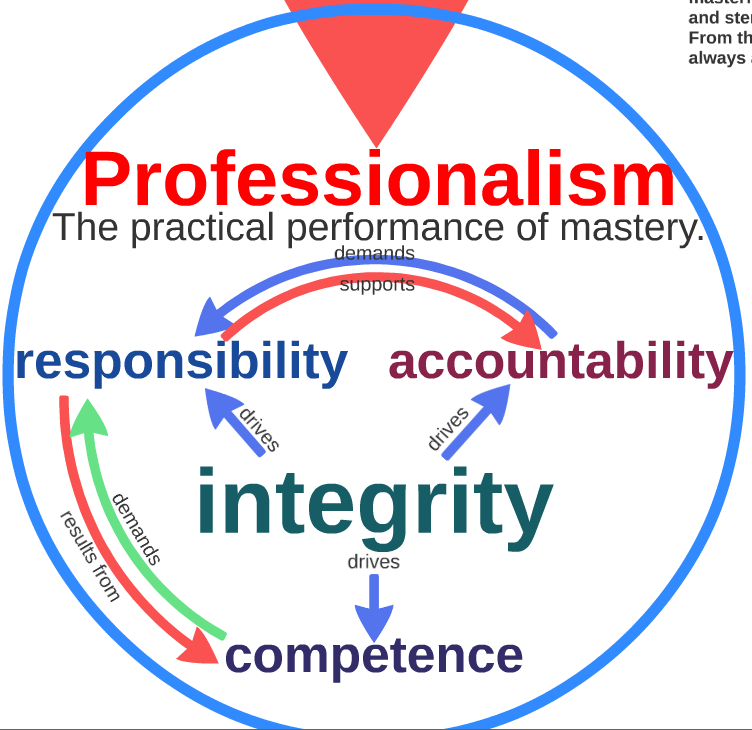
I'm trying to work out what professionalism
is in a Prezi mindmap
The professional is, at their core, self directed.  You don't become an expert in something without being able to self assess and improve your own practice.  Integrity should drive this self directed improvement by demanding competence.  That competence naturally creates a sense of responsibility that a professional is more than happy to be accountable for.  Self direction and the integrity that drives it creates a professionally responsible environment that accepts stringent accountability.

In order to develop professional standards, professionals need only be left to their own devices, and perhaps given the time and space by management to focus on excellence.  Edcamps encourage this kind of professional development, in fact they can't happen without it.  PLCs also facilitate professional development by leaving the professional to develop their own means of improvement.  I've been involved in learning fairs, unconferences and other teacher centred/teacher presented learning opportunities that have been invaluable as well as empowering.

The difference between a talented amateur and a professional is that the professional is committed to improvement and is thus willing to be accountable to their profession.  The professional abides by the practices and standards of their profession and actively works to raise them.  In this way a professional has a social responsibility to their profession that a dilettante doesn't, no matter how talented they might be.  The professional isn't a one trick pony who acts solely on talent, but a talented individual who begins with natural inclination and then works to develop it into a much wider skill-set that acknowledges the full complexity of their discipline.  Some secondary teachers fall into thinking that they are a subject expert before they are a teacher.  Being a subject expert isn't what they are being paid (professionally) to do, it's teaching.  Teaching is the professional practice we (especially at the secondary level) sometimes forget.

Accountability is where professional development with teachers seems to fall apart.  Management fears that if left to their own devices some teachers will not actively work to improve their professional standards.  In some cases this may in fact be true.  It would be a fairly simple task to itemize the professional development opportunities teachers pursue and account for who is attempting to improve their professional practice and who isn't, but we don't do that in teaching.


You can usually tell which teachers take time to attend to
their professional practice...
The teachers who go out of their way to attend (or speak!) at conferences, who expand their professional qualifications, who attend edcamps, or work in their subject councils, or participate in online communities, these teachers have made quantifiable efforts to improve their profession.  The teacher who rolls his eyes at another board run PD which he is only attending because he is being paid to be there is simply not professional in the same sense.  They are the ones who 'professional development' is aimed at.

Instead of only looking at years in the classroom it would be nice if we accepted that some teachers take on a more professional approach to teaching.  It would be easy enough to quantify that approach.  How many subject areas have they become qualified in?  Do they demonstrate continuous improvement?  How many self directed PD opportunities do they take?  Do they take on positions of extra responsibility? What do they do to support their subject area?  The profession of teaching in general?  Until we accept that not all teachers are created equal, we ignore both integrity and responsibility and are unable to accurately apply accountability to our profession.

Is teaching a job that requires management to take attendance and force simplistic PD down people's throats?  Evidently, in which case it isn't really a professional activity.  Is teaching a profession that demands self directed development through stringent accountability?  If it was it would be driven by teachers' professionalism rather than by attendance rolls and tell-me-don't-show-me lectures.

At the core of professional practice is the self directed development of your expertise.  I've got a PD day (the only one this semester) next Friday.  It will be interesting to see how this board run day will compare to the dynamic and responsive urgency of the edcamp I just attended.  I imagine I'll see differences in the first few moments when teachers I never see doing self-directed PD are whining about why they have to be there (because they're being paid to do it).  Then they will take attendance and the differences will only get more obvious.

Professionalism Resources:

http://www.mindtools.com/pages/article/professionalism.htm


http://www.med.uottawa.ca/students/md/professionalism/eng/about.html


#edcampham discussion suggestion
http://www.ascd.org/publications/books/100047/chapters/Professionalism,_Teacher_Efficacy,_and_Standards-Based_Education.aspx

http://education.und.edu/field-placement/files/docs/professionalism.pdf

http://www.slideshare.net/jazzmichelepasaribu/professionalism-in-education

http://www.sciencedirect.com/science/article/pii/S1877042810025498


Sunday, 23 November 2014

Procedural Learning

You can learn anywhere,
but some places are better than others
We had one of our few professional development days last week (this one on metacognition) and I had a moment of insight in spite of the circumstances.

For the better part of three hours we were sitting on too-small benches designed for children in a large, drafty, echo-y cafeteria listening to booming, static-y microphones and online videos.  It was a near perfect storm of poor environmental factors around learning for me.  I'm not a good auditory learner at the best of times, when barriers to listening are in place I quickly fall off the engagement wagon, though I try to hang on.

Why was our professional development done here?  Because we could fit two schools worth of teachers into that space.  When teachers don't consider basic pedagogical factors in teaching each other, it makes me wonder what happens in their classrooms (also designed to fit as many bodies as possible).

What would a learning space designed for learning (rather than body count) look like?  Tech could mitigate the need for massive spaces to warehouse lots of bodies.  We've build this complex and expensive communications infrastructure between schools, but we still expect teachers to burn fossil fuels and gather physically for material that could have more efficiently and effectively been delivered through interactive video and shared notes.  If the advanced life-long learners aren't going to test these possibilities, who will?

It was in this environment, rather ironically, that Jenny Donohoo, one of the presenters, clarified procedural learning for me.  She did it in the context of metacognition, but it allowed me to more accurately understand why I fell out of subjects in high school that I otherwise had a great deal of interest in.

I'd initially entered physics wanting to get into astronomy, but instead of science being a tool with which to explore the universe, I discovered that it (at least in high school in the 1980s) was a procedural course designed to chase anyone who didn't like repetition for the sake of it out.  I greatly enjoyed computers too, but the computer science teacher approached the subject with the same procedural bent, as did most of my math teachers.  I'd like to think that things have changed since I was taking those classes, but the amount of photocopies still pouring out of those departments suggests otherwise.

I'd often find myself in a  math or science class doing procedural work with no idea why.  I'm not averse to procedural work, in fact, I have a great deal of respect for it.  You don't spend hundreds of hours power skating with a psychotic Russian figure skating instructor in full goalie's equipment if you don't appreciate what drilling can do for you, but I never suffered through that for the sake of suffering through that, I did it to become a better hockey goalie.


You don't have to look far for inspirational sports quotes.
Many encourage practice, but the goal is never practice itself.
When students are asked to do procedural work (ie: getting drilled in skills so they become second nature), the reason why they are being asked to do this difficult, repetitive thing had better be crystal clear or you're going to run into engagement problems.  I'll suffer through power skating, or exhausting 6am practices in a frozen arena if I know it'll give me a better chance at peak performance in my next game.  I'll get up early and ride a motorbike until my legs are jello if I know it will lead me to a moment of bliss on two wheels.  I won't do these difficult things without a reason.  No one has ever described dedication as doing something for no clear reason (that would be futility).

When I look back on my experiences in mathematics, science and computer science I see teachers who want to drill students without telling them why.  They want stringent discipline without a goal.  Unless you're some sort of masochist or really enjoy being told what to do, procedural learning for the sake of it is likely to cause a great deal of friction with your learners; it chased me right out of those subjects.

Another thing Donohoo said in that PD was, "the most useful thing you can do for your students is find ways to communicate what is going on in your mind when you are practising your discipline."  Maybe some teachers simply enjoy solving problems and couldn't give a care that there isn't a greater goal in mind, but that alienates a lot of students.  If your expertise allows you to do something useful, articulating that to your students is a valuable way to engage them in your discipline.


I've tackled this from an individual teacher perspective, but procedural learning leaks into the classroom in other ways.  The most obvious example is the data gathering process of standardized testing.  You can take any complex skill like literacy or numeracy and by applying standardized testing to it, reduce learning to procedure.  Doing this can often result in better standardized testing scores!  No one loves procedure more than statistics gatherers.  I'm speculating, but I bet there is a high correlation between those teachers with encyclopedic, complex marks books and procedural approaches to learning.

They are usually the ones wringing their hands over engagement and classroom management.

The idea that education is something we do to students fits well with this procedural approach.  Bells ring, ten year old photocopies are handed out, teachers repeat what they've said before word for word, and we continue the production line.  Sometimes I'm amazed that anyone learns anything in a school.

Monday, 1 July 2013

Changing My Mind About PD

OISE's Senior Computer Tech AQ
I'm about to head into the senior part of my computer technology AQ with the University of Toronto.  My instructor is an outstanding fellow, we're in a new school with a fantastic lab and if it's anything like last year I'll expand my knowledge in a subject I really enjoy both professionally and personally.

I've found myself at times falling in to the negativity that many teachers feel around PD, but it's easy to get excited about this course.  I could get all long in the face about how much it's costing me, how many weeks of my summer I've got to spend doing it, why I have to take an AQ in this subject when I see so many other teachers with no background or qualifications in the subjects they teach not doing it.  I could wallow in the negativity, but I won't because I don't want it to spoil the learning opportunity.  Learning dynamics are so closely tied to the emotional approach of the student that I'm making a conscious choice not to.  This has left me wondering at all those teachers who hate on PD.

I work with a number of teachers who don't do the AQ thing.  They think it's a waste of time and money, they think it's just a money grab with no real value.  These teachers often end up teaching subjects they have no background in.  Over time they learn how to teach the subject because they are smart, capable people who want to do the job well, but they consider teacher training to be beneath them.

I first came across this attitude in educators in teacher's college and I found it demoralizing and unhelpful.  I didn't sign up for teacher's college to go through the motions just to get an empty qualification.  As I began teaching I found that cynical negativity surrounding professional development.  PD was treated by a surprising number of teachers as a waste of their time, something beneath them.

Teaching is one of those jobs that demands a degree of arrogance in order to survive.  If you're timid or unsure you'll get eaten up by a difficult class.  Confidence, even over-confidence, is an important survival tool.  The spill-over into our own learning is distressing though.  Teaching is a challenging discipline, if anyone thinks they've got it all figured out they are kidding themselves.  By turning that self-defensive cockiness on our own learning we effectively limit our ability to perform our work well.

I'm not a fan of mindless optimism.  An accurate assessment of what is going on is more important than mindless positivity.  I see a lot of management types who do this and it drives me nuts.  The easiest way to lose me as a team member is to ignore facts in favor blind positivity, but that doesn't mean blind cynicism is any better, in fact it's worse.

A teacher who won't be taught is about as useful as a mechanic who can't drive or a doctor who ignores health; in both cases these are people are can't make use of what they claim to be experts in.  A negative approach to learning affects a teacher's ability to teach.  Beyond the professional problems, teachers who are bad students are hypocrites; they berate a student in class for doing what they themselves do at PD.  Unless you're able to model productive learning you aren't showing your students what you'd like them to do, and you probably don't have a good grasp on what it is you're supposed to be doing in a classroom.

Those teachers who don't make productive use of professional development, including taking AQs, do themselves and their profession a disservice.  Those administrators that trivialize teaching by ignoring qualifications aren't the kind of educators I enjoy working with.  There is something to be said for objectively taught professional designations.  They certainly have more credence than someone simply giving a teacher a class because they like them or think them capable.

So, tomorrow I begin a two hour daily commute and eight hours a day in class for three weeks to study a subject I worked  in professionally for years before I became a teacher.  I could turn my nose up at it, trivialize the experience, make it less than it could be, or I could approach it the way I'd like a student to approach my own class, with curiosity, humility, positivity and integrity.

Next time you find yourself dismissing professional development, consider how changing your mind might make you a better learner and teacher.  And if you're avoiding an AQ because you think it beneath you, perhaps you shouldn't be teaching that subject in the first place.  It's hard to argue for teaching as a profession if it doesn't have credible, valuable training that is a requirement for the job.  It's even harder to understand a teacher who refuses to be taught anything.

Saturday, 11 May 2013

Edcamp Hamilton: Let It Flow

I attended edcamp Hamilton this past weekend.  It was my first cross country trip on my newly minted motorbike license as well as a chance to meet and self direct my professional development with colleagues from beyond my own board.  I got there heavily oxygenated and cold; the Starbucks on tap helped warm me up and then we were into sessions that the edcampers themselves suggested.

With over 140 people interested in education showing up on a Saturday morning just to talk shop, it was a busy, energizing affair.  The first session I attended started off a bit stiff, but quickly loosened up as the bar was raised on the pedagogical reflection.  Peter Skillen pitched some critical thinking on technology use in learning, and it wasn't all the gee-wiz thinking from a few years ago.  We are such chameleons in our ability to change ourselves to fit our technology.  Peter asked some hard questions about how we're making students connect to technology.  Educational technology seems to have reached a stage of maturity where we can ask hard questions about it.  Jane Mitchinson also brought up the idea of multi-tasking (or more accurately, rapid task switching) in terms of the information overflow students face when using digital tools.  Getting information from the internet is like drinking from a fire hose  you'll get a face full, and it won't be graceful or particularly useful.  Learning how to use these tools is something we're still not very good at.  As an opening discussion it got everyone moving and for the newer edcampers it got them realizing how a single person isn't running any of the sessions; this is a truly an open, democratic process.  It can't be directed.

An awful lot of people meeting on their own time to discuss their profession,
I wonder how many politicians do that.
I got restless in the seconds session because it seemed to belabor a point that wasn't going anywhere.  After listening to a bit of talk around how to keep your idealism in the current educational environment, I started getting quite negative, so I went for a wander to think about what was said and do one of the best things you can do at an edcamp - wander by rooms and stumble across awesome conversations.

In that session I left, Carlo Fusco said, "the education system was designed to sort people into jobs in order to fit them in to the new industrial model.  Education is there to sort people."  I suspect he was being Socratic and pushing an idea so that others could question it, but my cynicism knows no bounds after the past year teaching in Ontario.  Others took a stab at it before I commented that I find it impossible to remain an idealist in the current Ontario educational climate.  With unions, governments and corporations playing games with education for their own benefit, I said I find it hard to believe in anyone's best intentions.

The wandering broke up my negativity as I stumbled across wonderful, critical discussions about  gamification, online learning tools and what a twenty first century student needs to know.  One of the nicest things about an edcamp is that you want to be there (or you wouldn't be).  No one is holding you to one mode of learning or thinking.

Earlier edcamps I attended had very few people in upper administrative roles attending, it was a real grass roots movement of teachers, student teachers and onsite admin, the people who work with students directly every day.  It was nice to see more senior administrative types at edcamp Hamilton, though their predilection for telling people how they should be thinking might get in the way of what edcamps are really about.  If  asking big questions settles my value theory and allows me to do my job better, then I'll do it at an edcamp because that is where I get to direct my own professional development.  Suggesting limitations on what people should be allowed to talk about in order to promote an administrative objective strikes me a missing the point.  This has me thinking about educational leadership in a twenty first century context.  If we're moving toward more self directed, less hierarchical ways of directing PD, how does an education leader move people in the direction they want them to?  We talk about student centered learning as an ideal to move towards.  Edcamps do that for PD, but not if we're going to start drawing lines around what people can and can't talk about.

I ended the day with some very interrogative discussions with people I have fundamental disagreements with about recent events in the Ontario PLN community.  This too was great PD because it allowed me to understand their point of  view and be less reactionary to it.

The last session of the edcamp still had larger groups meeting, but many smaller groups spun off and talked about what they needed to.  Ah, the freedom to not be told what to think; if only other PD had more of that.

I'll call #EdCampHam another excellent EdCamp experience.  Thanks to the EdcampHam organizers for a wonderfully immersive day of thinking about my profession.

Some other Ed-blogs on EdCampHamilton:
Karen
Michelle
Jane
Sue
Mark
Heidi
Stephen
Aviva

Sunday, 6 May 2012

Educational Snake Oil

I've recently cut most of the 'educational consultants' from my twitter feed.  I found the tweets, blogs and emails I was getting from them had a funny, self interested smell.  If I have to pay for entry into their private realm of secret ideas about how to become a super teacher, then what am I really paying for?  It reminds me of other groups that want to get me on a pyramid and get themselves another believer (with cash).

Can I not do this with any PLN?  Ask a colleague, it's cheaper, and more honest
I realize that Educational Consultants have to make a living, but the constant up-sell I've been getting on work email, and the secretive approach to building closed groups who will 'show you the way' that can only be entered through joining the club to learn insider information gives me the willies.

I don't even feel comfortable when public educational computing leans heavily on private companies to run their computers.  Our own board has a strange affiliation with MDG, Microsoft and Wordperfect that defies logical description (as well as expensive, foreign, consultant/keynotes when we have locally relevant talent available).  When open source, free, democratically (and transparently) developed not-for-profit operating systems and software are available for educational use, why would we be in tightly worded, long term contracts with for profit companies like these?  There might be a situation where a private option is the only one, but it appears to operate the other way around; the private option is the only option.  Ed-consultants seem to work under the same logic.

Given a choice, I think I like my professional development on an open source model; freely shared with people who, you know, actually teach, instead of just talking about it (from a country that has gutted its own public education system).  I know it's exciting to get some big money, charismatic cult-sultant up from the States (because evidently they like to export their poorly performing educational system world wide), and many senior educational administrators feel that this is real value, but after tasting the freedom of unconferences, ed-camps and keynotes from professors who are working to understand the complexities of change in 21st Century education, I'm wondering why we keep going back to the (expensive) snake oil.

It worries me to think that even educators would rather be told what to think than try and work it out for themselves.  It doesn't bode well for a 21st Century classroom when we ourselves aren't willing to be the experimental, freely collaborative learners we expect our students to be.

Monday, 2 April 2012

EdCamp Waterloo

My second EdCamp in the past six months, I guess I'm hooked.  EdCamp Waterloo Region was, like EdCamp Toronto, a chance to break the mold on how PD is done to us.

I volunteered before hand to do a first round session mainly because, after seeing the nerves and reticence at EdCampTO, I thought I could bring some experience to it and help it start a bit smoother.  I started off with an excerpt from a TEDtalk looking at how future technology could become more interactive and intuitive in the class room, and how we could access and present data more seamlessly while teaching.  Everyone seemed content enough to be lectured at, so I made it difficult for them.

Being an edcamper means being a good listener too, something else we've learned not to do in PD.  I made a point of listening closely to comments from the audience, and tried to reply with a question that refocused the discussion on them rather than trying to get them back to what I want them to know (standard PD protocol).  It took about 20 minutes, but they started to realize that EdCamp was all about the US, not the 'expert'.  A few of the bolder people spoke up, but by the end I think everyone in the room had said something at some point, and we went 15 minutes over.  That doesn't happen too often in PD, but then PD doesn't happen on Saturday mornings too often either (unless you've got a PLN).

About half an hour in I said, "there are no rules in EdCamp, but I'm going to make one anyway, no more hands."  It became a running joke, but the conversation began to flow after we got that nineteenth century convention of teacher control put behind us.

***

As a survival mechanism, many of us have developed the habit of, at best, being passive in PD in order to make it end sooner, or worse, have found ways to wander off in our minds while it's happening so the condescension, repetitiveness and/or latest poorly performing American EduFad which we have no interest in, doesn't make us angry.

Edcamp throws all that on its ear.  It's all about you being there.  It assumes your experiences in your profession, which are current and unique, are as valuable as an entrepreneurial guest speaker's (who hasn't been in a classroom in decades and when they were tried to get out of it as soon as they could to become a paid speaker and sell their latest book on a fad they've invented).  It assumes that teachers talking to teachers and valuing each others experiences are what professionalism and developing it are all about.

***

For me this EdCamp started with teachers showing and telling what they are doing to make the future in technology available to their students.  I then wandered into a group talk on the nature of professional development that evolved into a deeply nuanced philosophical discussion about the subtle, individually powered profession of teaching.  After lunch I watched a bit on Edmodo then finished listening to a talk on technology use across k-12 curriculum.  The last one was on how to continue EdCamp ideas beyond EdCamp.  By that point I was intellectually fried; something that doesn't happen too often in PD.  I found the focus on how to cater to the disinterested tedious, but if you don't get where it's going, you can leave!

EdCamp is, by its nature, an experimental process.  After doing a couple, I still wonder at the blocking of time, like classes.  Some of the discussions still had a lot of steam, others were ready to end (or should have earlier).  A more flexible schedule might be interesting to try.  Perhaps having spill-off areas where groups that want to finish a discussion can go would offer an out there, or having enough rooms that they aren't booked one after the other might work; built in extra time if you need it.

The other trick is to ensure that it's easy for people to slip in and out of classes.  Regular classrooms are designed around the opposite idea (keep them contained and accountable).  There were a couple of times where rooms were full enough that getting out would have been overly disruptive.  The classroom seating arrangements of rows facing a central board also cater to the sage on the stage, something EdCamps ideals don't seem thrilled with.

If you've never done an EdCamp, I highly recommend the experience.  You'll find it personal, meaningful, intense and empowering.  You'll have to break through many of those learned PD habits, but it'll be nice to let your chained inner-professional out to see the sun for the first time in years.

The only PD experience I've ever had that came close was (is) ECOO conference, which is very teacher driven as well, and Barrie Bennett's Beyond Monet workshop, which was career changing.  The vast majority of the rest feel like an infomercial admin demands that you sit through.

The next time I'm grinding my teeth as another professional presenter with a new book to hawk is telling me how I have to revolutionize my practice by doing exactly what they suggest (and nothing else, until the next book comes out), and who has been flown up to us (business class), and paid thousands of dollars that could have gone into classrooms instead, I'll think back on EdCamp and wonder why administration is so afraid to trust us with our own PD.

EdCamp Waterloo Region Twitter Doc

Sunday, 6 March 2011

Biological Education & Hot Groups

I've been to two Minds On Media events, at ECOO in October and the OELC Conference this past February. Both times I've been surprised by the response from teachers regardless of their technical prowess. Tech skills weren't the arbitrating force, curiosity was. The people who were involved in it found themselves working in their ZPD, and felt supercharged by the experience. So much of schooling involves crowd control rather than trying to get students into that zone of proximal development. So much teaching revolves around control, rather than encouraging self directed learning.

When I first attended MoM, the event reminded me of a gardener creating fertile ground, but having the sense not to micromanage the growing/learning. I suspect there is a truth in this that applies to all education. Whether you want to call it student centred or skills based or what have you, education isn't a mechanical/mathematical process, it's a biological one. Events like Minds On Media recognize this by empowering the learners (and the instructors) and giving them the freedom to move within a rich learning environment to where they think they need to be.

Most of the PD I experience exists in a mechanical process that alienates teachers and makes them resentful. This approach is used because administration is more concerned with a disciplined environment (that crowd control mentioned above) that ensures full participation even if it is entirely passive, than it is with presenting memorable content. When the learning takes a back seat to crowd control, you know the results aren't going to be pretty. In fact, they're going to look at lot like...

The other thing that's been bouncing around in my head is the idea of hot groups. I know many educators shy away from business approaches, calling them corporate and such, but this one is anything but corporate. Hot Groups recognize a fundamental truth about how people work together. In a hot group members will do work well beyond what is expected or required, simply for the joy of having it received as valuable within the group. In my own case, I recently did a hot group thing for our little cloud working group, I made a group logo and people dug it. It's an insider thing, only a few will appreciate it, but it builds team and even surprised me with a level of commitment (the fact that everyone wanted a t-shirt was what gave me the biggest buzz about it).

I've seen this happen time and again with students. As I type this I have my grade 12s putting together a network of computers using many different OSes. Some of them haven't done it before, others have, but are unfamiliar with the OSes I've provided them with (Red Hat Linux Server, Ubuntu Server, Windows Home Server, Ubuntu Desktop, Win7, XP and Vista). Listening to them talk, they are telling anecdotal stories of failed OS installs, upgrades that led to game failures due to compatibility issues and all sorts of other OS related experiences, all while working through multiple installs. This may look disorganized and inefficient, I'd argue that it's the opposite. Those students are creating context that I would not have imagined trying in a top down lesson on OS installs, and they're doing it while creating a sense of group coherence (made even more amazing when you realize that three of the ten of them in there are usually sequestered away in the autism learning class). Those guys came out of there, having installed half a dozen OSes during the period, and they'd also made this (a classic example of a hot group surprise - they were very keen to give me a copy when the class ended).

If you think that has nothing to do with what they were supposed to be doing, you're determined to force human relationships, and the learning the goes on within them into a linear, mechanical process. Those guys did many things that period that I hadn't intended, as well as most of the things I had. On aggregate, I'd suggest that they weren't limited by their teacher's knowledge of them, their own risk aversion to failure (installing unknown OSes), or a need to overly control the learning. The result is a non-judgmental, rich learning environment that encouraged creativity and constructive peer support. The team building that happened in there today will be something I can continue to develop for the rest of the semester.

If I can create that environment, I do. If a hot group grows out of it, I'm over the moon. You'll seldom experience a better teacher rush than the one you do when a hot group wows you with what you weren't expecting.