Showing posts with label self directed learning. Show all posts

Friday, 4 September 2020

#ECOOcampON 2020 Virtual Conference Reflections

ECOOcamp Ontario happened in Peterborough last year and was the usual mix of keen people getting together to improve their technical skills and launch another year of teaching in an avant garde style.  Had you asked anyone there what the summer of 2020's ECOOcamp would look like, a virtual online conference during a pandemic wouldn't have been the obvious guess, but ECOO managed to pull off #ECOOcampON, a virtual conference using tech most people hadn't used before, with astonishing fidelity.

As you'd expect there were technical issues, but what ECOO does a good job of spreading is the idea that teachers can become digitally fluent enough to resolve these problems themselves.  Early on link issues stopped the conference in its tracks, but the tech-savvy educators running the event iterated at high speed through troubleshooting and within twenty minutes everything was back on track again.

Digital fluency has been cast in a stark light this year with Ontario's sudden move to emergency remote learning, so you'd think that more educators have technical proficiency at front of mind as the first school year in a century kicks off in an ongoing pandemic.  ECOOcampON managed over 500 registrations this summer, which goes to show you just how resilient some Ontario educators can be in trying to get literate teaching in a still new(ish) digital medium, though only 0.3% of teachers attended in Ontario and I'd guess that 70% of them need it.  In a better world this conference would have drawn over one hundred thousand educators looking to raise their digital fluency in order to prepare for the inevitable next round of remote teaching.

What follows are some personal reflections prompted by the event.

Krista Sarginson and I presented on CyberTitan, the Canadian Student Cybersecurity Competition on the first day of the conference.  Krista's CyberLions rocked a 2nd place finish in the middle school division in her first year coaching in 2019.  I'd been looking for a brave teacher to leap into this and help me advocate for it.  Krista is fierce and fearless and did a great job encouraging other elementary panelists to consider giving it a try.

Secondary teachers tend to be more reticent about participating in things they can't show intellectual dominance in.  I'm hoping that Krista's influence engages more elementary Ontario teachers in participating in this competition.  It's a great way to raise awareness around information security and opens up an entire industry to students who might otherwise have no idea it exists.  It's a tough year to encourage extracurriculars, but something like CyberTitan could become the basis for a cybersecurity course, which is something Ontario is way behind the curve on.  Here's our presentation if you're curious:


The round table discussion that night talked about resilience and how we frame challenges.  This past year seems like almost infinite challenges.  From a vindictive government intent on attacking our profession and diminishing public education to a worldwide pandemic, it's been a burning dumpster fire of a year for educators in Ontario, with no end in site.  The new mix is the vindictive government using the pandemic to physically threaten staff and students.  It's not understatement to say that I've never seen colleagues so scared and uncertain about teaching in a few weeks.  How can we be in poorly ventilated classrooms that ignore the rules we've been told to follow for the past six months and feel safe?  Our doughty premier is frustrated at the response (usually framed as an attack on unions), but no other front line workers are being forced to ignore public health rules in their workplaces.


In this context I found the roundtable discussion difficult to navigate, though they gave it a good try.  One of the speakers was a big fan of nature, but it was a romanticized view of nature where people should just find themselves at their ease in natural surroundings.  That park-setting idea of nature is very much dependent on a manicured and managed environment.  I love being out in nature, but I enjoy it because it's relentless in its expectations of competence.  Being happy in nature is as simple as not being hungry or cold, or avoiding being eaten.  Few people have been face to face with that kind of nature.


Disney's romanticized version of nature,
in reality this is a great way to get rabies.
Austin Vince has a documentary on riding into the Sahara Desert called Mondo Sahara.  In it he talks to an off-road expert who has spent a lot of time in the deep desert.  He makes a clear distinction on what your focus should be: always make sure you're dictating what is happening because the moment the desert is in charge things fall apart quickly.

Survival training was like that too, especially the winter stuff.  Our instructors were insistent on the exhausting job of managing cold and wet to ward off the ever present fear of hypothermia.  Nature isn't only beautiful, it's also so immersive and demanding that you can quite easily drown in it.  Most people have never been in a survival situation like that.  Society does everything it can to ensure you don't have to keep yourself alive in nature, it'll do it for you - usually while killing nature in the process.  If most people got driven into the wilderness and dropped off they'd be dead in a week.  That is terribly beautiful, but that isn't how nature was presented.  Being demanding is what makes nature teach resilience, but we try and weed harsh lessons like that out of education wherever we can.

I've recently had trouble with how our return to face to face classrooms was being framed.  We were initially told that relationships are all that matter and that we shouldn't even worry about curriculum.  There is a place where that is the case, it's a daycare centre, but I didn't go through the long and difficult task of becoming a teacher so I could provide daycare.  Yet in the greatest social crisis we've seen in recent years, instead of focusing on being resilient and holding everyone to higher standards, the reflex is to do whatever it takes to make people more comfortable.  You can learn a lot by being uncomfortable.  A good place to realize that is in nature.

The other side of the roundtable focused on happiness, which is much more complicated because we're more than happy to destroy nature just to ensure our own short-term comfort, future generations be damned.  If we want to consider nature it's as a form of entertainment.  Living in nature is nasty, brutish and short, to paraphrase Hobbes, and too much like hard work unless you think nature is pulling your RV into a campground.  Look no further than our response to COVID19 (which is nature at work).  We've actually slew footed our own self-serving, cancerous economic system just to keep as many humans alive as we can, yet even during a world wide health emergency we're still adding the populations of Guelph AND North Bay to the planet every single day, while stopping economies to keep everyone alive for as long as we can.  Everything we do with technology, economics and society are contrary to nature, so holding it up as a solution seems a bit disingenuous.  It doesn't matter though, nature will sort things out soon enough.  If we're too stupid and selfish to be on the right side of that it won't matter because ultimately what we think doesn't matter.

The happiness side of the discussion was enlightening.  The question of what is happiness is a surprisingly complicated one.  I was chasing it in an online psych course from Yale earlier this year called The Science of Well Being.  For many people happiness is doing as little as possible, but I'm all about agency (your ability to act).  When that is cut away from me I become very frustrated.  The best leaders I've had recognise that I'm a self starter who wants to act and provide a framework that directs me into doing what they need to get done.  The vast majority of leaders I've had are frustrated by my inability to stand in line waiting to be handed the same work as someone who doesn't want to do anything at all.  During the pandemic this everyone-do-less approach has been strangling me.  Most of the managers I've had in Ontario education are of the lesser variety who want to cookie cutter everyone into undifferentiated jobs.  I'd hoped being a professional in a recognized field would bypass that, but Ontario education is remarkably juvenile in how it directs its employees.

If you've ever seen Saving Private Ryan, I'm a Tom Hanks kinda guy: I don't care if the work's difficult, but I need the people in charge to recognize that with a bit of latitude I can get things done that others cannot.  Most organizations' inability to differentiate their duties for employees is why I often have problems with organizational structure.  The people who maintain that structure very much identify their own self worth through it, and I frequently come into conflict with them as a result.  Give me a big, difficult job and the latitude to attack it and that's happiness for me.  It's why I've never been on a cruise or to an all-inclusive resort, it's my idea of hell.  That understanding was a great metacognitive reflection that ECOOcampON provided for me at the end of day one.

I attended a number of sessions ranging from equity to media literacy around the credibility of sources, and found them rich and helpful in framing this year's difficulties, but it was the closing keynote that closed the circle for me.  Daniel Lewis is a successful entrepreneur who struggled in the education system and overcame a number of personal hardships to find success.  He is inspirational by nature, and I enjoyed his relentless positivity, though I'm often cautious with optimism because it can be used to overly simplify a difficult situation.  When someone says, "you got this" in terms of going back to school it feels an attempt to ignore the difficulties.

Daniel didn't take that approach though.  He emphasized the power of your own thinking; self determination was the underlying message.  Even if you're in a broken, leaderless system staggering under absurd political machinations, you are still free to think what you want to think.  There is power in that kind of stoicism, especially in tough times.

There was a lot of talk about getting out of the box in terms of thinking without being restricted by the people and systems around you, which aligned well with the keynote's theme (though it contrasted with the resiliency and happiness roundtable from the beginning).

I'm always cautious around entrepreneurial pep talks.  Business has a way of turning that optimism and relentless enthusiasm into sales.  In this case it was the idea that once you free yourself of the boxes other people have put your thinking in, YOU then get to make the boxes.  I took that to mean for other people.  Why would you want to make a box to limit your own thinking?

Perhaps I'm odd in that I educate to empower, so breaking out of the box aligns with that, but the last thing I'd want people to do with that freedom is start boxing in other people, but that's society.  I was troubled by the idea that the moment we free our minds we look to use that freedom to enslave others, but maybe that's just how people work.  Freeing people doesn't guarantee happiness in any case.


Boxes aside, it was an engaging and uplifting closing keynote to a remarkably resonant ECOO Conference.  We are free in our own minds regardless of how tightly our struggling school system ties us, and there is comfort in that.  If you're able to free your mind from the fear and uncertainty you can grasp your own agency and get things done.  The pandemic has deeply wounded everyone's agency, so Daniel's stoic message resonated well, though I'm still troubled by the reflexive need to box people.

If you bounce over to the ECOOcampON webpage, you'll find links to all the presentations.  I think they're also wrangling the recordings of all the presentations together so you can view what you might have missed.  I've always found ECOO's model of teachers directing their own PD to be both engaging and effective.  When I compare it to professional development that's mandated and thrown at me, this feels much more valuable, but that's probably because I use my own agency to create and participate in it.  There is a distinctinction in there somewhere around passive and active learning that anyone interested in pedagogy should be considering, especially in a world where a passive-do-nothing approach is now a governmental demand.

***

I"ve been reading a lot of Tao Te Ching this week.  It offers me some perspective when the walls feel like they're closing in.

Tao is empty (like a bowl). It may be used but its capacity is never exhausted
It is bottomless, perhaps the ancestor of all things.
It blunts its sharpness. It unties its tangles. It softens its light. It becomes one with the dusty world.
Deep and still, it appears to exist forever.
I do not know whose son it is. It seems to have existed before the Lord.

Heaven is eternal and Earth everlasting.
They can be eternal and everlasting because they do not exist for themselves, And for this reason can exist forever.
Therefore the sage places himself in the background but finds himself in the foreground.
He puts himself away, and yet he always remains.
Is it not because he has no personal interests? This is the reason why his personal interests are fulfilled.

To hold and fill a cup to overflowing Is not as good as to stop in time.
Sharpen a sword edge to its very sharpest, And the (edge) will not last long.
When gold and jade fill your hall, You will not be able to keep them.
To be proud with honour and wealth Is to cause one's own downfall.
withdraw as soon as your work is done. Such is Heaven's Way.


Sunday, 11 January 2015

Metacognition Missteps


What Mr. Cleese is so eloquently describing above is the Dunning-Kruger Effect, something that didn't receive a moment of notice in the metacognitive PD we recently received.  Metacognition is often seen as a way to encourage student directed learning, and I'm generally a fan of the idea, but this bias deserves some consideration, especially if we're trying to improve student learning.


In trying to break this down I came up with the Venn diagram to the right in hopes of understanding what should be a process toward enlightenment rather than a barrier to it.

There is a degree of stupidity so intense that it is self-consuming.  People trapped in that tend to reinforce their own ignorance and simply can't hear alternative points of view, even if they are self evident.  These people tend to wallow in limited, habitual action.  If you want to see it happening watch most digital natives on a computer.  In that kind of stupidity you're going to be hard pressed to learn anything, let alone expect any kind of accurate self assessment.

Ignorance is bliss, you're going to be happy if you think you know everything.  Anyone who lives in an Earth centred universe and thinks their species the darling of creation is that kind of certain-happy.  People like this make a point of surrounding themselves with like minded people.

If you can begin to take in evidence from around you, certain self-evident truths will begin to make you question your beliefs.  That would get you out of the stupid vortex and into ignorance.  The more you realize you don't know, the more rapidly you're able to move toward knowledge.  Humility is a vital component in this process, and where metacognition could begin to help.

In the realm of knowledge you may know many things but your experience with them is limited, so while you know theory you are unable to successfully interact with it in reality - this is one of the reasons I enjoy teaching tech so much (reality doesn't coddle you in your learning).  You've read about riding a bicycle but you've never done the deed.  The final step is to do as well as know, only then do you graduate from talking head to doer.


Metacognition is a valuable tool in creating the kind of self-aware humility that can move you from ignorance to knowledge, but applying it too early will push you in the wrong direction.  At the early stages of learning you are incapable of knowing what you don't know, so you'll think you're better at something than you are.  This appears especially true in mind based, academic work because your math equation doesn't burst into flames when you do it wrong.

At no point did our metacognitive training suggest that there was a threshold where you should (carefully) begin to implement self-analysis of learning, rather, it was suggested that we do this continually and throughout, which appears to be just what you shouldn't do if you want to get somewhere with it.


I like the DIY motive here, but getting to "learning to self correct" is a tricky step
that can push you the wrong way if you do it too soon.

Wednesday, 19 March 2014

Learning Curves

Following up on the 'just tell me the answer' post last week, I've been trying to find ways to articulate what I'm attempting to do with students so that they don't become frustrated.  It's said that familiarity breeds contempt, but what I'm hoping is that familiarity breeds confidence and a willingness to experiment and push the boundaries of student knowledge.  


The germination of self-directed learning should be the goal of instruction in any teaching.  A student who is forever dependent upon a teacher is a poor student indeed.  With that goal in mind I'm working out the process of developing self directed learning in students using Prezi to map out how familiarity breeds confidence and self direction.


Some brilliant Google+ sharing by Liz Krane &
Carmelyne Thompson via Josh Kaufman
Explaining this to my senior computer engineers I tried to stress that this process is what I'm looking at, not necessarily what you know.  Even though the seniors are supposed to have previous experience many don't so the course needs to be flexible in how it approaches a wide range of abilities.  If I see steady growth in familiarity through guided instruction the inevitable result should be the formation of self-directed learning demonstrated through experimentation, collaboration and troubleshooting.  Looking for what a student knows is much less important than looking for where a student is in this learning process towards mastery.  Mastery itself is really just another word for a person who knows enough to error correct and self direct their learning - expertise never came at a teacher's hand, mastery is always self taught.

Josh Kaufman's TEDtalk on how 20 hours takes you through the initial steep climb (humbling and intensely rewarding) when picking up a new skills is telling:

We fail to do a lot of these things in school.  Distractions in the form of bells, announcements, lousy chairs and tables, large classes, and dozens of other interferences break focus.  I like to say, "stop learning now, you have to leave" to students when the bell goes and students who were lost in what they were doing are jarred back into the present.


Kaufman's learning curve,
seems perfectly sensible...
On top of school itself we now have digital technology which is most effective at monetizing us if we 'surf' rather than focus.  The habits we develop while being consumers online plague educational technology as students who are used to being digitally shallow out of school bring the same lack of focus to their learning.  That we ignore digital habits and corporate influence in educational technology will probably be the reason it never does what it promises it might do.

Beyond industrialized settings and digital distractions education systems fail to recognize the basic process of learning and in doing so spend a lot of time and money producing under-performing students.  When 50% is a pass even a perfect pass rate isn't saying much.  If our learning happens on a curve as Kaufman suggests, then we are doing this wrong in just about every possible way.

About a year ago I took a weekend course in order to begin riding a motorcycle.  Difficult and uncompromising it demanded my full attention both in the classroom and for hours in the saddle.  Not paying attention resulted in possible injury (and several people were).  That weekend course might seem too short but it just happens to be about twenty hours long (what Kaufman suggests you need to get over the steepest part of the learning curve).  With the right kind of support (small class size with a 1:4 instructor/student ratio and everything we needed to learn the skill including bikes, space, etc) and an expectation of focused learning, that twenty hours got me over the hump and able to continue developing expertise in a complex skill set that I had no previous experience in.  I'd have to say, anecdotally, that Kaufman's 20 hours seems right on the money.


We don't think about learning curves in school.  We don't consider how students feel when they are picking up a new skill and feel inadequate; feelings aren't in the curriculum.  Worse, we consider learning to be a twelve year long marathon in school rather than a series of short sprints.  Student goals aren't always clear or consistent, failure isn't considered an option and learning itself is less a focus than are irrelevant personal details like your age.  We'd rather bunch students by age than where they are in their learning process.  We lose sight of the possibilities and challenges inherent in the first twenty hours of new learning in favour of decade long statistical growth.

Can you imagine a school guided by Kaufman's logic?  Students are given focused learning to get them into a self correcting phase and then are expected to self-direct their learning. There would be classrooms with very high student:teacher ratios where the focus is on early learning.  There may be other times and spaces where students are entirely independent and producing their own directed learning.  Instead of a blanket approach our classrooms and schedules would reflect our variable learning curves; our schools would be responsive to how we learn instead of the other way round.

Digital technology would lend itself to this kind of learning by offering information, collaboration and communication to students on a profoundly personalized level.  If we don't begin taking the training of digital tools seriously the consumerist habits developed by everybody (students and staff) outside of school won't allow us to de-industrialize education and adapt it to how we learn.

Sunday, 16 March 2014

You're Supposed To Tell Me The Answer

"You're supposed to tell me the answer, you're the teacher, it's your job!"


Isn't that a sad expectation from a senior high school student?  After twelve years in education this is what they think the process is about.  I wonder how many teachers it took to embed this thinking in these students.

My considered response to this was, "it's not my job to give you the answer.  If I give you an answer it isn't yours.  It's my job to ask you the right questions and give you the tools you need to answer them yourself."  This isn't a handing off of the responsibilities of teaching, and it isn't easier than giving students answers by talking at them each period; this isn't a case of a teacher becoming a facilitator.

Part of setting up the right question is carefully considering the student's knowledge and where it can go next.  The right question is a tricky proposition.  Your classroom relationship with students has to contain a lot of two way communication and observation if you're going to get a handle on where they are in their learning, you're never doing that when you're talking at students giving them all the answers.  You can't frame questions that are in a student's zone of proximal development without a lot of feedback and observation.  Teachers who talk at students and hand out answers and information like candy have little idea of where student understanding begins or ends. 


The other side of this equation is providing tools for learning.  This is a bit more complicated in an engineering class as I have to bring in a lot of equipment for student use.  That equipment needs to be open and accessible so that students are the ones setting it up and making it functional.  I was amazed this year when the vast majority of my senior computer engineering students had never partitioned a hard drive and installed an operating system.  That kind of nuts and bolts work when building a functional learning environment is vital if students are going to begin to take responsibility for their learning.

Responsibility is at the bottom of this.  Learning isn't something that you do to someone, though many of our students believe this to be the case.  Learning never happens unless the student doing the learning is active in the process, no one ever learned something from being told.

We're back at it again tomorrow, and I'm still working to convince my senior engineers that they are the ones creating their learning, not me, I do a lot to curation though.

Saturday, 14 December 2013

Living in an Information Rich World

The other day I had a senior high school student who has been conditioned to be helpless say, "How am I supposed to know what aperture is?  You're supposed to teach us!"  Aside from the fact that this student has evidently won photo competitions and got an 81% in grade 11 photography, I suggested that we have this thing now called the internet that has all sorts of information on it.  I was genuinely frustrated at her unwillingness to resolve her own ignorance.

I may have been a bit curt, but this is an essential truth of our age: information is at hand.  If you think education is about imparting information you're about to become quite redundant.  Education isn't redundant, it's more important than ever to prepare students for information that is no longer vetted by the forth estate for them.  Unfortunately this isn't a focus in education where bells still signal the start of shifts, um, classes, and teachers can still be found talking the whole period long.

Digital access to information greatly emphasizes how out of touch the sage on the stage is nowadays.  The teacher who talks for an hour straight giving their students facts has failed to realize that we no longer live in an information poor world.  Instead of letting students access information pouring out of the technology that surrounds them, the sage teacher puts themselves in the middle of the class and drips information on them slowly, like water torture.

Assuming we have connectivity, something school boards aren't very good at because they were never meant to be internet service providers (yet have taken on this task poorly), and assuming the people in the room have developed some degree of digital mastery, then information will fall to hand.  Waiting for it to drip, drip, drip out of a teacher's mouth or out of a static, out of date textbook shows a startling lack of awareness in how the world works nowadays.

The opportunity to collaborate and support each other is continuously available and learning reverts to the self-directed and driven activity it was before we institutionalized it.  Questions of engagement quickly become irrelevant in a world where teachers aren't vital because of facts they know.  Those sages are going to have to find other ways to pamper their egos.  If they aren't expert learners themselves they will quickly find that they have no skill to share with students, and if you have no skills to teach you don't serve much purpose in a world where any fact is a few keystrokes away.

There was a time when you needed a teacher to show you the way into hard to find information.  Nowadays a good high speed internet connection has that information at your fingertips, assuming you know how to use it.  Many teachers are still trying to be a font of information, even as the information revolution passes them by.  The real losers in this aren't the teachers struggling to keep things the way they were, but the students we're graduating who have no idea how different the world on the other side of school actually is.

Cultivating Genius & the Zen Teacher


A recent issue of WIRED has an article on student directed learning called: The Next Steve Jobs, which asks some hard questions about teaching and learning during an information revolution.

The idea of regimented learning in rows in classrooms is so obviously indicative of 19th Century factory thinking that it begs for change, but many traditional education organizations have so much invested in the status quo that they will spend all our time and money hammering people into system-serving standardized thinking.  Instead of developing the skills vital for learning in an information revolution, we cling to politics and habits.  Nowhere was this more obvious than in a poor Mexican school that wasn't serving a genius in their mix.

You have to wonder how many of our students are marginalized and never see their own potential because we are wringing our hands about how not-average they are and how they don't respond appropriately to being indoctrinated by an archaic education system.

The article leans on technology, brain science and student centred and directed learning to bring out real genius in a student who was otherwise disengaged.  The brain research is fairly straightforward (though ignored by most education systems):

“The bottom line is, if you’re not the one who’s controlling your learning, you’re not going to learn as well,” says lead researcher Joel Voss, now a neuroscientist at Northwestern University.

Neuroscience has proven this again and again, but education stubbornly holds to an information limited, rigidly programmed learning system because these traditions support the political makeup of that education system.

“If you put a computer in front of children and remove all other adult restrictions, they will self-organize around it,” Mitra says, “like bees around a flower.”

Mitra's research still assumes a teaching presence that will bump students along when they run into repetitive habitual patterns.  The key is a good leading question and then that dogged support as students find their own way to an answer.  The urge to interfere in this process in order to make learning clinical and exact is great, and many teachers do this with the best possible intentions, but what they are actually doing is taking away the student's opportunity to internalize learning.

Learning is a messy process, at its best teaching is a subtle presence focused on producing a fecund environment for fearless experimentation and research.  An idea is only learned when it is internalized by the learner and that can only happen experientially.  Any time you see a teacher talking at students there isn't any learning happening.

Faith in the self direction of a learner is something we've tried to remove from every aspect of the education system.  The system becomes the intent rather than the learner's learning.  Words like curriculum, assessment and standardized data become watchwords for how effective the system is as a system, it all has nothing to do with learning.  

Many of the fads we embrace in education around self-directed learning are little more than smoke and mirrors - the appearance of self-direction in order to fool the student into engagement with otherwise rigid systemic need.  This is exactly why a genius in a poor Mexican school couldn't engage enough to show her talents until her teacher threw away the paradigm.

Saturday, 21 September 2013

Learning Goals & Success Criteria

Learning Goals & Success Criteria


This past week we had a department heads visioning day.  One of the focuses (from the Ministry through the Board) was a concerted focus on clearly articulating learning goals and success criteria.  This goal/criteria approach has a lot of traction in current educational thinking.  Clearly stating the point of a lesson allows for greater focus for the teacher and greater fairness in instruction for the student.  In the ideal classroom clearly articulated learning goals along with specific criteria that demonstrate success allow everyone to work to a commonly understood end.

Learning goals and success criteria offer a trendy sense of student centered equality and transparency with no chance of nasty teachers changing up goals to suit their own megalomania.  In the process of establishing these learning goals and success criteria, teaching becomes a linear, reductive process that anyone with the right flowchart could follow.

There has been an ongoing attempt to simplify teaching in order to more efficiently (read: cheaply) manage it.  This is often hidden in business terminology like data driven analysis or goal orientated production.  The urge to simplify teaching offers some real financial payoffs.  If teaching is something that can be reduced to piece work we can drastically reduce professional expectations (and what we pay for them).  This cynicism is what I approached this latest PD with.  Do the powers that be want me to do this for the good of my students or for the good of the system?  The two things are often not mutually compatible.

Like many other previous educational fads LG/SC seems to have come from elementary classrooms.  In a grade two class where you need to provide structure around early student learning in order to show them the way this might have a credible place.  With sixteen year olds on the verge of moving beyond the classroom, clearly articulated goals and criteria could as easily obstruct the purpose of the lesson as it does help students.  In complex learning environments the teacher can often use the process of self-directed discovery to empower student learning.  If we are working in a lab on an experiment, clearly articulating the goal and success criteria to get you there reduces the complex process of scientific experimentation to a series of if/then statements.  In a room where experienced students are working with advanced ideas, learning goals seem like a simplistic step backwards.

In the working world you don't often find yourself with clearly articulated goals and criteria.  Workplaces and even post secondary education are complex environments in which self directed learning, organization and initiative are valued more than your ability to follow clearly articulated goals, assuming you're given any goals at all.  Asking high school teachers to focus on this means of 'student success' is like asking capable bicycle riders to put training wheels on in order to not fall over so much.  The intent might be to offer them a greater sense of safety and focus, but the result is a capable rider not being able to test their limits on the bike.

Schools already do a great job of atrophying initiative, creativity, self-direction and differentiation of learning in students.  That a new system hopes to close that off even more is worrying.  Where is there space for initiative, self directed learning or differentiation in classroom focused on listed goals and criteria?  Clearly articulated goals might help those who have no idea why they are in school, but they limit everyone else, especially at a secondary level, and even more so in non-deterministic learning situations.

I teach computer engineering and like many technology classes the students are asked to work in a stochastic, non-deterministic learning process.  As we push learners into more advanced learning situations clear goals become a detriment to their learning, much like any other expectation.  Rather than being able to discover direction through research and experimentation, the goal orientated classroom is barren and linear.  Perhaps it works for academic subjects but it never has in my experience, and the academic teachers it does work for aren't teachers anyone brags about.  If education is about discovery and engagement then ideas like goals and success criteria need to be handled very lightly, not suggested as a school wide success strategy by class room reviewers.

Many of the heads at our meeting weren't interested in picking up another one year fad from the Board, though they didn't articulate why other than simply being tired of them.  For me this latest educational focus raises some fundamental questions about education.  Are we teaching students to learn or are we teaching them curriculum material?  Since those two things often conflict with teach other, it would be good to hear what our overall goal is.  I'm all for learning to learn, and to do that you can't be trying to reduce learning to a flowchart of actions.  Learning is a fantastic and fantastically complicated process, and teaching someone how to do it goes back to the old adage about teaching a person to fish as opposed to giving them a fish.

Learning goals and success criteria fit nicely into the data driven educational management paradigm.  I have a number of concerns about driving education by the numbers.  Data (statistics) might offer some insight, but to drive education policy based upon them seems a cart before the horse approach.  I'd much rather follow a vision than my own tail (the stats from last year).  Following the numbers smacks of the kind of self-justifying business think I and others have railed against.

Teacher Intent


Teacher intent: pure evil? If so,
learning goals can save you from
yourself!
Teacher intent is probably the most important piece of this puzzle.  A teacher who doesn't know what they are doing or is doing it maliciously is the kind of teacher that needs learning goals and success criteria in order to be fair to their students; goals and clearly stated criteria stop that kind of teacher from doing damage.  Anyone teaching from a place that needs learning goals and success criteria in order to be fair to their students shouldn't be teaching.  A powerful learning environment is safe enough that students can be humble without feeling inferior and a teacher can let compassion rather than megalomania direct their ego when they are trusted with that most fragile of vessels, an ignorant human being.

In Ontario we've done everything possible in the past year to damage teacher intent.  From governments to media to political parties to ministry to boards and unions; teacher intent has taken a beating from pretty much everyone.  Into this low place we're delivered the latest silver bullet in education that seems designed to replace teacher intent entirely with data driven, linear, flow chart orientated goal setting.

Is teaching an art or a flowchart?  Is it a complex human endeavor or a business process?  I know many education managers and their financial overlords would like to turn what we do into (data driven) piece work, but that will result in an Americanization of our education system that will cause a plunge in quality much like they have experienced south of the border.  Simplifying education hurts everyone.

Teacher intent is the elephant in every room whenever I hear anyone talk about teaching and learning. Politicians love to take it out and abuse it for their own shabby ends, the general public only remembers their worst experiences in school and belittle teachers for it, and unions refuse to even consider teacher intent because it would call into question the competence of their own members.  Meanwhile, many teachers question it in themselves and in their colleagues.

If your teachers are caring, careful, professionals who approach each lesson with the intention of maximizing their student's potential,  you're going to have a positive learning environment.  Making teachers write that intent on the board won't stop bad teachers from being unfair, and good teachers will find it limiting.  How often have you started a lesson only to have to make an abrupt change because student understanding or mood isn't where you need it?  If you've already written up what you're doing it makes what should be a graceful, responsive changes into an awkward situation in which you've emphasized student ignorance.

The mindset a teacher enters a classroom is pivotal to successful learning in that classroom.  A teacher who is resilient, mentally agile, even handed and humble before their own power is the most powerful thing a student could hope for in learning.  That teacher happily bounces out that door to do extracurriculars, works with colleagues beyond their own classroom and encourages personal growth rather than data collection in their students.  They aren't trapped in myopic data collection, they don't see people as data, they see them as people.  A happy, capable teacher is a wonder.
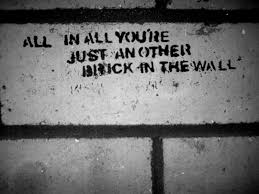


Rather than frankly examining, understanding and improving teacher intent we get professionally developed toward systematic, process orientated teaching practices that feed data into the education machine.

Students aren't the only bricks in the wall.

Thursday, 22 August 2013

Closer To Genius

I just spent a brain busting three days wandering around Amsterdam.  It was my first time there, and like all travel to new places it pushed my thinking in a number of ways.

Mastery is hard work
The Van Gogh Museum is one of those must visit places while in Amsterdam.  The main thrust of the current display is his development as an artist.  This has strong undercurrents for anyone in education, teacher or learner.

Like all original thinkers, Van Gogh didn't suddenly wake up one morning full of genius.  Genius is often presented to us as an unattainable brilliance, something normals can look at with wonder and awe.  There is a hidden assumption of a magic, genetic advantage in this presentation of genius, but it isn't true.

Vincent's early career was full of formal and informal learning opportunities that he took and walked away from.  His early work is rough, even poor, but he improved with practice. Van Gogh learned what he needed to learn and then moved on, usually completely out of sync with whatever the curriculum or his classmates were doing - it was a self directed curriculum.  I imagine he was a failure in every way on his report cards.  However formal education helped or hindered him Vincent moved on, a self-directed learner voracious for an opportunity to learn more about his craft.

Self directed learning is a key aspect of mastery.  Walter Gretzky once responded to a reporter who described Wayne as a natural born talent.  He said this was nonsense.  Before school every day, rain or shine, Wayne would be out with a hockey stick in hand.  Every day after school until it got dark he'd be out with a stick in hand; mastery is never a gift.

Any talent you'\re born with isn't mastery, it's probably something simple, like being ambidextrous.  Real craft mastery is only earned through the old adage: blood, sweat and tears.

The only thing that people like Van Gogh, Gretzky or Einstein bring to their mastery naturally is a fascination, an inborn love of their area of study.  That atypical fixation allows (forces?) them to ignore just about everything else in order to hone their craft in a way that the typical, disinterested, distracted, minimally engaged human being never will.

It's vogue these days to assume that everyone is a genius is some way, they just have to find out what it is.  After visiting Vincent's museum and immersing myself in his work for a few hours I couldn't help but think that true genius is something well beyond what most people are capable of.  Most people don't have the will power or focus to master simple skills (driving, reading, writing) let alone the relentless drive to open up new areas of human endeavor.  Real genius also leads to emotional crisis and a ghettoization of the person struck by it; others find your obsessive fixation frightening.  That so many geniuses suffer the fate that Vincent did isn't a surprise.  That we admire genius from a safe distance isn't a surprise.

What I did take from Vincent's development as an artist is that his mastery was a function of an unyielding and constant development of his skill.  If you want to develop mastery in anything, anything at all, a genuine relationship with your craft is what you want to cultivate.  If you're able to nurture and maintain that intimacy with your craft you'll find mastery.

The trick, if you're not a natural obsessive, is not to fall out of love with what you're learning.

In a classroom, demonstrating a genuine affection for the material you're teaching and encouraging this in students might be the closest many of us ever come to genius.  It's a shame that education doesn't recognize a love of a subject in learners and teachers alike.  We make gestures towards the lifelong learner but do nothing to acknowledge its presence in students or teachers.  A living fascination with your learning is the surest path to the most effective, most enthralling kind of education (and life) you could hope for, and, as Vincent will tell you, the only road to mastery.


Note:
I was in Amsterdam after returning my Mum's ashes home.  Her suicide was on my mind as I wandered through Vincent's work.  She too was an artist, a talented one, and her work often consumed her.  I'm still not sure whether to take Van Gogh's meandering trip into madness as a warning or a comfort.  In the end we all die, it would be nice to think that our fixations, though they may eventually claim us, would also allow us to create some beauty to be left behind in the world.

Saturday, 11 May 2013

Edcamp Hamilton: Let It Flow

I attended edcamp Hamilton this past weekend.  It was my first cross country trip on my newly minted motorbike license as well as a chance to meet and self direct my professional development with colleagues from beyond my own board.  I got there heavily oxygenated and cold; the Starbucks on tap helped warm me up and then we were into sessions that the edcampers themselves suggested.

With over 140 people interested in education showing up on a Saturday morning just to talk shop, it was a busy, energizing affair.  The first session I attended started off a bit stiff, but quickly loosened up as the bar was raised on the pedagogical reflection.  Peter Skillen pitched some critical thinking on technology use in learning, and it wasn't all the gee-wiz thinking from a few years ago.  We are such chameleons in our ability to change ourselves to fit our technology.  Peter asked some hard questions about how we're making students connect to technology.  Educational technology seems to have reached a stage of maturity where we can ask hard questions about it.  Jane Mitchinson also brought up the idea of multi-tasking (or more accurately, rapid task switching) in terms of the information overflow students face when using digital tools.  Getting information from the internet is like drinking from a fire hose  you'll get a face full, and it won't be graceful or particularly useful.  Learning how to use these tools is something we're still not very good at.  As an opening discussion it got everyone moving and for the newer edcampers it got them realizing how a single person isn't running any of the sessions; this is a truly an open, democratic process.  It can't be directed.

An awful lot of people meeting on their own time to discuss their profession,
I wonder how many politicians do that.
I got restless in the seconds session because it seemed to belabor a point that wasn't going anywhere.  After listening to a bit of talk around how to keep your idealism in the current educational environment, I started getting quite negative, so I went for a wander to think about what was said and do one of the best things you can do at an edcamp - wander by rooms and stumble across awesome conversations.

In that session I left, Carlo Fusco said, "the education system was designed to sort people into jobs in order to fit them in to the new industrial model.  Education is there to sort people."  I suspect he was being Socratic and pushing an idea so that others could question it, but my cynicism knows no bounds after the past year teaching in Ontario.  Others took a stab at it before I commented that I find it impossible to remain an idealist in the current Ontario educational climate.  With unions, governments and corporations playing games with education for their own benefit, I said I find it hard to believe in anyone's best intentions.

The wandering broke up my negativity as I stumbled across wonderful, critical discussions about  gamification, online learning tools and what a twenty first century student needs to know.  One of the nicest things about an edcamp is that you want to be there (or you wouldn't be).  No one is holding you to one mode of learning or thinking.

Earlier edcamps I attended had very few people in upper administrative roles attending, it was a real grass roots movement of teachers, student teachers and onsite admin, the people who work with students directly every day.  It was nice to see more senior administrative types at edcamp Hamilton, though their predilection for telling people how they should be thinking might get in the way of what edcamps are really about.  If  asking big questions settles my value theory and allows me to do my job better, then I'll do it at an edcamp because that is where I get to direct my own professional development.  Suggesting limitations on what people should be allowed to talk about in order to promote an administrative objective strikes me a missing the point.  This has me thinking about educational leadership in a twenty first century context.  If we're moving toward more self directed, less hierarchical ways of directing PD, how does an education leader move people in the direction they want them to?  We talk about student centered learning as an ideal to move towards.  Edcamps do that for PD, but not if we're going to start drawing lines around what people can and can't talk about.

I ended the day with some very interrogative discussions with people I have fundamental disagreements with about recent events in the Ontario PLN community.  This too was great PD because it allowed me to understand their point of  view and be less reactionary to it.

The last session of the edcamp still had larger groups meeting, but many smaller groups spun off and talked about what they needed to.  Ah, the freedom to not be told what to think; if only other PD had more of that.

I'll call #EdCampHam another excellent EdCamp experience.  Thanks to the EdcampHam organizers for a wonderfully immersive day of thinking about my profession.

Some other Ed-blogs on EdCampHamilton:
Karen
Michelle
Jane
Sue
Mark
Heidi
Stephen
Aviva