Showing posts with label professionalism. Show all posts

Friday, 23 August 2019

Simple Magic

We recently spent a day in Stratford and one of the more surprising and engaging events was a Q&A talk with two of the Festival's experienced actors.  Maev Beatty and Ben Carlson are both starring in The Front Page.  We hadn't seen the play and I was a bit worried that it'd be all about that, but it wasn't at all.  When you get two smart, capable professionals showing you inside their process, whatever their profession, it's an enlightening experience.  Here are some of the highlights that I'm still mulling over:

Adrenaline

Early on someone intimated that it must be nice only having to work 2-3 times a week for a couple of hours and I think both actors bristled at that suggestion.  One of the stresses on acting that most people wouldn't think about is the physiology of putting yourself out there in an absolute physical sense.  On an evening you're going on stage you typically start to feel that intensity in the early afternoon.  By the time you're on stage your adrenaline is peaking and, though they didn't mention it, I doubt many actors can go right to bed after performing.  Ben noted a study that showed a working actor experiences as much adrenaline as you'd feel in a car accident, times two!  He noted that if a normal person were to receive that much adrenaline at once they'd have a heart attack and die; it's a high intensity high.

There's something to be said for putting yourself out there.  It's one of the reasons I encourage my students into competition.  The heightened sense of purpose that burst of adrenaline gives you allows you to do things you might not otherwise be able to do.  Experiencing that intensity also teaches you to manage it.  This is one of the reasons why I think things like school plays, competitions and sports are so important, yet they tend to be the first thing we throw under the bus when we start to look for 'extracurriculars' to cut.  The fact that the school system calls them extracurriculars is telling in and of itself.


Controlled adrenaline meant the busy kitchen we had lunch at was churning
out dishes at a prodigious rate.  The three chefs barely said a word to each
other, and could often be seen wordlessly handing each other what they needed
just as they needed it.  Professionalism kept popping up in all sorts of places
after that morning talk.
Teaching students to take risks and manage the adrenaline that comes from it should be a vital part of any school experience, but the vast majority of students running through schools don't and the few that do tend to be the most economically advantaged ones; that's a real system failure.

Watching these two professionals, who do a job that most people would find too terrifying to imagine (me being one of them), and listening to how they deal with that terror, was fascinating.  Many people say they wish they had a job like that, an extreme job that demands all of you, but even taking the exceptional skill-sets required out of the equation, the vast majority of people couldn't take the heat of working in a kitchen like that.  For all the jealousy people feel for successful actors, musicians or athletes, most couldn't handle the intensity of a life like that.  The amount of work involved puts it beyond the reach of most, but it's the performance aspect that people don't think about.  The wear and tear on their minds and bodies is astonishing.

Failure

There were a lot of questions around how you deal with failure in theatre production, including a number of questions about how you deal with poor performers or productions, but the most telling moment, again, I suspect in response to that initial intimation that acting was an easy gig, was how they both described auditioning.

These are two of Canada's more well known actors and both are making a good living at it.  When asked if they still had to audition, they both said they did.  Ben suggested you could find the odd moment when you'd just give a hard no, but that isn't generally the place of an actor.  Actors act and to do that you audition.


Once again referring back to how a Stratford actor fills their idle days, both said it isn't uncommon for people in the troop to be on stage in up to half a dozen different plays, all of which required thousands of hours of preparation and rehearsal.  Since all actors are inherently self-employed, they also have to keep their ears to the ground in terms of possible TV and film opportunities and prepare auditions for them, which also take time and commitment.  The agonizing thing about this is that the vast majority, even if you're a well known name, end up giving you back nothing.  To the I-do-work-and-get-paid-for-it crowd, this is yet another example of why one of those dream jobs like acting isn't what you think it is.

Both Maev and Ben described weeks where they would audition almost daily and walk away empty handed.  Their experience has taught them to not take this personally (casting is alchemical and complicated and not about who is most well known).

At another point someone asked if they could create productions that suited them, but they said an obvious truth: "that's not the job of an actor."  They also mentioned that that's a good thing.  Twenty-something Ben would have told you he could do anything, but the wiser, older Ben knows now that he couldn't.  Letting directors direct and actors act is yet another of those intensity based requirements that we should consider in a classroom, but don't because we shy away from genuine experiences in favour of artificially successful ones.

I've long talked about risk aversion and modern education's almost psychotic insistence on success for everyone all the time.  Building resilience in an environment like that is nearly impossible.  Failure and our response to it is vital in everything from daily life to the grand trajectory of our lives.  Our education system is still built on the idea of passing and failing, but failing is where we learn the most and gain the least in our system.

Watching two toughened veterans of a brutal industry might make you think that they have become hardened themselves, but another repeating theme of their talk was in surviving the onslaught of theatre by working with the right people...

Working from a place of love and support

In the fiery crucible of the stage you really don't want to be doubting where the people you're in there with are coming from.  Any ideas of office politics or drama (the pedantic kind) make working in such an intense situation untenable.  Maev talked about a few productions where the people on stage were very difficult to work with due to their nastiness, but as a general rule this isn't how actors relate.

When you're displaying that kind of vulnerability on the stage you don't want to be wondering if your partner is going to throw you under the bus.  She said, and it has stuck with me, that " you want to be working with people who are coming from a place of love and support".  Even under the crushing pressure of a live stage performance with everyone OD'ed on adrenaline, knowing that your colleagues have your back is vital.

I've been in situations where the pressure has created friendships that have lasted the rest of my life.  I can only imagine the personal connection actors feel with each other after going through that glorious hell together.  Staring into the abyss but knowing the person next to you isn't going to let you down allows you to do incredible things, like create live art on stage.

That kind of empathic bonding is something else that too few students get to enjoy in school.  Once again this is a division of the haves and havenots.  The kids who have to go to work right after school never get to develop that sense of belonging whether it's on a sports team or a stage production or a technical competition, and that's a tragedy.  From that angle there is nothing extra about those extracurriculars.  There is a reason why you can't remember a single lesson from high school but those experiences are pivotal to who you are today.  We'd be insane to dismantle them and should instead be incorporating them into learning expectations for all students.  Who doesn't deserve to learn what that kind of love, belonging and support feels like?

Loving a bad character

The idea of having to act a character you hate came up along with the how do you work in a bad production or with bad people questions - there was a lot of curiosity from the audience about how things might go wrong.  The positivity and boundless optimism of the responses points to yet another difference between most people and the few who are willing to throw themselves at seemingly impossible jobs.

Ben's answer to this once again pointed to that idea of positivity overcoming seemingly insurmountable odds.  He and Maev gave several examples of characters they found so difficult that it seemed impossible to express them well.  In looking at the character, Ben said he always looks for something he can love about them and works from that.  Unlike the unwashed masses, actors can't work from a binary place of I like 'em or I don't like 'em.  This must seep out into their dealings with other people, though they didn't mention that.

This was yet another theme that paralleled my own professional experience.  I've had students who I couldn't stand, but I've always tried to operate from a place of positivity.  In getting to know them, I've always found some aspect of them that is worthy of appreciation.  It's that approach that keeps me away from the staff room where well meaning binary colleagues want to tell you what a worthless piece of shit a child is when you mention that you're teaching them for the first time.  I've never met a person so unworthy of any consideration.


Simple Magic

My glorious wife, Alanna, asked a question that had been tugging on her since our last trip to Stratford.  I commented, in my usual way, about how we are quite venerable ourselves and yet we were the youngest people in the audience by a decade or more.  In twenty years that theatre would be mostly empty.  My conclusion was that theatre is dying with this demographic.  The audience at the Q&A were of a similar demographic.

Alanna asked if theatre was evaporating before our eyes and Ben picked this up with glee.  He noted that theatre has been dying for centuries, but what always saves it is its simplicity. If you have an actor and an audience, you have theatre.  In talking it through, and this happened on many questions, both actors would think through the implications of a question out loud, he unpacked the history of theatre and came to a conclusion about how it always seems to survive its imminent demise; at its root, theatre is about people getting together.

That simple magic is what keeps theatre alive; it feeds a human need to gather together.  No number of screens, wifi or virtual presences have satisfied that need, and he noted there is some push back against the direction this has taken.  Making anonymous or even just remote comments online is nothing like the same as having a face to face encounter.  My role as a computer teacher and technician has no issue with this observation.  There is a quality in face to face human interaction that not only satisfies a deep human need, but also never be achieved through digitization, something will always be lost in translation whether through a lack of fidelity or a genuine presence and responsibility.


Theatre, like schools, libraries, concerts or sporting events, offer people something that digital experiences don't.  That complexity of presence (call in bandwidth if you want) and sense of belonging call powerfully to the human psyche.  The sense of being there is important, though our digital adolescence crops up there too with idiots on lousy cell phone cameras making terrible media instead of enjoying the moment they went to so much trouble to experience first hand.

The current drive to elearning as a cost effective way to deliver learning is yet another example of failing forward into the idea that digital experiences can replace the real world.  It's cheaper because it isn't as good.  If you consider it from a bandwidth perspective, the sheer amount of data passing between a teacher and student in even a simple face to face encounter is something digital simply can't touch.  Augment?  Assist?  Absolutely, but we replace basic human needs with poor digital equivalents at our own peril (and a multi-national's profit).   We're all poorer as a few get rich in this scenario.

That response got me thinking about how we prioritize our lives.  I'm an avid photographer, always have been, which is one of the reasons I don't have a lousy cell phone camera in my hand all the time, especially when I'm at an event.  If I take a photo, it's gonna be a good one.

Sean Penn has a great line in The Secret  Life of Walter Mitty when he's talking about being in the moment instead of trying to record it, and he's speaking about it from the perspective of a photographic artist, not some idiot with a cell phone in their hands.  These digital invasions, ironically driven by our need for digitally impoverished social contact, are eating away at our lived experience.

Simple magic is a good way to look at many aspects of modern life.  What core needs do human beings have and how have we always met them socially?  Are we meeting them as well in digital media?  Theatre is going to survive because it has more in common with genuine human need than social media ever will, and it's able to do it in a simple and direct way.  The response to Alanna's question gives me hope that one day we'll wake up from this attention economy nightmare we've immersed ourselves in.

***

I went to this initially thinking that it would be a bunch of theatre shop talk, but there was barely any (and what there was came mostly from the audience).  Instead it was an introspective and insightful talk by two talented people at the height of their powers.  Their understanding of themselves, their art and the insight it gives them into the human condition makes it a must-do for anyone who can get out to Stratford... and it's free!  It runs into October - a field trip including a talk like this  (though each is, of course, different) could change lives.

Saturday, 11 June 2016

National Skills Competition Reflection

We're back from Skills Canada's National Competition.  It was my first time as a Team Ontario coach and it was a spectacular six days in New Brunswick.  The sight seeing was frenetic and then the opening ceremonies astonishingly loud and boisterous.  To say we were revved up would be an understatement.


After a weekend waiting for competition to start we were finally able to do what we went there for (compete), except we didn't.  I'd hoped for a top half finish.  Ontario's provincial skills are much more competitive than most other province's simply because we have the biggest population and therefore the most contestants; we had to beat more people to get to Nationals.  Aiming for a top half finish didn't feel like a long shot, especially when we'd done so well in provincials (a gold medal and one of the highest technical scores in all competitions).  I fear our good provincial results meant we didn't drive at Nationals like we should have.


I prefer Bull Durham's
dissonance over the pat
just be humble quote.
There is a place for
swagger in competition
as long as it doesn't blind
you to what you need to do
You need a bit of arrogance when you walk into a competition because, despite the platitudes, everyone isn't a winner, in fact the vast majority are losers.  When you dangle yourself out there in competition you need a bit of cockiness to survive the failures.  There were a steady stream of people bursting into tears and running out of the awards ceremony when they didn't medal.  Humility wasn't helping them keep their composure when they lost.  If you don't think composure in the face of failure matters you probably haven't competed much.

IT & Networking came up early and because of a screw up on the screen I'd realized we hadn't medaled before they actually made the announcement.  In that moment all that hope evaporated and I was struggling with disappointment.  As a coach, I felt protective of my student who wasn't happy with the result but didn't run out of the room in tears.  Since we were announced so early we had another hour and half to sit there watching others succeed.  It certainly set a reflective mood.

Our approach to Skills all along has been one of the long game.  Each competitor returns and brain dumps everything they can remember into a document that we can use to prepare better next time.  Our current competitors are often able to get in touch with alumni (the benefits of a small town) and get additional support and advice.  That'll happen with our first go at Nationals as well, so when we get there next time we won't be going in blind.  The three who did medal in this national competition had all been there and seen the scope of competition before.  Knowing what to expect is a key to success.

But there is another side to this that I need to consider beyond the long game.  I was very hands off with training my competitor after our successful provincial run.  He asked questions about subnetting and IPv6, and I provided him with material on it, but didn't follow up to see if he'd looked at it.  He hadn't.  I'd assumed he'd grabbed this opportunity with both hands and put his training into overdrive, but end of year distractions and a very successful provincial run had shifted him to glide.  After a long, exhausting first day of competition we were both sitting there going over material that should have been second nature instead of resting up for day two.  At that point hope replaced confidence for me.  I hate depending on hope.

I'm a big believer in students, especially seniors and even more especially competitors, being self driven.  I have no interest in hand puppeting students to a win, I want them to feel like it's their's because they are the prime movers in their own skills development.  I don't believe in moulding students in the likeness of my own learning, I want them to internalize it in their own most effective manner.  My job is to do backflips in the background making sure they have the information and tools they need to efficiently and effectively develop their own skills.

High school seniors on the verge of post secondary work in technology should have a developed sense of professionalism as a part of their skills formation, which means not off-loading blame when you fail, and taking on responsibility for fine-tuning your own expertise (I drive this home in class constantly).  Because these things didn't happen I'm at peace with losing - we didn't deserve the win - though it still irks me and has me wondering what I could have done differently.

Another reflective piece for me was remembering all of the curriculum I ditch in order to serve the relatively digitally illiterate students I get in computer technoology.  As we were going over subnetting I remembered how doing this used to be second nature for me as a technician, but I can barely get basic IP addressing across to the majority of my students let alone binary subnetting.  Dumbing down curriculum might make my program more palatable, but it didn't help us get ready to compete at Nationals.  That one's entirely on me.  If this experience means I'm not shying away from expected curriculum in the future, it might cripple my program's ability to take in the digital dilettantes and guidance refugees I'm expected to serve, but at least we won't get pwned again in competition.

When the lights come up and judgement begins, you don't want
to be hoping you might squeeze out a medal after missing
questions and going in unprepared.  Hope isn't how you win.
After losing for years (see below) and putting a good face on it (I don't like losing, I'm competitive by nature), I suddenly found myself, on only my third attempt, on Team Ontario, coaching my strongest Information Technology student yet.  That we didn't perform like we could have is the most disappointing part of this experience for me.

I don't care if questions are repeated so students who have been there before have an advantage, I don't care if the environment they put us in seemed intentionally designed to produce poor results (we were placed between an amplified loud speaker job presentation and millwrights hammering metal and running power tools) because everyone had to suffer through it.  What I do care about is approaching Nationals with a self-driven, professional mind-set, and I think that's what I'll focus on next time around.  Not shying away from complex material in my courses and keeping a focus on being properly prepared will help my competitors to do more than hope for a medal.  The valuable information we gathered this year on how Nationals are scoped means we're not going in blind next time either.


Losing for Years...
I stopped coaching soccer at my high school after a number of years because it was a constant hassle trying to get players out to practice (the fact that our talent pool was desperately shallow and we lost almost every game wouldn't have shaken me off like indifference did).  The time the student players decided (after losing another game) to just not show up at 7am the next day for the practice time they told me they had to have broke it for me.  I'd paid for daycare, put my own child into it at 6:30 in the morning and was standing there alone on the pitch in the pre-dawn light when I decided I'm done volunteering for this kind of abuse.  I'm glad I was able to find Skills Ontario/Canada as an outlet for competition that also helps improve my own program.

Sunday, 20 March 2016

The Professional

When an under funded amateur produces better results than professionals,
it calls into question the idea of where we find excellence.
I recently watched an interesting film on the Dakar Rally. In this film a skilled amateur takes on the most challenging endurance race in the world. Most competitors in this race are corporately funded professionals with teams of mechanics and loads of extra equipment, all designed to mitigate failure and ensure the success of the brand they represent. By contrast this guy struggled to find enough money to go, found a second hand motorcycle and proceeded to complete a race that many of those funded, enabled professionals did not. It got me thinking about where we find human excellence. I suspect it isn't behind a professional pay-cheque.

The Blanchard quote in the picture above notes the difference between curiosity driven experience and results driven experience.  Curiosity might get you started, but at some point you're probably going to want to judge your skills by harsher criteria than merely whether or not you feel like doing it.  Competition does this, but it does it in a very binary fashion producing as many winners as it does losers, especially in sports.

The professional athletes who perform in that binary competitive environment are often trotted out as examples of excellence.  When someone has a certain inclination everyone else gets quite excited by their talent, more so if it appears easy for them.  When a particularly coordinated young person shows an affinity for a sport they tend to get an awful lot of support even though the vast majority of them will never earn a penny playing it.


The few who break into the moneyed world of professional athletics tend to be so specialized, supported and hyped that their being there is more a matter of investment than it is of skill.  Moneyball does a good job of revealing this hype.  A draft pick with buzz can leverage ridiculous sums of money even though their fundamental skills (as show in statistics) are suspect.  Like most human activities, it's what others think about you rather than what you are that matters.

I often wonder where professional athletes fell in society at any other time in history.  Within the confines of a carefully constructed game that they are ridiculously compensated for they are highly motivated and virtually infallible, but in more open ended, rigorous situations without the support and confined success criteria where would they be?

Games themselves are crafted to reduce chance and focus on very specific skills.  The less chance the better, really. Professional athletes are the people with natural reflexes and strength who are best able to thrive in that very restricted and focused environment.  We admire their commitment, but it's a very blinkered existence that they live.


You hang on, no matter what, even when you shouldn't
Watching something like the Dakar Rally puts the limited nature of most professional sports into context.  It is typical for more than half the competitors not to finish the race at all.  An average of two people die in the event each time it is run.  Attempting to do this race, even with full sponsorship, the latest equipment and years of training, is dangerous.  Trying to complete the race on a shoestring budget, alone, with second hand parts seems mad, but Dream Racer points to an aspect of human excellence we really don't see in professional athletes.

At the end of the film the rider is in tears.  He is exhausted, battered and elated.  He has finished this gruelling race, but he has done something that dozens of fully supported professionals could not.  I find something like this a much better example of human potential than a win by a group of wickedly overpaid specialists versus another group of wickedly overpaid, myopic specialists.

Our societal love of professional athletes has wormed its way into the classroom as well.  We limit learning to clearly defined criteria and limit chance whenever possible.  We praise those students who find school easy whether it be through socio-economic advantage, family circumstance or natural ability.  With BYOD we encourage sponsorship of advantaged students and then praise their superiority over others (attend any graduation ceremony and enjoy the litany of awards all going to the same students).  We don't value effort or imagination over defined results and we glorify instruction that emphasizes clarity and limited outcomes over non-linear, discovery based, often unexpected learning.  Bafflingly, we don't rate learning itself, we rate static achievement.  The student who learns more and improves the most is inferior to the student who already knew the material and put in half an effort but scored higher on tests.

The professional student, like the professional athlete, is a myopic specialist who excels at a very limited set of skills.  Beyond the walls of a classroom those good-student habits won't get them far in a world that demands resiliency, creativity and agility.  The most successful student is what we are trying to produce, and that student, like a professional athlete, trains exclusively in a specific set of skills in order to hit restricted, carefully defined outcomes.

Maybe that's why watching something like Dream Racer resonated with me.  It was a man battling real-world limitations to enter a challenging competition that offers failure as the likely outcome.  When he achieves success in spite of everything against him, I got teary too.  Too bad we can't offer failure as a likely option any more in the classroom.  It would make success that much sweeter and produce students who are genuinely proud of their accomplishments.

Tuesday, 8 December 2015

Professionalism: it's more than skin deep

Head's meetings give me a chance to think without constantly having to juggle the needs of dozens of students at once.  Our most recent one had us developing a school mission statement.  The idea was that if staff develop the mission they'll be more likely to back it.  It was an agonizing process of planning by committee, but we got it done.

In the process of developing this statement one of the more golden heads suggested that focusing on the dress code would reinvigorate a sense of professionalism in the staff.  I don't entirely disagree, dressing appropriately does help present a sense of professionalism, but thinking that an enforced dress code will somehow improve professionalism in staff had me thinking about what is involved in a teacher's sense of professionalism.


Visual cues like dress codes felt like the crust of something much more complicated, so I went to work on an orange.

If you want a sense of a teacher's professionalism start with their qualifications.  Do they have advanced qualifications (honours, post-graduate, master-technical, etc) in the subject areas that they teach?  

Have they expanded their teacher training from what they graduated teacher's college with?  Do they demonstrate the kind of life long learning they claim is so important in their students?

Are they attending subject specific PD to improve their ability to teach this material in the most current and comprehensive manner possible?  Do they create curriculum?  Serve on their subject council?  Work to improve learning in their subject area in other ways?

Have they developed a diverse personal learning network (this doesn't necessarily have to be digital).  Are they known in their school, in their board, in their province, in their country, in their world, as a collaborative and supportive colleague?  Do they encourage growth in learning?  Do they interact with other educators to improve their craft?


Have they taken on school leadership roles?  Are they known in the school as a dependable fixer?  A colleague who puts the needs of the school before their own?   Do they work in other aspects of the school?  Student competitions?  Sports?  Clubs?  School events?  Academic initiatives?

Have they ever supported the organization that protects their profession?  Volunteering for union work says a lot about how much a professional is willing to put themselves out to protect their profession.  It also demonstrates a sense of belonging to that profession.

There is probably much more you could put into the orange, but these many things are what feed the skin of the orange (the appearance of the teacher).  Dress codes and appearance do matter, but professionalism is much more than skin deep.

***

At its root professionalism is a self driven desire to improve one's field of work.  Being self driven is the key to professionalism and the major difference between an employee and a professional.  The professional takes their work to heart and self-identifies with how they are doing it, an employee just does what they are paid for and no more.   Employees require direction.  Professionals are self directed. Unfortunately, I know a fair number of teachers who approach teaching as an employee.  If you want to resurrect teacher professionalism it doesn't mean ties for all, it means getting those disaffected employees to approach their profession with a sense of authorship.


... unless you play for Newcastle
The other morning I was watching Premier League Football and heard about how Newcastle has hired an motivational speaker for its players.  The millionaire players who never had to grow up and get paid more per week to play a game than I make in a year need motivation?  This speaks to professionalism in a big way.  Having been coddled and paid ludicrous sums of money since they were teenagers, many of these players have no idea how good they have it playing a game that the rest of us pay to play for leisure.  Can you be a professional without a profound appreciation of the importance of the work that you do?  This situation does point to a key element of professionalism:  an unwavering commitment to your profession and a willingness to seek constant improvement.  You're not a professional unless you're always on the clock, always ready to perform beyond minimal expectations.

A doctor doesn't get to say she's on holiday when someone has a heart attack on the beach where they happen to be vacationing.  It is professionalism that drives her to say that she is a doctor and perform her duty.  When you see Mike Holmes losing his mind about poor craftsmanship in a home reno you're seeing a man railing against a lack of professionalism.  When Newcastle has to hire a motivational speaker to convince its millionaire players to do their job, you're looking at a deep lack of professionalism.

Professionalism seems to germinate in people where the work they are doing is valued, valuable and challenging.  The professional becomes attached to their profession, self-identifying with it and authoring their approach to it.

Professionalism isn't conformity, it's empowerment.  Many workplaces use the word professionalism while offering staff no opportunity to critically assess and improve their process.  In such dictated working environments professionalism is a catch phrase for doing what you're told promptly and without question (ie: being manageable).  These workplaces have a strange democratic flatness to them - we're all professionals here at Xmart!  Perhaps this is why professionalism is so confused in the modern mind - we have a misplaced idea of what it is.

Out of high school I became I millwright's apprentice.  One of my mentors, Leo, was an older Caribbean gentleman who was incapable of sugar coating things, though his honesty was presented with a Jamaican easy-goingness that made it easy to listen to.  One day he told me the story of our department supervisor.  This was the guy who used to take night shifts and then roll himself under a truck and fall asleep for hours.  He had one of the worst work records in the shop and was known for being the guy you shouldn't go to see if you were having technical problems.  He got promoted off the floor to minimize the damage he was doing there.  Leo looked me in the eye and said, 'that's what most management is.  If they were good at something, they'd still be doing it.'  I've tended to approach management with a suspect eye ever since.

Leo was proud of his mechanical skills, he was a master of his trade.  He took great pains to perform his job at the highest level and continually looked for challenges to grow his skill and knowledge.  That one of the most impactful mentors I've ever had wore coveralls while the clown running the department showed up in shirt and tie every day has meant I've always preferred to see what people do rather than what they look like before I start to form an opinion about their sense of professionalism.

Between the smoke and mirrors business-appearance sense of professionalism and the demonstrated excellence of the true professional there is a lot of social static.  Things are further complicated by organizations eager to use the term professionalism as an adjective to encourage compliance and conformity to corporate norms, but for professionalism to germinate the person doing the work has to have control over their approach to the work - and germination is indeed the process.  You can't force professionalism with a dress code.  What you can do is create a fertile environment where people are engaged in their work.  Where the work is challenging and complex enough that it makes demands on the worker to continuously develop their own approaches to it rather than being managed into a conformed response.  Systematized work environments are the death of professionalism.

In spite of the business blah blah that greets you when you look up professionalism, there isn't a single, regimented pathway to it unless you're in business where your can-do attitude and proper attire matters more than any specialized skills you may have.  Professionalism blooms out of expertise and works in service to it.  Some of the best teachers I've ever had wore overalls, many of the worst wore suits.  Appearance can be as much a distraction as it can be an indicator of professionalism (unless you're in business).


NOTES  

True Colours offers some real insights into personality types.  Being a green / blue I'm not beholden to social expectations or image.  The Gold who suggested adhering to dress codes is though.  Where she thinks that professionalism can be generated by dressing nicely, I've experienced the opposite.  I try to keep this in mind when I hear someone suggest something that I have an immediate negative reaction to.  What works for them might work for them...


Sunday, 19 April 2015

What is Professionalism?

A long, contemplative ride
on the road less travelled to
self directed PD.
I attended Edcamp Hamilton this past weekend.  On a Saturday morning what did almost one hundred teachers and administrators do on the eve of a strike?  They spent their own time and money to travel to Ancaster to direct their own professional development.

Discussions ranged from technology integration to how to most effectively assess student learning (along with dozens of other topics).  What is magical about the edcamp experience is that teachers direct their own research and reflection.  There is no top down directive or education consultant being paid to sell an idea.  No one is paid to be there, no one is expected to be there, yet the room was full at 8:30 on a Saturday morning.

I've long thought that self-direction is the key element in professional development.  I'd actually argue that PD isn't PD unless it is self directed.  When you're sat in a room being indoctrinated by a talking head it isn't professional or development, it would be better described as mediocre training.  Lecturing a group of people implies that they lack knowledge and need to be informed.  It implies that they aren't professionals but unskilled employees who need direction.

I've got PD coming up this week.  PD often involves a paid consultant earnestly exhorting you to differentiate your teaching practice, but they do it in a completely undifferentiated, university style lecture.  If student centred differentiation is what you're selling, selling it in a lecture is either incredibly lazy or ignorant.  In any case it suggests a lack of integrity.


I'm trying to work out what professionalism
is in a Prezi mindmap
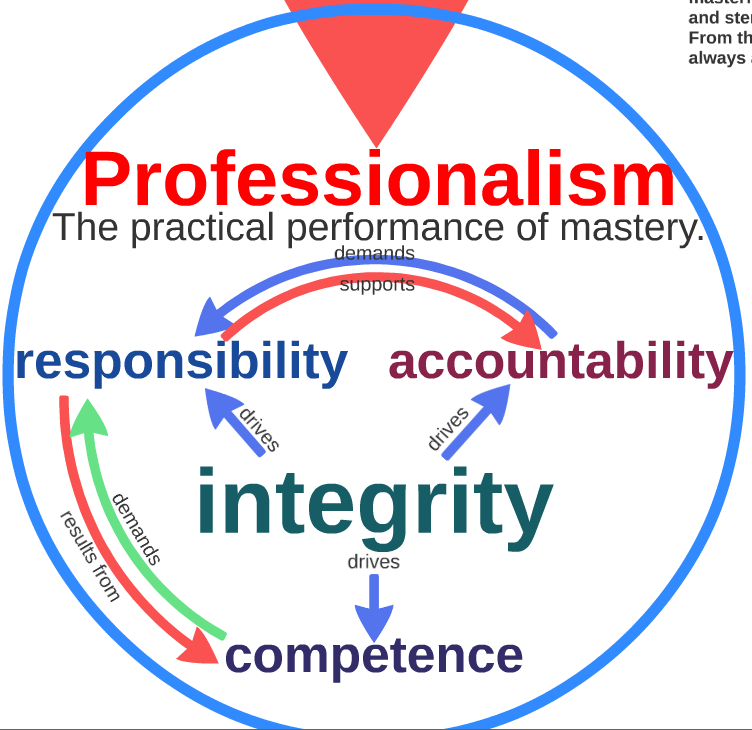
The professional is, at their core, self directed.  You don't become an expert in something without being able to self assess and improve your own practice.  Integrity should drive this self directed improvement by demanding competence.  That competence naturally creates a sense of responsibility that a professional is more than happy to be accountable for.  Self direction and the integrity that drives it creates a professionally responsible environment that accepts stringent accountability.

In order to develop professional standards, professionals need only be left to their own devices, and perhaps given the time and space by management to focus on excellence.  Edcamps encourage this kind of professional development, in fact they can't happen without it.  PLCs also facilitate professional development by leaving the professional to develop their own means of improvement.  I've been involved in learning fairs, unconferences and other teacher centred/teacher presented learning opportunities that have been invaluable as well as empowering.

The difference between a talented amateur and a professional is that the professional is committed to improvement and is thus willing to be accountable to their profession.  The professional abides by the practices and standards of their profession and actively works to raise them.  In this way a professional has a social responsibility to their profession that a dilettante doesn't, no matter how talented they might be.  The professional isn't a one trick pony who acts solely on talent, but a talented individual who begins with natural inclination and then works to develop it into a much wider skill-set that acknowledges the full complexity of their discipline.  Some secondary teachers fall into thinking that they are a subject expert before they are a teacher.  Being a subject expert isn't what they are being paid (professionally) to do, it's teaching.  Teaching is the professional practice we (especially at the secondary level) sometimes forget.

Accountability is where professional development with teachers seems to fall apart.  Management fears that if left to their own devices some teachers will not actively work to improve their professional standards.  In some cases this may in fact be true.  It would be a fairly simple task to itemize the professional development opportunities teachers pursue and account for who is attempting to improve their professional practice and who isn't, but we don't do that in teaching.


You can usually tell which teachers take time to attend to
their professional practice...
The teachers who go out of their way to attend (or speak!) at conferences, who expand their professional qualifications, who attend edcamps, or work in their subject councils, or participate in online communities, these teachers have made quantifiable efforts to improve their profession.  The teacher who rolls his eyes at another board run PD which he is only attending because he is being paid to be there is simply not professional in the same sense.  They are the ones who 'professional development' is aimed at.

Instead of only looking at years in the classroom it would be nice if we accepted that some teachers take on a more professional approach to teaching.  It would be easy enough to quantify that approach.  How many subject areas have they become qualified in?  Do they demonstrate continuous improvement?  How many self directed PD opportunities do they take?  Do they take on positions of extra responsibility? What do they do to support their subject area?  The profession of teaching in general?  Until we accept that not all teachers are created equal, we ignore both integrity and responsibility and are unable to accurately apply accountability to our profession.

Is teaching a job that requires management to take attendance and force simplistic PD down people's throats?  Evidently, in which case it isn't really a professional activity.  Is teaching a profession that demands self directed development through stringent accountability?  If it was it would be driven by teachers' professionalism rather than by attendance rolls and tell-me-don't-show-me lectures.

At the core of professional practice is the self directed development of your expertise.  I've got a PD day (the only one this semester) next Friday.  It will be interesting to see how this board run day will compare to the dynamic and responsive urgency of the edcamp I just attended.  I imagine I'll see differences in the first few moments when teachers I never see doing self-directed PD are whining about why they have to be there (because they're being paid to do it).  Then they will take attendance and the differences will only get more obvious.

Professionalism Resources:

http://www.mindtools.com/pages/article/professionalism.htm


http://www.med.uottawa.ca/students/md/professionalism/eng/about.html


#edcampham discussion suggestion
http://www.ascd.org/publications/books/100047/chapters/Professionalism,_Teacher_Efficacy,_and_Standards-Based_Education.aspx

http://education.und.edu/field-placement/files/docs/professionalism.pdf

http://www.slideshare.net/jazzmichelepasaribu/professionalism-in-education

http://www.sciencedirect.com/science/article/pii/S1877042810025498


Friday, 2 September 2011

The Mediocrity Virus


So I'm sitting there with a room full of people who have just won the bronze medal world-wide in the most recent round of 'who's got the best education system'. After years of diligent effort and insightful leadership, Canada is ranked third worldwide in educational performance, and is very close to toppling the two leaders. In every metric you care to apply, we are awesome.

We've applied differentiated instruction, we push technology as far as our budgets will let us, we professionally consider every angle that we can to improve student achievement, from student centred learning to expanding non-academic stream programming in order to meaningfully serve our entire student base.

Are there still problems? Certainly. We still have to work to get every member of our team to produce a peak performance, but this too is happening. Our professionalism, our dedication and our society's values allow us to compete at the highest level.

Into our victory celebration comes a guy from a team that didn't even make the olympics. They've suffered a precipitous drop in performance, dropping from the mid-teens (the highest they've ever been) to thirty-third over all in terms of student performance. Their teaching profession is in shambles, and their society generally views educators as over paid loafers who take summers off. Their public education system (like their prison system or their military) is being taken over by private contractors who are more focused on simplistic metrics, like their own profitability.

He tells us that we have to drastically simplify what we're doing, go back to drilling students on facts, strictly limit teachers to curriculum and install discipline back into education; this is the only way we will get them all back on a college track.  He exemplified teachers who drill their students and run their classes with a simple, military efficiency. He floated odd statistics like, students who already know a lesson will learn 400% better if they are made to repeat what they already know over again, rather than differentiating and enriching their specific learning.

He was statistics driven and awash in his country's educational expertise (almost exclusively driven from privatized schools). He suggested that we might be 'a bit ahead'.

The coach in me suggests that if your team is performing well, you keep doing what you're doing. Certainly you tweak it here or there, but when you turn in a world class performance, you don't bring in a coach from a team that didn't even make the show to give suggestions, but we did, because we're Canadian, and the one thing we have even more than an awesome education system is a giant inferiority complex with our big cousins to the south.