Showing posts with label PD. Show all posts

Tuesday, 8 December 2015

Professionalism: it's more than skin deep

Head's meetings give me a chance to think without constantly having to juggle the needs of dozens of students at once.  Our most recent one had us developing a school mission statement.  The idea was that if staff develop the mission they'll be more likely to back it.  It was an agonizing process of planning by committee, but we got it done.

In the process of developing this statement one of the more golden heads suggested that focusing on the dress code would reinvigorate a sense of professionalism in the staff.  I don't entirely disagree, dressing appropriately does help present a sense of professionalism, but thinking that an enforced dress code will somehow improve professionalism in staff had me thinking about what is involved in a teacher's sense of professionalism.


Visual cues like dress codes felt like the crust of something much more complicated, so I went to work on an orange.

If you want a sense of a teacher's professionalism start with their qualifications.  Do they have advanced qualifications (honours, post-graduate, master-technical, etc) in the subject areas that they teach?  

Have they expanded their teacher training from what they graduated teacher's college with?  Do they demonstrate the kind of life long learning they claim is so important in their students?

Are they attending subject specific PD to improve their ability to teach this material in the most current and comprehensive manner possible?  Do they create curriculum?  Serve on their subject council?  Work to improve learning in their subject area in other ways?

Have they developed a diverse personal learning network (this doesn't necessarily have to be digital).  Are they known in their school, in their board, in their province, in their country, in their world, as a collaborative and supportive colleague?  Do they encourage growth in learning?  Do they interact with other educators to improve their craft?


Have they taken on school leadership roles?  Are they known in the school as a dependable fixer?  A colleague who puts the needs of the school before their own?   Do they work in other aspects of the school?  Student competitions?  Sports?  Clubs?  School events?  Academic initiatives?

Have they ever supported the organization that protects their profession?  Volunteering for union work says a lot about how much a professional is willing to put themselves out to protect their profession.  It also demonstrates a sense of belonging to that profession.

There is probably much more you could put into the orange, but these many things are what feed the skin of the orange (the appearance of the teacher).  Dress codes and appearance do matter, but professionalism is much more than skin deep.

***

At its root professionalism is a self driven desire to improve one's field of work.  Being self driven is the key to professionalism and the major difference between an employee and a professional.  The professional takes their work to heart and self-identifies with how they are doing it, an employee just does what they are paid for and no more.   Employees require direction.  Professionals are self directed. Unfortunately, I know a fair number of teachers who approach teaching as an employee.  If you want to resurrect teacher professionalism it doesn't mean ties for all, it means getting those disaffected employees to approach their profession with a sense of authorship.


... unless you play for Newcastle
The other morning I was watching Premier League Football and heard about how Newcastle has hired an motivational speaker for its players.  The millionaire players who never had to grow up and get paid more per week to play a game than I make in a year need motivation?  This speaks to professionalism in a big way.  Having been coddled and paid ludicrous sums of money since they were teenagers, many of these players have no idea how good they have it playing a game that the rest of us pay to play for leisure.  Can you be a professional without a profound appreciation of the importance of the work that you do?  This situation does point to a key element of professionalism:  an unwavering commitment to your profession and a willingness to seek constant improvement.  You're not a professional unless you're always on the clock, always ready to perform beyond minimal expectations.

A doctor doesn't get to say she's on holiday when someone has a heart attack on the beach where they happen to be vacationing.  It is professionalism that drives her to say that she is a doctor and perform her duty.  When you see Mike Holmes losing his mind about poor craftsmanship in a home reno you're seeing a man railing against a lack of professionalism.  When Newcastle has to hire a motivational speaker to convince its millionaire players to do their job, you're looking at a deep lack of professionalism.

Professionalism seems to germinate in people where the work they are doing is valued, valuable and challenging.  The professional becomes attached to their profession, self-identifying with it and authoring their approach to it.

Professionalism isn't conformity, it's empowerment.  Many workplaces use the word professionalism while offering staff no opportunity to critically assess and improve their process.  In such dictated working environments professionalism is a catch phrase for doing what you're told promptly and without question (ie: being manageable).  These workplaces have a strange democratic flatness to them - we're all professionals here at Xmart!  Perhaps this is why professionalism is so confused in the modern mind - we have a misplaced idea of what it is.

Out of high school I became I millwright's apprentice.  One of my mentors, Leo, was an older Caribbean gentleman who was incapable of sugar coating things, though his honesty was presented with a Jamaican easy-goingness that made it easy to listen to.  One day he told me the story of our department supervisor.  This was the guy who used to take night shifts and then roll himself under a truck and fall asleep for hours.  He had one of the worst work records in the shop and was known for being the guy you shouldn't go to see if you were having technical problems.  He got promoted off the floor to minimize the damage he was doing there.  Leo looked me in the eye and said, 'that's what most management is.  If they were good at something, they'd still be doing it.'  I've tended to approach management with a suspect eye ever since.

Leo was proud of his mechanical skills, he was a master of his trade.  He took great pains to perform his job at the highest level and continually looked for challenges to grow his skill and knowledge.  That one of the most impactful mentors I've ever had wore coveralls while the clown running the department showed up in shirt and tie every day has meant I've always preferred to see what people do rather than what they look like before I start to form an opinion about their sense of professionalism.

Between the smoke and mirrors business-appearance sense of professionalism and the demonstrated excellence of the true professional there is a lot of social static.  Things are further complicated by organizations eager to use the term professionalism as an adjective to encourage compliance and conformity to corporate norms, but for professionalism to germinate the person doing the work has to have control over their approach to the work - and germination is indeed the process.  You can't force professionalism with a dress code.  What you can do is create a fertile environment where people are engaged in their work.  Where the work is challenging and complex enough that it makes demands on the worker to continuously develop their own approaches to it rather than being managed into a conformed response.  Systematized work environments are the death of professionalism.

In spite of the business blah blah that greets you when you look up professionalism, there isn't a single, regimented pathway to it unless you're in business where your can-do attitude and proper attire matters more than any specialized skills you may have.  Professionalism blooms out of expertise and works in service to it.  Some of the best teachers I've ever had wore overalls, many of the worst wore suits.  Appearance can be as much a distraction as it can be an indicator of professionalism (unless you're in business).


NOTES  

True Colours offers some real insights into personality types.  Being a green / blue I'm not beholden to social expectations or image.  The Gold who suggested adhering to dress codes is though.  Where she thinks that professionalism can be generated by dressing nicely, I've experienced the opposite.  I try to keep this in mind when I hear someone suggest something that I have an immediate negative reaction to.  What works for them might work for them...


Sunday, 19 April 2015

What is Professionalism?

A long, contemplative ride
on the road less travelled to
self directed PD.
I attended Edcamp Hamilton this past weekend.  On a Saturday morning what did almost one hundred teachers and administrators do on the eve of a strike?  They spent their own time and money to travel to Ancaster to direct their own professional development.

Discussions ranged from technology integration to how to most effectively assess student learning (along with dozens of other topics).  What is magical about the edcamp experience is that teachers direct their own research and reflection.  There is no top down directive or education consultant being paid to sell an idea.  No one is paid to be there, no one is expected to be there, yet the room was full at 8:30 on a Saturday morning.

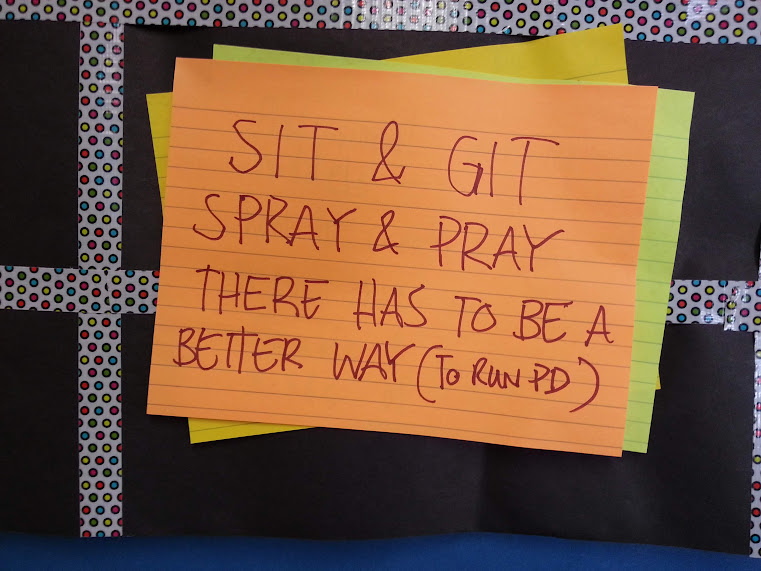
I've long thought that self-direction is the key element in professional development.  I'd actually argue that PD isn't PD unless it is self directed.  When you're sat in a room being indoctrinated by a talking head it isn't professional or development, it would be better described as mediocre training.  Lecturing a group of people implies that they lack knowledge and need to be informed.  It implies that they aren't professionals but unskilled employees who need direction.

I've got PD coming up this week.  PD often involves a paid consultant earnestly exhorting you to differentiate your teaching practice, but they do it in a completely undifferentiated, university style lecture.  If student centred differentiation is what you're selling, selling it in a lecture is either incredibly lazy or ignorant.  In any case it suggests a lack of integrity.


I'm trying to work out what professionalism
is in a Prezi mindmap
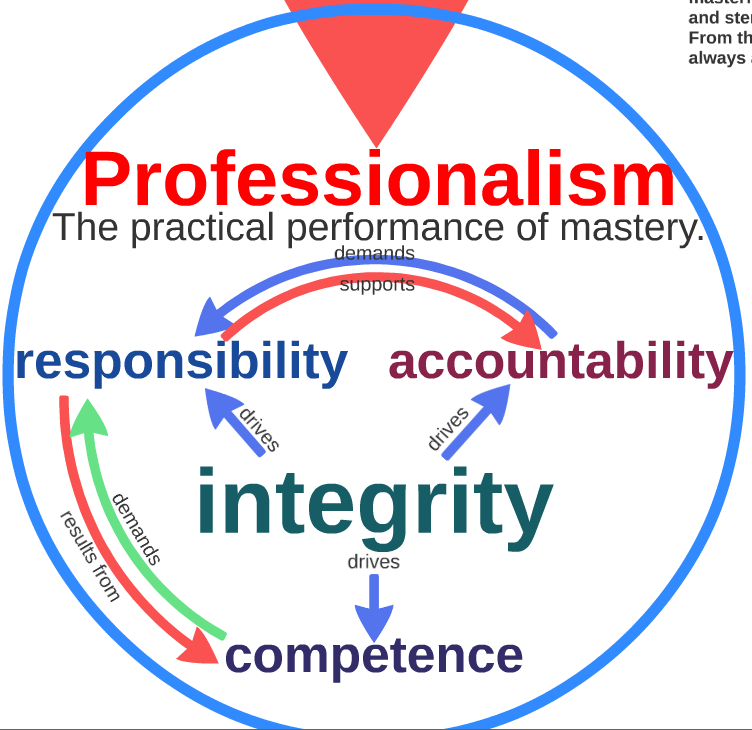
The professional is, at their core, self directed.  You don't become an expert in something without being able to self assess and improve your own practice.  Integrity should drive this self directed improvement by demanding competence.  That competence naturally creates a sense of responsibility that a professional is more than happy to be accountable for.  Self direction and the integrity that drives it creates a professionally responsible environment that accepts stringent accountability.

In order to develop professional standards, professionals need only be left to their own devices, and perhaps given the time and space by management to focus on excellence.  Edcamps encourage this kind of professional development, in fact they can't happen without it.  PLCs also facilitate professional development by leaving the professional to develop their own means of improvement.  I've been involved in learning fairs, unconferences and other teacher centred/teacher presented learning opportunities that have been invaluable as well as empowering.

The difference between a talented amateur and a professional is that the professional is committed to improvement and is thus willing to be accountable to their profession.  The professional abides by the practices and standards of their profession and actively works to raise them.  In this way a professional has a social responsibility to their profession that a dilettante doesn't, no matter how talented they might be.  The professional isn't a one trick pony who acts solely on talent, but a talented individual who begins with natural inclination and then works to develop it into a much wider skill-set that acknowledges the full complexity of their discipline.  Some secondary teachers fall into thinking that they are a subject expert before they are a teacher.  Being a subject expert isn't what they are being paid (professionally) to do, it's teaching.  Teaching is the professional practice we (especially at the secondary level) sometimes forget.

Accountability is where professional development with teachers seems to fall apart.  Management fears that if left to their own devices some teachers will not actively work to improve their professional standards.  In some cases this may in fact be true.  It would be a fairly simple task to itemize the professional development opportunities teachers pursue and account for who is attempting to improve their professional practice and who isn't, but we don't do that in teaching.


You can usually tell which teachers take time to attend to
their professional practice...
The teachers who go out of their way to attend (or speak!) at conferences, who expand their professional qualifications, who attend edcamps, or work in their subject councils, or participate in online communities, these teachers have made quantifiable efforts to improve their profession.  The teacher who rolls his eyes at another board run PD which he is only attending because he is being paid to be there is simply not professional in the same sense.  They are the ones who 'professional development' is aimed at.

Instead of only looking at years in the classroom it would be nice if we accepted that some teachers take on a more professional approach to teaching.  It would be easy enough to quantify that approach.  How many subject areas have they become qualified in?  Do they demonstrate continuous improvement?  How many self directed PD opportunities do they take?  Do they take on positions of extra responsibility? What do they do to support their subject area?  The profession of teaching in general?  Until we accept that not all teachers are created equal, we ignore both integrity and responsibility and are unable to accurately apply accountability to our profession.

Is teaching a job that requires management to take attendance and force simplistic PD down people's throats?  Evidently, in which case it isn't really a professional activity.  Is teaching a profession that demands self directed development through stringent accountability?  If it was it would be driven by teachers' professionalism rather than by attendance rolls and tell-me-don't-show-me lectures.

At the core of professional practice is the self directed development of your expertise.  I've got a PD day (the only one this semester) next Friday.  It will be interesting to see how this board run day will compare to the dynamic and responsive urgency of the edcamp I just attended.  I imagine I'll see differences in the first few moments when teachers I never see doing self-directed PD are whining about why they have to be there (because they're being paid to do it).  Then they will take attendance and the differences will only get more obvious.

Professionalism Resources:

http://www.mindtools.com/pages/article/professionalism.htm


http://www.med.uottawa.ca/students/md/professionalism/eng/about.html


#edcampham discussion suggestion
http://www.ascd.org/publications/books/100047/chapters/Professionalism,_Teacher_Efficacy,_and_Standards-Based_Education.aspx

http://education.und.edu/field-placement/files/docs/professionalism.pdf

http://www.slideshare.net/jazzmichelepasaribu/professionalism-in-education

http://www.sciencedirect.com/science/article/pii/S1877042810025498


Saturday, 11 May 2013

Edcamp Hamilton: Let It Flow

I attended edcamp Hamilton this past weekend.  It was my first cross country trip on my newly minted motorbike license as well as a chance to meet and self direct my professional development with colleagues from beyond my own board.  I got there heavily oxygenated and cold; the Starbucks on tap helped warm me up and then we were into sessions that the edcampers themselves suggested.

With over 140 people interested in education showing up on a Saturday morning just to talk shop, it was a busy, energizing affair.  The first session I attended started off a bit stiff, but quickly loosened up as the bar was raised on the pedagogical reflection.  Peter Skillen pitched some critical thinking on technology use in learning, and it wasn't all the gee-wiz thinking from a few years ago.  We are such chameleons in our ability to change ourselves to fit our technology.  Peter asked some hard questions about how we're making students connect to technology.  Educational technology seems to have reached a stage of maturity where we can ask hard questions about it.  Jane Mitchinson also brought up the idea of multi-tasking (or more accurately, rapid task switching) in terms of the information overflow students face when using digital tools.  Getting information from the internet is like drinking from a fire hose  you'll get a face full, and it won't be graceful or particularly useful.  Learning how to use these tools is something we're still not very good at.  As an opening discussion it got everyone moving and for the newer edcampers it got them realizing how a single person isn't running any of the sessions; this is a truly an open, democratic process.  It can't be directed.

An awful lot of people meeting on their own time to discuss their profession,
I wonder how many politicians do that.
I got restless in the seconds session because it seemed to belabor a point that wasn't going anywhere.  After listening to a bit of talk around how to keep your idealism in the current educational environment, I started getting quite negative, so I went for a wander to think about what was said and do one of the best things you can do at an edcamp - wander by rooms and stumble across awesome conversations.

In that session I left, Carlo Fusco said, "the education system was designed to sort people into jobs in order to fit them in to the new industrial model.  Education is there to sort people."  I suspect he was being Socratic and pushing an idea so that others could question it, but my cynicism knows no bounds after the past year teaching in Ontario.  Others took a stab at it before I commented that I find it impossible to remain an idealist in the current Ontario educational climate.  With unions, governments and corporations playing games with education for their own benefit, I said I find it hard to believe in anyone's best intentions.

The wandering broke up my negativity as I stumbled across wonderful, critical discussions about  gamification, online learning tools and what a twenty first century student needs to know.  One of the nicest things about an edcamp is that you want to be there (or you wouldn't be).  No one is holding you to one mode of learning or thinking.

Earlier edcamps I attended had very few people in upper administrative roles attending, it was a real grass roots movement of teachers, student teachers and onsite admin, the people who work with students directly every day.  It was nice to see more senior administrative types at edcamp Hamilton, though their predilection for telling people how they should be thinking might get in the way of what edcamps are really about.  If  asking big questions settles my value theory and allows me to do my job better, then I'll do it at an edcamp because that is where I get to direct my own professional development.  Suggesting limitations on what people should be allowed to talk about in order to promote an administrative objective strikes me a missing the point.  This has me thinking about educational leadership in a twenty first century context.  If we're moving toward more self directed, less hierarchical ways of directing PD, how does an education leader move people in the direction they want them to?  We talk about student centered learning as an ideal to move towards.  Edcamps do that for PD, but not if we're going to start drawing lines around what people can and can't talk about.

I ended the day with some very interrogative discussions with people I have fundamental disagreements with about recent events in the Ontario PLN community.  This too was great PD because it allowed me to understand their point of  view and be less reactionary to it.

The last session of the edcamp still had larger groups meeting, but many smaller groups spun off and talked about what they needed to.  Ah, the freedom to not be told what to think; if only other PD had more of that.

I'll call #EdCampHam another excellent EdCamp experience.  Thanks to the EdcampHam organizers for a wonderfully immersive day of thinking about my profession.

Some other Ed-blogs on EdCampHamilton:
Karen
Michelle
Jane
Sue
Mark
Heidi
Stephen
Aviva

Monday, 2 April 2012

EdCamp Waterloo

My second EdCamp in the past six months, I guess I'm hooked.  EdCamp Waterloo Region was, like EdCamp Toronto, a chance to break the mold on how PD is done to us.

I volunteered before hand to do a first round session mainly because, after seeing the nerves and reticence at EdCampTO, I thought I could bring some experience to it and help it start a bit smoother.  I started off with an excerpt from a TEDtalk looking at how future technology could become more interactive and intuitive in the class room, and how we could access and present data more seamlessly while teaching.  Everyone seemed content enough to be lectured at, so I made it difficult for them.

Being an edcamper means being a good listener too, something else we've learned not to do in PD.  I made a point of listening closely to comments from the audience, and tried to reply with a question that refocused the discussion on them rather than trying to get them back to what I want them to know (standard PD protocol).  It took about 20 minutes, but they started to realize that EdCamp was all about the US, not the 'expert'.  A few of the bolder people spoke up, but by the end I think everyone in the room had said something at some point, and we went 15 minutes over.  That doesn't happen too often in PD, but then PD doesn't happen on Saturday mornings too often either (unless you've got a PLN).

About half an hour in I said, "there are no rules in EdCamp, but I'm going to make one anyway, no more hands."  It became a running joke, but the conversation began to flow after we got that nineteenth century convention of teacher control put behind us.

***

As a survival mechanism, many of us have developed the habit of, at best, being passive in PD in order to make it end sooner, or worse, have found ways to wander off in our minds while it's happening so the condescension, repetitiveness and/or latest poorly performing American EduFad which we have no interest in, doesn't make us angry.

Edcamp throws all that on its ear.  It's all about you being there.  It assumes your experiences in your profession, which are current and unique, are as valuable as an entrepreneurial guest speaker's (who hasn't been in a classroom in decades and when they were tried to get out of it as soon as they could to become a paid speaker and sell their latest book on a fad they've invented).  It assumes that teachers talking to teachers and valuing each others experiences are what professionalism and developing it are all about.

***

For me this EdCamp started with teachers showing and telling what they are doing to make the future in technology available to their students.  I then wandered into a group talk on the nature of professional development that evolved into a deeply nuanced philosophical discussion about the subtle, individually powered profession of teaching.  After lunch I watched a bit on Edmodo then finished listening to a talk on technology use across k-12 curriculum.  The last one was on how to continue EdCamp ideas beyond EdCamp.  By that point I was intellectually fried; something that doesn't happen too often in PD.  I found the focus on how to cater to the disinterested tedious, but if you don't get where it's going, you can leave!

EdCamp is, by its nature, an experimental process.  After doing a couple, I still wonder at the blocking of time, like classes.  Some of the discussions still had a lot of steam, others were ready to end (or should have earlier).  A more flexible schedule might be interesting to try.  Perhaps having spill-off areas where groups that want to finish a discussion can go would offer an out there, or having enough rooms that they aren't booked one after the other might work; built in extra time if you need it.

The other trick is to ensure that it's easy for people to slip in and out of classes.  Regular classrooms are designed around the opposite idea (keep them contained and accountable).  There were a couple of times where rooms were full enough that getting out would have been overly disruptive.  The classroom seating arrangements of rows facing a central board also cater to the sage on the stage, something EdCamps ideals don't seem thrilled with.

If you've never done an EdCamp, I highly recommend the experience.  You'll find it personal, meaningful, intense and empowering.  You'll have to break through many of those learned PD habits, but it'll be nice to let your chained inner-professional out to see the sun for the first time in years.

The only PD experience I've ever had that came close was (is) ECOO conference, which is very teacher driven as well, and Barrie Bennett's Beyond Monet workshop, which was career changing.  The vast majority of the rest feel like an infomercial admin demands that you sit through.

The next time I'm grinding my teeth as another professional presenter with a new book to hawk is telling me how I have to revolutionize my practice by doing exactly what they suggest (and nothing else, until the next book comes out), and who has been flown up to us (business class), and paid thousands of dollars that could have gone into classrooms instead, I'll think back on EdCamp and wonder why administration is so afraid to trust us with our own PD.

EdCamp Waterloo Region Twitter Doc

Sunday, 6 March 2011

Biological Education & Hot Groups

I've been to two Minds On Media events, at ECOO in October and the OELC Conference this past February. Both times I've been surprised by the response from teachers regardless of their technical prowess. Tech skills weren't the arbitrating force, curiosity was. The people who were involved in it found themselves working in their ZPD, and felt supercharged by the experience. So much of schooling involves crowd control rather than trying to get students into that zone of proximal development. So much teaching revolves around control, rather than encouraging self directed learning.

When I first attended MoM, the event reminded me of a gardener creating fertile ground, but having the sense not to micromanage the growing/learning. I suspect there is a truth in this that applies to all education. Whether you want to call it student centred or skills based or what have you, education isn't a mechanical/mathematical process, it's a biological one. Events like Minds On Media recognize this by empowering the learners (and the instructors) and giving them the freedom to move within a rich learning environment to where they think they need to be.

Most of the PD I experience exists in a mechanical process that alienates teachers and makes them resentful. This approach is used because administration is more concerned with a disciplined environment (that crowd control mentioned above) that ensures full participation even if it is entirely passive, than it is with presenting memorable content. When the learning takes a back seat to crowd control, you know the results aren't going to be pretty. In fact, they're going to look at lot like...

The other thing that's been bouncing around in my head is the idea of hot groups. I know many educators shy away from business approaches, calling them corporate and such, but this one is anything but corporate. Hot Groups recognize a fundamental truth about how people work together. In a hot group members will do work well beyond what is expected or required, simply for the joy of having it received as valuable within the group. In my own case, I recently did a hot group thing for our little cloud working group, I made a group logo and people dug it. It's an insider thing, only a few will appreciate it, but it builds team and even surprised me with a level of commitment (the fact that everyone wanted a t-shirt was what gave me the biggest buzz about it).

I've seen this happen time and again with students. As I type this I have my grade 12s putting together a network of computers using many different OSes. Some of them haven't done it before, others have, but are unfamiliar with the OSes I've provided them with (Red Hat Linux Server, Ubuntu Server, Windows Home Server, Ubuntu Desktop, Win7, XP and Vista). Listening to them talk, they are telling anecdotal stories of failed OS installs, upgrades that led to game failures due to compatibility issues and all sorts of other OS related experiences, all while working through multiple installs. This may look disorganized and inefficient, I'd argue that it's the opposite. Those students are creating context that I would not have imagined trying in a top down lesson on OS installs, and they're doing it while creating a sense of group coherence (made even more amazing when you realize that three of the ten of them in there are usually sequestered away in the autism learning class). Those guys came out of there, having installed half a dozen OSes during the period, and they'd also made this (a classic example of a hot group surprise - they were very keen to give me a copy when the class ended).

If you think that has nothing to do with what they were supposed to be doing, you're determined to force human relationships, and the learning the goes on within them into a linear, mechanical process. Those guys did many things that period that I hadn't intended, as well as most of the things I had. On aggregate, I'd suggest that they weren't limited by their teacher's knowledge of them, their own risk aversion to failure (installing unknown OSes), or a need to overly control the learning. The result is a non-judgmental, rich learning environment that encouraged creativity and constructive peer support. The team building that happened in there today will be something I can continue to develop for the rest of the semester.

If I can create that environment, I do. If a hot group grows out of it, I'm over the moon. You'll seldom experience a better teacher rush than the one you do when a hot group wows you with what you weren't expecting.