Showing posts with label digital learning. Show all posts

Wednesday, 4 February 2015

The End of Knowledge

I've just wrapped up a grade 11 university level English class.  I only tend to teach these classes once every couple of years now, so I see real differences in how academic students are evolving with technology use.

This time around we have a Google Apps for Educators system well established and I assumed academically focused students would be very handy with it.  I shouldn't assume these things.  Once again I'm surprised at how habitual digital natives are with their technology use; they know how to do the few repetitive things they use technology for very fluently, but asking them to extend that fluency to other software or hardware results in the same kind of frustration you see in anyone.  Technology use really needs to be a generally taught skill - teaching specific apps on specific hardware doesn't create real understanding of information technology.

Beyond the typical tech-incompetence that we prefer to ignore rather than resolve, there were some deeper implications to technology use that became apparent while marking the final exam.  As a general rule I encourage productive use of online information resources.  I consider a student who can meaningfully and accurately use the internet to enhance their knowledge to be in a good place academically.  I'm starting to rethink that position.

Marking these exams I was surprised at how many of the students I thought were A+ English students couldn't see the figurative implications of a fairly basic piece of satire.  This article from The Onion was included on the exam, but a frustratingly high number of students thought it was about ants.  Those that did pierce the literal barrier more often than not thought it was about the government (?) in spite of me telling them again and again that figurative meaning isn't your opinion, it's there in the text.  Less than 1/5 of the class were able to recognize the obvious references to religion and see that article as a satire about it.
Google doesn't know anything.  The confusion between
information and knowledge is now rampant.  It's
based on misunderstanding how technology works.

I'm left wondering, as I finalize grades in this class, how many students didn't so much understand Macbeth as spout internet revelations about it.  In class students would frequently answer questions from the smartphone Google search in their laps.  I once lamented, "there is no intelligence left, just high speed internet."

Perhaps the future of learning is the opposite of what it has always been.  Instead of internalizing information and creating constellations of meaning within our own minds, we only need know how to find what someone else said about it on the interwebs.  This raises some scary questions around what understanding is.  Complex ideas (like being able to see into figurative meaning in a text) aren't a matter of looking up what to say on the internet.  Skills like these are based on interrelated knowledge and practice.  If it isn't internalized (no matter how tedious digital natives may find that process), you don't know it.

That digital natives, even the really capable ones, are shying away from internalizing knowledge in favour of getting highly proficient at finding other people's thoughts online is a real problem.  General ignorance around how digital technology works allows people to say stupid things like 'Google knows everything!'  Educational technology happily exists in that ignorance, encouraging the use of technology without understanding the hows of it.  Rather than question technology use in learning using epistemology and pedagogy we try to mimic its general use in society where it is driven by market forces.  If the kids are carrying smartphones around with them everywhere, they should be in class too.  BYOD, wifi everywhere, a screen for every student; these things aren't going to necessarily increase learning; when you've got Google in your pocket you end up questioning nothing.

Learning has always demanded the internalization of information in order to form knowledge.  This was due in part to the scarcity of information in the past, but it also developed the kind of self discipline that allowed knowledgeable people to do their own research.  In our information rich world the struggle for knowledge is everything modern education is turning away from.  Student centred learning, 1:1 technology, metacognition, de-emphasis on traditional learning methods: all of this is the new normal.  What was once a demanding, internal process is turning into flat, generic, external fact regurgitation.

Digital natives live in a world of media at their finger tips.  The information revolution is, for them, an entertainment revolution where digital delivery systems create a personalized cocoon of immediate and continuous whim satisfaction. The personalization of media has created the impression that technology is there as either distraction or, at best, a shortcut to easy answers.  When all our knowledge is reduced to information we might be able to spout facts, but we understand nothing.

***

After repeatedly being told verbally and in writing that you can't have an electronic device within reach during a formal exam, one of those grade 11s had his cell phone fall out of his jacket pocket while writing.  He wasn't cheating with it, he just thought all those warnings didn't apply to him because asking him to leave his phone at the front of the room is the equivalent, in his mind, of asking him to pull off his ears.  The digital revolution is fusing itself to our bodies and our minds, and it isn't always an improvement.


Thoughts on how information becomes knowledge.  We simplify a complex process that demands focus and self discipline
when we infect human knowledge with machine fact.

Sunday, 28 September 2014

Anti-Edtech or Anti-Distraction?

Is technology in the classroom a distraction or a tool for improving learning?  The results of vastly improved student learning from technology haven't materialized, yet we continue to throw money at educational technology hoping that it will help.

A wise internet jedi recently shared an article in which a new media professor is putting an end to digital distraction in a class in which he teaches about digital distraction.  A better person to explain the assumptions we make about digital technology you'd be hard pressed to find.  He had a couple of quotes that really punched assumptions about edtech use in the face.

"Multi-taskers often think they are like gym rats, bulking up their ability to juggle tasks, when in fact they are like alcoholics, degrading their abilities through over-consumption."


"Multi-tasking is cognitively exhausting; when we do it by choice, being asked to stop can come as a welcome change."


The concept of multitasking has long been championed by the rise of the digital native crowd.  It's something we poor immigrants to this brave new world simply can't do like they can, except it isn't.  If you want to follow the science rather than the marketing, you'll find that multi-tasking is indeed a myth.  If you want to do something well, you focus on it.  That might seem like simple common sense, but you'll find a lot of digital education evangelists pushing for it anyway.

For the Luddites that want to attack computers themselves for this dilemma, he had this:

"programming, a famously arduous cognitive task, will acquaint you with stories of people falling into code-flow so deep they lose track of time, forgetting to eat or sleep. Computers are not inherent sources of distraction — they can in fact be powerful engines of focus — but latter-day versions have been designed to be, because attention is the substance which makes the whole consumer internet go."

As a philosophically minded technologist I straddle this uneasy divide between the tech-hater and the fan-boy/girl, and I like neither.  Where I see computer technology as a tool to use, many others either vilify or champion it from an emotional angle.  I struggle mightily in class to get students to stop this emotional love/hate relationship with computers that many model on the adults in their lives, but it's a simple truth when Shirky says our computers are now designed to be distractions.  If you're only going to be a user, you're going to be a loser.

Clay Shirky goes on to describe the intellect as the rider atop an elephant of emotions, desires and urges.  The rider may direct the elephant occasionally, but when the two are in conflict the elephant will usually win.  This is what happens when you put a distraction engine like the modern internet in front of a child whose rider is still working out how to direct the elephant (not that many adults are better).  No wonder I find it a continual frustration to direct students... and I'm teaching computers designed to distract!

The engagement game we play in education nowadays is based on this battle with software designed to distract.  As Shirky says, we're bringing whiteboard markers to a gun fight, and losing badly.  When we decide to get in sync with the modern world we are actually downgrading education in order to play the distraction game in the same split attention, broken thinking world that has people driving into each other.

Educational IT should be the leading edge, designed to vary student access to digital technology in order to promote pedagogy at every step.  What it shouldn't be is what it is, a hand-me-down variety of the very software and hardware that is causing the problem in the first place.  This realization puts concepts like BYOD, tech-branded education and open internet access in a very awkward place if you want to champion learning over engagement, though I get the sense that engagement has infected educational management much as it has everything else.


This infected thinking, the kind that has monetized the internet and made a generation of software engineers billionaires, demands constant human attention.  When everything touched by technological integration gets infected with the idea of deep psychological engagement, people in the world become little more than variables in an economic equation.

Education is now just another enabler in a digital distraction  end game that is infecting society as a whole.

Sunday, 21 September 2014

Gaming Everything

Via NBCnews: the glory of the hardcore video gamer.  Not
 the kind of thing that's ever going to challenge the Olympics

for public attention I think.
I've had a lot of trouble playing video games lately.  My problem seems to be around that idea of scripted experience.  If I'm playing a video game I'm working through a narrative someone else created.  I enjoy narratives but what irks me about video games is they pretend to have an element of choice in them when in fact they don't.  They suggest that they are the next evolution in entertainment but the interactivity they offer is so limited that it's really just a hidden script that you follow under the illusion of choice.  Gamification in general seeks to use this illusion to hook people into otherwise tedious situations.

The first step away from video gaming occurred when I found I couldn't get into single player games anymore.  Even the good ones with epic narratives felt banal.  I went to multi-player games for several years hoping that the human element would create choice, but I find that these too are scripted, and worse, they force players into scripted responses to the point where you can't tell the players from the bots.  When a game is so restrictive that it makes the people in it act like machines it's not a game I care to play.

There is a particular situation in which we're happy to turn people into bots if the illusion of engagement is preserved.  That situation also happens to be seen as quite tedious by many of its participants.  Education is eager to digitize if it ensures engagement, even if that engagement mimics the dimensionless engagement found in online activity.  Standardized testing feeds this thinking, producing learning outcomes that are easily quantifiable as data even as they fail to demonstrate learning.  Deep contextual human activities (like learning) are lost in simplistic digital data.

Doubt is cast on an individual teachers' ability to teach a subject.  Consistency is demanded in modern education as a result of this doubt and the slippery nature of digital information encourages this by eroding the space between classrooms and lessons.  This is shown as some kind of great step forward in terms of fairness, but what it really does is reduce teaching (as it has done with many other human activities) to a vapid exchange of information, incidentally, what digital machines do best. 

We fill in templates, teach centralized material and are encouraged to sync how we teach it.  Proof of success is found in standardized test scores.  There is little interest in assessing teaching or learning in any other way.

This digital infection also carries the parasitic idea of gamification, usually championed by video game evangelists who believe that the structure of gaming can overcome every obstacle.  Teachers are encouraged to design student success through scripted outcomes, pretty much like a video game does.  If the game you're playing is designed to have you eventually win, it isn't much of a challenge, and certainly isn't something you can be proud of, but then modern learning isn't about challenge, it's about engagement.  The idea of gamification makes me uneasy for this very reason.  When we gamify situations that aren't games I'm afraid that we pollute complex situations with the implied success found in most gaming outcomes.  If education is supposed to prepare students for the world beyond school, this isn't going to do it.


When you're gaming everything, you've lost the ability to
immerse yourself in anything.
If you offer open ended, 'real' experience many digital natives shy away from a situation where the rules can't be gamed for advantage.  The hacking mindset implies that the system is more important than the content.  Perhaps that is why I can't play video games anymore.  It's hard to get lost in a narrative when you're constantly looking at ways to subvert the delivery method.

Wilful suspension of disbelief is lost in the digital age.  This is the root of the pessimism and disengagement you see in many students.  When education becomes another process you hack to guaranty your own success, it becomes increasingly impossible to do anything useful with it.

This grew out of Scripted Lives which itself grew out of Unscripted Moments.  I'm pulling at a lot of threads here.  I've been a fan of RPGs since I got into D&D when I was 10.  I love sports and would describe myself as a serious gamer.  I've spent most of my life learning digital technology, so I'd hardly call myself a tech-hater either, but watching digital technology and gamification aiming for society wide acceptance has made me very uneasy.

Scripted Lives

I've been mulling this over on the motorcycle side of things, but the idea runs throughout modern digital life, so I'm going to open it up further here.


Being a computer technology teacher I have a passing acquaintance with software.  I'd even say I'm pretty handy with it, but I don't really like where it's going since it has become an integrated part of modern life.

Since we started carrying networked computers around with us we have become scripted creatures.  Our devices wake us up, tell us what we're doing, and how to get where we're going.  They remove doubts and make memory redundant.  We no longer guess at unknown information, or watch media by accident.  We live in a walled garden of playlists and information at our fingertips, surprises seldom happen.  Technology gives us access to information and media, as well as allowing us to communicate, but it changes how we do it; the medium is indeed the message.

When we connect to The Network we are operating within a script, quite literally, all the time.  Software scripts dictate what we see, how we see it, and how we express ourselves. Complex human relationships are being reduced to scripted simplicity dictated by technological limitations rather than the full range of human ability.  This restriction has begun to redefine what people are capable of doing.

I struggle to find non-scripted moments when software isn't dictating my responses.  You'd think this only happens when you make a choice to connect on a device, but it happens constantly in the world of action.  I can't stop my car in heavy snow as quickly because a computer steps in to keep the wheels spinning, even when I'm making a conscious choice to lock them.  Scripts are written for the largest possible population.  We're all being held to the outcomes of average thinking.

As Kenneth Clark states in Civilisation:
35:36: The obvious: "...our increasing reliance on machines. They have really ceased to be tools and have begun to give us directions..."
... and that was his angle on things in 1969.  Things have come a long way since.  Our brave new world of technology is levelling everyone off.  Individual ability doesn't matter when we are all just variables in an equation.

Students experience education, entertainment and interpersonal relationships through a digital lens whose singular intent is that of continued engagement.  When your world is housed within a simplistic digital process designed to constantly get your attention you have a lot of trouble dealing with your irrelevance in the real world.


How can you do that? They say, it's so dangerous, they say.
Fear driven risk reduction is a big part of why the scripted
world exists.  It's thinking pushed by actuarial accountants.
It isn't real if it's designed to be unfailable, if there is no risk.. 
When prompted into unscripted situations where I am asking them to critically analyze a piece of media, students long for a Google search to tell them what to think.  When given a opportunity to express themselves many students will leap into the same template to organize other people's material they copy off the internet.  When given a stochastic engineering problem with no clear, linear resolution they freeze up and long to return to scripted experience.

Technology is such an enabler, but it's also limited by its capabilities.  If friendship is now understood through the lens of social media then it isn't what it once was, it's less with more people.  More isn't necessarily better even though we're told that it is more efficient.  If communication with a student is primarily through screens then teaching isn't what it once was, it's more information with less learning.  Both friendship and teaching pre-date digital communication and have deep, nuanced social histories, but we are happy to simplify them into oblivion for convenience and the illusion of efficiency.

If you ever find yourself struggling against invisible limitations, fighting to express yourself but finding it increasingly difficult, you're up against this reductive technology.  That freedom of choice you feel when you put aside the digital and reclaim your full range of sense and capability is intoxicating.  It supercharges your mind and allows you to retain your humanity.  That I see so few people having those moments is a real cause for concern.


My son and I searching the tidal pools at Pacific Rim National Park on the edge of the world.  Carefully selected technology (a motorbike - so no digital distractions and out in the world) got us there, and then we put it all down and got lost in the world with no scripts telling us how to interact with it.  When was the last time you were unplugged?

This was such a complicated idea it spawned a number of others, including these thoughts of gamification.  The wise Skillen of the internet also shared this article on distraction prevention by a new media professor, which led to thoughts on distraction.

Tuesday, 8 April 2014

Hack The Future

Between questions of how student data is being used and technology monopolists pushing for standardization in edtech, I'm left with an uneasy feeling.  As we reach a tipping point in digital educational technology we simplify and standardize to the point where the people doing the teaching don't know or care what happens behind the curtain.  What is happening behind that curtain is being decided in closed rooms between multi-national corporations and governments.  The bait is a 'free' digital learning system for education.  The payoff is habituated users and data mining on a level unprecedented in history, and we're happy to sell our students and ourselves into it in order to get the freebies.

If this were all happening in the light of day I'd be a lot happier about it.  That it's happening behind closed doors and shouldn't be publicized is something that should concern everyone.

If you're not paying for it you're the product being sold.  Corporations may state that they do no evil but they aren't after what education is after, they are after profit.  That student information is being brokered well beyond the reach of educational institutions by these information merchants should be a cause of concern, but instead I see public educators increasingly branding themselves with corporate logos and shouting their evangelism from the social media rooftops.

Technology is exciting, and digital technology is such an intimate thing because it nestles up to our minds.  Our habit of elastically coupling with our technology suggests that digital-tech is going to become an intrinsic part of how we see ourselves.  People are already describing unplugging as feeling like an amputism, it's only going to become more entwined, especially as we begin to wear our digital selves.

I'm reminded of Kenneth Clark's unsettling end to what many consider to be the best documentary series ever created, Civilisation...
Start at 35:30 if the link doesn't take you right there.

That one of the most intelligent observers of human society was pondering this in the year I was born lurks in the back of my mind.  Machines that make decisions for us, many educators seem thrilled with this idea.  You may be all gungho over the latest shiny i-thing or googly-eyed over that app that will revolutionize your teaching, but the true costs of these things are a carefully kept secret.  At the very least, when we adopt a single digital ecosystem (no matter how free it is), we're selling our students (and our own) habitual technology use into a closed environment.

As educators it should be a goal to recognize tools in terms of what they can do rather than how easy they are and how well integrated they come.  And we should never be deciding on a tool that inserts itself into the learning process based on how little we're expected to learn about it.  Technology and the internet aren't Google, and tablets aren't Apple.  Computers aren't Microsoft.  Only by offering students access to all of these things and more are we approaching the teaching of technology in as complete and well rounded a way as possible.

Over the past ten years I've watched education stagger into digitization always hesitant to change old ways, and I've pushed as hard as I can to encourage that change.  Only by catching up to this revolution can we hope to prepare students for the strange world that awaits them.  Now that we're at a tipping point I'm watching what could be a powerful new fluency being boiled down into canned access to technology, always under a single brand.  Instead of teaching technology like it's becoming an intimate part of our lives (which it is), we pass it off with idiotic notions like 'digital native' that allow people who have no interest in learning technology to also off-load the responsibility of teaching our children about technology.  Into that ignorance vacuum corporations have crept, offering you an easy solution, and most people are more than happy to take it even if it means being walled in to a monopoly.

I wrote last on the idea of being a tech-ronin, a digital samurai without a master.  That works for me but I come from a time before data dictated who I am.   I'm worried about my students.  In a world where we've sold them into digital servitude as data sheep (call them digital natives if that makes you feel better), the only way out is to know the system well enough to circumvent it.  Instead of teaching a closed, monopoly limited mindset in technology that serves everyone except my students, I want them to develop a broad understanding of digital tools and how they work.  In a broad edtech learning environment my students will develop a meta-cognitive view of both technology and how they are represented by it.  In a time where we are increasingly defined by our data the only free people will be the ones who have a sense of themselves beyond their student record in the LMS.

My department logo has 'learn how to build the future' on it, but perhaps I need to make a change just to give my students a chance to self-realize beyond whatever data metric they are being sold into.
Rage against the machine

Saturday, 1 March 2014

Rockstars of the Digital Classroom!


Another one of those things that would have been unimaginable only a decade ago - an  international micro-conference!  Wendy Gorton of Wikispaces fame collected together teachers using digital tools in the classroom and created a virtual meeting place where they could all share their processes and practices.

Garth Holman is a teacher deep into how #edtech pushes pedagogy in Ohio.  Jessica Sullivan is living in eternal summer in Caracas, Venezuela where she is leveraging social media and digital tools to produce students who are actually digitally fluent!  Our kids should be so lucky.

That it is possible to put something together like this with little more than an internet connection and a few laptops is astonishing.  Wikis themselves are a web-specific evolution in information sharing, a crowd sourced medium for self publication.  The social power of wikis are still reverberating around the world.  Garth talked about how his students create learning content and then set it free online, my own students do something similar using wikis.  As a way of creating shared notes and interconnecting information, wikis leverage digital learning spaces in a way that many other digital tools that act like paper analogues do not.  If you're using Google-docs to replace handouts you're not getting what the new medium is capable of.  Many teachers use digital tools as a replacement for paper, but that doesn't use the fluidity of digital information to best effect.

Besides exploring the limits of digital information sharing and delivery you've also got to consider the best digital tool for the job.  If you're only using a single digital tool you're probably finding it difficult.  When trying to use Google-docs to create shared notes you've probably run into the chaos that ensues.  Wikispaces lets you create working groups and lock out areas of a wiki so only the production team in that subject can edit.  As each student builds their own interlinked page in the wikispace, they are able to produce collaborative, supported material without stepping on each other.  Diversifying your digital learning toolbox is vital.  If you're not picking the best tool for the job you're going to run into organizational problems.

I'm doing a presentation at the upcoming elearning Ontario symposium on creating a sufficiently complex digital learning ecosystem.  The idea that a single system (D2L) or a single platform (GAFE) can give you a sufficiently diverse digital learning environment isn't just simplistic, it's also a bit monopolistic.  As a digitally fluent teacher you should be able to reach out online and find the digital tools that suit your learner's needs best.

In addition to regularly using Wikispaces, I'm also a big fan of Prezi and blogging (platform irrelevant).  If you're looking to leverage digital tools in learning, offering a broad ecosystem of digital tools is the first step towards a student centred, diversified learning environment.  All of the teachers above talk about how they are using Twitter in addition to a variety of other digital tools to make that happen.

Tuesday, 28 May 2013

Damned Statistics & Digital Meta-cognitive Opportunities

Tweeting my mouth off
Education would rather  focus on arbitrary and fabricated data, like graduation rates.  It's easy to increase graduation rates, just lower standards.  It has been working for Ontario Education for years now.  You barely have to even attend a class now to get a credit, and if you fail? A teacher not even qualified in the subject area will pass you along; we call that student success.  The grade eleven university level English paper with no less than three grammar and punctuation errors IN THE TITLE was an example I saw of this.  It was given a 78% by the credit recovery teacher grading it.  That failing student will now go on to university thinking that they are an 'A' student (they went from failing badly to 80%!).

There is another way.  Rather than chasing our own tails by trying to improve statistics that we create ourselves, why not start harnessing data that is actually useful and relevant to students beyond the context of education?  Digital technology offers us a fantastic and under utilized avenue for collecting meaningful data on student learning; data that might actually help them beyond the walled garden of education.

Rather than addressing the distraction caused by digital devices, we ignore them, or try to ban them.  Even at our best we only tentatively use digital tools, and when we do we ignore the data they could be providing on student activity.  Digital devices could shine a powerful light on student learning, instead we call them a distraction and let students abuse them into uselessness.  Effectively harnessing educational technology could give us granular, specific data about student activity in the classroom, yet we choose to wallow in darkness.  Really useful data-driven learning is only a decision away from implementation.

Education, like so many other sectors, has become increasingly interested in data driven management.  I don't have anything against that on principal, in fact, I'd rather be managed according to logic and fact than the usual management ethos (egomania and paranoia).  Where we go wrong with data driven educational reform is where human beings are involved.  Education, more than most fields, prefers not to reveal its inner workings.  The choices made on what data to collect and how to present it usually revolve around a sense of self preservation rather than a focus on student success.  The only data we collect is data we can control for our own ends.

The intent of the education factory is to reduce something as complex as human learning down to a percentage.  That in itself is about the biggest abstraction you could devise, what Twain would call a statistic in the truest sense.  Those numbers are ultimately useless in anything other than education.  The only time in your life your grade will ever matter is if you're transferring from one educational institution to another.  No will ever ask what your marks were once you're out of school.  They don't even ask teachers what their marks were before hiring them; even educators realize how meaningless grades are.

Instead of spending all our energy fabricating meaningless statistics in the form of grades, imagine harnessing all the data that flows through education technology and presenting it in a radically transparent reporting system that connects students to their lives after they graduate. That system would provide students with a powerful tool for metacognitive review around their own learning, and their use of digital tools.  Instead of reductive grades and empty comment banks, why not offer an insightful statistical analysis of how a student uses digital tools as they learn?  The tools themselves are eager to share this data, it is only educators who are stopping it.

A student who is shown, in specific detail, why they failed a course (but watched oh so many fascinating youtube videos), is being shown their own poor choices in stark detail.  One of the great joys I have in elearning is showing students their analytics.   When I get the, "I don't understand this!" line, I ask for specifics, which usually gets me a, "I don't get any of it!"  I can then pull up an analysis of what lessons the student has attempted.  The student who didn't bother to actually even try any of the lessons gets wonderfully sheepish at this point.

With meaningful data on hand about their poor choices, education's arbitrariness instead becomes a metacognitive opportunity to adjust learning habits; something we seem loath to do on digital tools, even as we criticize how students use them.

Collecting meaningful student data would allow us to connect the abstract world of education with what students will face on the other side of graduation, especially if we continue to collect data after they move on.  Ever wondered what high school courses are actually useful (and I don't mean in graduating, I mean in finding work, being useful, living a good life)?  How about a live stat attached to each showing employablity based on course choice?  Think you'll move over to applied level English because your friends are in there and you don't like doing homework? Welcome to a 14% higher unemployment rate, and a 6% higher criminality rate!  Imagine what parents and students could do if this kind of data were available.  Realizing that there are real world consequences to your educational choices would do much to remove apathy and a lack of engagement on the part of students.  Education has very real consequences beyond school but we seem intent on trying to remove any obvious connection between education and the rest of a student's life.  With open learning data we'd have way fewer students who have missed the starting gun.

Last year my school talked about creating a cosmetology program.  This would be a hugely expensive undertaking requiring changing the face of the school.  That was OK though because the board was willing to throw tens of thousands of dollars at an increase in graduation rates for at risk girls.  What would they do with it once they were out?  It made me want to start up a video game program, not because it would do anything helpful, but because it would fill sections.  We subvert usefulness in a desperate attempt to game graduation statistics.

I couldn't help but think of the college computer engineering program I'd been to see a few months before.  They had a 100% placement rate for grads with starting pay well above the Canadian average, but they couldn't find enough people interested in the field to run a full course each year.  They didn't have any females in the course at all, and were desperately trying to get more women interested.  I can't find enough kids in my high school to run more than one combined senior computer engineering course... in a field that all but guarantees a good job when you graduate and is about as future proof as you could wish.  I don't imagine cosmeticians are walking into that kind of employment certainty at high rates of pay, but a future out of school isn't what we're aiming students at, we're just concerned with graduating them.

It sounds harsh, but one of the reasons students are so disengaged from school is because they recognize the cognitive dissonance between the world beyond school and the fabricated reality we keep them in until they turn eighteen.  If you want students to engage in their educations provide them with metacognitive data that actually helps them.  Education has gone to greater and greater lengths to try and protect students from themselves and the 'real' world, all to chase fictional statistics.

Digitization in the classroom offers us access to meaningful data on student learning behaviour that was impossible even ten years ago.  Instead of being ignored and treated as a distraction, we should be harnessing digital technology and communicating that data.  A student who spends less than 10% of class time working on their project before failing it?  If that data were included in assessment, a student would have a metacognitive opportunity to understand the mechanics of their own failure.  They might then also begin to harness digital tools rather than being distracted by them.  Digitization shouldn't be an escape from accountability, it should amplify it.

In such an environment, assessment might become something more than a damned statistic.

***

I didn't even get into how this data could serve employment after school.  Detailed data on how students tackle work would be of great interest to employers.  Even the basics like attendance and ability to focus on work would be of more interest to employers than any grade.

Imagine an Ontario Student Record that offered employers an automated resume that included attendance and other useful details like ability to complete work in a timely fashion, group/team skills, communications and approach to new challenges.  Instead of hiding education behind a curtain of graduation, we could begin to make it immediately and obviously connected to future success.

Saturday, 18 May 2013

I Know It's Just a Number: 30K

I just turned forty four; that's just a number.  A day later Dusty World is going to cross the thirty thousand page view mark.  That's just a number too, but I like it a lot more than forty four.


Blogging started as a bit of catharsis; a chance to reflect on my profession.  I picked up the idea from ECOO a few years ago and hit 5000 page views in February 2012, just over two years after I started posting.  I was overjoyed then.

In June of 2012, just four months later, Dusty World passed ten thousand page views.  Once a backlog of posts builds, people wander in off the internet looking at old posts as well as new.  This is my 168th post.  I tend to stay away from the picture and/or short comment posts.  When I write it tends to be about me trying to develop an idea, usually with graphics and a lot of hypertext to support it.  

I love how blogging has sharpened my voice and I love talking to people about ideas reading a post has sparked in them.  I even love listening to the disagreements; most times I agree with them.  When I write a post, I have to follow the idea all the way down the rabbit hole, it's why I do it.  Blogging has let me shake the dust of my English and philosophy degrees and exercise them.

Posting has become a natural part of my reflective process.  I sometimes don't even necessarily agree with what I end up working out in Dusty World posts, but they always offer me some perspective on what I'm wrestling with.

During the worst of the job action in Ontario this past year Dusty World occasionally wandered into politics. After being bitten by all sides of that dissonance I'm thinking that nothing is to be gained from trying to untangle the nasty politics around education in Ontario.  The interests are so deeply ingrained and self involved that coming out on one side or the other is essentially meaningless if you're interested in supporting education itself.  My energy is better spend focusing on the unnerving, exciting and revolutionary technological change we're going through.  It not only frightens and excites me, but it also makes for a rich source of reflection, especially when I see students being experimented on with it every day.  How technology is changing our society is always a source of interest and something I'd never want to stop looking at.

The bizarre future we're making for ourselves is going to make existing political structures around education increasingly tenuous and inconsequential.  If I have to take a side it would be the side that doesn't exist yet, but it will.  I'm OK with being the villain for thinking in a way that is only just beginning to exist.

Dusty World is going to keep its eye on the prize and speak to the radical changes we're all going to have to adapt to in the coming years.  Meanwhile, thirty thousand is a nice number to think about.

Noon on May 18th!!!

Friday, 17 May 2013

Get off the Bus and Drive


The transition from institutionalized, single platform education technology to a decentralized model is in full swing at our school.  I'm getting blow back from various teachers who want things to remain as they've always been.  I don't think they mean ditto machines, facsimiles and telegrams, but they might.  There is always a tendency to fight advances in technology, it's difficult to change ingrained habits.

The difference between this and previous technological shifts is that we've institutionalized helplessness into educational digital technology.  We've convinced teachers that computers are an appliance and networking is a utility.  We treat internet access the same way we treat electricity or water delivery; it's off loaded to a bureaucracy who guarantees delivery.  As the old guard retires and their traditional thinking around passive technology use fades, we are left with whole generations of teachers who have been taught to do nothing except sit on the institutionally provided bus and go where it takes them.  Complaining about it is about all they can do.

Any decision making about educational technology has long been taken from teachers.  Digital learning tools are seen as remotely operated apparatus that should be dropped the moment they don't perform as expected.

When I suggest that teachers can get off the #edtech bus and drive their own educational technology they get anxious; driving a car takes a lot of effort compared to sitting on the bus.  You not only have to drive it, but you've got to look after it too, make sure it has gas, service it, take ownership of it.  The reward is much finer control over how you travel on your journey.

If you want to get where you're going (making education relevant and useful to your students?) driving your technology will get you there much sooner.  You'll get to decide what vehicle to take, what options to put on it, and even how you want various technologies to enhance your teaching.  Diversification of technology is vital to a better understanding of what it is and how to use it effectively. Digital technology isn't one app or one platform, it is a sea change in how we access and share information.

Driving your own technology usage does take a lot more effort than sitting on the #edtech bus, though it's just a different kind of effort.  All that energy you used to expend on worrying when the bus would show up?  or why it's so old and dilapidated?  You can now spend deciding what to get, what options you want and how you want to implement it.  You get to decide what, when and how your students are using technology to enhance their learning; you get to actually control your digital learning environment.

That last bit is perhaps the most enjoyable part of driving your own technology use; being able to control your #edtech environment is a key factor in customizing 21st Century learning to suit your students.

If we treated classrooms the way we treat digital learning environments, all rooms would be exactly the same, with the same seating plans, the same chalk boards and the same size.  Those classrooms would also be years out of date, and the teacher couldn't move a table or chair if they wanted to, because they'd all be nailed to the floor.  If you dare to ask why the furniture is nailed to the floor you'd be reprimanded with a fear based diatribe on how not keeping everything locked down and the same is potentially dangerous to your students and staff.

A Digital Skills Continuum: Differentiation of technology is a key to technical fluency!

If you're teaching using technology you're also teaching technology, and it would behove you to know what's under the hood.  Being ignorant of the machinery you're operating makes you a very bad driver indeed.  You don't necessarily need to be a full-on mechanic, but a tinkerer's mindset allows you to understand and look after your own needs in terms of the technology you use.

There are going to be some crashes with all these new drivers coming onto the road, but each collision will result in a learning experience.  I only hope that teachers who are inexperienced are willing to look past the messiness of their own learning to the possibilities opening up to them in a digital world.  At some point we'll tip over and teachers will accept that competence in technology isn't someone else's job but an integral part of their profession in the twenty-first century, just as it has become a basic fluency in so many other professions.

Saturday, 2 February 2013

Refresh 2

@banana29 got me thinking about the computer refresh going on at her school last week.  We're in the same  process at my school.

In my case I'm the head of computers and trying to focus on keeping as many computers as possible in student hands. We waste a lot of machines at teacher desks to do online attendance and check email, work that could easily happen on an alternate, much cheaper and efficient device than a full desktop system, but even those changes would resolve into a desperate attempt to keep things the same.

I had a couple of my seniors do an inventory of the school.  We have over 300 desktops.  Each costs about $1500 when you factor in purchasing and insurance on them.  We have close to half a million dollars of desktop computers in our building, and every year we squirm to keep as many as we can as we are refreshed down.  If we were to drop the cost of those desktops, radically reduce the number of printers in the building (and the subsequent tens of thousands of dollars we spend each year on printing), and remove local server storage, we could easily produce over $500 for every staff member and student in the building; more than enough for a device per person, even if those devices aren't attached to specific people. Some classes with Chromebooks, some with Windows, some with Macs, some on Linux, some tablets, some laptops, some BYOD.  A startlingly wide ecosystem of technology that encourages broad familiarity with many digital tools.

Broad Based Digital Skills Development
We status quo our edtech because change is hard, and we've borrowed an educationally uncomplimentary business model of I.T..  We fight to keep antiquated desktops because many teachers barely know how to use a ready made lab, let alone what to do with a variety of hardware with various operating systems and software on them. With digital fluency removed from them by board I.T., many teachers have learned helplessness. Those that struggle against this forced ignorance often disappear into the cloud in order to avoid the stifling local computer environment... a choking environment that should be founded on learning, not on ease of management or paranoia.

I'd love to spring us free from the nineties corporate I.T. model we've been slavishly following and begin pushing widespread familiarity and fluency on digital tools of all shapes and sizes.  I dream of an experimental, curiosity driven access to technology that encourages timely, relevant learning for our students.

I fear we'll end up finishing another year still running Windows XP on five year old desktops with an increasingly irrelevant OSAPAC software image.  I suspect I'm going to escape into the cloud again to escape that choking simplicity, all while playing the keep-the-desktop-game on the management side.

Sunday, 28 October 2012

Hybridized Education

The Toyota Prius hybrid car is a series of expensive compromises.  Born at a time when we are transitioning from fossil fuels to electrical power, the Prius is a car that combines gas tanks, gas powered drive trains and engines with batteries, and electrical motors that do the same jobs more efficiently.  The result is a poor performing car that weights a thousand pounds more than the equivalent gas powered vehicle because it's trying to live in two worlds at once.  If you've ever driven one, you've got to know that the future is grim indeed.  Fortunately, hybrid cars are a momentary blip on the automotive evolutionary scale.  As the transition from gasoline to electrical vehicles happens, and electrical infrastructure and technologies improve, the compromise of a hybrid along with all the pointless redundancy will no longer be necessary.


Our education system is in a similar situation, and it's an expensive moment to have to live through.  The future consists of paperless, friction-less information.  The past consisted of papered, controlled, expensive, limited access to information.  In 2012 education is straddling that paper/digital divide, trying to answer to centuries of paper based tradition while also struggling to remain relevant in a rapidly digitizing world.  It's an expensive gap to cross, and one that is full of incongruities and compromises - ask Toyota engineers, it's an impossible position to create anything elegant in.

We struggle to produce students relevant to the increasingly digital world they are graduating into while experiencing more paper-based drag than just about any other industry.  Whereas business and research have leapt into digitization, driven by the need to find efficiencies in order to be competitive, education struggles to understand and embrace the inherent advantages of digitization.  The only urge to do so is in trying to remain relevant to our students - perhaps the least politically powerful (yet most important) members of the educational community.

I see teachers spending thousands of dollars a year on photocopying handouts (of information easily findable online which then get left behind), and no one bats an eyelash.  Thousands more are spent on text books that are already out of date when they are published, also often showing information that can as easily be found online.  At the same time we struggle to find funds to get the basic equipment needed to embrace digital advantages; the between directions is apparent.

No trees were destroyed in the writing of this blog, but a significant number of electrons were terribly inconvenienced.

The good news is that this is a temporary shortcoming - we won't be building Priuses or trying to fund two parallel (analogue & digital) education systems for long.  Once the tipping point is reached and migration happens, the inherent efficiencies of digital information will transform education.  In 20 years will look back on this time of factory schools like we look back on the age of one room school houses.  In the meantime, the strain of trying to please the past and the future at the same time is causing confusion and misdirection.

We ignore what is happening digitally in society in general and risk becoming increasingly irrelevant as an education system.  We also risk producing students who are increasingly unable to perform (aren't taught how to manage the digital)  in a world very different from the one they were presented in school.  In the meantime we're trying to satisfy traditional academic habits in order to appear proper and correct (books on shelves, teacher at the front, tests on readily available information, streamed classes that feed the right students to the right post secondary institutions using the same old established marking paradigms).

Once again, the ECOO Conference, its feet firmly planted in the future, looked forward while getting slew footed by traditional interests.  Perhaps the best we can hope for is compromised hybridization.  Oddly, those traditional interests often include the people who run IT in education who seem more interested in ease of management than they are in our primary purpose (learning... right?).

The term guerilla-teacher came up again and again; a teacher who goes off into the digital wilderness alone in order to try and teach their students some sense of the digital world they will graduate into.  The last presentation I saw by Lisa Neale and Jared Bennett made a compelling argument for bringing the rogue digital teacher in from the cold, but as a digital commando I am reluctant to trust a system that still places perilously little importance on my hard earned digital skills.

Very little of my practice now occurs in traditional teaching paradigms.  My classes are all blended (online and live), virtually all of my students' work happens online in a collaborative, fluid, digital medium.  I don't spend a lot of time in board online environments.  It's as much about my own discovery as it is my students.  Traditional teaching situations seem more about centralization, standardization, itemization and control.

If we move past a hybridized analogue/digital divide in education and digitized learning becomes standardized and systematized, I may very well lose interest.  There's something to be said about being a cyber settler, alone on the digital frontier.  Perhaps I should be pushing the hybridized divide - it keeps this hacker/teacher beyond the reach of standardization.

Saturday, 26 May 2012

Sacrificial Laptops

Personalizing of technology will one day reach education (hope, hope)
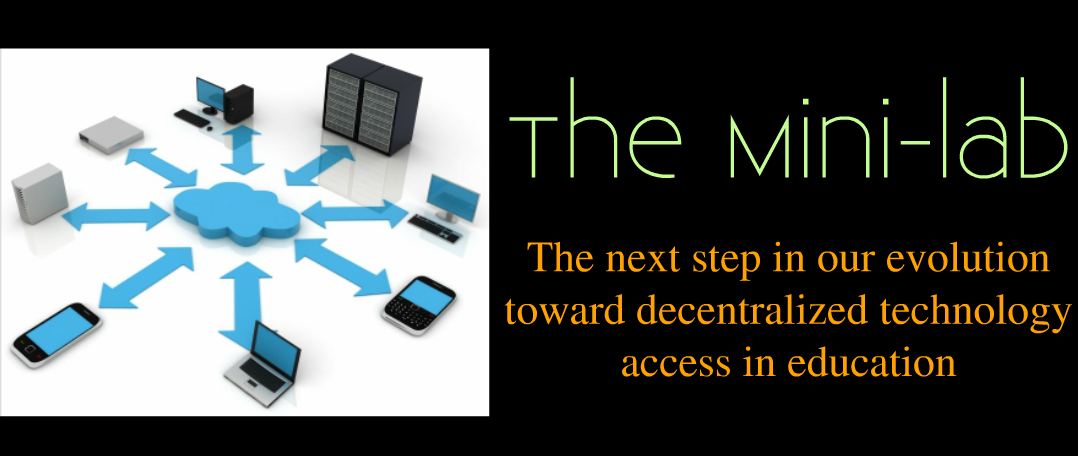
I went to my principal last year and suggested we try the mini-lab idea, wherein a technology curious/experienced teacher collects a class set of digital tools around themselves in order to develop some digitized pedagogy.  Alas, we couldn't go all in.  The idea of a teacher directly selecting diverse technology and then going off the school/board controlled and organized IT system was more than even our forward thinking principal could take.


The end result was a laptop cart of netbooks, one for each of our three floors.  The idea of the mini-lab is a constellation of differentiated technology orbiting a specific teacher. The variation in technology encourages wider digital fluency, and the single teacher focus produces a strong sense of ownership that helps reduce neglect and misuse.

Acer Netbook  http://www.acer.ca/ac/en/CA/content/model/LU.SGA0D.064   
: 
It was great to get these machines unhobbled by board IT.  The last time the board issued a cart of netbooks, they'd erased the manufacturer's fresh Windows 7 and installed the board's ten year old Windows XP package complete with numerous driver problems (companies don't make a new laptop then spend a lot of time building drivers for an operating system no one has used in three years).  The results were disastrous.  These new netbooks are no slouches (dual processor, decent memory, the latest software), they worked right out of the box, but they didn't have anything to do with the antiquated board network.

I had real trepidation about how to administer these carts.  The massive job of unpacking and setting up 70 odd netbooks seemed overwhelming, but a couple of pizzas and some helping hands later it got done over lunches; then came the putting them into operation part.

At the staff meeting I showed everyone the cart and explained that these are not board issued laptops.  This involved answering a number of questions around what that means.  No, the school server with it's piddling 10 megs of memory per student isn't available, but Googledocs is with 8 gigs, or Microsoft's Skydrive is waiting for you to use for free with 25 gigs.  No, you can't print to school printers, they're all on a closed network, but if you had to print, you could always have students email you work, or, you know, don't print it and just look at it on the screen.

I also stressed that these are our computer carts.  The board isn't going to maintain them, so benign neglect isn't an option.  If you're booking a lab so you can ignore your students for the period while you mark, these are a poor choice.  Tech-keen teachers on each floor were given the happy job of looking after the carts.  In many cases this allowed them to make use of the carts, which they have done eagerly.  Adoption by other teachers has been slow, but it has steadily improved, which worries me.

The first problem resolved around poor student privacy habits.  When a class ends the vast majority of students simply shut the lid and walk away, leaving themselves logged into Facebook (which they are inevitably running in the background), and saving whatever they are working on to the desktop.  Soon Macbeth papers, history essays, moderns translations and other digital flotsam, all named document1, document2, etc, bloomed on the desktops.  The inevitable Facebook spamming ensued, which greatly upset the students too lazy or clueless (or both) to bother logging off before putting the machines away.

Concern has arisen around plagiarism (taking essays found on a laptop and handing them in because an essay left by someone on a desktop called document3 HAS to be worth copying), and the opportunity for digital bullying with the not logging off the social network they're not supposed to be on anyway.

Today I got my first broken hardware issue.  Apparently a key 'popped off' the keyboard.  Those things are like popcorn, sometimes they just come flying off by themselves.

We're getting out of the initial roll-out phase of the off board IT netbook experiment.  The novelty is wearing off and teachers who wouldn't otherwise use them are starting to book them for periods they aren't actually in the school so the kids can play online (yes, we made a rule about that, but some teachers can be remarkably lackadaisical about rules when it means they have to be there to enforce them).

The digital coaches I'd envisioned in the mini-lab are still competently using the carts regularly, but as the carts find their way into the hinterlands of our school, teachers who don't understand (or care to understand) how to use digital devices in class to actually, you know, teach, will book out the carts and return them in a steadily deteriorating state.

We've done well with the initial portion of the roll out, putting the laptops together and having digital coach types making good use of them early, now comes the mediocrity.  One of the things we strive for is equal access to technology in education.  Unfortunately, we don't encourage development of digital competency in teachers and the end result is a lot of extra work for the few educators who are interested in making education meaningful and relevant to a new, digital millennium.