Showing posts with label Microsoft. Show all posts

Friday, 19 February 2016

Still Waiting...


The teacher PC in our school computer lab, like every other PC in the room, is a free-range machine.  The whole lab runs on the newest Windows we can get (beta if it's out) and are open to allow students to install and test various software in order to stay current with technology.  We extensively use Microsoft's Developer tools to test software and hardware.

On the teacher PC I purchased Windows 7.  Then I purchased a Windows 8.1 Pro upgrade key a year later in order to keep up with student machines using Windows 8.  The next year I was led into Windows 10 by Microsoft's persistent upgrade messages.  The lab was migrating to Windows 10 beta at that point so it made sense that I'd be seeing the same software as my students.

All was good until yesterday.  My old motherboard only had 4 usb ports and couldn't handle the number of peripherals I was needing plugged in.  I installed a new motherboard, everything else stayed the same.  The old motherboard got pressed into lab work and no longer had Windows on it.

Suddenly Windows 10 was plastered with activate warnings, so I contacted Microsoft.  Here is the transcript.

I'm still waiting, they aren't going to contact me.

After purchasing Windows 7, and purchasing 8.1 Pro, I'm told that they don't hand out free Windows 10 keys?  I'm not asking for a free key, I'm asking Microsoft to honour the multiple keys I've already purchased.  I'm not purchasing another one, especially not at nearly $300 Canadian!  It feels like extortion.

I've updated hardware before.  It was a quick matter of the Microsoft admin updating the new hardware to match the old key.  Apparently this is no longer possible.  Windows 10 (a much needed improvement after getting me to buy the awkward Windows 8), will not let you migrate with hardware updates, something PC users do quite a lot.  The PC that had Windows on it has been wiped and is no longer using it, so this isn't a matter of getting 'free' Windows - it's the same install on the same hard drive.  Migration shouldn't be difficult, but then why do it if you can force people into buying something they've already purchased (twice) over again?

If I'd purchased a Microsoft car and then had a new transmission installed, they'd tell me they no longer acknowledge the car and that I have to buy a new one.  Were I running the old motherboard on the old hard drive with Windows and demanding a new key for a new machine, I'd agree that they shouldn't give free licenses, but this isn't that.

I'm a fan of Microsoft.  I've been buying Windows since it was single digits and Microsoft OSes since they were DOS, but this whole thing has left a bad taste in my mouth.  I expected better, especially from a company so committed to supporting education.  

Unfortunately, this is turning into a teachable moment for the dozens of students I'm teaching I.T. to.  That Microsoft's support thinks the best solution is to simply walk away from a long time customer is pretty baffling too.

Followup:  I've got Windows 10 reinstalled on that PC.  I had to wipe the disk, reinstall Windows 7 (and download several gigs of downloads from Microsoft) before I updated to Windows 8.1 (followed by several more gigs of downloads), followed by the WIndows 10 update.

The Microsoft roadmap is this:  we'll give you Windows 10 'for free', but we won't let you reinstall it.  If you make any hardware changes or need to reinstall, we'll make it such a pain that we can then force you to re-buy Windows even though you already have.

The problem is that this process requires Microsoft to maintain drivers and support for two stale OSes (Win7, Win8+8.1), and pay for the bandwidth to allow owners of their software to reinstall and update what they own (even though they'll never use it because they're heading for 10).  It's like Microsoft is cutting off its nose to spite its face.

Anyone who has updated to Windows 10 should have a Windows 10 key that allows them to reinstall it.  Their previous Windows keys should then go stale.  Keeping everyone on the most current OS means better security for everyone and less overhead for Microsoft (who can then focus on making Windows 10 as bullet proof as possible).

I'm not sure which MBA wizard convinced them that their current approach is the best one.  I can tell you that the engineers who have to make it happen wouldn't be thrilled with it.

Sunday, 15 March 2015

Which Digital Overlord Do you Bow To?

I'm pretty handy when it comes to technology, but the past week has really underlined for me just how proprietary digital technology has become.  In the past seven days I've had to root my phone and I'm still struggling to free the magazines I have purchased from the clutches of Apple.

With content so closely tied to software delivery, and more and more of that software delivery being locked to specific hardware, you seemingly have to accept the fact that you don't own anything you legally download from the internet without also accepting that the only way to view it is through a multinational's proprietary ecosystem.


While the tech giants are holding each other off with proprietary technology, the humans run for cover.  Tech used to be all about user empowerment, its first duty now is to the multinational that created it, users are way down the priority list.
I'm just over two years into a three year contract with Telus.  Last year Samsung decided that my Galaxy Note2 wasn't allowed to update the Google Android operating system that runs on it.  I normally wouldn't care, but Google Play keeps updating the apps I have on the phone, eventually making a number of them incompatible with my stale version of Android.

Why would Samsung do this?  It's been two years, it's time to force me into an upgrade to a new phone.  This wouldn't be an issue in most markets where telecoms can't bully customers, but it's only recently that Canada decided to join the rest of the first world in limiting its cellular carriers in terms of abusive contracts.  Why would Telus shrug about my phone problems?  Because they are selling me a new phone early, even while I'm still on a contract that was deemed unfair to consumers.


What's left for the user?  The hacker community, thankfully.  After having a chat with my students (all of whom have hacked their phones), I found Jedi X and installed it on the Note2.  Suddenly the phone is faster than it's ever been, no stability issues at all, lots of extra features that I got to select, and best of all, I'm not forced to run any of the cruft that Telus and Samsung demand I run 'under contract'.

I'm suddenly no longer the owner of a phone that bricks itself every two hours and needs the battery pulled to restart it.  I'm also the owner of a Note2 that makes lightsaber noises whenever you take the stylus out (I can't express how happy this makes me). Without the modding community I'd be stuck with a useless phone and paying my way out of a contract that wouldn't be legal in most of the world, and isn't legal any more in Canada.


So, with the phone hacked and sorted, I turned to Apple's Newsstand.  I've been using an ipad mini to read, but some magazines on the newsstand are locked to aspect ratio and zoom.  Since they were designed for a regular ipad, they don't present well on the mini.  Fortunately, after much searching, I've found a tablet that I actually enjoy using.  The Microsoft Surface is a tablet that also lets me snap a keyboard on and do work as a full Intel i5 laptop.  I can even do photoshop and video editing on it!  Its high resolution screen is comfortable for reading too.


Like my Microsoft iPad?
It can also be a Microsoft
Android tablet, or a linux
PC, or, you know, a
Windows PC.
Should be no problem, right?  Just install itunes and I'll be able to access the content I paid for.  Um, no.  Apple locks that content to an i-device.  You don't own the magazine you paid for, it only exists when you're looking at it through an Apple iOS screen.  I don't save money buying electronic subscriptions, each magazine costs me $3.99 instead of $6.99 for a paper copy, plus the price of an ipad.

As you might imagine, Apple doesn't make an ipad emulator, but lots of other people have.  A couple of downloads later (and a second OS install) and I'm in business, reading the content I paid for on the device of my choice.  I can also boot the Surface into Android mode and view Google Apps on it.  I'm sure this is breaking all kinds of Apple, Microsoft and Google legalese, which is really the point of this whole piece.

There was a time when digital technology was designed to empower users at all costs; the user wasn't the first thing, they were the only thing.  Users weren't a data point to be mined, or consumer to be duped into committing to a closed ecosystem, they weren't buried in legalese and they could expect hardware to run software without worrying about the brand on it.

In the earlier days of digital technology, before these digital giants (who are now synonymous with high-technology) turned this into a vicious game of one-upmanship capitalism, we could depend on digital tech to offer real improvements over the way we used to do things.  Recently I've found myself instead wondering what the angle is every time I see a new digital delivery system.

The good news is most people aren't bothered to learn ways around it and just keep feeding the giants money.  For the few who are willing to learn and experiment, there are always work arounds.

Saturday, 26 April 2014

Dogmatic Digitization

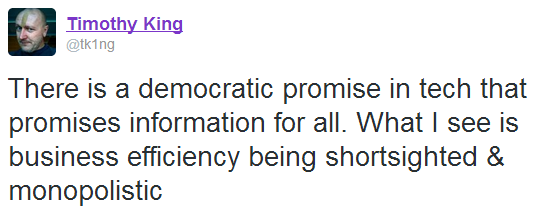
Digital technology thrives on a covenant of radical democracy that promises information for all.  The giants of technology market themselves on this egalitarian ideal.  From Google's corporate counter culture to Apple's fixation on design to empower the user, technology companies are founded and thrive on the idea of a future of individual empowerment.  People love them for it and self identify with digital technology companies in a personal way that is quite foreign to other consumer relationships.

Social norms have changed over the past five years.  Where once pulling out a smartphone demonstrated your importance and wealth, it is now a common gesture for pretty much everyone in North America.  We've passed a tipping point, the majority of people are on a computer connected to the internet all the time.  If you don't believe me go for a walk in any public place and see how many people are operating handheld computing devices.

As the majority adopts digital platforms I've seen a consistent dumbing down of digital tools and content in order to reach as wide an audience as possible.  This is probably a complaint form many early adopters, but when I see simplicity and limitation rather than functionality and access begin to infect how we use technology in education I have to question the pedagogical value of our educational technology.

In order to cater to as many people as possible educational technology has created systems that hide much of what happens behind simplistic interfaces.  Can the promise of radical democratization of information survive when most people want to be spoon fed in the most limited manner possible?  Free access to material doesn't matter when most people only want to use the internet in the same, simplistic way.
Digital technology still presents itself with those early ideals of democratic information access and transparency, but like everything else as it matures it begins to develop a more pragmatic approach.  My feeling now is that these egalitarian, transparent technology companies are actually anything but.  No one that wealthy feels the need to be transparent, or to educate others.  When you are worth billions your goal becomes market share and monopoly.

Educational technology, as an offspring of the digital technology giants, suffers from this dogmatic stiffening of its intent.  Rather than focusing on individual empowerment and the promise of de-industrializing the education system they are happy to embrace dehumanizing, data-driven testing, especially if it offers ease of implementation.  If education technology isn't interested in offering users diverse, personally nuanced, highly adaptive, open ended digital learning tools in a transparent and universal access to information, then what hope have the rest of us in a consumer driven digital world?  We're preparing the next generation of drones.

Tweets from the ASU/GSV Summit in Phoenix
We're in a position as educators and educational technologists to try and direct digitization away from closed systems with limited access to tools and information but the money infects our good intent.  Rather than focusing on diversity and acclimatizing students to the radical openness of the internet (something that, like the Wild West, may soon disappear), we preach walled gardens and monopolistic access.  We teach students to value limited access in order to train them for a future internet controlled by the rich and we do it because it's easier, not because it's better.


For some new tools empower,
but for far too many they create
habitually driven repetiton
That this is all done under the guise of freer information for all is laughable.  How can education claim to support the ideals of the early information revolution if it is in bed with pragmatic companies pushing for tiered access to information based on wealth?  If the information revolution was ever about ideals it has long since been replaced by moneyed interest.

Between datamining users to support wrong headed standardized testing policies to simply fleecing student data to generate sellable marketing information, the flipside to education technology is complex and not particularly flattering.  As a teacher of technology I hope to empower my students with knowledge of how information technology works in order for them to remain independent entities in the brave new world we're creating.  For the other 95% who take no computer studies and yet live on this technology all day every day, I see a future every bit as dogmatic and limited as the industrial one we are now shedding.  In fact, it may be much worse because, unlike the punch card factory worker of the Twentieth Century who was reduced to a number for eight hours a day, dogmatic, digitized information demands your undying attention and submission 24/7/365.

If you can't hack it, it owns you.

Tuesday, 8 April 2014

Hack The Future

Between questions of how student data is being used and technology monopolists pushing for standardization in edtech, I'm left with an uneasy feeling.  As we reach a tipping point in digital educational technology we simplify and standardize to the point where the people doing the teaching don't know or care what happens behind the curtain.  What is happening behind that curtain is being decided in closed rooms between multi-national corporations and governments.  The bait is a 'free' digital learning system for education.  The payoff is habituated users and data mining on a level unprecedented in history, and we're happy to sell our students and ourselves into it in order to get the freebies.

If this were all happening in the light of day I'd be a lot happier about it.  That it's happening behind closed doors and shouldn't be publicized is something that should concern everyone.

If you're not paying for it you're the product being sold.  Corporations may state that they do no evil but they aren't after what education is after, they are after profit.  That student information is being brokered well beyond the reach of educational institutions by these information merchants should be a cause of concern, but instead I see public educators increasingly branding themselves with corporate logos and shouting their evangelism from the social media rooftops.

Technology is exciting, and digital technology is such an intimate thing because it nestles up to our minds.  Our habit of elastically coupling with our technology suggests that digital-tech is going to become an intrinsic part of how we see ourselves.  People are already describing unplugging as feeling like an amputism, it's only going to become more entwined, especially as we begin to wear our digital selves.

I'm reminded of Kenneth Clark's unsettling end to what many consider to be the best documentary series ever created, Civilisation...
Start at 35:30 if the link doesn't take you right there.

That one of the most intelligent observers of human society was pondering this in the year I was born lurks in the back of my mind.  Machines that make decisions for us, many educators seem thrilled with this idea.  You may be all gungho over the latest shiny i-thing or googly-eyed over that app that will revolutionize your teaching, but the true costs of these things are a carefully kept secret.  At the very least, when we adopt a single digital ecosystem (no matter how free it is), we're selling our students (and our own) habitual technology use into a closed environment.

As educators it should be a goal to recognize tools in terms of what they can do rather than how easy they are and how well integrated they come.  And we should never be deciding on a tool that inserts itself into the learning process based on how little we're expected to learn about it.  Technology and the internet aren't Google, and tablets aren't Apple.  Computers aren't Microsoft.  Only by offering students access to all of these things and more are we approaching the teaching of technology in as complete and well rounded a way as possible.

Over the past ten years I've watched education stagger into digitization always hesitant to change old ways, and I've pushed as hard as I can to encourage that change.  Only by catching up to this revolution can we hope to prepare students for the strange world that awaits them.  Now that we're at a tipping point I'm watching what could be a powerful new fluency being boiled down into canned access to technology, always under a single brand.  Instead of teaching technology like it's becoming an intimate part of our lives (which it is), we pass it off with idiotic notions like 'digital native' that allow people who have no interest in learning technology to also off-load the responsibility of teaching our children about technology.  Into that ignorance vacuum corporations have crept, offering you an easy solution, and most people are more than happy to take it even if it means being walled in to a monopoly.

I wrote last on the idea of being a tech-ronin, a digital samurai without a master.  That works for me but I come from a time before data dictated who I am.   I'm worried about my students.  In a world where we've sold them into digital servitude as data sheep (call them digital natives if that makes you feel better), the only way out is to know the system well enough to circumvent it.  Instead of teaching a closed, monopoly limited mindset in technology that serves everyone except my students, I want them to develop a broad understanding of digital tools and how they work.  In a broad edtech learning environment my students will develop a meta-cognitive view of both technology and how they are represented by it.  In a time where we are increasingly defined by our data the only free people will be the ones who have a sense of themselves beyond their student record in the LMS.

My department logo has 'learn how to build the future' on it, but perhaps I need to make a change just to give my students a chance to self-realize beyond whatever data metric they are being sold into.
Rage against the machine

Wednesday, 30 October 2013

Free Range Computing

I'd initially gone into this with pi in the sky (sic) daydreams of students working entirely on open source hardware and software that they have assembled and coded themselves, free from the evil influences of corporations.  After attending ECOO this year I'm less on the hippy open source bandwagon and more on the inclusivity bandwagon.  It isn't an educator's job to ignore corporate technology, but it is their responsibility not to indoctrinate students in only one particular company's technology because it is easier or cheaper for them.  Student digital fluency has to drive technology access, not corporate carrots or teacher laziness.

I've noticed a real move toward the branding of education (and teachers) by technology interests.  This is almost always done to ensure their own monopolistic dominance rather than offering students the widest range of technology experience.  In order to indoctrinate students in a single means of access (in order to later capture them as consumers), many boards are locking students into company specific technology, usually because some kind of discount being offered.  Selling out student technological fluency in order to appear more cost effective isn't very pedagogically sound.


...but I'm certified with screwdrivers!
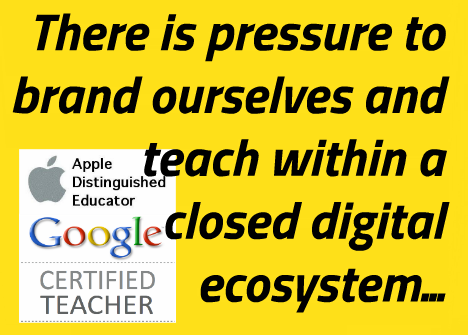
Would you trust the literacy teacher who only uses one publishing company and brandishes the logo like a qualification?   Does this not call a balanced approach to their discipline into question?  How can the same thing not be said for Google Certified or Apple Distinguished? 

It's one thing to get a professional certification from an platform agnostic professional organization that has no interested in monetizing you, it's another to brand yourself with the name of a profit driven company that is intent on turning you and your students into revenue streams while limiting access to alternatives.


My knee jerk reaction to this is what had me storming off into the woods and getting all back to nature with open source hardware and software:


***


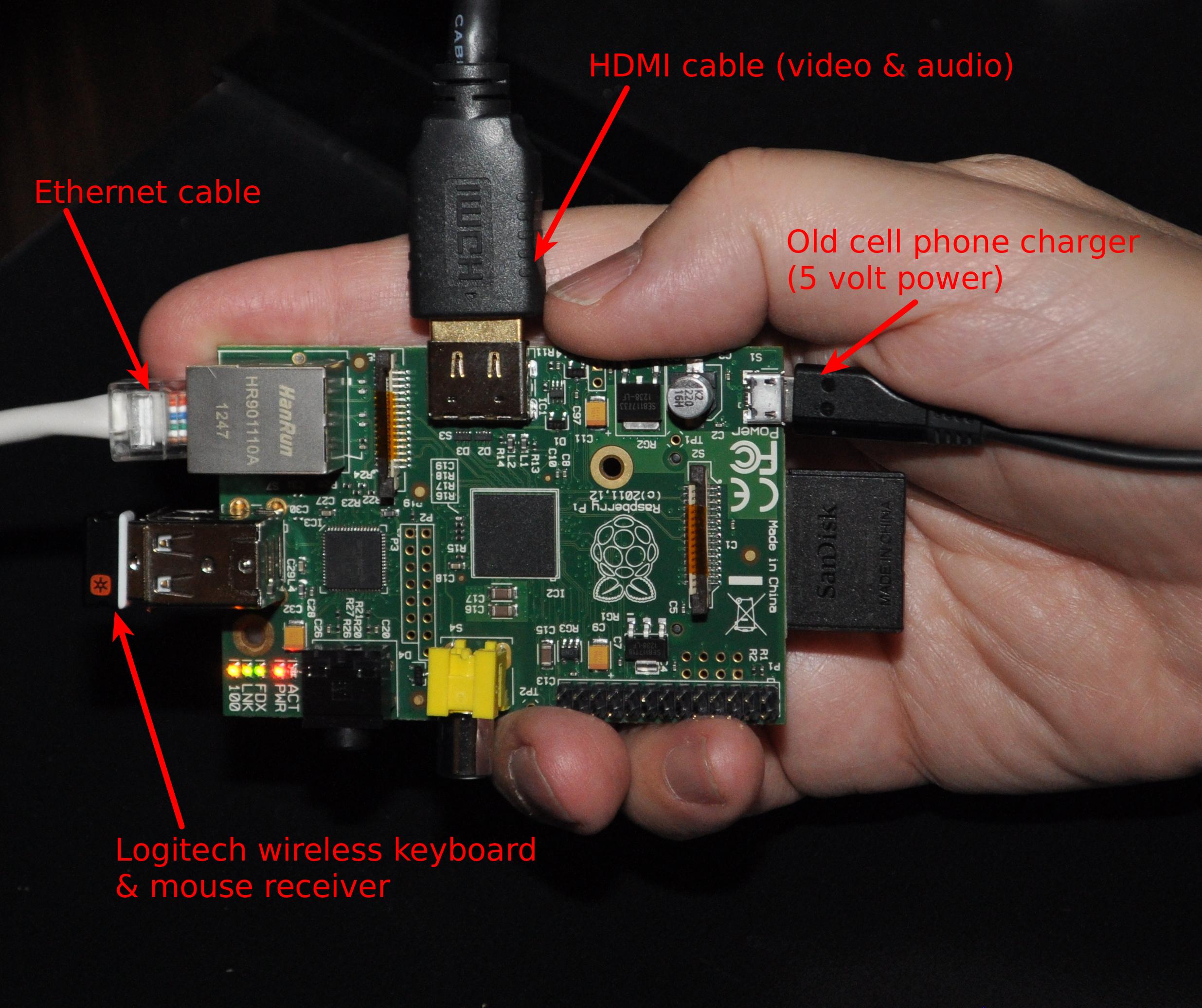
Raspberry Pi, almost fits in your wallet!
I've been thinking about the open source technology classroom I wish I could run.  Engineering based rather than brand based hardware with accessible, open software.  Hardware that could run free, crowd-sourced software.

Raspberry Pi is an obvious starting point.  As a way of showing students the basics of computing cheaply (it'll run a full GUI OS with internet for about thirty bucks per student), it's something that they can use to get familiar with how software and hardware work with each other.

I wish they'd come up with a Raspberry Pi Ã  la mode, a 1 ghz 2 core unit with a gig of ram, hdmi and 2 usb 3.0 ports.  They can toss the video in and separate audio 3.5 jack out (hdmi has audio built in anyway).  If they could pull that off and keep it close to the same size I'd think twice about stepping up from the Pi.


***

It's beyond the Pi that open source hasn't developed enough high level hardware to take on more advanced learning environments, though having students build digital tools from a variety of components has its own value.  

There are plenty of software options, but ready made agnostic hardware is thin on the ground.  This is when I started to think about systems that, while branded and corporately developed, might be focused on access to a variety of technology rather than the tyranny of one:


***


In the meantime, from the Pi how do you create a free range system that lets students experience a variety of operating systems and software?  The recent nano-desktop round of computers offer some interesting options.


Intel NUC
The NUC (next unit of computing) by Intel is an engineering platform that crams an astonishing amount of processing power into a package the size of a paperback novel.  With an i5 processor and up to 16 gigs (!) of ram, this thing is a monster.  It would handily outperform any desktop in our school right now.

If we could get a NUC sorted out in some kind of student-proof Otterbox type enclosure we'd have a tough, durable, wickedly fast, open computer that would offer students a totally customizable platform for just over $400.  Presumably we could whittle that down to cost (maybe ~$300?).

Having a dock in labs that would allow students to plug their own PCs (personal again!) in would be one means of accessing the box.  Offering a plug in touch screen peripheral that could do the job of a screen/mouse/keyboard would be another avenue that would create a very powerful laptop/tablet option.  Pica-projectors would be another way to produce screens out of thin air, and they are rapidly becoming smaller and less energy consuming.

The nicest thing about the NUC is that it could work with pretty much any operating system you could want.  Students could come to class with a paperback sized computer that could boot into Apple OSx, the Windows flavour of your choice or any of a number of Linux distros (including Chromium).  You wouldn't have Mac labs, or Windows labs, you'd have whatever you wanted/needed to boot into.  

A truly agnostic hardware platform that would offer you access to any software on any operating system.
Foxconn Nano PC

Another (cheaper) option is the Foxconn Nano PC, which retails for substantially less (only $219 retail vs. the $420 NUC).  The Foxconn unit runs on an AMD processor (not Apple friendly) but offers strong graphics performance from its (Canadian!) graphics subsidiary ATI.

It would still run any flavor of Windows or Linux you could throw at it (including Chromium) and is as svelte as the Intel option.  Education purchasing could probably get these down into the $150 range.

***

The real goal would be to create opensourceedtech.org and have educators themselves crowdsource an open, upgradeable, accessible hardware system that is designed to teach students about technology in all its various forms.

The chance to develop personalized learning technology would take us away from the ignorance and learned helplessness we peddle today in education and offer all technology companies a level playing field on which to ply their wares.  Our students would experience a wide range of operating environments and software as well as being aware of how hardware impacts those systems.

Thoughts on mastery learning in digital spaces
(from my ECOO13 presentation)

Imagine high school graduates who have worked on a variety of operating systems that they have installed and maintained themselves.  


Imagine graduates who understand how memory, processor and storage work with software because they've experienced hands on changes in this hardware.  


Imagine graduates who are able to problem solve and resolve their own technological problems because the breadth of their familiarity with technology is such that any new digital tool they lay their hands on isn't a mystery to them.


Imagine students and educators who go to the tool they need to get the job done instead of having the tool dictate the job.


Imagine students who have enough familiarity with code that they can appreciate the complexity of the world we're living instead of being baffled by it.


I was having doubts about putting corporate logos on my office windows, but I don't any more.  Instead of taking down the Google stickers I've added Apple, Microsoft, Linux, Toshiba, Dell, Asus, IBM, Lenovo, Arduino, Raspberry Pi and will continue to add others.  The point isn't to run off into the woods and live in vegan austerity on open source hardware, it's to make all technology available to students so they can appreciate the astonishing variety of systems we're immersed in, and not be made helpless by it.

Tuesday, 20 November 2012

The ideal digital learning tool

I'm thinking about what the ideal digital tool would be for student learning.

It has to offer strong reading and browsing abilities as well as data entry.  I want the benefits of a passive consumption device (like a tablet) with the benefits of an active media production device (like a laptop).  My ideal device must have a keyboard and mouse pad, but also offer touch screen functionality.  It'll also rotate to use the screen more effectively as a reader/tablet.

It also has to be ruggedized (I have no misconceptions about how hard kids are on electronics).  It would also be built like lego (compartmentalized and accessible to easily replace failed parts).  The goal weight would be under 3 pounds.  At three pounds we'd be providing a device that can easily carry all the student's text books, binders and loose paper without injuring them or destroying the planet.


Some devices I'd shamelessly steal brilliant design ideas from:


Dell's latest round of ultrabooks with a flippable screen offer the kind of flexibility I'm looking for - the benefits of a rotating tablet screen (allowing you to turn a widescreen to a tall screen for reading), light weight, flexible, powerful...


In fairness (and because I have one), HP has been making touch screen/tablet laptops for years.

I don't care which technology gets used (which ever is more durable), but the idea of a lightweight touch screen reader AND a laptop that allows for full media creation is vital!

Horizontal wide-screens are designed for entertainment, but reading only happens well when you've got continuous text you don't have to constantly scroll through a narrow window.  These learning tools MUST allow for the most accessible e-reading experience - meaning a device that can mimic a tablet.  


The end result has at least a 128GB solid state drive (SSD), that allows for multiple OS installs if a student wants them.  The hardware would be able to run CHROME OS, LINUX, OSx and Windows (depending on student experience, preference and ability).  The choice to upgrade on-device storage would be easy because the SSD it comes with would be a standard 2.5 inch laptop hard drive bay that would take any of many choices of hard or solid state drive.

Basic connectivity to the device would be through USB3 and video out - mini-dvi (for sharing presentations).  No manufacturer specific connectors (Apple, I'm looking at you and your weird dongle fixation).

The screen would be a 13 inch unit with a standard resolution of 1366x768, though a student who wants a higher (retina) level display could always upgrade to one (since they bolt on, this would be a matter of standardizing monitor connectors and offering variations in resolution and colour quality based on cost and need.  

While we're standardizing things, these digital tools would use standardized screws and fasteners that make repairs easy (are you still listening Apple?).  Any high school would have its own genius bar/nerd cave where students in senior computer engineering can repair and upgrade equipment at minimal cost.

The compartmentalization is vital to this tool.  The screen needs to detach logically and easily for replacement, same with the memory, hard/solid state drive, CPU, battery and keyboard.  Compartmentalization allows for much cheaper upkeep.  I'd also like all the pieces to be easily recyclable as well as replace/up-gradable.


The end result would be an easily upgrade-able, component replaceable device that is operating system agnostic, highly adaptable and tough.


The idea of an environmentally sensible laptop isn't a pipe dream.

Google could easily make this happen working with their hardware partners (an Edu-Nexus?) - Microsoft and Apple seem intent on closed eco-system models, even for education, but I live in hope.

It's already the end of 2012.  I'd love to see the silicon valley geniuses recognize that digital literacy is vital for education (and for the future of industry too - we're not producing digitally literate graduates!).


If we could get our hands on that modular, easily upgrade-able/maintainable, ruggedized transformable laptop/data creation, tablet/content consumption device, we'd be one giant step closer to helping students grasp opportunities for digital literacy.

I think we could mass produce these things for $300 for a basic one up to $600 for a tricked out one.  The revolution is well underway, it's time for someone to give us the classroom tools we need to teach it.