Showing posts with label apple. Show all posts

Sunday, 15 March 2015

Which Digital Overlord Do you Bow To?

I'm pretty handy when it comes to technology, but the past week has really underlined for me just how proprietary digital technology has become.  In the past seven days I've had to root my phone and I'm still struggling to free the magazines I have purchased from the clutches of Apple.

With content so closely tied to software delivery, and more and more of that software delivery being locked to specific hardware, you seemingly have to accept the fact that you don't own anything you legally download from the internet without also accepting that the only way to view it is through a multinational's proprietary ecosystem.


While the tech giants are holding each other off with proprietary technology, the humans run for cover.  Tech used to be all about user empowerment, its first duty now is to the multinational that created it, users are way down the priority list.
I'm just over two years into a three year contract with Telus.  Last year Samsung decided that my Galaxy Note2 wasn't allowed to update the Google Android operating system that runs on it.  I normally wouldn't care, but Google Play keeps updating the apps I have on the phone, eventually making a number of them incompatible with my stale version of Android.

Why would Samsung do this?  It's been two years, it's time to force me into an upgrade to a new phone.  This wouldn't be an issue in most markets where telecoms can't bully customers, but it's only recently that Canada decided to join the rest of the first world in limiting its cellular carriers in terms of abusive contracts.  Why would Telus shrug about my phone problems?  Because they are selling me a new phone early, even while I'm still on a contract that was deemed unfair to consumers.


What's left for the user?  The hacker community, thankfully.  After having a chat with my students (all of whom have hacked their phones), I found Jedi X and installed it on the Note2.  Suddenly the phone is faster than it's ever been, no stability issues at all, lots of extra features that I got to select, and best of all, I'm not forced to run any of the cruft that Telus and Samsung demand I run 'under contract'.

I'm suddenly no longer the owner of a phone that bricks itself every two hours and needs the battery pulled to restart it.  I'm also the owner of a Note2 that makes lightsaber noises whenever you take the stylus out (I can't express how happy this makes me). Without the modding community I'd be stuck with a useless phone and paying my way out of a contract that wouldn't be legal in most of the world, and isn't legal any more in Canada.


So, with the phone hacked and sorted, I turned to Apple's Newsstand.  I've been using an ipad mini to read, but some magazines on the newsstand are locked to aspect ratio and zoom.  Since they were designed for a regular ipad, they don't present well on the mini.  Fortunately, after much searching, I've found a tablet that I actually enjoy using.  The Microsoft Surface is a tablet that also lets me snap a keyboard on and do work as a full Intel i5 laptop.  I can even do photoshop and video editing on it!  Its high resolution screen is comfortable for reading too.


Like my Microsoft iPad?
It can also be a Microsoft
Android tablet, or a linux
PC, or, you know, a
Windows PC.
Should be no problem, right?  Just install itunes and I'll be able to access the content I paid for.  Um, no.  Apple locks that content to an i-device.  You don't own the magazine you paid for, it only exists when you're looking at it through an Apple iOS screen.  I don't save money buying electronic subscriptions, each magazine costs me $3.99 instead of $6.99 for a paper copy, plus the price of an ipad.

As you might imagine, Apple doesn't make an ipad emulator, but lots of other people have.  A couple of downloads later (and a second OS install) and I'm in business, reading the content I paid for on the device of my choice.  I can also boot the Surface into Android mode and view Google Apps on it.  I'm sure this is breaking all kinds of Apple, Microsoft and Google legalese, which is really the point of this whole piece.

There was a time when digital technology was designed to empower users at all costs; the user wasn't the first thing, they were the only thing.  Users weren't a data point to be mined, or consumer to be duped into committing to a closed ecosystem, they weren't buried in legalese and they could expect hardware to run software without worrying about the brand on it.

In the earlier days of digital technology, before these digital giants (who are now synonymous with high-technology) turned this into a vicious game of one-upmanship capitalism, we could depend on digital tech to offer real improvements over the way we used to do things.  Recently I've found myself instead wondering what the angle is every time I see a new digital delivery system.

The good news is most people aren't bothered to learn ways around it and just keep feeding the giants money.  For the few who are willing to learn and experiment, there are always work arounds.

Wednesday, 12 November 2014

Money Clouds

You hear a lot about the magic of the cloud these days.  It's linked to online integration, website optimization and the evolution of computers.  Integration and optimization involve encouraging users to put information online and making that data easy for agitators to access.  The modern, monetized internet is built around turning data into a commodity.  The 2014 web is designed around encouraging you to put as much of your life online as possible because that data has value.


Gotta watch out for those people who drink the koolaid...
The idea of computers evolving from mainframes to desktops to laptops to smartphones appears self evident, but I'm not so sure.  I'm starting to think the devices prompted us online and the evolution idea was set up afterwards as a marketing angle.  Our devices might not be a response to market needs, but a push by the data bankers to get more people producing.

When you boot up a computer you've created a self contained virtual environment that is designed for and subservient to your needs.  Within that machine you have security, privacy and administrative power over your data.  It's hard to argue that this is anything other than an empowering position for a user.

When you connect to the internet you surrender administrative control.  Your virtual environment is no longer yours, your data is no longer internal and local, it's no longer your data.  Privacy is an antiquated idea you have to let go of and security is entirely at the discretion of hackers who are increasingly supported by big business and government.  When you go online you have lost that private computing experience and thrown it wide open to many interested parties.


When you send in three one year old
broken Chromebooks you get one back, the
rest aren't cost effective. If driving people online to

collect data is the goal, then the Chromebook is a
master stroke - disposable hardware that funnels you
into using a single browser - a branded internet.
Why have we stampeded to the cloud?  Did our devices change to serve our needs or have our devices been designed to drive us online?  Apple famously rolled out the ipad.  At the same time they put together itunes, which not only dominates media sales but has also now come to dominate app sales as well.  Selling an ipad is nice, constantly selling media is an exciting, never ending source of income.

Data as an income stream is at the root of our online migration.  Microsoft made billions selling an operating system, but the data produced inside it was very much the domain of the user.  Software we purchase for that environment had to also be subservient to the user.  This is a lousy approach if you want to monetize data and enjoy the benefits of a continuous income stream.

Blizzard realized this with the move to online gaming.  World of Warcraft was one of the first games to successfully follow the data=continual income model, charging monthly fees instead of a one time point of sale for the game.  The end result is a gamer spending hundreds of dollars on a game instead of the single $50 outlay.  If you don't think it worked, check out how WoW compares to the other top grossing games of all time.

Google famously claims that it wants to organize the world's information and make it available and useful.  This is always dressed in altruistic nonsense, but this is a profit driven business that goes to great lengths to not pay taxes.  Google is a data mining company, it always has been.  The happy result of this data mining is a remarkably accurate search engine that also happens to feed the data mining operation.  

Once the search engine was established Google went after traditional desktop based applications.  Lite versions of word processing, spreadsheet software and other traditional desktop apps drew users in with the suggestion that your software and data could be wherever your internet connection was.  This drove the expansion of the internet as well as the need for more bandwidth. Once the apps were rolling other data collection techniques like mapping and geo-location were added to the mining process.  The more data that feeds the machine, the more ways it can monetize it.

Claiming to be free, these apps drive users out of their private desktops and into the fishbowl of the internet.  Online apps feed data mining operations just like search engines do.  This blog is written on Blogger, a Google owned web application that encourages information to be put online so it can be mined.  Why do I use it?  Because I want to publish my writing.  In certain circumstances it makes sense to put data out into the fishbowl, but you don't get to choose those circumstances on the web today.

The reason Google struggles with offering unmined online resources is because Google is a data mining company, it's what they do.  This isn't necessarily evil or nefarious, but it behooves us to understand how online companies work, especially if we're going to get all giddy about driving students online.

A lot of infrastructure had to be put into place for your personal computer to be built, but that infrastructure is minuscule compared to what is involved in creating an internet.  The cost of building and maintaining a worldwide networking infrastructure is staggering.  The only way to make it cost effective is to make the data itself pay.  There are cost benefits to scaling up this kind of infrastructure, so online companies drive as many people into producing data as possible.

Any company that lives online can't simply create something of value and then stand by it.  The sand is constantly falling through the hourglass, it costs bandwidth to offer even a simple online service in this expensive, complex, cut throat infrastructure.  The only way you can survive in an environment this carnivorously expensive is to make the data you're attracting pay.  You push to schools, to charities, anywhere you can to generate input.

There is no such thing as a free online app.  The whole point of any online service is to get you producing data that can be mined.  This data is valuable even if your name isn't attached.  Most privacy legalese attached to online services explicitly allows them to use your data as they see fit.  Cursory efforts are made to hide your name because no name = privacy, but your data is where the money is, and it isn't yours according to most online agreements.  You surrender control of your data when you agree to use their data mining, um, nifty, online application.

Now that we've trained entire generations to ignore traditional media, this intrusive and invasive analysis is where market research has gone.  Multinationals don't spend marketing dollars on TV commercials for people under thirty any more, it's wasted money.  Instead, they drive the herd online, creating heat around exciting new smartphones / tablets / wearable computing - whatever gets people producing data to feed the network.

Again, this is neither good nor evil, but it is an evolution away from ideas of traditional advertising (which itself could be cast in a poor light).  The questions we need to ask ourselves as educators are: 

  • If we demand that students use online services that monetize the information they share, are we eroding ideas of privacy and personal security by demanding their online interaction?
  • Are we commoditizing our students' learning?
  • Should that make us uncomfortable?

There are ways to bypass all of this, but that means turning away from the carefully designed, market driven future laid out for us.  Education could adopt open source software that offers complete administrative control.  Educators could require students to actually learn how to manage digital tools from a mastery learning perspective (instead of whatever bizarre kids-know-this-stuff-intuitively / digital native thing we're doing now).

We could supply Tor browsers for students to use that would guarantee real anonymity and privacy.  We could expect students and teachers to learn how to manage their own online spaces and develop their own tools with education as the focus and no hidden data mining agenda.  We could leverage the sharing power of the internet to spread these tools around the world at little or no cost, but we don't, because the future we've been sold is so shiny that we can't think of anything else.


One thing is for sure, the future will be branded.  Branded
information, branded thinking, branded learning?
At the Google presentation at the recent ECOO conference the g-employee asked the room, "why aren't you all joining Google For Education?  I'm not going to go on until someone can tell me why!"  He was very enthusiastic in his hard sell.

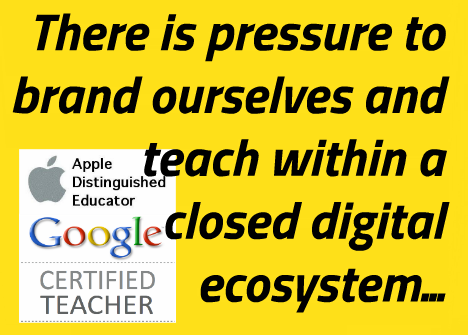
In a less high-pressure sale situation I can formulate a response:  I use Google tools, but I make a point of understanding what they are.  I get the impression that most Google Certified Teachers are more interested in being unpaid sales reps than they are recognizing the complexities of cloud based computing.  Any teacher who rushes into branding themselves with a private company's logo makes me question their commitment to pedagogy.  What's more important, using the best tool available or using the best tool from your brand?  It's a big reason why the idea of brand specific computing devices will never get my vote.  

We're being led to the cloud by implacable market forces who have monetized our information flow.  They offer ease of access, integration and a general malaise that many regular users of technology turn into ecstatic fandom.  You don't need to learn this stuff, we'll take care of all that for you, just hook yourself up to this milking machine and it'll all be OK.


Hook up students to the milking machine and tell them it's for their own good.  Edtech is preparing them for the future!

Saturday, 26 April 2014

Dogmatic Digitization

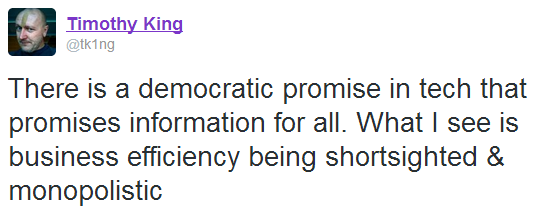
Digital technology thrives on a covenant of radical democracy that promises information for all.  The giants of technology market themselves on this egalitarian ideal.  From Google's corporate counter culture to Apple's fixation on design to empower the user, technology companies are founded and thrive on the idea of a future of individual empowerment.  People love them for it and self identify with digital technology companies in a personal way that is quite foreign to other consumer relationships.

Social norms have changed over the past five years.  Where once pulling out a smartphone demonstrated your importance and wealth, it is now a common gesture for pretty much everyone in North America.  We've passed a tipping point, the majority of people are on a computer connected to the internet all the time.  If you don't believe me go for a walk in any public place and see how many people are operating handheld computing devices.

As the majority adopts digital platforms I've seen a consistent dumbing down of digital tools and content in order to reach as wide an audience as possible.  This is probably a complaint form many early adopters, but when I see simplicity and limitation rather than functionality and access begin to infect how we use technology in education I have to question the pedagogical value of our educational technology.

In order to cater to as many people as possible educational technology has created systems that hide much of what happens behind simplistic interfaces.  Can the promise of radical democratization of information survive when most people want to be spoon fed in the most limited manner possible?  Free access to material doesn't matter when most people only want to use the internet in the same, simplistic way.
Digital technology still presents itself with those early ideals of democratic information access and transparency, but like everything else as it matures it begins to develop a more pragmatic approach.  My feeling now is that these egalitarian, transparent technology companies are actually anything but.  No one that wealthy feels the need to be transparent, or to educate others.  When you are worth billions your goal becomes market share and monopoly.

Educational technology, as an offspring of the digital technology giants, suffers from this dogmatic stiffening of its intent.  Rather than focusing on individual empowerment and the promise of de-industrializing the education system they are happy to embrace dehumanizing, data-driven testing, especially if it offers ease of implementation.  If education technology isn't interested in offering users diverse, personally nuanced, highly adaptive, open ended digital learning tools in a transparent and universal access to information, then what hope have the rest of us in a consumer driven digital world?  We're preparing the next generation of drones.

Tweets from the ASU/GSV Summit in Phoenix
We're in a position as educators and educational technologists to try and direct digitization away from closed systems with limited access to tools and information but the money infects our good intent.  Rather than focusing on diversity and acclimatizing students to the radical openness of the internet (something that, like the Wild West, may soon disappear), we preach walled gardens and monopolistic access.  We teach students to value limited access in order to train them for a future internet controlled by the rich and we do it because it's easier, not because it's better.


For some new tools empower,
but for far too many they create
habitually driven repetiton
That this is all done under the guise of freer information for all is laughable.  How can education claim to support the ideals of the early information revolution if it is in bed with pragmatic companies pushing for tiered access to information based on wealth?  If the information revolution was ever about ideals it has long since been replaced by moneyed interest.

Between datamining users to support wrong headed standardized testing policies to simply fleecing student data to generate sellable marketing information, the flipside to education technology is complex and not particularly flattering.  As a teacher of technology I hope to empower my students with knowledge of how information technology works in order for them to remain independent entities in the brave new world we're creating.  For the other 95% who take no computer studies and yet live on this technology all day every day, I see a future every bit as dogmatic and limited as the industrial one we are now shedding.  In fact, it may be much worse because, unlike the punch card factory worker of the Twentieth Century who was reduced to a number for eight hours a day, dogmatic, digitized information demands your undying attention and submission 24/7/365.

If you can't hack it, it owns you.

Tuesday, 8 April 2014

Hack The Future

Between questions of how student data is being used and technology monopolists pushing for standardization in edtech, I'm left with an uneasy feeling.  As we reach a tipping point in digital educational technology we simplify and standardize to the point where the people doing the teaching don't know or care what happens behind the curtain.  What is happening behind that curtain is being decided in closed rooms between multi-national corporations and governments.  The bait is a 'free' digital learning system for education.  The payoff is habituated users and data mining on a level unprecedented in history, and we're happy to sell our students and ourselves into it in order to get the freebies.

If this were all happening in the light of day I'd be a lot happier about it.  That it's happening behind closed doors and shouldn't be publicized is something that should concern everyone.

If you're not paying for it you're the product being sold.  Corporations may state that they do no evil but they aren't after what education is after, they are after profit.  That student information is being brokered well beyond the reach of educational institutions by these information merchants should be a cause of concern, but instead I see public educators increasingly branding themselves with corporate logos and shouting their evangelism from the social media rooftops.

Technology is exciting, and digital technology is such an intimate thing because it nestles up to our minds.  Our habit of elastically coupling with our technology suggests that digital-tech is going to become an intrinsic part of how we see ourselves.  People are already describing unplugging as feeling like an amputism, it's only going to become more entwined, especially as we begin to wear our digital selves.

I'm reminded of Kenneth Clark's unsettling end to what many consider to be the best documentary series ever created, Civilisation...
Start at 35:30 if the link doesn't take you right there.

That one of the most intelligent observers of human society was pondering this in the year I was born lurks in the back of my mind.  Machines that make decisions for us, many educators seem thrilled with this idea.  You may be all gungho over the latest shiny i-thing or googly-eyed over that app that will revolutionize your teaching, but the true costs of these things are a carefully kept secret.  At the very least, when we adopt a single digital ecosystem (no matter how free it is), we're selling our students (and our own) habitual technology use into a closed environment.

As educators it should be a goal to recognize tools in terms of what they can do rather than how easy they are and how well integrated they come.  And we should never be deciding on a tool that inserts itself into the learning process based on how little we're expected to learn about it.  Technology and the internet aren't Google, and tablets aren't Apple.  Computers aren't Microsoft.  Only by offering students access to all of these things and more are we approaching the teaching of technology in as complete and well rounded a way as possible.

Over the past ten years I've watched education stagger into digitization always hesitant to change old ways, and I've pushed as hard as I can to encourage that change.  Only by catching up to this revolution can we hope to prepare students for the strange world that awaits them.  Now that we're at a tipping point I'm watching what could be a powerful new fluency being boiled down into canned access to technology, always under a single brand.  Instead of teaching technology like it's becoming an intimate part of our lives (which it is), we pass it off with idiotic notions like 'digital native' that allow people who have no interest in learning technology to also off-load the responsibility of teaching our children about technology.  Into that ignorance vacuum corporations have crept, offering you an easy solution, and most people are more than happy to take it even if it means being walled in to a monopoly.

I wrote last on the idea of being a tech-ronin, a digital samurai without a master.  That works for me but I come from a time before data dictated who I am.   I'm worried about my students.  In a world where we've sold them into digital servitude as data sheep (call them digital natives if that makes you feel better), the only way out is to know the system well enough to circumvent it.  Instead of teaching a closed, monopoly limited mindset in technology that serves everyone except my students, I want them to develop a broad understanding of digital tools and how they work.  In a broad edtech learning environment my students will develop a meta-cognitive view of both technology and how they are represented by it.  In a time where we are increasingly defined by our data the only free people will be the ones who have a sense of themselves beyond their student record in the LMS.

My department logo has 'learn how to build the future' on it, but perhaps I need to make a change just to give my students a chance to self-realize beyond whatever data metric they are being sold into.
Rage against the machine

Tuesday, 20 November 2012

The ideal digital learning tool

I'm thinking about what the ideal digital tool would be for student learning.

It has to offer strong reading and browsing abilities as well as data entry.  I want the benefits of a passive consumption device (like a tablet) with the benefits of an active media production device (like a laptop).  My ideal device must have a keyboard and mouse pad, but also offer touch screen functionality.  It'll also rotate to use the screen more effectively as a reader/tablet.

It also has to be ruggedized (I have no misconceptions about how hard kids are on electronics).  It would also be built like lego (compartmentalized and accessible to easily replace failed parts).  The goal weight would be under 3 pounds.  At three pounds we'd be providing a device that can easily carry all the student's text books, binders and loose paper without injuring them or destroying the planet.


Some devices I'd shamelessly steal brilliant design ideas from:


Dell's latest round of ultrabooks with a flippable screen offer the kind of flexibility I'm looking for - the benefits of a rotating tablet screen (allowing you to turn a widescreen to a tall screen for reading), light weight, flexible, powerful...


In fairness (and because I have one), HP has been making touch screen/tablet laptops for years.

I don't care which technology gets used (which ever is more durable), but the idea of a lightweight touch screen reader AND a laptop that allows for full media creation is vital!

Horizontal wide-screens are designed for entertainment, but reading only happens well when you've got continuous text you don't have to constantly scroll through a narrow window.  These learning tools MUST allow for the most accessible e-reading experience - meaning a device that can mimic a tablet.  


The end result has at least a 128GB solid state drive (SSD), that allows for multiple OS installs if a student wants them.  The hardware would be able to run CHROME OS, LINUX, OSx and Windows (depending on student experience, preference and ability).  The choice to upgrade on-device storage would be easy because the SSD it comes with would be a standard 2.5 inch laptop hard drive bay that would take any of many choices of hard or solid state drive.

Basic connectivity to the device would be through USB3 and video out - mini-dvi (for sharing presentations).  No manufacturer specific connectors (Apple, I'm looking at you and your weird dongle fixation).

The screen would be a 13 inch unit with a standard resolution of 1366x768, though a student who wants a higher (retina) level display could always upgrade to one (since they bolt on, this would be a matter of standardizing monitor connectors and offering variations in resolution and colour quality based on cost and need.  

While we're standardizing things, these digital tools would use standardized screws and fasteners that make repairs easy (are you still listening Apple?).  Any high school would have its own genius bar/nerd cave where students in senior computer engineering can repair and upgrade equipment at minimal cost.

The compartmentalization is vital to this tool.  The screen needs to detach logically and easily for replacement, same with the memory, hard/solid state drive, CPU, battery and keyboard.  Compartmentalization allows for much cheaper upkeep.  I'd also like all the pieces to be easily recyclable as well as replace/up-gradable.


The end result would be an easily upgrade-able, component replaceable device that is operating system agnostic, highly adaptable and tough.


The idea of an environmentally sensible laptop isn't a pipe dream.

Google could easily make this happen working with their hardware partners (an Edu-Nexus?) - Microsoft and Apple seem intent on closed eco-system models, even for education, but I live in hope.

It's already the end of 2012.  I'd love to see the silicon valley geniuses recognize that digital literacy is vital for education (and for the future of industry too - we're not producing digitally literate graduates!).


If we could get our hands on that modular, easily upgrade-able/maintainable, ruggedized transformable laptop/data creation, tablet/content consumption device, we'd be one giant step closer to helping students grasp opportunities for digital literacy.

I think we could mass produce these things for $300 for a basic one up to $600 for a tricked out one.  The revolution is well underway, it's time for someone to give us the classroom tools we need to teach it.

Tuesday, 25 September 2012

Tablets are like high heels part 2

The original: Tablets are like high heels
A while back I tried to wrap my head around tablets and why they are so popular.  I struggled using an original ipad and eventually gave up.  A bit later I had an opportunity to use a windows tablet and almost broke it across my head in frustration.  I'm a tech savvy type, so I kept at it.  If tablets are so great, what wasn't I getting?

This past year I got my hands on an Asus Transformer - the tablet that would convince me that tablets are handy (because it also comes with a keyboard).  It only convinced me that Android has a long way to go in being a tablet OS.

I've got an ipad2 and the Asus Transformer floating around my department waiting for robotics to start, so I offered them out to my staff for test drives.  18 emails requesting the slower, lower memory, single tasking ipad, one saying either would be fine (he got the quad core multi tasking Asus).  Marketing works.  Perhaps that is the key to tablet success.

The sell on tablets is a hard one.  You're getting epic style (yes, Picard has epic style) along with interweb access.  I want to be peppy, mobile and look like I come from the future!  I want a tablet, right?

Turns out I don't.  After trying and trying to tablet up, it just isn't sticking.  It appears I'm at an impasse when it comes to tablets and how I use the internet.

When I go online it's a full contact sport.  I like to get into many things simultaneously (that knocks the ipad out), I'm constantly taking pictures from one thing and slapping them into another.  I'm in and out of photoshop, dreamweaver and other processor heavy software, I want lightning fast responses, the ability to create media on the fly, a keyboard that rewards me for years of learning how to touch type, and a screen that offers a clear view of as many full colour pixels as I can lay my eyes on.

Keep your filthy touch screens!
I want no part of it!
I expect to be able to toss something I found online onto my twitter feed or Facebook or linkedin, or flickr or evernote, or Ning, or Edmodo or any of a million other online tools without having to wonder if it'll copy and paste this time or not.

Touch screens drive me bonkers.  Until I'm getting Iron Man like performance from my 3d touch interface, I'm not interested in taking stabs at data to see if I can pick them up over and over again.  Watching people do this on tablet baffles me, they seem content to have to attempt the same action over and over again, resigned to it - the inefficiency drives me batty.  The fact that you look like a lost mole looking for a hole makes me snort in derision!

Then there's the screen itself.  I'm the kind of guy who cleans the windscreen in his car often (or his glasses before he got the lasers).  If I have to look through it, I want it pristine.  Peanut butter encrusted high def screens hold no interest for me at all.  Even a plain old finger print smudge makes me wonder why you'd pay for the high-def screen in the first place.  I'm a visual person, I want my digital window to gleam.


Tablets are for people who like to watch, spectators.  If you are a passive web media consumer, I'd suggest going back to TV, but if you're determined to lurk, tablets are a good fit for you.  You look nice, but can't do much; we're back to the high heels again.

If you're an active web user, someone who produces (and by produce I mean generate media, not merely be a retweeting machine) as much as they consume, then you're going to find that the all show
Geeky high heels.
and no go reality of tablets frustrating.

There is no single moment where I've wished for a tablet when I've had my ultrabook handy.  Light, fast and fully capable, and running on a full/real operating system instead of the dumbed down mobile OSes on tablets; that is where my proclivities lie!

If I have to have a tablet at all, it's a phone and it fits in my pocket.  It has a good camera, can get me online in a pinch, the batteries last all day and it doesn't run so slowly as to drive me around the bend.  I'll live with the lame mobile OS until they get better and it'll do everything I'd ever need a tablet for without spending hundreds of dollars on a redundancy.

At any other point, when I really want to hit the web, I'll turn to the laptop.

Tablets might be a good fit for how you go online if you're a freaky lurker, but otherwise stay clear!  You'll look great using them, but you won't actually be doing much.  If that's your M.O., an Apple genius is waiting to take your order.

Wednesday, 25 January 2012

Three Years Out

Here we are at the beginning of 2012.  Our board is having a learning fair at the end of the summer (9 short months away) and they are looking at 21st Century learning and technology as a focus.


My suggestion is three years of time travel.  It doesn't sound like much, but at the current rate of change, we're stretching the boundaries of reasonable speculation pushing even three years out.  What will our class rooms look like in 2015, if we moved with the technology?   Looking back might give us a clear idea of how little we may be able to guess!


*** 2009: An Archeological Review Of A Year In Tech ***


The economy was on its knees, a radical new voice was about to be sworn in south of the border, and gas prices were about to leap and then leap even higher; peak oil panics abounded.  BRIC countries were in huge growth while the old democracies fed their young to capitalist bandits.


Three years ago, Facebook was in its massive growth phase and wasn't a habit so much as a new sensation.  Tablets were an in-joke on the Simpsons from the '90s, and Apple was still a year away from getting it right with the first ipad.  There was no tablet market as such.


Netbooks (net what?) were the new and exciting technology craze, what everyone thought would make personal computing affordable, portable and available to everyone.  An obvious way to keep tech moving forward as the entire banking system fell into disrepute.


Smartphones were still half screens with keyboards, and ruled by RIM.  An exciting new phone by a company called "Palm" was the buzz at CES2009 and Microsoft evidently once made a Mobile Windows OS for phones!  The first iphone was a year old, stratospherically priced, attached to a single provider and had a new app store with no apps.  Android wasn't even a glimmer in Google's eye.


In 2009 our school was in the process of installing wireless internet, but it was still a year away from being stable enough to use (and is still a poor second place due to bandwidth issues).  Everyone in the school used a single core, IBM/Lenovo, board desktop etherneted to the wall, if they used one at all.  Less than 1 in 100 students brought their own laptops to class (though more and more were beginning to bring netbooks, though they couldn't use them online because they were allowed to plug in to the ethernet).  


Walking in to an old-school, centralized IT environment did not seem so silly in 2009.  The network ran on board owned machines in a closed system.  Other than email, cloud based storage was unheard of.  It was a long three years developing UGDSB's Google Cloud project; it was non-existent in 2009.


*** Can We Forecast a Classroom in 2015? ***


Things have zigged and zagged in surprising directions.  Game changers like ipad and Android and the abject failure of the biggest technical buzz item of 2009 (those netbooks) show that there are some changes that sweep through our digital ecosystem so quickly that they are impossible to foretell.


Having said all that, I've been hammering away at ideal directions in Bring Your Own Device (BYOD) and multiple ecosystem technical learning environments for months now, and think I might be able to take a viable stab at it.

I only hope my colleagues are willing to jump into mix with me.  We could contribute to yet another real step forward in our board's technical evolution:


Mini-lab: the decentralized Education Lab
The Future of Media Arts Labs
Future School
IBM's 5in5 (great example of shocking changes that are probable)


Saturday, 6 August 2011

Paper is so 20th Century

@banana29 is currently taking her Master's degree. We're already 500 sheets of paper and a lot of toner and electricity into printouts. All of that paper immediately becomes less accessible once she's read it and made notes on it; it disappears into a stack of unsearchable ideas. Obviously not ideal for keeping your ideas accessible and developing them. Paper is so 20th Century.

The master's course is online, but the text book isn't available electronically. Does this strike you as inconsistent? Why would this university make a course available online and then not offer the text digitally? Money!

I'd love to move her to a digital format, where her content creation and her content consumption is entirely electronic, but text book publishers won't release their content digitally because they can only respect the money they've put into paper publication and refuse to see the digital wave happening all around them. Very similar to what music companies did a decade ago, and we all know how that turned out. Burying their heads in sand is exactly what they shouldn't do, but it's what they are doing.

The other side of the problem is a good educationally friendly digital window. Ipads are nice, but they aren't designed to show text books in their original format. With low resolution and limited screen real estate, ipads work very well as quick digital windows, but long term content contact means lots of page turning through a small 1024x768 window.

I had high hopes for the Kno tablet, but it's been cancelled...

http://youtu.be/uL-2Egqc1qc : Kno tablet awesomeness that never will be.

Is the idea of an educationally focused computer/tablet that mimics text book layout and offers generous screen real estate dead? Can we get by with an Apple monopoly? It looks like we have little choice. Microsoft has cancelled its Courier 2 screen tablet as well. For the foreseeable future, 1024x768 is the only window you're going to get into ereading.

Kno is now an ebook presentation software for ipad (ipad dominance destroys potential improvements in hardware before they can even appear). This isn't an entire loss, a piece of software that lets students organize and access their texts on a single device is great, but I think I'd prefer something web based, so I can get at my content anywhere on anything.

The fact that they are trying to force the paper based text industry into providing etexts is also invaluable. They are forcing the change that is coming anyway. Until we can pry text content control from an industry solely focused on paper based money streams, the option to adopt an etext is very limited.


"What a student needs, according to Kno's research, is something that faithfully reproduces a full-size textbook, without compromise. In contrast, the attempt to cram a textbook onto a smaller screen is a primary reason that previous trials with replacing textbooks with e-readers such as the Kindle DX were abject failures."

I love the idea of a dual screen tablet that folds like a book. The screens are protected while in a bag, it can be opened into a 2 screen or 1 screen layout (by flipping it over) and one screen could be used as a full(er) sized keyboard, the benefits of a short interface ipad like device or a longer term dual screen interaction with content (that doesn't require all books to be reformatted).

I also love the idea of a transformable tablet, so here is my wishlist for that ideal education tablet:
  • a tablet that can be purchased like Lego pieces: one screen, two screen, three screen, keyboard, whatever: you can keep joining them together and configuring depending on what you need
  • the ipad2 has nice dimensions, but a huge bezel! And the resolution is too low.
  • Keep the dimensions for length and width but lets aim for 5mm thick (so 2 folded together are only slightly thicker than a current ipad), and 500g (so 2 folded together still only weigh about a pound and a half)
  • instead of a 9.7 inch display, an 11.8 incher would all but eliminate the MASSIVE BEZEL, making for an almost seamless dual (or more) display.
  • 1400x1050 resolution on that bigger screen
  • when you link multiple screens the systems work in sync to offer you a multicore, networked machine, more screens equals better performance
  • yeah, it should run FLASH, and HTML5, and offer an open source, community driven OS (so I guess Apple and M$ are out)
ipad3? Not without Jobsian control. Asus, are you into this? Google? You could partner up for the OS, Honeycomb is awesome! I'd ask Blackberry but they'd take 3 years to get it finished.

In the meantime, reams of paper get printed and paper text books get delivered. Living in a hybrid time period kinda stinks. Twentieth Century, will you end already?