Showing posts with label #teched. Show all posts

Saturday, 8 November 2014

ECOOs1: Nerd Machismo & Other Barriers That Prevent Technology Learning

Nerdismo works like any other kind of machismo,
insecure boys belittle others and make the most
of what little they know to establish a social
space they can control.
I attended an excellent talk by Anne Shillolo on how to engage girls in technology at the ECOO Conference this year.

I've been struggling for a number of years to convince girls to hang in there in senior computer classes.  In the grade nine introduction course I have a number of girls who are often front runners in terms of skills and ability to learn tech, but they all drift away in the senior grades.

Anne covered the systemic and social issues around this in great detail during her presentation.  Hopefully those issues will begin to resolve themselves now that many tech companies are conscious of the problem.  As much as I'd like to I can't model being a woman in technology, but there are some other angles I can pursue.

In grade nine, especially in semester one, you tend not to get a lot of attitude because they are all fairly terrified to be in high school for the first time and are cautious.  As students become acclimatized to their new school they look for where they are strongest and tend to establish dominance in those areas; the jocks own the gym, the drama kids rule the stage, etc.  I was dismissively told by a university professor once that tribalism is dead as a theory of human socialization, but that guy was an idiot.  In the world of high school (and pretty much everywhere else, including online) tribalism is alive and well.  Computer society is more tribalistic than most.

In the senior grades the (mostly male) computer geeks do to computer lab what the jocks do to the gymnasium, they establish dominance.  I've seen a number of girls begin a senior computer studies course only to bail after the first week because of all the posturing.  The most frustrating was a coding prodigy whose parents were both programmers who vanished to take an alternate course online where she didn't have to put up with the drama.  This nerdismo ends up damaging the field of computer studies in all sorts of ways, not the least of which is choking it of sections in high school because the vast majority of students feel ostracized by the culture of the students in the room.

Anne's girls missing out on technology presentation led me to consider just how insular computer culture can be.  The idea of barriers to learning mathematics, sciences and technology came up in Anne's presentation.  As someone who wanted to be an astronomer before he almost failed grade 10 physics (and did fail grade 11), I know that it takes a fair amount of effort by the alpha-nerds of the world to shake otherwise interested right-brained kids out of 'their' fields of study.  From the science teachers who seemed to take great joy in pointing out that this wasn't my thing to the computer science teacher who watched me drown in mathematical abstraction with an absent smile on his face when all I wanted to do was tinker with code, I've experienced those barriers first hand.

As a non-linear/tactile/intuitive/experimental thinker I was intentionally bludgeoned by numbers until I couldn't care less about computers.  Watching the tribe of like-minded students (many of whom were good friends) form around those teachers and pass beyond that semi-permeable membrane into the math/science/tech wonderland scarred me.

My tactile nature eventually paid off when I got back into computers (years later - scars heal) through information technology, but I've never forgotten how those left brained mathletes made me doubt myself and turn away from the computer technology I loved.  I went from being the first kid in our school to publish code and own his own printer to going to college for art (and dropping out) because that was what I thought was left to me.  There was certainly nothing like code.org leading a charge for greater accessibility in learning coding (Anne showed this in her presentation):


I can't help but wonder how many kids we shake out of technology because they don't approach it in an orthodox manner, or don't fit the stereotype of what we think a person in tech is.  It might be slowly changing, but the gateway to learning technology is guarded by your stereotypical computer geek, and they are as fierce about guarding it as any athlete in a locker room. 

When I see teachers putting students in silos because of this kind of thinking, or worse, punishing students who don't follow their discipline in the same way that they do, I can't help but remember that I was once that kid who ended up dropping out and walking away.

Everyone can learn coding and computers.  Anyone who says, "I'm no good at that stuff" (including all the teachers I hear say it daily) are responding to the barriers that surround it.  Exclusivity driven by arrogance has defined how many people see the computer field.  Digital technology is so big now that any kind of thinker and doer can survive and thrive in the field, but we need the traditional computer experts to tone down the nerdismo.

The people who build the digital world we inhabit have as much swagger as a professional athlete does nowadays, and it starts in high school with insecure boys chasing everyone who isn't like them out of the lab.  Until we take steps to open up technology to more diverse learners it'll continue to chase the girls and atypical thinkers out of this left brained, male dominated industry.


Perhaps I can convince more girls and alternative thinkers to keep learning technology into senior high school by not being an arrogant git, but I'm also fighting this well established conception of what a computer geek is.  Until I can tone down the nerdismo in the classroom, I fear that preconceptions and the aggressive nerdismo in the computer lab will dictate who takes my courses.  The field of computer studies would greatly benefit from an influx of creative/alternative thinkers, but until the geeks loosen their grip, nothing will change.

Sunday, 26 January 2014

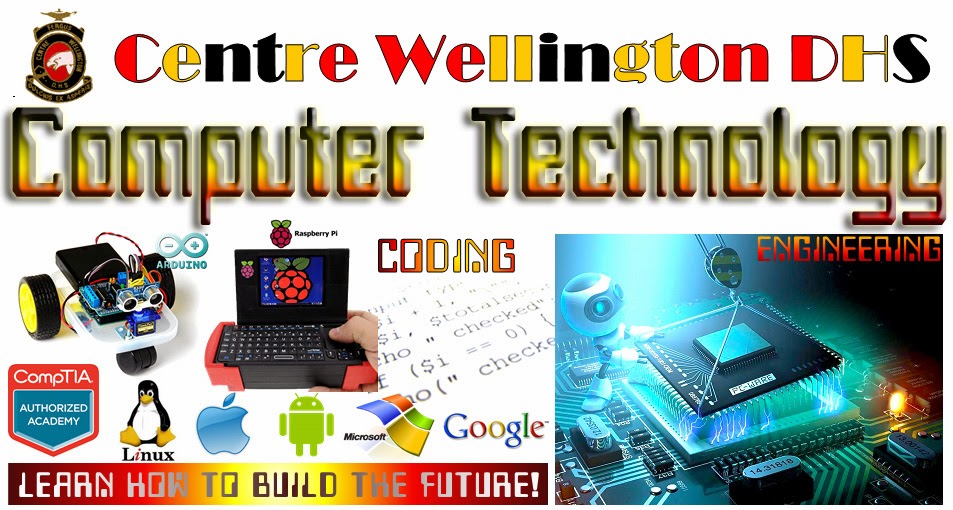
Rebranding & Refocusing on Applied Computer Technology


After learning about the messy history of computer studies in Ontario, I've been catching up on our school's history.  The computer studies department was created just prior to the new computer curriculum in order to create a headship for a computer science teacher who has since moved on.  The headship consolidated computer technology, computer science and the school IT support role all in one place.

When computer studies (actually computer science) became its own area of study independent from the rest of computer technology in 2009, our departmental divisions minimized that damage by keeping the now separated computer studies/technology (what's the difference? It's hard to tell with the vague titles) together.
  
Was it a good idea to keep computer studies and computer technology (two apparently completely different courses of study) together?  I'd argue that it's a pointless distinction based on a prejudice deeply ingrained in Ontario education.  Computer science teachers, like the majority of teachers, come from university/academic backgrounds.  These teachers are catered to in Ontario education with easier access to high pay grades (it's much easier for an academic teacher to gain level 4/honours specialist).  Many technology teachers who come into teaching through industry experience and apprenticeships (many of which are as long or longer than university programs) never achieve the highest pay grades in teaching.  Teaching in Ontario is inherently geared toward academics.

When computer science was amalgamated into computer technology (as a technology course), many comp-sci teachers thought it a demotion into 'tech'.  It took them eight years to get their academic subject back.

In a perfect world computer studies would be just that - computer studies, meaning a curriculum that addresses the subject completely from the most academic/theoretical side (computer-science) to the most applied/immediately useful (information technology, computer repair).  As in science (biology, chemistry, etc), we could have teachers with different backgrounds and training teaching complimentary subjects and collaborating within the same department.  It happens throughout the school (arts, science, tech), but apparently it can't happen in computer studies.  I believe this is because it attempts to straddle that academic/applied divide.

Between the political history of Ontario's computer studies and my own school's focus on consolidating heads, it looks like our computer studies headship will go away and computer science and computer technology will fly apart.  Personally, this is a relief.  Trying to give students access to coding through a computer science department that does more photocopying than English and clings to Turing as the be-all and end-all of programming languages has been a continuing frustration.  Being able to refocus around the more open technology curriculum in comp-tech would allow me to develop real world computing skills for students, something that I think 'computer studies' has failed to do.

If applied computing is the focus of computer-technology, then I don't intend to leave coding to computer science.  They can have the theoretical end of it all, and teach to university bound students interested in advanced mathematics, but I've long contended that coding is a universal skill that everyone should at least have a passing knowledge of, especially in the 21st Century.  To that end I've been remapping our course offerings in Computer Technology (as well as rebranding my subject area, because that is apparently - and sadly - what we have to do in Ontario).


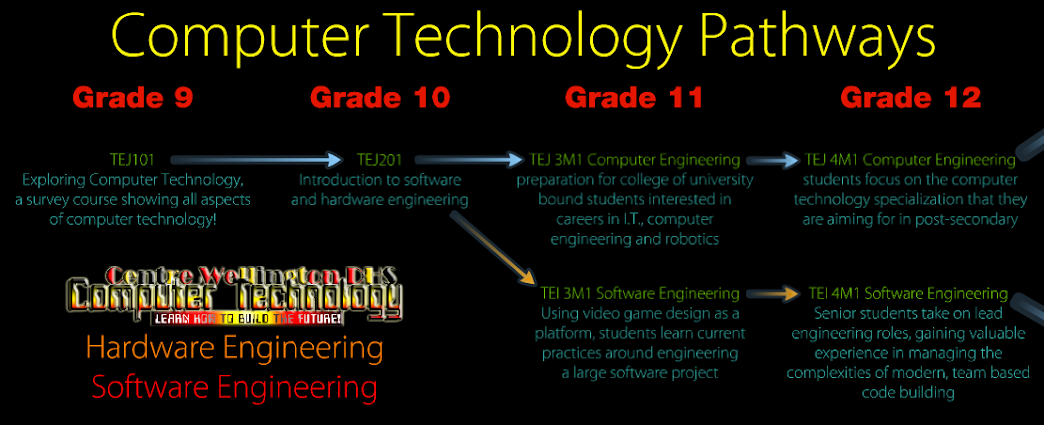
A grade 9-12 curriculum of applied computer technology study using current technologies that would give students
immediately applicable skills. A student who took this path would be literate in information technology, computer
repair, networking and coding, as well as have an understanding of industry practices in all those fields.
Would this dig into computer science's sections?  Yes, but isn't it more important to introduce a computer technology curriculum that increases digital fluency school wide?  Computers may have once been a theoretical subject area, but they've long since become a daily part of our lives.  Our computer curriculum should be introducing computer fluency to as many students as possible.  Our comp-sci department hasn't had a single girl in any senior course in the past four years.  That has to change.  Many other students who have an interest in digital technology are chased out of computer science by the photocopies, mistakenly thinking that comp-sci will teach them applicable skills.  That has to change too.


Rebranding computer studies to computer technology, because that matters to people in Ontario Education (though
it causes a lot of confusion for everyone else).  It'd be nice if pedagogy instead of prejudice dictated our computer
studies curriculums.
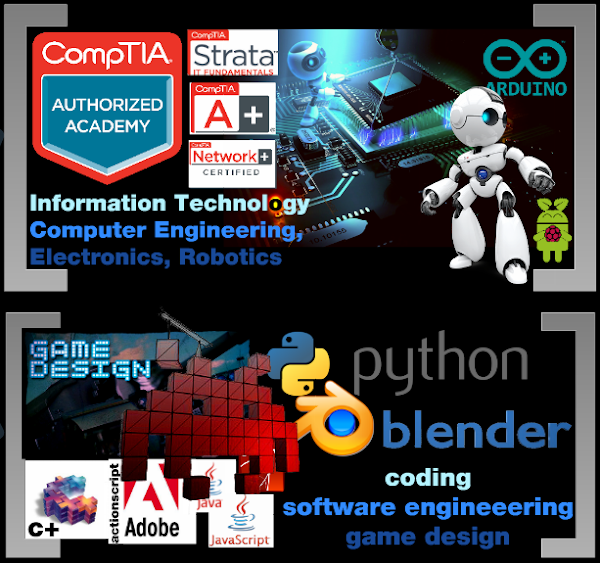
Here are some other pieces created for the rebranding:


Taken from code.org's fantastic array of promotional material and ICTC's Canada specific technology industry research.
And yes, I cut out the word science after computer because that apparently causes confusion in Ontario.  Is this really
how we do computer studies in Ontario?  Yes, yes it is.

Here is the  post on the computer technology graphics.
Here is the post from grade 8 parent's night, where computer studies was still a subject headship, that's all gone now.

The computer studies prezi: showing parents a coherent focus on computer studies (comp-sci included)
The computer technology prezi: showing parents a coherent focus on applied computer technology (no comp-sci in sight).


Other Reading:

Straddling The Divide: the end of computer studies at CWDHS.
Do You Teach Computer Studies or Computer Studies?:  where Tim stumbles into the political distinctions in Ontario's computer curriculum.

Thursday, 12 December 2013

Is Simple Better?

Once again Twitter teacher chat raises some interesting educational technology questions.  Chromebooks or ipads?  Louise's question had me asking questions about the question.  Why have we come to a place where we're asking which incomplete but branded and popular technology should we buy for schools?  Google and Apple have spent a lot of money locking in educators to their brand.  To me, that question signals a marketing victory for both of them.

Later in the conversation Julie asked what Chromebooks can't do.  At three hundred bucks a pop I'd hope they can do everything a comparably priced netbook could, but they can't.  They can't print, they can't connect to a projector to share a presentation, they can't install drivers so you can't use any peripherals on them (one wonders why they have usb ports at all).  Want to plug a scanner in to your chromebook?  No.  Want to plug in an Arduino?  No.  Want to install a decent graphics editor?  Sorry.  Want to install a fully fledged word processor instead of frustrating yourself with what g-docs still can't do?  Sorry.  Want to install an IDE and do some programming?  Nope.  Want to try a different operating system, or even dual boot into multiple environments?  Definitely not, that is the whole reason ipads and Chromebooks exist, to keep you in a closed ecosystem; you give away usefulness for simplicity's sake.

It was suggested that Chromebooks are much cheaper than laptops, but this isn't true either.  The much maligned netbook has grown up.  What used to be a single core, stodgy little laptop is now a dual core machine that starts with much more memory than it used to.  Taking the $300 per Chromebook cost I went looking for a comparable netbook in the fall and found the ruggedized, student ready Lenovo X131 retailing for about $250.  For $300 I'd add another 4 gigs of RAM to it and have an 8gb of RAM multicore netbook for the same price as a glorified browser.  It'll run the Windows version of your choice, and any Linux distro you could throw at it all off the same hard drive... oh, and you can install Chrome and still do everything a Chromebook can.


OK, it might be a bit unfair to call iOS a pointy stick,
but calling Linux needlessly complicated isn't.
I find the limited OSes in tablets and Chromebooks very frustrating.  I'll put up with it in a phone for mobility's sake, but in a day to day device for learning?  I'll admit, Linux is daunting, but Windows & OSx offer full operating systems with many uses.  If we're evolving into simpler and simpler OSes, what does that say about how we are using (and teaching) our technology?

Code.org is doing their hour of coding this week.  I got my nine year old doing it last night.  After we gave up on his ipad not being able to run the site we went to... yep, a regular old Windows machine.  You can't even expect an ipad to display a website properly.  Won't that be fun in a class of thirty kids?  At least it would have worked on a Chromebook.

During the conversation it was suggested that expecting teachers to understand the basic limitations of technology is exclusionary and doesn't allow them to focus on teaching.  I'd argue the opposite: selecting minimally functional technology to begin with is the problem, especially when we do it through the brand moderated ecosystems offered by Google and Apple.  Teachers don't all need to edit their own kernel in Linux, but they should have an understanding of how various technologies enable and limit their ability to perform basic functions (like opening a website properly), especially in a learning space.  Asking for basic digital fluency in teachers isn't asking too much in 2014.  We can then ask for it (by extension) in our students.

This may all sound anti-Google, but I assure you it isn't.  I've had a gmail account since it came out and I've got gigs of data in various Google drives (Dusty World is written in Blogger!).  I own an Android phone because it offers the most open ecosystem.  I value the tools Google offers, but I feel like the Chromebook is a tool designed to close off digital opportunities and drive everyone into a Google-centric cloud.  It follows ipad down the same closed-system dead-end that Windows is flirting with now.

When I'm using peripherals I need a computer, not a glorified web browser.  When I am setting up a complex document I need a proper word processor.  I can't do graphics and video editing in the cloud, I need a general purpose computer, and your students will too, even if that does mean teaching them how to maintain a more administratively complicated machine.

I'd argue for as big a tool-kit that offers as many digital opportunities as you can afford, something the question, "ipads or Chromebooks" doesn't begin to consider.