Showing posts with label Ontario curriculum. Show all posts

Sunday, 30 June 2019

Victory Lapping Like You Mean It

I've always struggled with the idea of victory lapping in Ontario high schools.  As someone who returned to high school to finish his final year in his early 20s, I understand the need.  Had I not been able to do that, I wouldn't be doing what I'm doing now and paying the taxes that I am.  I can see the value in a victory lap, but I did it with purpose, doing a full semester of school while also working a forty hour week.  For those victory lappers I see returning with that kind of intent, I have nothing but patience.

Find Rick & Morty hard to stomach? Your students don't...
Unfortunately, this past year I saw a number of victory lappers who didn't apply themselves in school and then did the same again on their victory lap, at great expense to the system.  If it's to get credits needed to graduate or get into a particularly difficult post-secondary program and the graduate is attacking the opportunity like it matters, then it's obviously a good thing, but if it's for familiarity's sake, as has been the case this year, then I have to wonder why anyone would want to chuck their final year of income (which is usually your best one) down the toilet so they can hang out in high school for an extra year.

Just think about that for a sec.  You're not giving up your first year of income when you victory lap, you're giving up your last.  Students (and parents) often misunderstand this fact.  You'll always start off at the lower end of the pay scale, but where you finish when you retire is what you're cutting a year from because you're starting late.  Victory lapping isn't just expensive to the system, it's astonishingly expensive to the student, but in a world of helicopter parents and childhoods designed to protect children from the results of poor decision making, we continue to produce graduates who want to stay in the safe, no deadline, guaranteed success of high school.


In addition to this costing each victory lapping student tens of thousands of dollars, it's also costing the system millions.  Victory lapping isn't a very efficient way of resolving graduates, but we do tens of thousands of times a year in Ontario.

The other night I was at our graduation where I saw all sorts of students graduating who are returning next year.  If they're graduating then it means they've already gotten the credits they need to move on, so why stay?  Some will argue that they're staying to raise their grades.  Was it worth tens of thousands of dollars to screw around in your grade 12 year instead of buckling down and getting it done?  Some are staying because they simply can't think of what to do next and couldn't be bothered to make plans because the system is waiting to look after them yet again.  Those students (and their parents) are putting an awful lot of weight on an increasingly underfunded school system by doing that, in addition to flushing that year of income down the toilet.


Year over year I've seen some radically different approaches to victory lapping.  In 2018 I had some very strong students victory lap and in doing so they did incredible, portfolio building things that helped them get into nearly impossible to access post-secondary programs.  When students do that with a victory lap, ie: ride it like they stole it, then I'd argue it's a brilliant strategy.  They might have lost a lower last year of earnings, but they've gained a new career trajectory that annihilates that loss.  In the case of 2018, where our victory lappers were winning their way to national titles and opening up career opportunities they otherwise wouldn't have considered, you'd be hard pressed to make an argument, economic or otherwise, for not doing it.

A few years ago I noticed that our victory lappers were often hanging around the computer tech lab having completed the course curriculum.  In many cases they were heading into digital technologies in post secondary and needed a final boost in terms of experience and an opportunity to build portfolio.  I developed the TEN4M course, specifically designed for digital technologies students looking to build portfolio for post secondary.  Up until this year it has worked a treat.  An opportunity to exercise engineering process and lead a self directed project that raises digital literacy in our school has been very beneficial.

The first year we did it Zach, who had struggled earlier on, was able to direct his new found maturity into his development as an IT technician to the point where he dominated Skills Ontario provincials with the highest technical score and a gold medal, and then a top five finish in Canada.  In the years since we've had students who have helped hone the TGI Game Development course into the weapon it is today, medal winning co-op students who have developed programs with our feeder schools to enhance both their technology and their teaching of it and a wide variety of other students who have developed the hands on technical experience needed to launch themselves into a career in tech.  Cal, our most recent Skills Ontario champion, used his victory lap to help form our first CyberTitan cyber security team and land us a national finalist position, then he went on to win Skills Ontario and get another top 5 national finish.  Cam, another of last year's victory lappers, also helped launch our CyberTitan program and then went on to a top 10 finish in our first ever attempt at coding at Skills.  In both cases these experiences launched them into Waterloo's Computer Science program, which is notoriously hard to access.

Finding the time to develop and explore technical skills that require hands-on experience and space to develop is especially challenging in an Ontario secondary curriculum that is still very much focused on academics.  For the students (and there are many) who want to work with their hands rather than at a desk, having an extra year to focus on applied skills is invaluable in a system where every subject is mandatory except those that teach hands-on technical skills.  For students who are trying to expand their digital portfolio in order to access difficult post-secondary options, it really is a necessity if the curriculum is going to remain as it is.

It looks like we've got a pretty good handle on how to accelerate students accessing a victory lap into post-secondary options, but this past year has been a victory lap disaster.  In semester one my only victory lapping student wasn't interested in leading projects or improving school technology access and learning (the point of the course: using your digital expertise, help to improve the school's digital access and usage).  From the year before when I had students blowing expectations (both mine and their own) out of the water, I went to 2019s flaccid VLappers who were just looking for a free go-around with no initiative or effort required.  In semester two they were so shaky they just ended up dropping out - after flushing a year of income down the toilet.  In cases like this, it's hard to justify victory lapping in any way.

For the students who need to make up credits or align their high school trajectory with a difficult to access program, I have infinite patience when it comes to victory lapping, but for the directionless, there needs to be something in place (a charge for dropped/failed courses?) that stops this being a year of doing as little as they can while draining a system that is already being strangled financially.  If students are victory lapping with purpose, developing their capabilities using focus from late blooming maturity, then I am more than happy to pay the taxes that enable them to fight their way into a world that is more economically inaccessible now than it has been for any previous cohort.

Sunday, 13 November 2016

ECOO16: the DIY approach protects you from the tyranny of technology

The perils of presenting last; you've got other things on
your mind instead of what you planned to present,

but it helped!
By the time I got to my presentation in the last slot on Friday I was brain full, exhausted and not entirely sure I would be coherent.  After a rambling review of what got me to the DIY lab concept I finally got rolling on the building and operation of your own classroom computer lab.  I hadn't intended to, but a moment from my time as a high school dropout was on my mind as I began the presentation.  Vocalizing the story helped connect several ideas that explained where the DIY technology idea came from.

Being handy I ended up working at a Canadian Tire for a couple of months as the tire change guy before I started apprenticing as a millwright.  One day early on I was watching one of the mechanics diagnosing a Renault Fuego.  As he moved around under this unfamiliar car he burned his arm on the exhaust pipe.  In a fit of rage he threw his spanner across the shop and then stormed off, shouting that he was going to make the customer buy a new exhaust system (the car was in with carburetor issues).  The customer, having no idea what happens under the hood of her car, reluctantly accepted the 'fact' that she needed a very expensive exhaust system replacement.  This moment stayed with me because it not only taught me what ignorance can cost you, but also made me question the veracity of 'professionals'.

My father is an industrial heavy machinery mechanic and told me, even as my technology got increasingly complicated (bicycle to car, Meccano to early computers), that if something was built by people he could figure out how it worked. I'd internalized that idea from an early age. My second bicycle was home made, after buying early software I started writing my own. We spent cold hours on the driveway replacing head gaskets and tuning carburetors. I came to the point where I'd never shrug off the complexity of technology and trust it to someone else.

This doesn't mean I'm an expert at everything, but I always have a look under the hood and grasp the basics before I use a technology, whether it's smartphones, the internet or a motorcycle.  Since cars became dependable enough the vast majority of the public have lost any interest in their inner workings, but that wasn't always the case.  Early adopters of automobiles were their own mechanics.  The maker movement is a step back towards that kind of technical familiarity, but it takes a special breed to maintain that level of curiosity and ownership of technology.

The difference between digital technology and automotive technology is that the digital stuff insinuates itself into your relationships and becomes a 24/7 part of your life.  It affects your thinking rather than your muscles.  Not knowing how a car works might occasionally inconvenience you and cost some money, but not understanding digital technology when you spend hours a day socializing through it or (worse) teaching with it, is a disaster waiting to happen.  It isn't a disaster for tech driven multinationals who live off your data though.  They will happily convert you and your students' ignorance into profit.

This growing ignorance is what prompted the do-it-yourself classroom computer lab.  Handing students turnkey digital tools like Chromebooks might suit Google's market penetration strategy, but it doesn't teach students about the tools they are using.  Some teachers have said that they are teaching their curriculum and not technology but if you're going to use it you should, as a teacher, understand it, otherwise it will make decisions for you.  That is neither professional nor desirable.  If you can't be bothered to understand it, don't use it - but you risk quickly becoming irrelevant.

I'm in the strange situation of teaching the technology that the vast majority of Canadians use but no one wants to understand.  A general understanding of how digital technology works is vital if you're going to have it participating in your life all day every day, and especially if you're going to teach and learn with it.  You don't need to be an expert, but you do need to have some conception of how this potentially invasive thing works.


ICTC posts Canadian statistics in digital technology
jobs each month.  Yet Geography is a mandatory course
while computer technology is an afterthought.
I look at Ontario curriculum and fail to understand how digital technological literacy isn't a fundamental requirement.  The vast majority of Canada's population uses personal, digital technology and in many cases that use is almost continuous, yet very few people understand how it works.

We're graduating students into a millennial unemployment rate of over 14%, but it drops to 6% if they are information-communication technology focused.  Even if they aren't specializing in technology, every graduate we produce is going to use ICT/computers in their job in some capacity or another.  Our graduates don't have the option to ignore digital technology as so many educators have.


The DIY lab I presented might be a bridge too far for many teachers, but for digital technology teachers or anyone whose curriculum depends implicitly on digital technologies (business tech, media arts) I think it should be a requirement.  The teachers presenting this technology to their students owe it to them to develop a deeper understanding of the tools they are using.  For everyone else (teachers and students), an understanding of what's under the hood should be an essential requirement, otherwise they are teaching and learning in ignorance, which isn't helping anyone.

It turns out that walking in to the presentation unfocused allowed me to laterally connect a lot of the foundational ideas around this do-it-yourself philosophy of educational technology use.


Sunday, 26 January 2014

Rebranding & Refocusing on Applied Computer Technology


After learning about the messy history of computer studies in Ontario, I've been catching up on our school's history.  The computer studies department was created just prior to the new computer curriculum in order to create a headship for a computer science teacher who has since moved on.  The headship consolidated computer technology, computer science and the school IT support role all in one place.

When computer studies (actually computer science) became its own area of study independent from the rest of computer technology in 2009, our departmental divisions minimized that damage by keeping the now separated computer studies/technology (what's the difference? It's hard to tell with the vague titles) together.
  
Was it a good idea to keep computer studies and computer technology (two apparently completely different courses of study) together?  I'd argue that it's a pointless distinction based on a prejudice deeply ingrained in Ontario education.  Computer science teachers, like the majority of teachers, come from university/academic backgrounds.  These teachers are catered to in Ontario education with easier access to high pay grades (it's much easier for an academic teacher to gain level 4/honours specialist).  Many technology teachers who come into teaching through industry experience and apprenticeships (many of which are as long or longer than university programs) never achieve the highest pay grades in teaching.  Teaching in Ontario is inherently geared toward academics.

When computer science was amalgamated into computer technology (as a technology course), many comp-sci teachers thought it a demotion into 'tech'.  It took them eight years to get their academic subject back.

In a perfect world computer studies would be just that - computer studies, meaning a curriculum that addresses the subject completely from the most academic/theoretical side (computer-science) to the most applied/immediately useful (information technology, computer repair).  As in science (biology, chemistry, etc), we could have teachers with different backgrounds and training teaching complimentary subjects and collaborating within the same department.  It happens throughout the school (arts, science, tech), but apparently it can't happen in computer studies.  I believe this is because it attempts to straddle that academic/applied divide.

Between the political history of Ontario's computer studies and my own school's focus on consolidating heads, it looks like our computer studies headship will go away and computer science and computer technology will fly apart.  Personally, this is a relief.  Trying to give students access to coding through a computer science department that does more photocopying than English and clings to Turing as the be-all and end-all of programming languages has been a continuing frustration.  Being able to refocus around the more open technology curriculum in comp-tech would allow me to develop real world computing skills for students, something that I think 'computer studies' has failed to do.

If applied computing is the focus of computer-technology, then I don't intend to leave coding to computer science.  They can have the theoretical end of it all, and teach to university bound students interested in advanced mathematics, but I've long contended that coding is a universal skill that everyone should at least have a passing knowledge of, especially in the 21st Century.  To that end I've been remapping our course offerings in Computer Technology (as well as rebranding my subject area, because that is apparently - and sadly - what we have to do in Ontario).


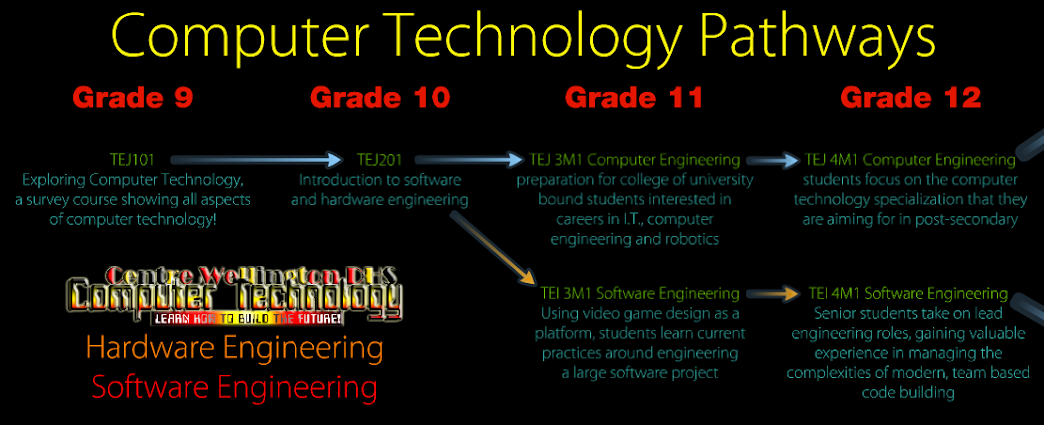
A grade 9-12 curriculum of applied computer technology study using current technologies that would give students
immediately applicable skills. A student who took this path would be literate in information technology, computer
repair, networking and coding, as well as have an understanding of industry practices in all those fields.
Would this dig into computer science's sections?  Yes, but isn't it more important to introduce a computer technology curriculum that increases digital fluency school wide?  Computers may have once been a theoretical subject area, but they've long since become a daily part of our lives.  Our computer curriculum should be introducing computer fluency to as many students as possible.  Our comp-sci department hasn't had a single girl in any senior course in the past four years.  That has to change.  Many other students who have an interest in digital technology are chased out of computer science by the photocopies, mistakenly thinking that comp-sci will teach them applicable skills.  That has to change too.


Rebranding computer studies to computer technology, because that matters to people in Ontario Education (though
it causes a lot of confusion for everyone else).  It'd be nice if pedagogy instead of prejudice dictated our computer
studies curriculums.
Here are some other pieces created for the rebranding:


Taken from code.org's fantastic array of promotional material and ICTC's Canada specific technology industry research.
And yes, I cut out the word science after computer because that apparently causes confusion in Ontario.  Is this really
how we do computer studies in Ontario?  Yes, yes it is.

Here is the  post on the computer technology graphics.
Here is the post from grade 8 parent's night, where computer studies was still a subject headship, that's all gone now.

The computer studies prezi: showing parents a coherent focus on computer studies (comp-sci included)
The computer technology prezi: showing parents a coherent focus on applied computer technology (no comp-sci in sight).


Other Reading:

Straddling The Divide: the end of computer studies at CWDHS.
Do You Teach Computer Studies or Computer Studies?:  where Tim stumbles into the political distinctions in Ontario's computer curriculum.

Tuesday, 21 January 2014

Do you teach computer studies or computer studies?


Stay with me now, we're going down the rabbit hole that is Ontario curriculum for computer studies, or as it's also known, computer studies.  

What was once computer science is now called computer studies.  Shortly thereafter computer studies (same name) was created in the technology section of curriculum.  These computer studies are so different that qualification in one doesn't qualify you to teach the other (unless you happened to be already qualified in computer science ten years ago).  The descriptions of each have so many similarities that you may be forgiven for wondering why a teacher of one isn't a teacher of the other (computer studies).


Computer Studies (aka: computer science) defines itself as:

Computer studies is about how computers compute. It is not about learning how to use the computer, and it is much more than computer programming. Computer studies is the study of ways of representing objects and processes. It involves defining problems; analysing problems; designing solutions; and developing, testing, and maintaining programs. For the purposes of this document, the term computer studies refers to the study of computer science, meaning computer and algorithmic processes, including their principles, their hardware and software designs, their applications, and their impact on society. The major focus of these courses is the development of programming skills, which are important for success in future postsecondary studies.

When you compare the computer studies curriculum outline with the computer studies curriculum outline you may notice many similarities.  Both begin with an emphasis on how they aren't about teaching users to use computers, and neither are limited to programming.  Both go on to emphasize a course of study focused on how computers operate, including how computers are able to create and manipulate objects and run processes.  The computer studies (comp-sci) document then goes on to state that computer studies actually means computer science, which doesn't really help clear anything up since computer studies (tech) calls it computer and information science, which may or may not be the same thing.

The computer studies (tech) curriculum is pretty much interchangeable with the computers studies (comp-sci) curriculum, but it also offers engineering focuses on electronics and computer hardware, so it might be argued that this is a more complete 'computer studies'.


The 'other' computer studies found in technology studies defines itself as:

Computer and information science is more than running application programs and programming.  Rather, it relates to the ways in which computers represent conceptual objects and how computer systems allow those objects to interact. Computer and information science is the study of ways of representing objects and processes. It involves defining problems, analysing and designing solutions, and developing, testing, and maintaining programs. Computer and information science education is relevant for all students because it incorporates a broad range of transferable problem-solving skills and techniques. It combines logical thinking, creative design, synthesis, and evaluation, and also teaches generically useful skills in such areas as communication, time management, organization, and teamwork. Computer and information science will prepare students for an increasingly technological world. A foundation in this discipline will introduce students to the excitement and opportunities afforded by this dynamic field and will begin to prepare them for careers in information technology.

As you can see, not only is the language used similar, but even the explanation of the scope of the subject seems the same.  I suppose computer and information science are so completely different from computer science as to make this a no-brainer.

If this wasn't muddy enough for you, there is also the issue of computer science teachers (because they were here first) getting grand-fathered in as computer studies-tech teachers, even though they may have no engineering background at all and may be as familiar with the inside of a computer as your grandmother.  This results in computer science teachers (theoretical mathematics majors) attempting to teach how to solder a circuit or build a functioning network.  More often than not, in my experience, they simply ignore this part of the subject.

If you want to be computer studies (tech) certified now-a-days you have to produce years of industry experience and professional certifications in order to even be considered qualified to begin the certification.  If you were hanging out in a math class ten years ago it landed on you.  I'm having trouble doing the pedagogical calculus with that one.

Between the confusion in subject area titles, almost identical descriptions and the right-time-in-the-right-place-with-no previous-experience history of computer studies qualifications, it's little wonder that Ontario Education in this area is, at best, confusing, and not particularly effective.  When you meet a computer studies teacher that doesn't know how to open up a computer, you have to wonder where we went wrong.

I just threw together a quick venn diagram of computer studies to try and straighten out my thinking around this.  Now, I'm not a curriculum expert at the ministry or anything, but it seems to me that arbitrarily dividing a subject into two camps isn't very pedagogically helpful, let alone logical.
I'm just spit-balling here, but wouldn't a coherent course of computer studies
that recognizes how all these parts integrate into a whole make some kind of sense?
If you consider the basics, computers run code on hardware.  If you're going to teach computer studies, I would suggest that it makes sense to recognize this and form your curriculum around this simple truth.  Rather than grand-father in one extreme end of the computer studies curriculum (computer science), why not form a coherent, single department that studies the subject in all its glory?

If you've got previously computer science focused teachers, make it easy for them to expand their knowledge of the subject into the more practical side of computing, but don't expect it to magically be there.  If you have people coming at it from the more practical side (as I did from information technology), make it easier for them to bone up on coding and the theoretical side of things.  You'd end up with a curriculum of computer studies that not only addresses the extreme ends of the spectrum (computer science up one end, electronics up the other), but also creates a sensible, interconnected and relevant understanding of computers in both staff and students.  Best of all, you'd never run into a computer studies teacher who says things like, "Oh, I don't touch computers, I have no idea how to fix one."

Until we recognize computer studies as a single, coherent course of study and integrate curriculum to support this truth, we're going to continue to limp along producing radically undertrained graduates who aren't remotely ready for what faces them.  I often meet teachers in other schools who are surprised to learn that we teach computer engineering - or that it exists at all.  When I was in high school we ran two full teachers worth of computer studies (12 sections).  The school I work at now is about the same size and runs 7.  Are computers really about half as relevant now as they were in 1986?  Students numbers would suggest this is the case.  Instead of creating a modern, adaptive, complete curriculum, Ontario has created a divisive, broken one that students ignore.

I'd like to think we'll stop the bizarre divisions currently going on in Ontario computer studies curriculum, but I get the sense that there is some history in this that won't go away.  We need a clean sheet on Ontario's approach to computer studies (starting with just one computer studies that incorporates the entire field of study), or we won't be doing this emergent and vital 21st Century subject justice.

***

Follow-up:  Doug Peterson pointed out what each curriculum document is supposed to be replacing on G+, so I've been trying to trace the process.  Here's what I've got so far:

There are three curriculum documents that come up for computer studies.  

  • The year 2000 Technology Studies document that contains computer studies as a complete field of study, from engineering to computer science.
  • The 2008 Computer Studies document (revised) that looks like it is separating computer science from computer studies but took the computer studies name with it (implying, I think a complete study of computers, not just computer science)
  • and the 2009 Technology Studies document (revised) that contains "Computer Tecnhology" and has stripped any computer or information science material out.
The 2008 Computer Studies (science) revised document states:

This document replaces the Computer and Information Science component of The Ontario Curriculum, Grades 9 and 10: technological Education, 1999, and of The Ontario Curriculum, Grades 11 and 12: Technological Education, 2000. Beginning in September 2009, all computer studies courses for Grades 10 to 12 will be based on the expectations outlined in this document.


The 2009 Tech-studies document (revised) states:

This document replaces all but the Computer and Information Science component of The Ontario Curriculum, Grades 11 and 12: Technological Education, 2000. Beginning in September 2009, all technological education courses for Grades 11 and 12 will be based on the expectations outlined in this document.


From the original 2000 Tech-Studies document:

 This document replaces the sections of the following
curriculum guidelines that relate to the senior grades:
–  Broad-based Technological Education, Grades 10, 11, and 12, 1995
– Computer Studies, Intermediate and Senior Divisions, 1983
– Computer Studies, Ontario Academic Course, 1987
– Technological Studies, Intermediate and Senior Divisions, Part C: Ontario Academic Courses, 1987

I still can't help but think that the 'computer studies' title is at best confusing and at worst misleading.  I wonder at the politics that played around that course of study being created with such an expansive (and previously used) title but such a specific focus.  It would be like renaming the "biology" department "science", taking one part of a larger course of study and implying that it is the whole subject.  Computer Studies (the study of computers?) is not just computer science, or just engineering, or just information technology.  Trying to understand it in such a fractured way leads to confusion in the general public and students who then aren't taking the course.


Just to throw a wrench in things, if you're curious and look up
Ontario's technology curriculum you get the old curriculum
document first every time.  If you're not up on the secret
war between comp-sci and comp-tech in Ontario, you'll
remain ignorant looking at the old document.
If you were teaching computer studies prior to September 2009, that meant computer studies (from end to end).  If you were teaching computer studies after September 2009. it  means only computer science.  I'm beginning to see why computer science is atrophying in modern high schools.  At a time when computer studies should be offering population wide access to digital literacy, one of the foundational areas of  computer studies in it has taken its toys and gone home.

Another question (that Doug probably knows the answer to) is those early computer studies courses, were they computer science based on more general in their approach to all aspects of computing.  My own memory of taking computer courses in the 1980s was very comp-sci/math based, and the teachers who were qualified to teach computer studies were computer scientists in university.  Yet in 2000 it looks like technology education took over computer studies (including computer science), yet the amalgamation doesn't appear to have worked (hence the 2008/9 revisions).  I wonder why not.

The division seems to have happened over the past fourteen years, starting in 2000 with a failed attempt to place computer studies in technology education.  It's no better today, and I get the sense that the attempted fixes have caused more problems than they solved.