Monday, 27 July 2015

A Thin & Fragile Pretense

I'm still mulling my way through The World Beyond Your Head, by Matt Crawford.  It's a slow go because I'm re-reading and thinking over what I'm looking at, often paragraph by paragraph.

On page 153-4 Crawford is talking about the way in which we depend on established values when transacting with each other.  He is talking about how he bills his motorcycle repairs, but I found a surprising correlation between this and my current views on grading:


P.153-54 The World Beyond Your Head by Matt Crawford


This could easily be re-written to describe my own battle with grading:

Consider the case of a teacher. In handing a final grade to a student, I make a claim for the value of what they know about what I have taught them, and put it to them in the most direct way possible (a grade). I have to steel myself for this moment; it feels like a confrontation.  (I hate grading, I feel it actively discourages learning by implying there is a definitive end)

 The point of having posted criteria, rubrics, due dates, class rules,  and the use of complex grading systems with byzantine weights and balances, is to create the impression of calculation, and to appeal to the authority of an institution with established rules. But this is a thin and fragile pretense observed by me and my student - in fact the grade I present is never a straightforward account of the skill of a student. It always involves a reflection in which I try to put myself in the shoes of the other and imagine what he might find reasonable.  (Freeing myself from the tyranny of grading programs is both professionally satisfying and existentially terrifying – what are we all doing here if not making numbers?!?)

This lack of straightforwardness in valuing learning is due to the fact that learning is subject to chance and mishap, as well as many diagnostic obscurities. Like medicine, teaching and learning are what Aristotle calls "stochastic" arts. Especially when working on complex skills at the high school level, in trying to teach one discipline (learning how to code), I may unearth problems in another (the student has little grasp of basic logic). How should I grade for work done to solve a problem beyond the realm of what I’m supposed to be teaching? Should I hand off this new problem to spec-ed, or simply blame previous grades and move on? (I do neither, I consider a student who is able to overcome previous failings to catch up to his peers to be superior to a student who is simply going through the motions because this is easy repetition for them)  This question has to be answered when I formulate a grade, and in doing so I find that I compose little justificatory narratives.


When a student receives a grade, I usually go over the reasons with them in detail, and I often find myself delaying the presentation of the grade, because I fear that my valuation isn't justified (I can never have all the facts needed to be completely accurate). But all my fretting about the grade has to get condensed into a simplistic number for the sake of systemic learning on an established schedule (our education system is predicated on the receiving of numbers that are so abstract as to be virtually meaningless). Whatever conversation may ensue, in the end the grade achieves a valuation that is determinate: a certain amount of educational value exchanges hands. As the student leaves the class for the last time, I want to feel that they feel they have gotten a square deal in terms of me not using grades as either a gift or a punishment; I want to come away feeling justified in the claim I made for what I think they know and can do.   (but many teachers don't - empathy and grading can be safely made mutually exclusive thanks to the absolute truth of mathematics, the more complex the calculation, the truer the grade it produces must be)

Sunday, 19 July 2015

Sympathetic Teachers

For the past couple of weeks my yoga instructor has been away so I've been learning with another teacher.  I've been with the same instructor for about a year and I've gotten used to her ways.  Our fill-in instructor is actually the studio owner and a more experienced teacher, but I'm used to what I'm used to and I'm finding the change challenging.

The differences in how each teaches got me thinking about how learning and the relationship it is based on works.


My regular instructor pushes herself and her students.
It works for me.
I'm the furthest thing from a yoga expert but I enjoy the process and I've gotten better at it in a year of practice.  My regular instructor is very focused on form and pushing through physical barriers.  Her own practice is flawless.  Our current instructor is much more mentally focused, asking us to be mindful of what we're doing and de-emphasizing the physical side of things (though I still find her classes very physically strenuous).  Neither is right, but they are very different in how they demonstrate their mastery and what they focus their students on.  I've enjoyed the change but I've bonded with my regular instructor and I'm looking forward to getting her back.

The personal nature of the relationship between a master and apprentice is based on choices by both.  Masters tend to select for apprentices who they can work with, and vice-versa.  Back in the day when apprentices were unable to select their masters this wasn't the case, but nowadays you see this self-selection all the time.  When a student finds a teacher they share a wavelength with they tend to latch on.  Variety is the key to this selection process.  I probably wouldn't have stuck it out (yoga is hard work) if I hadn't connected to the instructor's approach enough to overcome the difficult early months.


Another philosophical thought from my regular instructor.
She wants you to develop quickly, find your limits and
then push through them. In that struggle is found yoga.
In my first year of university I asked my history TA how she knew what to focus on.  She laughed and said it was all about the prof, why else would she be doing her Masters in Scottish history?  That personal relationship is an important part of a student's willingness to put up with the pain of learning a discipline.

In the education system you get the impression that this individualism is a bad thing.  Teachers are encouraged to adopt whichever educational philosophy is in vogue and be ready to move on to the next one when the next book comes out.  Most experienced teachers have learned to not get caught up in this kind of thinking (one of the key failures of professional development).  It tends to be the game of educational leadership to push a school-wide vision of teaching in order to establish some kind of standard.  Teacher assessment uses checklists and fill-in-the-blank templates based on the school system's idea of an ideal teacher.  This implies that there is only one way to teach properly which would kill any chance of a student finding a teacher who speaks to them, unless your students are as generic as your teachers.  When the system assumes surrogacy for learning, human relationships are diminished and the ability to learn is compromised.

Ease of learning is another aspect of this problem.  I like my yoga instructor because she doesn't make it easy, she demands hard work but she's quick to praise both the effort and the improvement that comes from it.  Many students came and went but this only reinforced the success of the ones who stuck it out.  This is the opposite of the everyone succeeds approach in the current education system.  Learning is not easy, nor should it be, but that doesn't mean a teacher should be cruel or dismissive, quite the opposite actually (watch Whiplash for a complex look at this idea).  If learning is a challenge (and someone is trying to sell you something if they say it isn't) then a teacher should offer an individualized and sympathetic means of accessing a discipline rather than making an already difficult task harder.  Empathy is implicit in teaching, but especially so when it's between a sympathetic student and teacher - their shared ideals allow them to tackle ever more complicated learning on the road to mastery.  Not only is this an emotional support while dealing with difficulties, but it's also an aid to communication.  Much less needs to be explicitly stated when you're working with someone you understand.  I'd actually argue that mastery learning can't happen without this relationship.

The concept of edutainment seems to have infected all levels of the education system.  Fun, happy learning where the teacher must provide so much entertainment value that students don't even feel like they're learning (!) is the mantra of modern education.  Expecting students to put up with difficult lessons and experience failure isn't the way nowadays.  The vast majority of the coddled students I deal with wouldn't have come back after the first week in my yoga class.

Perhaps the gee-wiz, 'learning is fun and easy' philosophy of education is really another attempt to undermine the pivotal personal relationship between teacher and student.  When students aren't expected to overcome any difficulties and can't fail you also don't need to depend on the personal bond between teacher and student to encourage a student to withstand defeat, build resilience and eventually experience the kind of confidence that isn't systemically assumed.


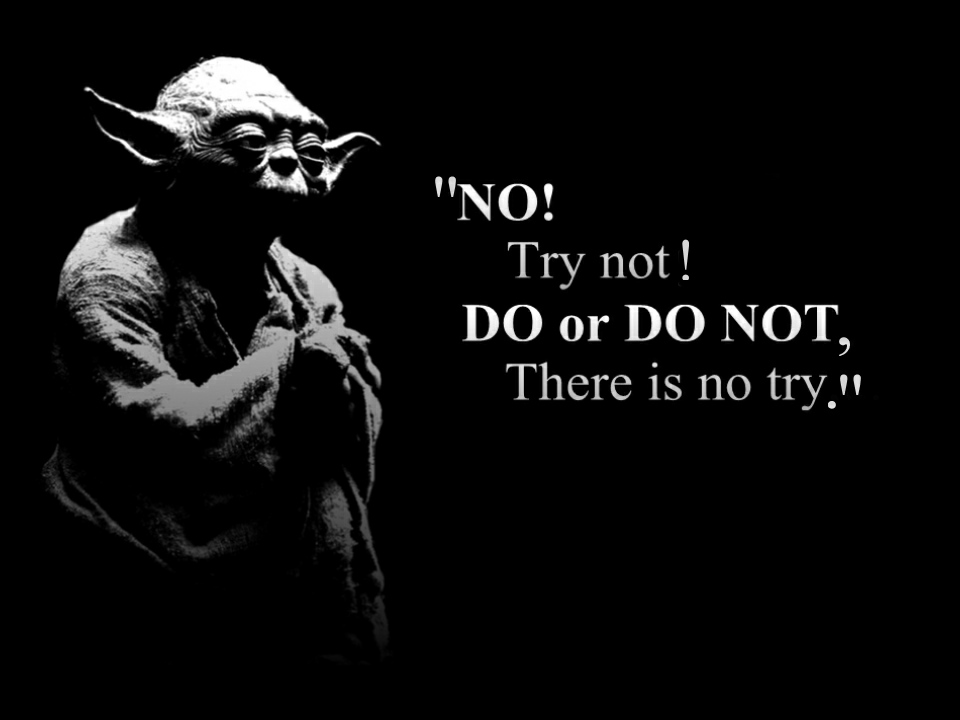
That muppet knows mastery learning!  The modern education
version would be, "just show up (optional)
and we'll get you a diploma."
I was looking for a challenge when I started yoga.  I was feeling stiff and old and I was willing to work at fixing it.  Being dared by my instructor to push beyond the obvious discomfort I was feeling only worked because I respected her approach to the practice.  The first time I found my toes again or got heels down in downward dog I was ecstatic.  It took me months to get there.

Almost a year later I weigh 20lbs less, my flexibility is always improving and I find yoga much less painful than it once did.  It wasn't easy and I was tempted to quit a number of times.  The day after often felt like I'd been 'hit by the yoga truck'.  I was able to see improvement, but it happened slowly and sometimes I regressed.  Trust and respect in my instructor is what got me through the urge to quit early.  Why would my instructor spend all this time on her students who stick it out, pushing herself to demonstrate her practice in order to benefit us?

I've taken many aspects of my instructor's practice and made it my own.  Her practice is uniquely her's, but as her student I've been able to closely observe and internalize various aspects of her practice as well as her overall philosophy in order to develop my own yoga.  As a teacher my approach tends to be copied in part by like minded students (the incompatible ones aren't even aware there is an approach, they think it's all about facts).  It's thrilling for me to see a student tackle a difficult problem and see a bit of myself in it - it's almost like I'm the parent of their practice.

I speak with the voices of the sympathetic teachers in my life, any good student does, but if we continue to push for a systematized version of teaching that de-emphasizes the human connections through which we develop resiliency and master challenging learning, we'll end up with students who are unable to do anything other than exist within an ineffective education system.

We should be celebrating differences in teachers because they all speak to different students and allow a wide variety of learners to find their own way to mastery.  The standardized, generic teacher who follows the lesson plan template using the educational philosophy of the moment is no teacher at all (though you sure could pay them less!), and they would be teaching to a standard student that doesn't exist.  Had I walked into that on my first night of yoga I would have walked out again.

Monday, 22 June 2015

The New Efficiency

This African proverb passed me on the
internet last week, and left me thinking.
Last semester I had an energetic grade 9 suddenly stop his interaction with the internet and wonder out loud (and it was asked in all seriousness):  "why is it in video games and movies old people are so cool, with hidden knowledge and special powers, but in real life they just suck?"

He received an avalanche of 'how could you say that?!', but then everyone went on to say how wonderful their grandparents were.  Everyone loves their grandparents, but no one was willing to defend age and by extension experience in and of itself.

When this African proverb popped up I immediately felt the pinch of that class discussion (yes, I know, we were talking about the value of age and experience in a class where I was supposed to be teaching computer engineering, I guess my kids won't be ready for whatever standardized test they invent for it).

What role does age and experience have in the information age?  This proverb also refers to libraries, which have been facing their own test of relevance thanks to the Googliable nature of information.

Information technology has made personal knowledge irrelevant.  The life experiences of human beings have become meaningless, replaced by internet searches.  Why would you bother to ask your grandfather how to change the brakes on your car when you can just Google it?  Once a useful source of information, the elders around you are now objects of affection and little more, they serve no function.  You can get the information you need without any of the static (anecdotal stories that accompany the information).  This sanitized, machine driven version of knowledge has many benefits.

You can reduce complex human knowledge (for example, the development of literacy) into simplistic, easy to quantify standards and then make sweeping suppositions about the results.  Banal opinion based on internet 'fact' is the new intelligence.  Like any opinion you hear online, carefully crafted grading schemes end up becoming the truth, which fits nicely into the antiseptic version of knowledge the information age peddles.

Another benefit is the downward social pressure on human communities.  When you plug people into a centralized source of information you wean them from the social necessities of family, community and even nation.  When no one needs anyone else (but they do need an ISP), you have removed all the social static and laid the groundwork for a kind of hypercapitalism that will make past look like the middle ages!


When we try and argue for meaningful learning (in anything other than a poster), we are met with educational administration making sad faces and saying it's not viable.  The reasonable provision of caps on class sizes is just such an attempt, which is why the meme on the right goes straight to the heart of this issue.

Tangible data that grossly oversimplify human endeavour are how we roll nowadays.  As the poster states, class caps mean nothing, but fail to hand out a piece of paper with grades so abstract that they are meaningless along with computer generated comments, and 'everyone loses their minds!'

There is some push back against the dimensionless facts that drive the information age.  You find it in the physical world in grass roots movements like slow food or maker spaces
where you see individuals trying to wrest control of production from the hands of remote systems.  In these places the idea of human interaction is key to the process of learning.  They are trying to build communities in an arid digital landscape that is bereft complex human interaction... unless they are under a corporate banner; communities designed for marketing purposes.  What would be the economic sense in creating a community solely for the benefit its members?

Ironically, human interaction is less and less a factor in human education.  The push to integrate technology into pedagogy without considering its implications has infected education systems with the same efficiency that we now enjoy everywhere else.  We can hardly expect the personally demeaned yet highly efficient funployees in the private sector to demand anything other than consistent menial labour, it's what they do.  Developing complex personal relationships in order to effectively mentor and teach aren't very efficient/economically viable.  They are certainly discouraged in the brave new world of 21st Century education where teachers are now facilitators, reduced to getting out of the way of learning and making sure the #edtech is working.

One of my students from many years ago is now out in the world.  She was sitting in a restaurant a few weeks ago watching two employees, a teenage girl and an older woman on their break.  The older woman kept trying to start a conversation.  The teen ignored her, buried in her phone until she finally snapped, 'What? What do you want?"  She was incensed that this woman had interrupted her texting time.  She was probably in withdrawal because they don't let her have the phone while working.  I can bet which one of those two employees gets better performance reviews, though she sounds like an ass.

Maybe human experience is meaningless nowadays.  Maybe old people are useless and libraries are a waste of space (great idea: replace every one in school with franchise coffee shops to balance the books!).  Maybe we don't need each other to learn any more, it's certainly not as efficient.


LINKS

Watch the new efficiency infect the UK's Labour Party
"In 2015 we are living in a cold, cruel, and desolate country in which benefit sanctions, foodbanks, poverty wages, and ignorance reign, governed by a clutch of rich, privately educated sociopaths whose conception of society has been ripped straight from the pages of a dystopian novel."

Friday, 22 May 2015

Cheaper Teachers for a Cheaper World

I'm reading The World Beyond Your Head, the latest from Shopclass As Soulcraft writer Matt Crawford.  In this chapter he's been working out how experts manipulate their environment in order to expedite their mastery.

How an expert arranges the space around them in order to perform allows non-experts a window into skills that might otherwise be beyond them; you can comprehend mastery indirectly by observing how an expert arranges the space around them.  The difference between an amateur and professional chef becomes obvious from this assessment.

This is an interesting observation that goes to the core of much of the friction in teaching nowadays.  Most of the lay public has no idea how teaching works yet they feel capable of criticizing the profession.  'I was once in school, so I know how to teach' makes as much sense as, 'I once had surgery so now I'm a surgeon'.  By looking at how teachers 'jig' learning spaces someone who has never taught might get a glimpse into the complexity of the craft.

The idea that experts manipulate the space around them is something that many people might intuitively understand without thinking through the why.  With few exceptions a master will create an organized system around them that allows them to efficiently operate; the space around them becomes an extension of their mind used to organize and expedite their activity.  The process of learning how to jig your environment to support your expertise is one of the most obvious indicators of mastery.  Disorganization, clutter and lost tools are an apprentice's battle.  This sheds some light on my mechanic father's constant frustration at the state in which I left his work bench.  

The generic workspace is even worse.  This space is designed for you by the thinking class and you are reduced to a simplistic component with limited expectations.  You don't need professionalism or mastery in an environment like that.  This is the world most teacher critics inhabit. Their limited education has made them ideal simplistic components.
What a jig is and how it's vital to the expert.  Do you jig your
classroom, or do you rock the assembly line?  Via Google Books.

You can often see expertise in teaching through how a teacher arranges their classroom.  The learning environment that is jigged by the teacher to enable them to educate more effectively also reflects a deeper understanding of the art of instruction.  This teacher's classroom contains nothing extraneous.  The teacher knows where everything in there is and how to use it.  There are no dusty, unused text books on shelves or out of date posters on the wall.  You can see intent in how the classroom is designed.

Not only is the equipment at hand, but how its arranged can also facilitate how a lesson is presented; structured meaning is hidden in everything from floor plans to decorations to seating arrangements.  By contrast the classroom that looks like an assembly line indicates a teacher of the McDonalds variety.  It's hard to argue for professional dignity in teaching when so many teachers are more than happy to follow fast food methods.  Take a walk around any school.  Do all the rooms look the same?  Are they expected to?


A great example of how an expert creates and uses their own jigs to
enable them to produce results well beyond the layman.
The idea that a job can be done more efficiently (read: more cheaply) using a tightly controlled, top down system is the way of things in our increasingly computerized world.  We have machines making life and death decisions for us now instead of demanding human expertise.  Machines are only going to get better at making these decisions as humans only become more atrophied at them. 

The comparison between the McDonald's assembly line with its rigid, dictated jig and the cook who controls her own space is stark.  Both environments are designed to aid the person inhabiting them create a better product, but one is authored by the person themselves while the other is instituted (and enforced) by unseen management.  One is designed for cogs, the other demands expertise.  One demands respect for the worker's mind, the other makes them disposable hands.

We're offloading the value of skilled labour onto organizational structures.  The initial idea is that this saves money, but I suspect the long term implications are lowered expectations, workers made powerless and ultimately a less democratic division of knowledge.  If mastery is dying thanks to a neoliberal drive to lowest cost production (experts are more expensive and difficult to manage than easily exchangeable and cheaper unskilled labour, especially when we can oversee them with continually improving surveillance technology), we can expect some of the last bastions of professionalism to eventually dry up and take on the minionized labour processes that have infected private business.

"Cheap men need expensive jigs; expensive men need only their tools" rings true in the direction many people seem to want education to go.  A centrally controlled system with 'facilitators' instead of 'teachers' that lean on the burgeoning might of educational technology not only satisfies the possibility of selling technology to education systems (perhaps even monopolizing them!), but it also scratches the itch of the moneyed class to centralize both profits and knowledge.  We can expect less from facilitators in pre-jigged classrooms with assembly line learning couched in centralized cloud based computing with ready made lessons aimed at standardized tests.  You need only show up, start the video and let Khan at 'em on their clearly branded corporate learning devices.  You could probably hire three facilitators in that environment for the price of one teacher:  cost savings!


It's much cheaper to watch sanitized  media and sit in rows preparing
for standardized tests than it is to actually do things.  Fortunately, people
who actually do things aren't really needed in our efficiently designed future.
Since going mainstream digital technology is intent on market share rather than serving the user. Getting machines into as many hands as possible is the mandate now and that mandate is served by simplistic, closed ecosystems designed to create consumers.  I'm not sure if neoliberalism has incorporated digital technology or it's the other way around, but no matter how you look at it the two social influences work hand in glove.

The expectation of mere competence, let alone mastery, is dying.  You can observe this by watching how fewer and fewer employees are expected to jig their own environments to serve their process (the process™ isn't theirs any more).  Workplaces are now assembly lines of the mind with dictated jigs.  Employees are assessed on their willingness to adjust to these systems, the less free thought the better.

We are centralizing expertise on a massive scale (just follow the money) and creating a future where everything will look similar and pre-decided, but ever so efficient. The classroom is one of the last bastions of professionalism where an expert can apply their own jig but the days of reasonable class sizes and hands on learning that allow for this kind of jigging are drawing to a close.  Teachers should enjoy the final days of self determination in their workplace, the future is designed for cheap, disposable people.  Fortunately the world is full of them.


Once in the top five, Canada is beginning to follow the US down the education rankings
as de-professionalization reduces teachers (and the students they teach)

into low paid, disposable labour.

Friday, 24 April 2015

Neurology: Is it the car, or the car and driver?

We had board PD today (a 3 hour lecture).  It was a presentation on neurology in learning and layered curriculum by Kathie Nunley.  I'm generally a fan of a nuanced scientific approach to human activity (as opposed to a simplistic approach to things that usually support buying something).  Dr. Nunley's neurological approach to education offered a number of insights to what we're doing wrong.  If we don't consider biological imperatives in learning we will never be as efficient as we might be.


There was a moment where I came to the end of neurological approach and the 'ol philosophy degree kicked in.  Nunley had a slide stressing the importance of the appearance of choice in learning.  She stressed how engaging it is for students when they feel like they can choose their learning.

My knee jerk response was that this was manipulation, which led me down a metaphysical rabbit hole.

Neuroscience, because it's looking at the brain, comes dangerously close to itemizing our sentience.  It also tends to reduce multi-dimensional complexity into simplistic linearity.  This idea that the appearance of choice would prompt more efficient learning would encourage any right minded teacher to manipulate their students into thinking they have learning choice in order to harness better retention.  No right minded teacher should be manipulating anyone into anything.

An analogy immediately came to mind.  Is neuroscience the car or the car and driver?  On a neuroscientific level our minds are very complex mechanical devices.  Our actions are driven by a brain developed from millennia of evolution.  There is no free-will, only complex autonomous reaction.  If that is what we are, you should have no trouble manipulating these processes to get a desired result, especially if it's a good end.  School systems should treat the people in them like cogs in a machine, because that's all they are.

If neurology is the study of the car then we can make immediate and scientifically informed choices that will improve its maintenance and operation.  As Nunley suggested in her presentation, dietary and developmental principles can be applied to maximize the functionality of our brains.  If neurology is the study of the car and driver then there is nothing else to consider.  In addition to the spiritual considerations that a number of people would find difficult to swallow, concepts like ethics or metaphysical ideals beyond the immediately knowable world of science (like honesty) may be ignored.  Neurology is the rational tool that justifies treating people like machines because that is all they are.

One of the reasons I like teaching technology is because students don't get to work in imaginary value structures.  Those would be places where the science of neurology reigns supreme, where the teacher should manipulate students to lead them to success.  It's where a 60% means you've done enough.  In the world of hands-on experience 60% is as useful as a zero.  If you don't believe me have 60% of your next brake job done and see how that goes.


Teaching technology means I get to take students inured to reality after years of 'learning' in a school system and put them in close proximity to what is rather than what we wish.  Their discomfort is obvious.  They respond with comments like, "it didn't work, but I tried real hard.  Do I get an A?"  No, you don't, and reality is unimpressed with your intellectual resilience and general work ethic.  Thank goodness human value structures don't decide everything. 

Fortunately, and despite our best efforts, we don't live in a reality based on human value structures.  The large, unknowable universe that surrounds us makes itself felt constantly.   The tiny portion of reality we feel like we have a grip on because of science is only a gross approximation; mathematics and human ideas that roughly simulate reality enough to make crude use of it.  Science thinks in terms or breakthroughs and mastery, but neither actually happens.  Neuroscience offers us some useful insight into how brains function, but it is still far from understanding our minds; the driver is still safely out of their hands.

I tend toward moral absolutism.  One of the reasons I find science so agreeable is because it attempts to tell no lies, but in the case of neuroscience it seems to make some assumptions on how much it thinks it knows about being human.  Brains aren't all we are, even though we use them as a lens to make sense of the world.

I'm going to take many of the suggestions around how to best maintain and maximize brain efficiency from this PD, but I'm not surrendering morality in the process.  If I'm going to give a student a choice it's going to be a genuine choice because I believe those are superior to the appearance of choice.  In ways not immediately measurable I know that treating students and the subject I teach honestly creates the kind of fecundity that science is still having trouble quantifying.

Sunday, 19 April 2015

What is Professionalism?

A long, contemplative ride
on the road less travelled to
self directed PD.
I attended Edcamp Hamilton this past weekend.  On a Saturday morning what did almost one hundred teachers and administrators do on the eve of a strike?  They spent their own time and money to travel to Ancaster to direct their own professional development.

Discussions ranged from technology integration to how to most effectively assess student learning (along with dozens of other topics).  What is magical about the edcamp experience is that teachers direct their own research and reflection.  There is no top down directive or education consultant being paid to sell an idea.  No one is paid to be there, no one is expected to be there, yet the room was full at 8:30 on a Saturday morning.

I've long thought that self-direction is the key element in professional development.  I'd actually argue that PD isn't PD unless it is self directed.  When you're sat in a room being indoctrinated by a talking head it isn't professional or development, it would be better described as mediocre training.  Lecturing a group of people implies that they lack knowledge and need to be informed.  It implies that they aren't professionals but unskilled employees who need direction.

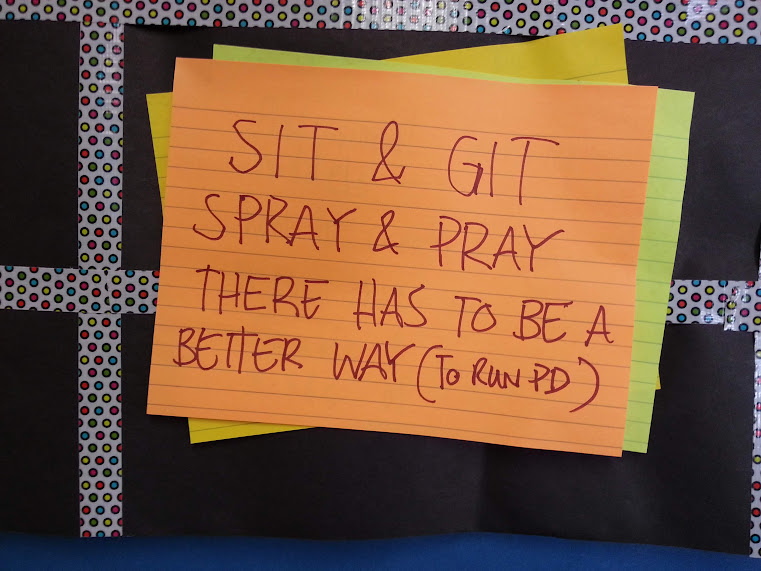
I've got PD coming up this week.  PD often involves a paid consultant earnestly exhorting you to differentiate your teaching practice, but they do it in a completely undifferentiated, university style lecture.  If student centred differentiation is what you're selling, selling it in a lecture is either incredibly lazy or ignorant.  In any case it suggests a lack of integrity.


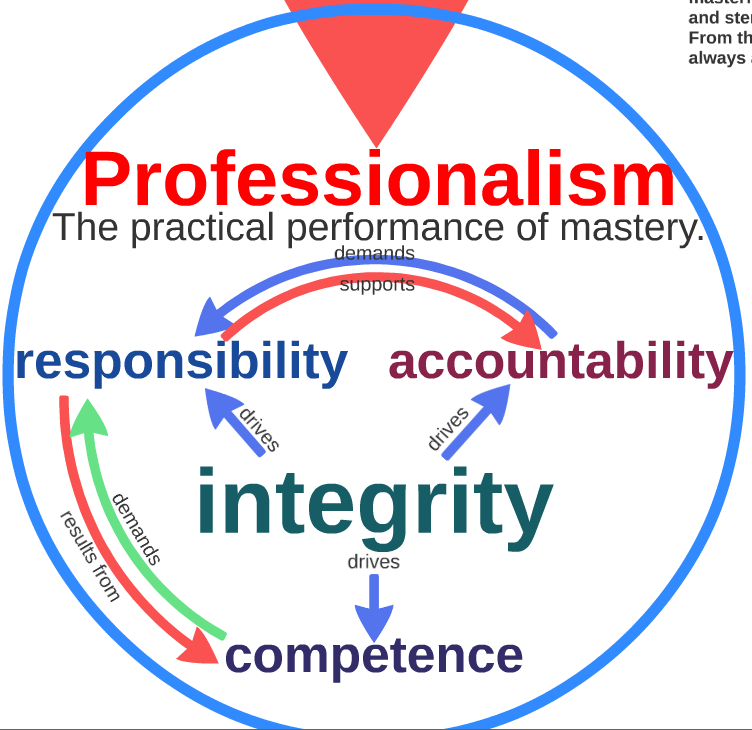
I'm trying to work out what professionalism
is in a Prezi mindmap
The professional is, at their core, self directed.  You don't become an expert in something without being able to self assess and improve your own practice.  Integrity should drive this self directed improvement by demanding competence.  That competence naturally creates a sense of responsibility that a professional is more than happy to be accountable for.  Self direction and the integrity that drives it creates a professionally responsible environment that accepts stringent accountability.

In order to develop professional standards, professionals need only be left to their own devices, and perhaps given the time and space by management to focus on excellence.  Edcamps encourage this kind of professional development, in fact they can't happen without it.  PLCs also facilitate professional development by leaving the professional to develop their own means of improvement.  I've been involved in learning fairs, unconferences and other teacher centred/teacher presented learning opportunities that have been invaluable as well as empowering.

The difference between a talented amateur and a professional is that the professional is committed to improvement and is thus willing to be accountable to their profession.  The professional abides by the practices and standards of their profession and actively works to raise them.  In this way a professional has a social responsibility to their profession that a dilettante doesn't, no matter how talented they might be.  The professional isn't a one trick pony who acts solely on talent, but a talented individual who begins with natural inclination and then works to develop it into a much wider skill-set that acknowledges the full complexity of their discipline.  Some secondary teachers fall into thinking that they are a subject expert before they are a teacher.  Being a subject expert isn't what they are being paid (professionally) to do, it's teaching.  Teaching is the professional practice we (especially at the secondary level) sometimes forget.

Accountability is where professional development with teachers seems to fall apart.  Management fears that if left to their own devices some teachers will not actively work to improve their professional standards.  In some cases this may in fact be true.  It would be a fairly simple task to itemize the professional development opportunities teachers pursue and account for who is attempting to improve their professional practice and who isn't, but we don't do that in teaching.


You can usually tell which teachers take time to attend to
their professional practice...
The teachers who go out of their way to attend (or speak!) at conferences, who expand their professional qualifications, who attend edcamps, or work in their subject councils, or participate in online communities, these teachers have made quantifiable efforts to improve their profession.  The teacher who rolls his eyes at another board run PD which he is only attending because he is being paid to be there is simply not professional in the same sense.  They are the ones who 'professional development' is aimed at.

Instead of only looking at years in the classroom it would be nice if we accepted that some teachers take on a more professional approach to teaching.  It would be easy enough to quantify that approach.  How many subject areas have they become qualified in?  Do they demonstrate continuous improvement?  How many self directed PD opportunities do they take?  Do they take on positions of extra responsibility? What do they do to support their subject area?  The profession of teaching in general?  Until we accept that not all teachers are created equal, we ignore both integrity and responsibility and are unable to accurately apply accountability to our profession.

Is teaching a job that requires management to take attendance and force simplistic PD down people's throats?  Evidently, in which case it isn't really a professional activity.  Is teaching a profession that demands self directed development through stringent accountability?  If it was it would be driven by teachers' professionalism rather than by attendance rolls and tell-me-don't-show-me lectures.

At the core of professional practice is the self directed development of your expertise.  I've got a PD day (the only one this semester) next Friday.  It will be interesting to see how this board run day will compare to the dynamic and responsive urgency of the edcamp I just attended.  I imagine I'll see differences in the first few moments when teachers I never see doing self-directed PD are whining about why they have to be there (because they're being paid to do it).  Then they will take attendance and the differences will only get more obvious.

Professionalism Resources:

http://www.mindtools.com/pages/article/professionalism.htm


http://www.med.uottawa.ca/students/md/professionalism/eng/about.html


#edcampham discussion suggestion
http://www.ascd.org/publications/books/100047/chapters/Professionalism,_Teacher_Efficacy,_and_Standards-Based_Education.aspx

http://education.und.edu/field-placement/files/docs/professionalism.pdf

http://www.slideshare.net/jazzmichelepasaribu/professionalism-in-education

http://www.sciencedirect.com/science/article/pii/S1877042810025498