Showing posts sorted by relevance for query pandemic. Sort by date Show all posts

Thursday, 19 March 2020

Exceptional Times: Using a Pandemic to Close the Digital Divide

Thoughts from the depths of the COVID19 pandemic: Rather than give in to the digital divide in times of crisis, why not leverage this moment and make moves to resolve it?

***

It has been suggested that due to the inequity of access to technology and internet, our education system should shut down during the COVID19 pandemic.  Rather than surrender to this inequity why not attempt to address it directly?  We could leverage all the digital technology we have sitting fallow in closed schools and sign it out one to one for every student in need.  If this goes on longer then connecting with educational technology charities like Computers for Schools would allow us to quickly get technology permanently into the hands of students without it.  We could approach this crisis as an opportunity to do something we should have been doing when things were in better shape, working to close the digital divide for all our students on the wrong side of it.

At the same time we could offer limited access to our public school library learning commons where students would have access to internet.  With appropriate safety precautions (limited numbers allowed, strict hygiene practices, solo seating arrangements), we could take immediate steps to bridge the lack of connectivity and allow some form of education to continue for students across Canada.  At a time of isolation, our poorest students are doubly so because they can't get online  Simply turning off the education system for months at a time will cause lasting damage for millions of students.  In the meantime, the ones who have always suffered on the wrong side of the digital divide are in even worse shape.

This is a measured and logical approach to resolving the digital divide (a lack of educational technology access to all students)  that has long plagued education.  Rather than having this pandemic make it worse, why not leverage it to make it better?

Handing out one to one technology for students in need so we can keep moving everyone forward educationally wouldn't be as expensive as you might think and the alternative is significantly more costly.  Our public schools have developed the network infrastructure necessary to provide internet, so limited access to that infrastructure could still address the needs of social distancing while providing connectivity that is vital to us battling this pandemic as a collective.  Those students aren't the only ones who would benefit, their entire families would, and so would society itself.


Companies like LOON are already building last mile
infrastructure
like this.  Partnering with Ontario schools
would mean internet at home for almost every student.
If this pandemic has shown anything, it's that our ICT infrastructure is more vital than ever if we're going to move against this crisis in a coordinated manner; communication is key.  There are existing technologies we could apply to extend school and municipal wireless networking out into the communities that surround them.  With fundamental networking infrastructure in place, some innovative final mile solutions (like Blimpernet - an idea that my students and I came up with last year) could make the internet available to many more Canadians just when we need it.  Google is already well down this road with their #LOONproject, which works right now and could provide emergency connectivity for almost every Canadian for up to 100 days at a time.  We could eradicate a problem that has been plaguing us as a society since the majority of us went online; getting everyone connected.


Seems like a no brainer with so few planes in the sky, no?

Wouldn't it be something if one of the lasting legacies of this pandemic was that it helped us close the digital divide and improve equity through access to technology in our schools and society in general?  That it would also allow our education systems to continue in a limited capacity instead of shutting down is a consequence that would benefit all Canadians.

***

I sent this to a number of MPs as well as the PM.  I only hope a measured, reasonable response is still in the cards.  If you feel the same way, forward it to your elected representatives.

Sunday, 26 July 2020

Pandemic Protocols: A COVID19 Ready Ontario Secondary System

COVID19 school early in the pandemic -
all that infrastructure not doing anything.
We can do better.
I've been reading the never ending speculation driven by an increasing panic on the part of educators as this school year approaches and this Ontario government seems incapable of planning for it.  When the panic rises too high people start making demands for things that we've never had, like a guaranteed safe school.  Teachers have been getting ill at schools since schools began, but this isn't about that, it's about managing COVID19 to the best of our scientific knowledge.  The point isn't to aim at the impossible, it's to put as many reasonable processes in place as possible to protect the people in the system.

This is about secondary (high) school, which might sound odd because no one is talking about high school COVID19 planning, so I thought I'd give it a shot.

From my admittedly layman's point of view there are two sides to COVID19 management.  One is the social responsibility side, which is something people seem to be struggling with.  The other is monitoring and response.  For me, if the system were to spin up in September following these rules, I think we could get things working as well as possible under the circumstances.


INDIVIDUAL RESPONSIBILITY COVID19 MANAGEMENT
  • If your child had been in contact with anyone infected they should be withdrawn from school for two weeks in quarantine.  During this time they are expected to keep up with class work remotely unless they have severe symptoms, in which case a doctor's note can release them from school work
  • Any child who is screened and discovered to have COVID19 is isolated at school and sent home at the earliest possible opportunity with minimal contact with others.  All schools have an isolated space reserved for this possibility
  • Staff and students are to wear PPE when in close proximity to each other.  When social distancing is possible it is the preferred method of management.
  • Any staff or student who does not follow PPE protocols is to be removed from interaction and re-trained
  • All staff are trained in PPE expectations prior to the beginning of school
  • All students are to be trained in PPE usage prior to beginning instruction
  • Heightened cleaning regimes are to be followed in all classrooms, especially focusing on shared work spaces and technology.  All will be sanitized at the end of each period
  • Classes will be quad-mestered to reduce traffic, but secondary schools will be open all day on a regular schedule
  • Lunches are to take place in quad-mestered classes
  • Strict hall-pass protocols are to be in place to minimize wandering and out of class interaction
  • No student has locker access during pandemic protocols
  • Students will be required to wear masks while bussing, but normal bussing loads will occur
  • Students will be trained to minimize physical contact while bussing or transitioning between classes
  • Any student who does not comply with COVID19 safety training will be re-trained
  • Students or families unwilling to comply with pandemic safety requirements are to be withdrawn from physical schooling if re-training proves ineffective and offered remote learning options with credible expectations and work required or credits will not be granted
SYSTEM MONITORING & RESPONSE
  • All staff and students will be subject to random temperature tests
  • Any staff or student who show fever will be spot tested for COVID19
  • Testing will focus on students and staff who were in contact with any infected person
  • If COVID19 is found to be present, the staff or student with it are to be immediately isolated from the school population and sent home for a minimum of 2 weeks quarantine (remote learning is expected to continue unless symptoms are severe)
  • If COVID19 is found through tracing to be transmitting between people in a school then an outbreak shall be declared and the school shall be closed and quarantined for one week and all shared surfaces disinfected.  During a school quarantine class work is expected to continue remotely
  • Upon return all staff and students will be tested for fever and any found will be tested for COVID19
  • Random spot checks for COVID19 testing will continue
  • School boards are responsible for putting testing procedures in place at every location that ensure a minimum of 10% of the school population will be tested for COVID19 each term
  • Any classroom which is so over full that it causes repeated closures is to be reassessed (and really should never happened in the first place because learning in such terrible conditions should never have happened to begin with), and reorganized to be more medically and pedagogically sound
TEACHING PRACTICE MODIFICATION
  • Teachers are to provide all in-class material online
  • Where possible teachers are not to provide material on physical mediums (like paper) which can transmit the virus
  • All teachers are provided with technology that allows them to video any instruction which are then to be shared in online classrooms for any students unable to attend
  • Teachers are encouraged to use blended learning strategies that leverage remote learning systems even when face to face
  • Any shared workspaces or technology must be cleaned at the end of each class
  • Remote learning outcomes are to be assessed using the same criteria as in-class learning outcomes
  • Teachers who are in subject areas that are unable to operate during pandemic protocols (COOP, outdoor education etc) will be used to relieve choke points in over full classes
There are countries in the world who have proven that with appropriate individual responsibility, access to cleaning and personal protective equipment and with regular monitoring and rapid response, COVID19 can be managed effectively.  If we're going to argue that education is a vital service to society then we need to provide access to schooling to as many students as possible in as safe and transparently monitored an environment as possible.  This suggestion emphasizes the importance of social engineering in managing the virus individually while also making it clear what system responsibilities are in responding to an outbreak.  Instead of being paralyzed by this pandemic we should be applying these practical and effective solutions to managing it.


I've been watching MotoGP restart the motorcycling world championship this past week.  They have strict protocols in place that if ignored get you banned.  What are they doing?
  • Personal responsibility for social distancing and group health
  • Testing all participants regularly including entry temperature testing for everyone on site
  • Being completely transparent in testing
  • Grouped teams with interaction between teams minimized
  • PPE everywhere for everyone
  • Enhanced hand washing and personal hygiene
  • No audience/crowds
  • Minimum technical and press personnel to allow for social distancing
How's it going?  No cases, no outbreaks.  Press is able to 'tele-commute' to races, drastically reducing interactions and the quality of commentary is as good as it ever was - which begs the question:  why were media outlets sending full teams to remote races in the first place?  All of this involves radically changing how things are being done and demanding the stringent following of guidelines - something we seem incapable of organizing in public education in Ontario, which is a real shame for students and families across the province.

Sunday, 3 January 2021

What 2020 Taught Me

This is the fifth attempt at this post.  Sometimes, reflecting your way out of dark place professionally takes some iteration.  Previous attempts ended up heaping frustration on top of frustration until it seemed overwhelming again - not the best way to resolve a metaphysical crisis even if it is all true.  I'm not the smartest, most upwardly mobile educator in the world, but I know my craft and I'm good at getting students to express their talents.  I'm also effective under fire and can always find a way to get back on my feet again when the going gets tough.  This year has been a test of that resilience and at times it has broken me, but reflecting on a year where Ontario education has lost the plot more than once has me thinking about a Banksy piece:


I've been tempted to leave education a few times over the past year for pastures less politically misdirected, but I genuinely enjoy my work, recognize its social importance and don't want to walk away while my profession has forgotten its primary purpose in a fog of political misdirection and pandemic panic.  Education matters.  It matters even more in a crisis.  That's a simple truth 2020 has taught me.  What else has this epically crappy year taught me?

LESSON 1:  The people running 'the system' aren't focused on pedagogy, they're focused on making it run (at all costs, even if it makes people sick or abuses their lack of privilege)

I've known this since I got thrown under the bus for handling my mother's suicide too slowly, but 2020 has reminded me of systemic intent by shining a harsh light inside the process.  From taking multiple pay cuts to protect student learning in January while admin sat in empty schools collecting salary, to watching the system lurch back into the classroom unprepared in September, 2020 has shown that the most important thing to people running Ontario education is making a schedule and then ensuring it happens.  Pedagogy and equity might come up in the marketing material, but action around it is non-existent.  Threaten the schedule though and you'll get an immediate reaction.

This came into focus in November when we watched Ontario Education Workers United's live webcast on how to stop the 'pedagogically impoverished' hybrid/simultaneous online and face to face learning model.  I've had a go at this unsustainable and problematic smoke screen of an approach on Dusty World previously.  There was a great deal of dissonance in listening to educational experts like Doctor Beyhan Farhadi talking about pedagogy when the system itself seems to have turned its back on it entirely.

Our absurd pandemic teaching approach reduces in-class instruction to less than half the normal face to face instructional time while making no changes to curriculum expectations because it's important to retain the appearance of credibility.  Actual pedagogical credibility, let alone equity, compassion and even teacher burnout doesn't appear to be a consideration unless it's an email or newsletter - board newsletters have proliferated this year.  2020 has taught me that the system must run at all costs - even at the cost of the people it serves.

Our broken pandemic teaching models also demand that teachers be simultaneously teaching online and face to face to two different groups of students simultaneously all day every day while throwing about a month's worth of material at students each week.  It's doing this having cancelled face to face special education support which has led to even further inequity in the classroom.  It's an approach that has hurt my son directly.  Listening to parents of students with IEPs begging for support and compassion is heart breaking.  I'm going to make a point of honouring that need even if the system appears to be deaf to these calls for help.

The paradigm shifting moment during that OEWU webcast was a Toronto teacher and union activist who approached the fight from a very pragmatic angle.  She said (and I'm paraphrasing), that the system is only interested in making sure the system works and if you want it to take notice you have to stop if from working.  Killing yourself to make a bad system run and then complaining about it isn't an effective approach.  System administration will only pay attention to you if you stop the system from functioning.  I'm not sure where to take that truth in 2021, but it's something to keep in mind if you see systemic abuse occurring and want to stop it.

The Ministry mandated full day of racism training we got in September prior to starting an unprecedented change in schooling feels more like a smokescreen rather than any kind of genuine attempt at addressing inequity.  Trot out a day of racism training (entirely delivered by 'woke' white women) and then execute a schedule designed to suit privilege while crushing students who don't have it.

2020 has taught me to see actions, not words, as the real barometer of an institution's intent.


LESSON 2:  "This isn't elearning, it's emergency remote learning"

A wise colleague said this in one of our earliest online remote meetings and it changed my mind about how to teach in a pandemic.  My reaction in a crisis is to display initiative and work to help people, but systemic paralysis was followed by a lurch into elearning with zero support and then a series of baffling changes of direction by the Ministry in terms of what technology we can use.

Ontario's experiment in remote learning ended when Stephen Lecce came on one Friday afternoon and told students across the province that marks don't matter in remote learning, which has established a culture of irrelevance in remote learning that continues.  We aren't supposed to grade any learning that happens remotely and many teachers have given up on it entirely due to poor student engagement.  The system's zero support is ongoing - we've been given no PD or even time to redesign the entire curriculum for remote learning on the fly.  The metaphor of building a plane in the air hasn't changed, and we're going back to full remote learning tomorrow.  How do you think that will fly?

2020 has taught me that curriculum is less important than student and staff welfare. It's a pity the people in charge only pitch wellness emails at this ongoing mental health crisis, but as a classroom teacher my ever shrinking sphere of control still allows me to address it with my  particular students, and I intend to.  While other teachers are crushing students (especially the ones with IEPs) in a desperate quest for academic credibility in a system that's only pretending to have it, I shall not.  This involves differentiating, which is another one of those pedagogical best practices we've burned to the ground during this crisis.

Some students, like myself, want to be engaged and kept busy lest they go mad with frustration!  For those students I will offer the variation and enrichment I've always pursued (yes, even in a pandemic), but for the vast majority less is their new normal.  For this group (which includes many teachers), being gentle is more important than being productive.  2020 has taught me that for the majority of people, when the going gets tough, waiting to be told what to do and then doing as little as possible is the way forward.  It doesn't bode well for a future bulging with ever increasing overpopulation in a limited ecosystem, but it's the world our systemic myopia has brought us to.

2020 has taught me that pushing broken people only breaks them more, so I won't be doing that even if the system demands it.

This is indeed emergency remote teaching.  It isn't a 'new normal' and we shouldn't all be waving flags proclaiming, 'I got this'.  What we should be doing is looking after the children in our care, supporting their families and our colleagues and making sure that everyone is alright instead of pretending that everything is business as usual.  We can always learn what we missed on the other side of this.  Meanwhile, we're getting strident 'you have to provide blah blah minutes of synchronous instruction online' directives as we return to our second bout of emergency remote teaching.

There are too many system-people hanging on too tight that need to unclench.  I realize that this is being driven by a sabotaged Ministry, but enforcing it makes you complicit in it.  I'm going to look after my little patch (even the ones with special needs!) and push back if my student wellbeing first approach isn't deemed appropriate by the powers that be.


LESSON 3:  Most people just want to be told what to do, even in a crisis...

My first instinct in a crisis is to show initiative and try to act in a way that helps, but the system thinkers don't want you doing that, they want you to fall in line and do what you're told.  This is problematic for me as my raison d'être in teaching is my agency as a teacher.  When the best I can hope from the system is benign neglect I can get a lot done in my immediate space, but when the system is in crisis it insinuates itself into my classroom and this is infuriating.  If I wanted to give up my idealism I'd go into management.

I'm able to do what I do in the classroom because I have agency.  One of the reasons I enjoy classroom teaching is because I have the latitude to make decisions that aim at the highest ideals and see them through without having to water them down.  In a crisis it seems that systems clamp down on individual agency and demand compliance.  My issue with that is that I've never done the bare minimum, always do excessively more and my students benefit from that in many ways.  I refuse do my job in an online lockstep of systemic expectations, especially if they're designed for marketing a fiction of a full school experience during a pandemic that is preventing exactly that.  I have no interest in misleading people, most especially my students.

Not all teachers are above-and-beyonders, but I gotta tell ya, the vast majority are.  You'd be hard pressed to find a single teacher in my school that doesn't do extracurriculars and work on the weekend.  Given some latitude they'll do more than the minimum simply because they are professionals.  2020 has taught me that I don't necessarily want to leave the classroom, but I would like to work for a system that recognizes my professionalism and honours it instead of treating me like an errant child.

Many people want to be told what to do and wait for that direction.  You'd think that would change in a crisis but it seems to intensify.  I've occasionally had leaders who recognize my need for action and honour it, but they are a minority.  I suspect this is a control issue for most.  Many people find invasive and systemic control a comfort, but for some it feels like strangulation.

Reading Matt Crawford's latest book, Why We Drive, this fall while I was getting waterboarded at work taught me how to differentiate to students in a crisis by recognizing the need for human agency in an increasingly automated world.  Some people need clear direction and eased expectations while others want to exercise their agency and do something to help.  I only hope that the people running things recognize that.  We could get a lot more done if the doers weren't being strangled by system lockstep thinking; we need to do much more than we are.

***

We're about to step back into emergency remote learning after the mid-winter break, which hasn't been much of a break at all.  Everyone looks grey, stressed out and exhausted.  We are probably not even half way through this pandemic marathon but I'm not about to let it diminish my professional scope.  My classroom will recognize that my students might be providing daycare for their siblings or working to support parents who have lost their jobs.  Others may live in rural locations with spotty internet or might be trying to do remote learning on ancient or poorly working technology that they only have occasional access to.  The school system likes to ignore these issues while sternly demanding full days of remote synchronous instruction.  I'm not going to demand that because I have no interest in maintaining a vicious government's fiction of business as usual in the classroom.  What I am going to do is help where I can, give each student what they need to feel like they're achieving something (anything) in this crisis, and make sure the ones who want to do more have the tools and material to create the agency they crave at a time of forced helplessness.  If everyone wakes up the next day feeling recognized and enabled then that's a sound pedagogical goal.

Personally?  2020 taught me not to throw myself into the massive gap between the system's failure to do what it should and what my students need, because it's unsustainable.  I'm not helping anyone if I hurt myself trying to make up for the lack of vision demonstrated by the thousands of people 'above' me on the org chart.  I'll read my Tao Te Ching and follow Lao Tsu's advice and withdraw when my work is done.  2020 has taught me that the system will happily let me burn myself out attempting to resolve its shortcomings.

To hold and fill a cup to overflowing Is not as good as to stop in time.
Sharpen a sword edge to its very sharpest, And the (edge) will not last long.
When gold and jade fill your hall, You will not be able to keep them.
To be proud with honour and wealth Is to cause one's own downfall.
withdraw as soon as your work is done. Such is Heaven's Way.

2020 also taught me that the education system's academic focus is a fiction we all tell ourselves to justify its existence, but it's actually much more foundational than that.  The deeper truth is that the system should be less about curriculum and more about equity and inclusion.  Public education is one of our best tools for socially enabling everyone to become their best selves.  If we approached this pandemic by differentiating our expectations and working from a place of compassion and inclusion instead of fake academic integrity we'd do more good and teach students about things that genuinely matter, like kindness.  Ultimately, education should be about recognizing individual needs and enabling students to express their best selves, the rest is paperwork.

Wednesday, 26 October 2022

2022 Treasure Mountain 7 Research Symposium & Thinktank: MediaSmarts Keynote & Digital Tools and Expertise for Resilient Learning


The seventh iteration of the Canadian School Libraries Treasure Mountain Canada Research Symposium just wrapped up in Vancouver, BC.  Canada is one of the only countries in the world without a national education strategy, though weirdly we have an international education strategy - just not one for Canadians in Canada.  That is strange, right?

TMC is an opportunity for teacher librarians to escape Canada's provincial education silos and share common challenges (which are very similar).  By sharing these problems and brainstorming solutions, best practices and future-ready strategies emerge. Wouldn't it be efficient if the whole country were engaged in this powerful professional practice instead of repeating the work over and over (if at all)? Yet many provinces were not not in attendance. I'm still struck by how there is no such thing as "Canadian Education", which has lasting implications for equity in our country.  Some provinces have cut teacher librarians entirely from their schools, preventing any of their students or staff from benefitting from these information literacy specialists - and these cuts happened during an information technology revolution when a guiding hand would have been most helpful.

We're in the middle of an information
revolution and your school system
wants to remove all the information
specialists
?  What an odd choice.
I'm not a librarian, bu
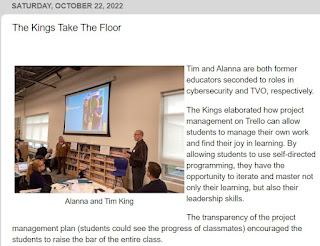
t I'm married to an awesome one.  Last time we flew out for a Treasure Mountain conference in BC my son and I went for a long ride up the empty coast of Vancouver Island while the librarians gathered, but this time I was in the room as the paper Alanna and I co-authored was featured in the event.

Treasure Mountain attracts librarians who are working to put school library learning commons squarely in the role of digital literacy development. This event was full of energetic thinkers who were digitally literate and well aware of the ongoing digital skills crisis happening across Canada.

Our presentation was about how using industry standard project management tools and organizational strategies not only prepares students for life after graduation, but also provides them with the organizational tools they need to be both resilient and successful, even when our school systems stagger under the weight of multiple pandemic shut-downs.  Being able select the right tools and move between digital and real-world information allows students to attend class, stay organized and continue to author their own student-led projects no matter how much chaos surrounds their learning.  Digital skills development and knowledge of a swiss-army knife of readily available digital tools could make our education systems pandemic-proof, if only we'd do it.


We shared examples of successes that demonstrated equity and inclusion as well as providing other examples of student-centred empowerment in learning through effective project management.  The tool we used was
Trello, based on the academic research Alanna was doing at Royal Roads University in the spring of 2020 when things fell apart.  The project management theory her post-graduate class was studying was applied directly in my game-development class, saving both student-led projects from almost certain disaster; it's a great example of a cross-pollination of ideas and shows how having a masters-TL in the room can help even a veteran teacher find effective learning tools.

***

Treasure Mountain is very much a hands-on experience with everyone participating and collaborating on developing ideas.  Those ideas are brought forward by the participants.  This year there were 27 (!) papers submitted on subjects ranging from how to audit your book collection to enhance diversity and how to keep an LLC operational during a pandemic, to how to embrace emerging digital literacies.  In my new role at ICTC I am especially interested in that digital literacy development.

Another example of the many cracks in
Canada's siloed education approach.
The morning keynote by Matthew Johnston, the educational director of MediaSmarts, an organization dedicated to improving media literacy in our students, focused on explaining how things had changed since pre-internet broadcast media.  The multi-directional web of media we now find ourselves in implicitly demands digital fluency, yet we still fail to engage these digital literacies by systemically teaching them.

This isn't just a Canadian problem, as code.org states, most schools don't have a computer science program (ours got locally cancelled during the pandemic).  Even though there has been a recent push to put coding into Ontario elementary curriculum, it's being delivered by teachers with little or no technology fluency themselves, and coding is only a tiny part of a much larger and more complex digital/media literacy framework.

Library learning commons are an ideal place to begin this work as (when they're well run) they act as a shared space for engaging with the iterative learning needed to make emerging technology work.  Librarians have always been information management specialists - the mediums may change, but the fundamentals of rigorous inquiry and source credibility assessment don't.  A digitally fluent librarian makes the LLC central in 21st Century learning models that effectively leverage digital tools.

Before the Friday night awards ceremony, Alanna and I did an interview with Dr. David Loertscher, one of the conceptual founders of the learning commons model.  David was curious as to how digital tools could be used to amplify and organize student-directed/inquiry based learning models, and our talk gave us a chance to clarify our own understandings too.  It'll eventually be available on Dr. Loertscher's ALiVE Virtual Library.  It's collaborative opportunities like these that help pave a pathway into the future that will not only make library learning commons relevant to student experience, but will also provide the framework for much needed digital skills system building capacity.

Sunday, 20 June 2021

Equity Theatre, Safety Theatre, COVID19 Theatre: The Appearance of Caring

Wired had an insightful piece on diversity theatre in a recent issue that exposes the organizational lie behind equity programs trotted out by management to give the appearance of caring about current social issues.  

"Diversity theater creates a sense of dissonance: Workers have to represent the company publicly while feeling victimized by it privately; they must identify shortcomings but are punished for acting on them."

The frustation felt by people of colour who take on equity management roles only to discover that they aren't allowed to be critical of anything their employer does casts a harsh light on the game of appearing to care as a marketing promotion.  Actually caring and the systemic change it would prompt is something most organizations are unable or unwilling to do because most organizations exist as a result of some very one sided history, and no one is willing to hand back their systemic privalege.

This isn't just as private company gambit, public services are in the same boat.  Governments formed on the back of economic imperialism aren't willing to move from that position of privalege and dominance.  The primarily white, heteronomative, neurotypicals who roost in organizational management positions are more than happy to spend a pitance on theatrical appearances but would never risk their privaleged positions by pushing for true institutional change.

One of the thrills (for me at least though many others don't seem to be feeling it) in teaching is helping a student in less than ideal circumstances rise above their socio-economic station and get onto a pathway that best reflects their potential.  In the past year I've seen the public educaiton system in Ontario, already under attack from a hostile government, convulse under the weight of a mismanaged health emergency.  The people to blame for this exist at the highest levels of government and, in this particular government's case, have been ushered in to office by a misled electorate who have given them the power to deconstruct the few remaining equity processes in our public education system.  When they couldn't force the system to throw its least privaleged students under the bus, they simply leveraged a pandemic to do it for them; and the political organizations standing against them in public education capitulated in a panic.

I'm not so sure that it did any more.  COVID has been the hammer Ford wished for - everyone else in education has been outsmarted by the virus but Ford seems to be leveraging it.

Theatre is a great way to hammer home inequity while appearing to care.  COVID theatre is the current weapon of choice.  I just learned that we are doing quadmesters again in the fall.  It won't matter that all staff and most students will be vaccinated by then, it's easier to look like you care by throwing a radically inequitable schedule at students and staff and then sitting back to watch it mulch them, all the time saying that it shows how much you care about their safety.

We're facing an unprecidented number of failures in school this year.  I have strong students who have simply given up and fallen silent, and my heart is broken for them.  I'm willing to bet these students in particular are in the middle of family economic crises with parents laid off due to the pandemic, and/or the loss of family members, and/or depression from the lack of genuine social contact for over a year now.  Even with all that happening, I'm hearing from even the strongest students that they are being run into the ground by twelve plus hours a day of maths work as teachers desperately try to jam 110 hours of complex instruction through the key-hole of emergency remote learning in wildly inequitable situations.  STEM is for the rich and privaleged who have the time and space to keep up with the workload.

Many parents of students with IEPs have told me of the crisis their children are experiencing at the hands of a system determined to play the COVID-theatre of business-as-usual in education.  Watching (usually young, energetic teachers looking for contract sections) pipe up about how there are real advantages to quadmestered teaching is laughable, but one of the best ways to get into a system is to help it support its myths.  This slight of hand is heartbreaking and deeply personal because I'm a parent of a student with special needs.  When your child's IEP specifically states they need extra time to work on material and you see teacher after teacher running them off the treadmill of quadmestered/reduced time/accelerated learning, you have to wonder where everyone's heads are at.  Compassion should lie at the heart of equity but it seems that compassion is in short supply over a year into this pandemic.

Last spring we magically passed everyone even though the system lurched into fully remote emergency learning completely unprepared.  After being run through face to face learning only to be pulled out again and again this year when school driven pandemic spread was proven to be the engine driving our provincial disaster, the validity of 'credits' in the 2020/21 school year is, at best, questionable.

Even when we were face to face (in masks, distanced) students were still expected to spend half of their course learning remotely.  The other half had them in barely functioning face to face cohorts where they were being taught in madly restricted classrooms by exhausted teachers trying to be in two places at once.  In the insane year I'm just staggering to the end of I never once had a covering teacher, either online or in person, who was qualified to teach my subject.  I never once even had a technology teacher covering me in live classes so that students could keep using tools and equipment in what little face to face instructional time they did have.
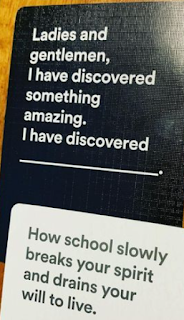
Quadmestered face to face teaching meant two 2.5 hour continuous instructional periods everyday where, if I had to duck out to use the washroom, I was putting my students at risk leaving them with a teacher (sometimes they weren't even teachers) who were unqualified to monitor safety in the room.  Safety-theatre is another one of these smoke and mirror games organizations like to play where (as long as it doesn't mean any extra work for them) they'll put you in a position where you'll do extra to keep things working to the point of hurting yourself, like I did this year.  Had anyone been injured you can bet I'd have had contract specifics being quoted at me as blame was leveled, regardless of the arbitrary nature of all the safety theatre.

Each of those 2.5 hour face to face instructional periods without qualified relief wasn't the only ball I was juggling.  Simultaneously I was also setting up remote learning and monitoring that, because every teacher I was partnered with was unqualified to teach my subject area and usually took that opportunity to fade away and leave me trying to be in two places at once.  Students in my current remote class don't know who our elearning support teacher is because they've never seen her.  Multiple calls to my union were met with silence and I've since stepped back from the position of CBC rep because I'm not sure I actually have a union anymore.

Theatre runs thick in our union too.  This spring at AMPA, the yearly provinical gathering of regional representatives, members of colour were kicked out of the online event for having virtual avatars on their accounts that upset the always-white provinical management.  White supremacy, as described on those avatars, wasn't an over the top suggestion but it hurt the feelings of the delicate white people in charge and so they banned those members of colour.  We've since had it explained to us (multiple times by old white people in charge) that those members broke the parlimentary rules everyone agreed to abide by and that's why they were removed.  They then voted in another white president, though it is a woman and we've only had two of those in a century, so little steps.  The woman of colour who could lead us into a more equitable future was convulsed out of contention as this old Canadian organization does what old Canadian organizations do best: cling to colonial prejudices when it best suits the people running them.

In reference to the attempts to address systemic racism in one of the biggest boards in the proivnce, a member of colour said they felt like OSSTF provincial was weaponizing our own consitution against us.  I've been seeing that side of OSSTF since 2012.  Maybe one day we'll put aside the equity theatre and actually be equitable.  Any mention of this online whips senior (white) union management into a, "you're a union basher!" stance.  I can assure you I am not, but I'm no fan of the status quo and they shouldn't be either.  Instead of weaponizing an archaic paliamentary system that keeps the status quo intact, perhaps we should be looking for ways to rejig the system so it's actually more equitable and representative of all members.  That isn't just something my union should do, it's something our not-so-representative Canadian governments should do too.

The hair-trigger decision to go with quadmestered classes in the fall even though we're not sure where we'll be by then and case numbers continue to fall even as the province opens up thanks to a vaccination system that is finally working is, at best, short-sighted.  It plays the COVID theatre game by showing how serious everyone is about safety while ignoring the gross inequities of quadmestered scheduling.  It also happens to reuse all the planning done last year but I'm sure that easy way out wasn't what prompted the decision.  Someone decided that students with special needs or the ones under durress at home can burn for another inequitable, unsustainable quadmestered school year for valid, pedagogical reasons, I'm sure.

Meanwhile, front line workers will get dunked into another year of unsustainable and inequitable work overload.  Attempting to be in two places at once (for me at least, for many teachers with smaller classes it's an easier ride) is absolutely harrowing.  COVID theatre will also demand that everyone wear masks in a one-size-fits-all organization in poorly ventilated rooms not because vaccinations don't work (they do), but because it's important to look like we're doing something.

We'll probably have a lot of well-meaning (is it well-meaning if it's theatre?) equity PD again this year even as we roll out a schedule that (once again) systemically attacks students with special needs or who lack the privalege needed to effectively leverage remote learning.  It'll once again be left to individuals on the front lines to make up for this systemic failure by trying to bridge the pedgagocial gaps we've opened up.  The theatre of cruelty isn't over yet.

It's not over - it may never be over.  That lack of hope is corrosive.  Some leadership that embraces hope would be... magical.


Friday, 4 September 2020

#ECOOcampON 2020 Virtual Conference Reflections

ECOOcamp Ontario happened in Peterborough last year and was the usual mix of keen people getting together to improve their technical skills and launch another year of teaching in an avant garde style.  Had you asked anyone there what the summer of 2020's ECOOcamp would look like, a virtual online conference during a pandemic wouldn't have been the obvious guess, but ECOO managed to pull off #ECOOcampON, a virtual conference using tech most people hadn't used before, with astonishing fidelity.

As you'd expect there were technical issues, but what ECOO does a good job of spreading is the idea that teachers can become digitally fluent enough to resolve these problems themselves.  Early on link issues stopped the conference in its tracks, but the tech-savvy educators running the event iterated at high speed through troubleshooting and within twenty minutes everything was back on track again.

Digital fluency has been cast in a stark light this year with Ontario's sudden move to emergency remote learning, so you'd think that more educators have technical proficiency at front of mind as the first school year in a century kicks off in an ongoing pandemic.  ECOOcampON managed over 500 registrations this summer, which goes to show you just how resilient some Ontario educators can be in trying to get literate teaching in a still new(ish) digital medium, though only 0.3% of teachers attended in Ontario and I'd guess that 70% of them need it.  In a better world this conference would have drawn over one hundred thousand educators looking to raise their digital fluency in order to prepare for the inevitable next round of remote teaching.

What follows are some personal reflections prompted by the event.

Krista Sarginson and I presented on CyberTitan, the Canadian Student Cybersecurity Competition on the first day of the conference.  Krista's CyberLions rocked a 2nd place finish in the middle school division in her first year coaching in 2019.  I'd been looking for a brave teacher to leap into this and help me advocate for it.  Krista is fierce and fearless and did a great job encouraging other elementary panelists to consider giving it a try.

Secondary teachers tend to be more reticent about participating in things they can't show intellectual dominance in.  I'm hoping that Krista's influence engages more elementary Ontario teachers in participating in this competition.  It's a great way to raise awareness around information security and opens up an entire industry to students who might otherwise have no idea it exists.  It's a tough year to encourage extracurriculars, but something like CyberTitan could become the basis for a cybersecurity course, which is something Ontario is way behind the curve on.  Here's our presentation if you're curious:


The round table discussion that night talked about resilience and how we frame challenges.  This past year seems like almost infinite challenges.  From a vindictive government intent on attacking our profession and diminishing public education to a worldwide pandemic, it's been a burning dumpster fire of a year for educators in Ontario, with no end in site.  The new mix is the vindictive government using the pandemic to physically threaten staff and students.  It's not understatement to say that I've never seen colleagues so scared and uncertain about teaching in a few weeks.  How can we be in poorly ventilated classrooms that ignore the rules we've been told to follow for the past six months and feel safe?  Our doughty premier is frustrated at the response (usually framed as an attack on unions), but no other front line workers are being forced to ignore public health rules in their workplaces.


In this context I found the roundtable discussion difficult to navigate, though they gave it a good try.  One of the speakers was a big fan of nature, but it was a romanticized view of nature where people should just find themselves at their ease in natural surroundings.  That park-setting idea of nature is very much dependent on a manicured and managed environment.  I love being out in nature, but I enjoy it because it's relentless in its expectations of competence.  Being happy in nature is as simple as not being hungry or cold, or avoiding being eaten.  Few people have been face to face with that kind of nature.


Disney's romanticized version of nature,
in reality this is a great way to get rabies.
Austin Vince has a documentary on riding into the Sahara Desert called Mondo Sahara.  In it he talks to an off-road expert who has spent a lot of time in the deep desert.  He makes a clear distinction on what your focus should be: always make sure you're dictating what is happening because the moment the desert is in charge things fall apart quickly.

Survival training was like that too, especially the winter stuff.  Our instructors were insistent on the exhausting job of managing cold and wet to ward off the ever present fear of hypothermia.  Nature isn't only beautiful, it's also so immersive and demanding that you can quite easily drown in it.  Most people have never been in a survival situation like that.  Society does everything it can to ensure you don't have to keep yourself alive in nature, it'll do it for you - usually while killing nature in the process.  If most people got driven into the wilderness and dropped off they'd be dead in a week.  That is terribly beautiful, but that isn't how nature was presented.  Being demanding is what makes nature teach resilience, but we try and weed harsh lessons like that out of education wherever we can.

I've recently had trouble with how our return to face to face classrooms was being framed.  We were initially told that relationships are all that matter and that we shouldn't even worry about curriculum.  There is a place where that is the case, it's a daycare centre, but I didn't go through the long and difficult task of becoming a teacher so I could provide daycare.  Yet in the greatest social crisis we've seen in recent years, instead of focusing on being resilient and holding everyone to higher standards, the reflex is to do whatever it takes to make people more comfortable.  You can learn a lot by being uncomfortable.  A good place to realize that is in nature.

The other side of the roundtable focused on happiness, which is much more complicated because we're more than happy to destroy nature just to ensure our own short-term comfort, future generations be damned.  If we want to consider nature it's as a form of entertainment.  Living in nature is nasty, brutish and short, to paraphrase Hobbes, and too much like hard work unless you think nature is pulling your RV into a campground.  Look no further than our response to COVID19 (which is nature at work).  We've actually slew footed our own self-serving, cancerous economic system just to keep as many humans alive as we can, yet even during a world wide health emergency we're still adding the populations of Guelph AND North Bay to the planet every single day, while stopping economies to keep everyone alive for as long as we can.  Everything we do with technology, economics and society are contrary to nature, so holding it up as a solution seems a bit disingenuous.  It doesn't matter though, nature will sort things out soon enough.  If we're too stupid and selfish to be on the right side of that it won't matter because ultimately what we think doesn't matter.

The happiness side of the discussion was enlightening.  The question of what is happiness is a surprisingly complicated one.  I was chasing it in an online psych course from Yale earlier this year called The Science of Well Being.  For many people happiness is doing as little as possible, but I'm all about agency (your ability to act).  When that is cut away from me I become very frustrated.  The best leaders I've had recognise that I'm a self starter who wants to act and provide a framework that directs me into doing what they need to get done.  The vast majority of leaders I've had are frustrated by my inability to stand in line waiting to be handed the same work as someone who doesn't want to do anything at all.  During the pandemic this everyone-do-less approach has been strangling me.  Most of the managers I've had in Ontario education are of the lesser variety who want to cookie cutter everyone into undifferentiated jobs.  I'd hoped being a professional in a recognized field would bypass that, but Ontario education is remarkably juvenile in how it directs its employees.

If you've ever seen Saving Private Ryan, I'm a Tom Hanks kinda guy: I don't care if the work's difficult, but I need the people in charge to recognize that with a bit of latitude I can get things done that others cannot.  Most organizations' inability to differentiate their duties for employees is why I often have problems with organizational structure.  The people who maintain that structure very much identify their own self worth through it, and I frequently come into conflict with them as a result.  Give me a big, difficult job and the latitude to attack it and that's happiness for me.  It's why I've never been on a cruise or to an all-inclusive resort, it's my idea of hell.  That understanding was a great metacognitive reflection that ECOOcampON provided for me at the end of day one.

I attended a number of sessions ranging from equity to media literacy around the credibility of sources, and found them rich and helpful in framing this year's difficulties, but it was the closing keynote that closed the circle for me.  Daniel Lewis is a successful entrepreneur who struggled in the education system and overcame a number of personal hardships to find success.  He is inspirational by nature, and I enjoyed his relentless positivity, though I'm often cautious with optimism because it can be used to overly simplify a difficult situation.  When someone says, "you got this" in terms of going back to school it feels an attempt to ignore the difficulties.

Daniel didn't take that approach though.  He emphasized the power of your own thinking; self determination was the underlying message.  Even if you're in a broken, leaderless system staggering under absurd political machinations, you are still free to think what you want to think.  There is power in that kind of stoicism, especially in tough times.

There was a lot of talk about getting out of the box in terms of thinking without being restricted by the people and systems around you, which aligned well with the keynote's theme (though it contrasted with the resiliency and happiness roundtable from the beginning).

I'm always cautious around entrepreneurial pep talks.  Business has a way of turning that optimism and relentless enthusiasm into sales.  In this case it was the idea that once you free yourself of the boxes other people have put your thinking in, YOU then get to make the boxes.  I took that to mean for other people.  Why would you want to make a box to limit your own thinking?

Perhaps I'm odd in that I educate to empower, so breaking out of the box aligns with that, but the last thing I'd want people to do with that freedom is start boxing in other people, but that's society.  I was troubled by the idea that the moment we free our minds we look to use that freedom to enslave others, but maybe that's just how people work.  Freeing people doesn't guarantee happiness in any case.


Boxes aside, it was an engaging and uplifting closing keynote to a remarkably resonant ECOO Conference.  We are free in our own minds regardless of how tightly our struggling school system ties us, and there is comfort in that.  If you're able to free your mind from the fear and uncertainty you can grasp your own agency and get things done.  The pandemic has deeply wounded everyone's agency, so Daniel's stoic message resonated well, though I'm still troubled by the reflexive need to box people.

If you bounce over to the ECOOcampON webpage, you'll find links to all the presentations.  I think they're also wrangling the recordings of all the presentations together so you can view what you might have missed.  I've always found ECOO's model of teachers directing their own PD to be both engaging and effective.  When I compare it to professional development that's mandated and thrown at me, this feels much more valuable, but that's probably because I use my own agency to create and participate in it.  There is a distinctinction in there somewhere around passive and active learning that anyone interested in pedagogy should be considering, especially in a world where a passive-do-nothing approach is now a governmental demand.

***

I"ve been reading a lot of Tao Te Ching this week.  It offers me some perspective when the walls feel like they're closing in.

Tao is empty (like a bowl). It may be used but its capacity is never exhausted
It is bottomless, perhaps the ancestor of all things.
It blunts its sharpness. It unties its tangles. It softens its light. It becomes one with the dusty world.
Deep and still, it appears to exist forever.
I do not know whose son it is. It seems to have existed before the Lord.

Heaven is eternal and Earth everlasting.
They can be eternal and everlasting because they do not exist for themselves, And for this reason can exist forever.
Therefore the sage places himself in the background but finds himself in the foreground.
He puts himself away, and yet he always remains.
Is it not because he has no personal interests? This is the reason why his personal interests are fulfilled.

To hold and fill a cup to overflowing Is not as good as to stop in time.
Sharpen a sword edge to its very sharpest, And the (edge) will not last long.
When gold and jade fill your hall, You will not be able to keep them.
To be proud with honour and wealth Is to cause one's own downfall.
withdraw as soon as your work is done. Such is Heaven's Way.