Showing posts with label media literacy. Show all posts

Saturday, 19 November 2022

Digital Disruption, The Collapsing 4th Estate and Foreign Inference in Canadian Media

Toronto's traffic misery means I don't fight my
way into The Six as often as I might, glad I
did on this occasion though.
We battled our way into The Six last night to attend TVO Today Live's: Can Democracy Survive the Collapse of Media? The documentary is the story of the Toronto Star as it struggles to survive in our diverse mediascape. Digital disruption came to newspapers at the same time the change from broadcast to the individualized, 2-way media access (aka, the internet) unhinged other traditional media giants. Many newspapers are hanging on by their fingernails as they struggle to develop a business model that would allow them to survive in the 21st Century.

The documentary raised difficult questions around the importance of an independent press as a means of holding government and business to account. It follows The Star as reporters exposed the many failures by the Ontario government during the COVID pandemic. By the end of the documentary it was hard to argue against the importance of an independent press as a pillar of democracy, though how they operate can no longer assume that they are the 'information celebrities' they were in the broadcast age.

The premiere took place on the
UofT Campus, just south of
Yorkville, which is surreal at
the best of times.
There was a lot of blame in both the documentary and the round table discussion afterwards aimed at 'tech' companies like Google and Facebook. While those companies depend on new digital media delivery systems, they seldom engineer their own tech. Google and Facebook aren't tech companies, they are advertising companies who have exploited digital disruption in order to eat traditional media company's lunches.

The fall-back position of the Fourth Estate (professional journalism) is that they provide an important balance in any country claiming to adhere to democratic principles. Transparency isn't something that comes easily to people when they gain money and power, which tend to get used to gain more privilege and power. This is a difficult truth to dispute, though how the professional press operated in the time of broadcast media when profit margins were huge and they were the only voice to be heard came with its own problems.

I found the documentary interesting in terms of tracking our dance into the datasphere two decades into our information technology/media revolution. The problems from clinging to an out of date business model (predicated on privilege and a lock on the media people see), were clearly defined, but what prompted me to get up and ask a question in front of Toronto's intelligentsia was the ignoring of foreign influence in this imbalance.

Next week I'm attending KnowledgeFlow & NATO Association of Canada's DEFUSE project focused on how to battle disinformation in Canada's fractured mediascape, and I've spent the last month attending cybersecurity conferences that made Canada lack of cyber-resilience when facing foreign cyber-powers terrifyingly apparent. Listening to reporters blaming advertising companies for how unfair it is that they share their journalism without any economic support pales in comparison to this more clear and present danger. 

We live in an increasingly interconnected world, much of which does not place any value in the balancing act of a functioning democracy. I'd go so far as to say many of these unfriendly governments see Canada's unregulated approach to online media as an opportunity to spread disinformation and fracture political cohesion. These unfriendly powers tend to focus on developing massive military cyber operations, some of which are larger than the entire Canadian military.

What finally got this introvert on his feet was Senator Pamela Wallin's repeated statements that the Canadian government has no place in supporting an independent press. The question that sprang into my head was, why is the Canadian government so worried about staying out of influencing media when so many unfriendly foreign governments are actively engaged in doing just that in Canada?

The Senator's feelings are understandable as she used to work as a professional journalist and deeply believes in keeping government influence out of an independent press, but does that mean ignoring all those other governments who are already manipulating media in our country? Canadian professional journalists have to adhere to legal codes of conduct that anonymous, foreign backed social media 'influencers' and the new-media 'tech' companies who deliver them (while earning advertising revenue) to every Canadian's screen can blithely ignore.

There are a couple of ways the Canadian government could protect professional journalism, assuming the battered fourth estate can get past its own privileged past and focus on journalistic best practices rather than chasing the same advertising that the tech giants are. Funding with no editorial influence for news outlets that are providing fact-based, Canadian information is a good place to start. That funding should come directly from the new-digital advertising delivery services (Google, Facebook and the rest) who distribute professional journalism without supporting it in any way. By requiring the online advertisers to pay Canadian content creators for their journalism, this could be an influence free source of financial stability for the fourth estate.

Bolstering fact-based Canadian journalism means Canadians are more likely to see vetted, locally sourced information rather than foreign backed disinformation, but we also need to aggressively pursue anonymous sources of funding. The fourth estate could help there to. Who better than an investigative journalist to track down how foreign backed disinformation is being distributed? However we approach this, transparency around how online information is being funded must be another priority. By providing data on social media funding, the federal government could publicize data on information transparency that would assist intelligence, academic and journalistic research into foreign interference.

In response to my question, the Senator emphasized the importance of understanding and preventing foreign influence, making specific reference to China's worldwide disinformation campaign. She wrapped it up by noting that education is the key, which makes me happy as a cyber-educator, but it isn't enough. We need intelligence apparatus that is providing much needed transparency into how social media is twisting our national conversation, otherwise we're at the mercy of well funded, unfriendly foreign governments who are already doing exactly that. There is clearly a place for our federal government in Canadian media, especially in 2022.

Steve Paikin looks like he's photoshopped in when you see him live.


https://freedomhouse.org/report/special-report/2020/beijings-global-megaphone
Canada is up against giants, and our unregulated online media makes for easy access to  Canadian politics by governments who happily leverage our lack of awareness for their own ends. Canadian journalists can't get paid for producing fact-checked local content, but the lunatic fringe gets paid by enemy states to flood Canadian screens with disinformation. There is clearly a role for the federal government in Canada's media.

Tax this and then use the funds to support fact-based, Canadian journalism.

Wednesday, 26 October 2022

2022 Treasure Mountain 7 Research Symposium & Thinktank: MediaSmarts Keynote & Digital Tools and Expertise for Resilient Learning


The seventh iteration of the Canadian School Libraries Treasure Mountain Canada Research Symposium just wrapped up in Vancouver, BC.  Canada is one of the only countries in the world without a national education strategy, though weirdly we have an international education strategy - just not one for Canadians in Canada.  That is strange, right?

TMC is an opportunity for teacher librarians to escape Canada's provincial education silos and share common challenges (which are very similar).  By sharing these problems and brainstorming solutions, best practices and future-ready strategies emerge. Wouldn't it be efficient if the whole country were engaged in this powerful professional practice instead of repeating the work over and over (if at all)? Yet many provinces were not not in attendance. I'm still struck by how there is no such thing as "Canadian Education", which has lasting implications for equity in our country.  Some provinces have cut teacher librarians entirely from their schools, preventing any of their students or staff from benefitting from these information literacy specialists - and these cuts happened during an information technology revolution when a guiding hand would have been most helpful.

We're in the middle of an information
revolution and your school system
wants to remove all the information
specialists
?  What an odd choice.
I'm not a librarian, bu
t I'm married to an awesome one.  Last time we flew out for a Treasure Mountain conference in BC my son and I went for a long ride up the empty coast of Vancouver Island while the librarians gathered, but this time I was in the room as the paper Alanna and I co-authored was featured in the event.

Treasure Mountain attracts librarians who are working to put school library learning commons squarely in the role of digital literacy development. This event was full of energetic thinkers who were digitally literate and well aware of the ongoing digital skills crisis happening across Canada.

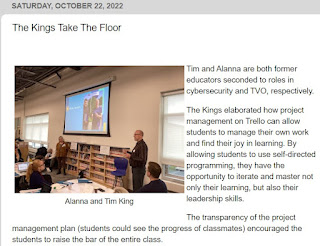
Our presentation was about how using industry standard project management tools and organizational strategies not only prepares students for life after graduation, but also provides them with the organizational tools they need to be both resilient and successful, even when our school systems stagger under the weight of multiple pandemic shut-downs.  Being able select the right tools and move between digital and real-world information allows students to attend class, stay organized and continue to author their own student-led projects no matter how much chaos surrounds their learning.  Digital skills development and knowledge of a swiss-army knife of readily available digital tools could make our education systems pandemic-proof, if only we'd do it.


We shared examples of successes that demonstrated equity and inclusion as well as providing other examples of student-centred empowerment in learning through effective project management.  The tool we used was
Trello, based on the academic research Alanna was doing at Royal Roads University in the spring of 2020 when things fell apart.  The project management theory her post-graduate class was studying was applied directly in my game-development class, saving both student-led projects from almost certain disaster; it's a great example of a cross-pollination of ideas and shows how having a masters-TL in the room can help even a veteran teacher find effective learning tools.

***

Treasure Mountain is very much a hands-on experience with everyone participating and collaborating on developing ideas.  Those ideas are brought forward by the participants.  This year there were 27 (!) papers submitted on subjects ranging from how to audit your book collection to enhance diversity and how to keep an LLC operational during a pandemic, to how to embrace emerging digital literacies.  In my new role at ICTC I am especially interested in that digital literacy development.

Another example of the many cracks in
Canada's siloed education approach.
The morning keynote by Matthew Johnston, the educational director of MediaSmarts, an organization dedicated to improving media literacy in our students, focused on explaining how things had changed since pre-internet broadcast media.  The multi-directional web of media we now find ourselves in implicitly demands digital fluency, yet we still fail to engage these digital literacies by systemically teaching them.

This isn't just a Canadian problem, as code.org states, most schools don't have a computer science program (ours got locally cancelled during the pandemic).  Even though there has been a recent push to put coding into Ontario elementary curriculum, it's being delivered by teachers with little or no technology fluency themselves, and coding is only a tiny part of a much larger and more complex digital/media literacy framework.

Library learning commons are an ideal place to begin this work as (when they're well run) they act as a shared space for engaging with the iterative learning needed to make emerging technology work.  Librarians have always been information management specialists - the mediums may change, but the fundamentals of rigorous inquiry and source credibility assessment don't.  A digitally fluent librarian makes the LLC central in 21st Century learning models that effectively leverage digital tools.

Before the Friday night awards ceremony, Alanna and I did an interview with Dr. David Loertscher, one of the conceptual founders of the learning commons model.  David was curious as to how digital tools could be used to amplify and organize student-directed/inquiry based learning models, and our talk gave us a chance to clarify our own understandings too.  It'll eventually be available on Dr. Loertscher's ALiVE Virtual Library.  It's collaborative opportunities like these that help pave a pathway into the future that will not only make library learning commons relevant to student experience, but will also provide the framework for much needed digital skills system building capacity.

Sunday, 27 June 2021

Hiding History Behind Politics

History isn't just an informational subject, it's also very much about critical media literacy.  Trying to get a clear view of history through what's left to us is nearly impossible because human beings will immediately want to spin it for their own benefit.  These prejudices come from the people at the time, the people who decided what survives and the people in charge now.  This propagandist approach has a great deal of power when applied to the study of national history because it produces dangerous byproducts, like patriotism based on national myths that systemically exclude whole swaths of our society.

This is the cover of Flashback Canada, the history book they handed me to teach a grade 8 class during my teaching practicum in Peel in 2003.  I wasn't a Canadian citizen when this piece of propaganda was handed to me and I was told, as an agent of the system, to indoctrinate the class (most of whom were also new Canadians) with this violently untrue rendition of Canadian Federation.

I can't find the full illustration from inside the book (it's a two page spread!) but I recall it had indigenous groups in traditional garb, unaccompanied women and many BIPOC characters fictionally back-written into the narrative of a multi-cultural Canadian history that never happened.  Teaching this "we've always been multi-cultural" myth of Canada made me very uncomfortable so instead of teaching the text I found some other historical images of Confederation done close to the time and then the students and I looked at the differences between the textbook's rendition and other historical documents.  As you might have guessed, Canadian Confederation in 1867 was a lot of white dudes (because they were the only people considered as people under the law - no one else could vote or politically mattered):

How did this play with a lively, very multi-cultural class of grade 8s in 2003?  Code-switching wasn't a common term back then but many of the BIPOC students talked about how stuff like this makes them doubt their own experiences with racism in Canada.  This made my older, white Canadian supervising teacher uncomfortable.  These days I'm sure she would be on board with the current 'woke' white settler types who want to make make a lot of noise in this moment that will quickly fade to leave us with our lousy status quo again.  Dwelling in the discomfort by prompting discussion and then making systemic change as a result is a way to move beyond our reflexive need to retain a status quo built on lies.

I've talked about historical prejudice before on Dusty World but the events currently happening in Canada are bubbling it all to the surface again, though I don't understand why anyone is so surprised by them.  These children disappeared in plain sight and reports of the nastiness of religious residential schools aren't new.  Choosing to be surprised by them now feels like political spin.  Part of that latest push is to cancel Canada Day but this politically divisive move only shames anyone who disagrees while amplifying the voices of those who want to leverage this disaster for their own political ends.

I've heard (smart, historically aware) people advocate for cancelling Canada Day because aboriginal families are mourning the recent discovery of thousands of children's graves from the Canadian religious residential school genocide, but the only people reeling from this 'discovery' are politicized left-wing Canadians who have now decided to (loudly) acknowledge this hiding-in-plain-sight colonial history.  I doubt native families are 'stunned' by these 'findings' as they've been living them for generations.  This 'white surprise' must seem disingenuous.

I'm left wondering if children's history text books are still as multi-culturally white-washed as that one I was handed in 2003.  My approach to that lesson caused friction with my (white, established-settler Canadian) teacher-mentor.  Teaching rote curriculum out of prejudiced texts works much like taking down statues and cancelling holidays: it's an effective way to revise historical fact to suit the current political narrative which is itself a nasty piece of work.

In the next two centuries the selfish decisions made by current generations around rampant overpopulation, wasteful consumption of resources and pollution of our limited ecosystem will make any previous genocides look tame, yet we're quick to burn anything historical that doesn't meet our myopic ethics.  That well-travelled, carbon spewing first-worlders who hop into their 4x4 SUVs wearing sweatshop made clothing are so loudly self righteous is another example of temporal prejudice, but then you don't see a lot of humility or self-awareness in history.

It's easy to criticize previous generations without making any attempt to contextualize their decisions in the time that they were made.  This temporal prejudice is every bit as corrosive as racial or gender prejudice.  Mass consumers waving social justice flags while making decisions that will kill billions in the future are just as blind to their own contextual short-comings.  Wouldn't it be something if everyone tried to overcome the pomp and circumstance of history with humility, honesty and fairness?

Cancelling holidays  that are guaranteed for you but not for others at the rough end of the socio-economic spectrum reeks of privilege, while taking down statues and renaming things is more about rewriting history to make it less uncomfortable than it is about making any genuine systemic change.  What we should be doing is legally deconstructing confederation and taking the colonial prejudices out of Canada's political structure.  First past the post British electoral systems prop up old prejudices and should be dismantled but won't because party 'representatives' that could make the changes won't because the status quo is what handed them power.

The nastiness of Canadian colonial history isn't easy to stomach but throwing a cancellation blanket over it isn't going to solve anything; we need to dwell in this discomfort if it's ever to prompt real systemic change.  Politically driven divisive ideas like cancelling national holidays and renaming everything to make it less offensive is more likely to support the status quo than change it.  We'll never overcome historically prejudiced propaganda by spinning more of it.  Real change has to happen at the legal level or we'll just keep spinning lies to maintain this poisonous politically charged status quo.

FOLLOWUP

This is still on my mind weeks later as I watch people struggling with how to approach this new awareness.  As a 'new' Canadian I'm finding the loudest white voices in this come from the most established (privileged) white Canadians who are struggling with family histories that are interwoven with Canada's vicious colonial history.

Stats Canada has some interesting breakdowns of Canada's immigration history.  What has me thinking about this from an alternate perspective is that Canada isn't just a colony.  For the vast majority of Canadians today Canada is the place that took them in when their own homes wouldn't or couldn't.  To present modern Canada as just a colony is divisive and untrue, it's so much more than that for the vast majority of its population which includes people of creeds and cultures from all over the planet.

For a poignant realization on modern Canada's place in the world you should make a point of going to Pier 21 in Halifax.  Only a tiny percentage of the people who live here came with expansion of empire in mind, though that isn't how media (social or otherwise) seems to be dealing with it.  For the people dealing with some murky family history I sympathize, but your Canada isn't my Canada.

When we came back from Japan in 2000 we attended an international festival on Toronto's waterfront.  After years living in one of the most mono-cultural societies in the world this burst of international expression was very moving.  As I stood there on the edge of Lake Ontario watching Brazilians express their own culture freely and beautifully in their adopted country that is increasingly built on an international cultural mosaic, I teared up.  That's perhaps the greatest strength modern Canada has:  it shows the way to a future where we can all live together.  Embarrassed descendants of colonist Canadians shouldn't be able to dictate the narrative of this latest chapter in Canada becoming a more perfect version of itself - they've been doing that for too long as it is.

Even though I'm from England I find Canada's adherence to old British habits (first past the post, how our constitution ignores founding cultures) incredibly frustrating.  The most Canadian thing we could do is, as I suggested previously, crack open the British North America Act one last time and create a modern Canadian constitution that is the most radically inclusive charter of rights on the planet.  First Nations people should have the same legal leverage that Quebec has.  With that leverage you'd never see another 'Indian Affairs' ministry - you'd see First Nations doing what Quebec has done:  leveraging the constitution to ensure equity under the law.


RESOURCES

https://blogs.umass.edu/linguist/secret-path-residential-schools-reconciliation/

"Come learn about indigenous people’s history that you probably weren’t taught in school..."

https://www.cbc.ca/news/canada/north/first-nations-right-to-vote-granted-50-years-ago-1.899354
First nations Canadians didn't get the vote until 1960!  Canada's concept of representative democracy has always been flawed and yet it's treated as sacred - which is how you ensure that status quo continues.  These days the old white guys in charge casually dismiss the Charter of Rights whenever it suits them.

https://www.cbc.ca/kidscbc2/the-feed/why-it-took-so-long-for-women-to-get-to-vote-in-canada
"...in September 1917, the Wartime Elections Act was passed in Canada. It granted the vote to women in the military and women who had male relatives fighting in World War I, but it also stripped away voting rights from many Canadians who immigrated from ‘enemy’ countries."

Asian Canadians didn't get to vote in Canada until after WW2!

"The story of the right to vote in Canada is the story of a centuries‐long struggle to extend democratic rights to all citizens. It’s a chaotic tale that includes rebellions and riots, as well as protests, and visits to the Supreme Court of Canada."

https://www.thecanadianencyclopedia.ca/en/article/confederation

"Indigenous peoples were not invited to or represented at the Charlottetown and Quebec Conferences. This despite the fact they had established what they believed to be bilateral (nation-to-nation) relationships and commitments with the Crown through historic treaties. (See also: Treaties with Indigenous Peoples in Canada; Royal Proclamation of 1763.) The Fathers of Confederation, however, held dismissive, paternalistic views of Indigenous peoples. As a result, Canada’s first peoples were excluded from formal discussions about unifying the country." 


You won't find anyone on the Canadian Encyclopedia page who isn't an old white dude because they are the ones that confederated Canada, specifically while denying anyone who wasn't from their background any participation.  Re-writing history to ignore what actually happened isn't a great way of learning from those mistakes.