Showing posts with label maker culture. Show all posts

Saturday, 11 May 2013

What Does A Self Regulated Person Look Like?

Another one of those why I listen to CBC radio moments this morning.  Day Six interviewed Cody Wilson about his 3d printed gun - a weapon that you can manufacture out of plastic on a 3d printer.  Here is another example of the internet bypassing governments and regulations while radically empowering individuals with information.  If you have a few minutes listen to the conversation, Bambury really tries to get around the subject and Wilson is more than willing to address it head on.

It doesn't matter what information wants,
in a digital world it is free, this is a simple fact
In a world where information is free whether we want it to be or not, and where the former owners of information (governments, corporations) find that they can't regulate, control or censor it, where are we left when the means of manufacturing is removed from the moneyed classes as well?

3d printing is tumbling in price.  Wilson posted his gun design online last week only to have to withdraw it this week under a request from the U.S. State Department.  Wilson did withdraw the download, but it doesn't matter, it's out there now.  Copies of copies of copies spread across the internet.  No government can stop it, no corporation can prevent it, the information now has a life of its own online.  As Wilson mentions in the interview, this is just information, what people choose to do with it is their choice... and there are many easier ways to get your hands on better guns, especially in America, so if someone is going to use this to commit violence, they are doing it for a very specific political reason.

The "dawn of wiki weapons"
As a philosophical action, posting these plans online asks questions about a not too distant future where you will be able to build anything you like at your desk in much the same way you can print anything you want now.  Printing presses, once the domain of industrial giants, became democratized; small item manufacture is about to go the same way.  What does the world look like when anyone can design (and freely share) a lethal weapon, and anyone could build it without serial numbers or identifying marks of any kind?

They use a term radical libertarianism in the interview.  The digital space is the new frontier, and on that frontier stand the usual early adopters, the same kind of people that colonized North America, with the same mindset; staunch individualists who have moved into the power vacuum of the internet and pushed technology into areas that make traditional powers very nervous.

Is this madness?  Is radically empowered individualism nerve wracking?  I'd say yes, because the vast majority of people, if given that kind of power, wouldn't do anything good with it.  While most of us are waiting to be told what to do with our new found freedom of information, radicals like Cody Wilson are taking what is already at hand and acting on it.

To paraphrase a famous evolutionary biologist, the future is not only stranger than we imagine, it's stranger than we can imagine.  I don't know what a world where anyone can build whatever they want looks like, but as Wilson said, short of turning off the internet, you can't stop the spread of information, and the internet has quickly made itself essential in this new age.  Turning it off isn't really an option any more, and should we want to?

Wednesday, 3 April 2013

Meet Your Maker

www.arduino.cc
I'm working my way through my second semester with grade nines in computer studies. I've tried to bring as much 'shop' as I can into computer studies.  My background was in I.T., so getting into the nitty gritty of electronics has been an expansion of my craft which I've enjoyed as much as the students seem to.

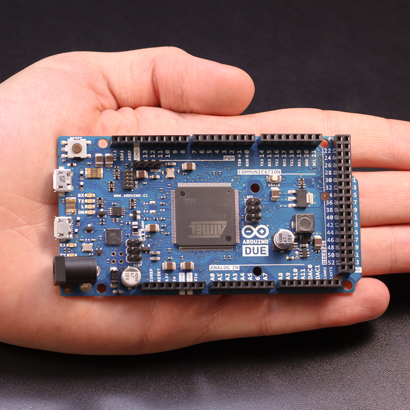
Using Arduino microcontrollers we bridge the gap between hardware and software and get students comfortable with the idea of building circuits as well as controlling it with code.  This year I've also gotten a Raspberry Pi up and running as well as building dozens of desktops. A resurgent maker culture has made electronics much more accessible and customizable; it's a good time to be teaching computers.

Maker Culture
This semester we've been pulling apart broken electronics and reusing digital displays, microphones and other components in our Arduino Frankenstein creations.  Some of it will work, some of it won't, but the process will make Makers of many of the students.

The real fear in using technology is that many users don't have the faintest idea how things work.  When it breaks there isn't a frame of reference of where to begin, fixing anything seems impossible.  After breaking apart their first digital clock, or radio, or electronic game, students begin to recognize the components because they're already familiar with the bits and pieces having used them to assemble a dozen Arduino projects already.  With the mystery gone, they begin to grasp the power their minds and hands have.

I'm re-reading Matthew Crawford's Shopclass as Soulcraft.  It's such a complex read, with so many ideas packed into each page, a second run through will do me good.  If you're an educator, and you can take some well intended criticism, reading the first couple of chapters will challenge many of the assumptions we wrongly found current educational theory on.   I imagine most educators won't find the criticism comfortable, no matter how well intentioned.

I'm about to get my first motorcycle and I've found myself casting about, trying to figure out who I can get to maintain it for me.  A chapter in and this ex-mechanic is getting his hands on a shop manual and doing it himself.  One of the reasons I want to begin riding is to develop a closer relationship with the machinery I use.  The plastic covered, warrantied cars I drive don't do that.  The nakedness of a motorcycle begs for it; I'm looking forward to that quiet, focused mind driving busy hands.

There is something inherently valuable in being able to fix what you use.  I've never had to argue for the value of what we do in computer studies, the learning has inherent worth, is immediately useful, and applicable in a surprisingly wide range of situations.  From the insides of an operating system to the flow of electrons around a circuit, these students develop a familiarity and comfort level with something that most people are more than happy to use in blissful ignorance (until it breaks).  The tactile nature of the work also draws in even the most reticent.  Working with your hands, making something real work through trial and error, offers an experience missing from much of academia.  Crawford's philosophical attack on the globalized knowledge economy happens every day in my classroom.

Many of these students will move on to other interests in other fields, but none of them will ever again be at the mercy of their ignorance while working with a computer.  I'll have to paste rubrics and marks over all this to make it credible to the establishment, but the moment a student who has been whacking his head against his own bad wiring for half an hour realizes what he's done and fixes it himself, he has developed a tiny bit of independence, and perhaps realized that paying attention is a powerful ally.  Learning shouldn't be frustration free, if it were, it wouldn't mean anything.  With minds and hands engaged in a battle with realistic demands, the rewards are hard to quantify in a mid-term mark.

Friday, 20 July 2012

Master/Journeyman/Apprentice

I'm once again in the additional qualification classroom in order to gain another teachable.  This one was a bit tricky.  I'd been working in information technology since I graduated with an honours BA in English in the mid '90s.  When I went into teaching, I looked into getting my technical qualifications (I'd spent a fair amount of money on getting IT qualified and wanted to keep a finger in the pie, so to speak).  It didn't happen.  The Byzantine rules around what I needed and how I qualified were taking so long to get through, it was easier to just plug in my degree (to a very degree friendly teacher qualification system) and start there.


I did computer clubs and delved into #edtech relentlessly, but didn't get my computer engineering qualification until now because I needed it for a headship, and they'd recently made changes that cleared up some of the labyrinthine rules around getting the qualification.


So here I am, a qualified IT technician in a computer engineering class.  If we're doing networking, or computer repair, I'm aces, but soldering?  Circuit boards?  Not so much.  The funny thing is we have electrical engineers that don't know what a registry is or how to reset an IP address, but they are brilliant on a circuit board.  I'm starting to realize that computer engineering is another one of those subjects that collects expertise from various disciplines and files it all under the same heading.  I'm also beginning to see why some comp-eng teachers' courses look so different from other comp-eng teachers' courses.


Other than cutting networking cables, running them and installing hardware, I'm not really a nuts and bolts of electronics kind of guy, but after taking this AQ, I will be.  When I was a kid I got into cars and stereos and did some wiring then, it's nice to get hands on with components again.  My experience has all be around making it (IT) work for business, after taking this AQ, I get the sense that I'm going to end up delving more deeply into maker culture, something I've wanted to do for too long.


Getting my head back into wiring diagrams felt impossible in the first few days.  I'm finding the tools available, especially Arduino and Fritzing to be invaluable in bridging gaps in knowledge.  I know I won't be a Jedi knight at circuitry by the end of the course, but the 1-2-3 system our instructor has been using has recognized the varieties of skills in the room and allowed people to focus on what they want to improve in, and improve I have.


I'm looking forward to hitting my tech-class in the fall and getting my hands dirty.  In the meantime, I just started Shop Class As Soulcraft, suggested by our instructor on the last day of class.  Some mechanic's philosophy will help fill in the gap I'm feeling between my academic background, and my urge to work with my hands again.