Showing posts with label WIRED. Show all posts

Tuesday, 5 February 2019

Learned Helplessness

Reading often creates strange resonances.  Most recently the latest edition of WIRED struck a chord with Paul Theroux's 1975 classic, The Great Railway Bazaar.  What could a travel book from the seventies have to do with a Twenty-first Century technology magazine?

Theroux was on a train trip across Asia.  In India he came across a taxi driver who did a brilliant job of looking after him.  After weeks on the road he found himself becoming desperately dependant upon this support.  I've read a lot of Theroux and he circles this theme again and again; the idea of how the ease that accompanies wealth leads to a kind of learned helplessness.


Way back in 1974 Theroux suddenly found his confidence eroded by an assistant too good for his own good.  Sahib is one of those words loaded with colonial weight.  In India it was used as a title of respect toward European men.  Theroux takes that supposed superiority and dismantles it with American anti-classist zeal, describing the wealthy people who came to depend on their servants as childlike in their helpless.  It's an interesting twist.  

In The Happy Isles of Oceania, Theroux lives the high life for a week in a luxury hotel cottage used by the PGA.  He becomes frustrated at how isolated, unproductive and paranoid he felt by the end of it, even though his every need was taken care of.  The next week he tried to live on one thousandth the money, or four bucks a day.  By the end of that week spent living rough on an empty beach and kayaking about, he felt empowered, productive and alive.  What most people do with money (having other people serve their needs) often leads them to a state of childlike dependence.  Theroux is often tempted by it and then hates himself for doing it.

In WIRED this week the Angry Nerd goes on a rant about Google's gmail predictive text technology that keeps jumping in front of you as you're trying to write an email.  No, I'm not a fan of this use of AI, I can type quickly and it breaks my flow.  There is a function for AI in writing, but leaping in front of composition, or worse yet, replacing the writer entirely, isn't it.  The Angry Nerd is especially worried about the inflationary nature of this interference:

"Once we embrace the personalized simulacrum, we start letting AI speak for us. Soon we let it speak as us. It’s … almost soothing. Frees up time. I’m nearing inbox zero! Ah, Grandma just checked in. She’s not feeling well. I’ll select “Oh no!” Yes. She’ll care that I care. And she’ll reply, so kindly, so expediently: “Thanks so much!”"

Before we know it the ever so helpful, never resting artificial intelligence is speaking for us, replacing our voice in our most intimate relationships.  This echoes Theroux's eroded competence, but the way AI is doing it is much more insidious than the old fashioned human servant.  The AI never rests, is always there and is always looking for ways to step in front of you and help until you become so atrophied that it assumes your voice.  Worse still, the companies peddling these virtual assistants aren't interested in small scale adoption, they want everyone to have the luxury of a virtual servant.


Between the industrial scale of adoption and the dissemination of personal electronics into all aspects of our lives, it's only a matter of time before we're all as atrophied and helpless as Theroux feared.  If we don't start setting limits on AI to prevent it replacing human being, we're in for a rough ride.  Don't expect the Silicon Valley giants to do what's best for humanity.  They've already proven that profit comes first. They'll happily create a society of illiterate social idiots as long as the money keeps pouring in.

Now, more than ever, we need some Asimovian laws in place to moderate the introduction of artificial intelligence.  We've already run into problems with digital technologies in terms of news and politics.  If we leave artificial intelligence to develop without ensuring it isn't atrophying human potential, it will relentlessly drive us into a dystopia we'll all be too helpless to recognize, let alone escape.

Sunday, 11 February 2018

A Media Comparison: Hactivism Then & Now

In 2012 I saw We Are Legion - The Story of the Hactivists at the Toronto Hot Docs film festival.  It's a full length film so it'll take a while to get through, but it's worth it.  It's an inside look at the birth of hactivism from its early roots in 4Chan to the birth of Anonymous.  It's edgy, funny and surprisingly gripping...

There is a kind of poetry in the chaos of those early moments of online activism, it makes me hopeful.  Technology used to overcome tyrannous governments, churches and corporations?  Technology used to bypass media control and free information?  I'm a fan.

Fast forward six years and we seem to be on the other side of this revolution.  Instead of technically skilled mischief makers fighting against systemic inequality, we have Nazis using that same technology to self-organize, tech-corporations removing net-neutrality and making advertising revenue from fake news and foreign governments disrupting elections.  The technology that once promised to set us free is being used to craft even thicker chains.


You can always count on WIRED
graphics to back up a powerful story
WIRED has hit this from a lot of different angles, all of which prompt some hard questions about how the technology we thought would free us has turned into a means of disenfranchisement and control.  Here are a couple of articles that highlight this change:


It's a difficult thing to see such a promising revolution end up serving the moneyed interests it claimed to stand against.

Thursday, 9 October 2014

Literacy, Engagement and Marketing

The latest WIRED has an editorial by Clive Thompson about Minecraft and literacy.  In the article it is suggested that Minecraft (and other video games) have engaged reluctant readers to the point where they are able to overcome their reading problems and devour challenging texts with near perfect accuracy.

I usually enjoy Thompson's reach, he tends to push back assumptions, but in this case it feels hyperbolic.  "Minecraft is the hot new videogame among teachers and parents".  It was three years ago, but then it hasn't just been sold to Microsoft for billions (with a "B") of dollars.  Sometimes I can't tell if it's hyperbole or marketing.

Thompson goes on to state: "Minecraft is surrounded by a culture of literacy." So is any hobby, video games are not magical because of this.  Motor vehicles are surrounded by a 'culture of literacy' - look in any magazine rack.  Back in the day Dungeons and Dragons was surrounded by a 'culture of literacy' with books and magazines galore.  Movies are surrounded by a 'culture of literacy' (IMDB, Entertainment Weekly etc), so is technology in general (WIRED).  That we read and write about the things that interest us is hardly a shock.  Why should video games be any different?  Many reluctant readers are willing to read material about a subject that interests them.  That this is newsworthy is a bit baffling, what is more surprising are the assumptions further on in the article.

Interest and engagement are key elements in developing basic literacy skills, no doubt, but the article goes on to imply that engagement through video games can somehow overcome illiteracy.  This is going from hyperbole to gross over-simplification.  I've already got my doubts about gamification, but championing gaming engagement as the solution to illiteracy isn't respecting the complexity of the skill, though it does sync well with valuations in gaming companies.

Back in 1973 when I was a three year old learning to read my grandmother would read me a bit of The Magic Faraway Tree and then say she was tired and put it down, usually at a critical part of the story.  I'd struggle through the text using the light from the doorway, desperately trying to find out what happened after she left me to go to sleep.  I have no doubt that she knew what I was doing.

I suppose WIRED might have written an article about that, but Enid Blyton doesn't have the market reach of Minecraft or the magic we desperately want to believe inhabits our brave new and oh-so-very-valuable media.

I'm a strong reader.  I can't remember a time when I couldn't read.  For me it meant independence and the ability to satisfy my own curiosity.  There is no doubt that my determination created intense engagement at a time when reading wasn't easy for me, but it was just the first step on the long road of literacy.  I wasn't displaying illiteracy one day and then suddenly became a fluent reader the next because I was "really, really motivated".

Thompson quotes Constance Steinkuehler (of whom I'm a fan) on the effects of video game focused literacy.  Middle and high school struggling readers were asked:

"...to choose a game topic they were interested in, and then she picked texts from game sites for them to read—some as difficult as first-year-college language. The kids devoured them with no help and nearly perfect accuracy."

How could they do this? “Because they're really, really motivated,” Steinkuehler tells me. It wasn't just that the students knew the domain well; there were plenty of unfamiliar words. But they persisted more because they cared about the task. “It's situated knowledge. They see a piece of language, a turn of phrase, and they figure it out.”


Situated knowledge plays a key role in literacy.  Scaffolded understanding and context awareness are inherent to good reading.  On a micro level it assists vocabulary and parsing written conventions like punctuation and grammar.  As we build our understanding of written language we're able to comprehend more complex texts using previous experience; literacy builds on itself in this way.  

Contextualization also assists a reader at the level of themes and ideas.  Being conversant in a video game allows you to make assumptions about words and concepts you would otherwise have no link to through the text.  No doubt many of those struggling readers were able to accurately guess vocabulary and concepts from their own experience, the text becomes a secondary resource, literacy a secondary skill.  Large scale contextualization can help a strong reader parse a complex, unfamiliar text, but if it is being used to parse familiar concepts and materials I'd argue that it isn't assessing literacy that effectively.

Literacy isn't merely the repetition of familiar ideas, at its best it is the ability to deeply comprehend new ideas through a written medium.  Video games might offer a hook that helps reluctant readers engage, but to suggest that Minecraft or any other game could act as a solution to illiteracy is more than misleading, it's dishonest.  It's also why complex, long term skills development like literacy is best left to education, where quarterly earnings and attention grabbing don't attempt to outsell learning.

Tuesday, 5 November 2013

ECOO13: soaking in the future

When you see this in the morning, it's hard not to be inspired!
ECOO13 was bigger better, and better located that any of the ECOOs I've previously attended.  If you believe in ley lines then putting ECOO on the edge of a natural wonder captured some wonderfully thunderous energy.

I'm told that back in the day ECOO was enormous, much bigger, but those early immigrants were following a huge first wave of personal computing.  Since then computers have insinuated themselves into so many aspects of life that they often feel like just more work.

Informational democracy courtesy of computer networking on social media is a slow burn and is still building.  Instead of feeling disenfranchised by machines more and more people are recognizing them as an enabling influence, allowing individuals a voice where only mainstream media and large organizations once broadcast their influence.  ECOO has been building on this new wave of social media democratization every year since I've been attending.  It's always in peril of being spun by the powers that be, but I still hold out hope that places like ECOO will allow people to realize how powerful they are in our new, flattened mediascape.


How to think in a new era? ECOO asking some big questions with Jaime Casap.
On a personal level I've been finding it difficult to engage with educational technology in the past few months.  Between a new infatuation and a year of difficult technology events (GAFE summit. Pearson Social Media Event), I've been finding the business of education to be politically charged and inexplicably restrictive.  The cavalier and simplistic manner in which technology is rolled out frustrates me.  In a difficult year I've been finding personal growth in other areas.

I'd signed up for an ECOO presentation without any really clear sense of direction. The past two years were pretty easy, I knew what I wanted to say and went after it, but after developing a digital skills continuum around pedagogy rather than cost cutting, and instead watching monopolistic corporate buy in, I'm not feeling overly engaged.  Sometimes rolling the rock up the hill just gets too heavy.


They ain't kiddin!
It was with this sense of unease that I went to ECOO, but quickly found my happy place again.  From the conversations I had with intelligent, interrogative educators to the fantastically chosen keynotes that went straight after the larger questions around the information revolution we are living through, ECOO does indeed tackle tough issues.

I really enjoyed all three keynotes and they didn't shy away from asking what education isn't doing to help our students get ready for a world most of us have no idea is coming.  

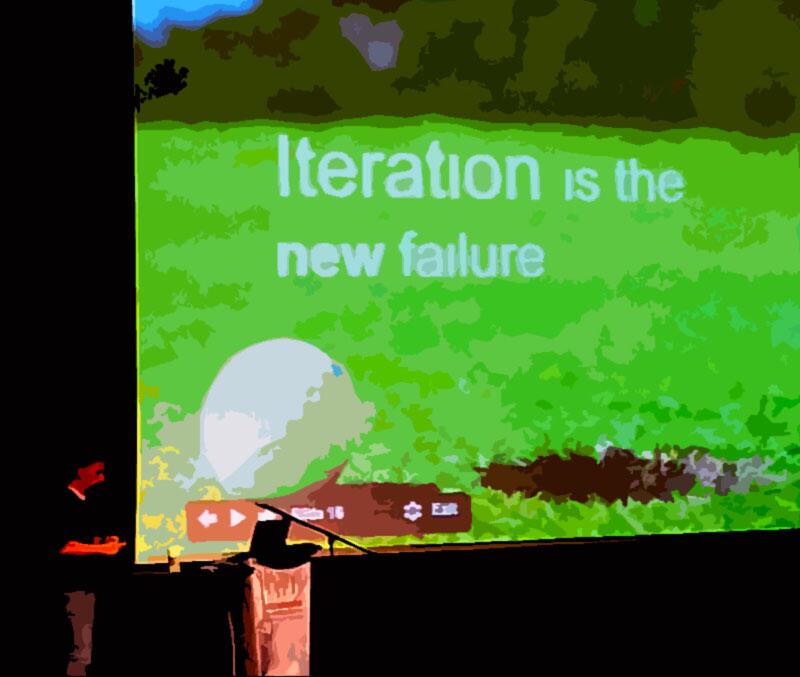
Wired caught up with our ECOO keynotes in their latest issue. Coming back to the 19th Century, factory designed education system hasn't been easy after soaking in the future for a few days.  ECOO is what education could be like if there wasn't all the friction from dinosaurs.

If nothing else, ECOO reminded me that change is inevitable and not to give in to the pessimism of bureaucratic thinking.  Being an agent of change is difficult.  There are a lot of entrenched educational interests that have no interest in adapting to change.  After being at ECOO for a few days surrounded by educators who have already made steps into the future I realize I'm not alone in this, and I'm on the right side of history.

Thursday, 9 May 2013

Wired Thinking on Neurodiversity

Wired at 20 years old
My favorite magazine is WIRED, and I'm a magazine guy.  No other magazine dares me to think as widely and as daringly about the times we live in (if you've never picked up a copy, give it a go!).  Wired will go after interests of mine (internet culture, technology, etc) but it will also introduce me to the leading edge of fields I have only a passing experience in, and make me care about them.

This month they turn 20 years old.  They've been daringly guessing what will happen next for two decades now, and while they don't always get it right, they always make you realize what changes are upon us.

As  I read a new edition I usually want to link and share the ideas they stir up.  This edition is full of them as Wired goes over an alphabet of ideas considered in the last two decades.

Neurodiversity is a topic that hits close to home.  With a son diagnosed, I've come to recognize how I've dealt with ASD myself.  One of the reasons I love reading Douglas Coupland or William Gibson is because many of their characters are neuro-atypical, and it's nice to read about people like yourself; I find much of mainstream media quite alienating.

I've struggled with my inability to care about social distinction forever, and I feel for my son while he does.  I also think that difference is wonderful.  When we heard the diagnosis I said, "excellent! Who would want to be normal!?"  I guess the normal people do.

WIRED's take on all this? Neurodiversity is like biological diversity; it develops resiliency.  The neurodiverse might not all be geniuses, but the ones that are (and geniuses by definition are neurodiverse) may very well save the human race.  Diversity allows a species to survive in extreme conditions, conditions that we're making for ourselves.  As long as we're hammering round pegs into square holes, we're not allowing human beings to be as neurally diverse as we naturally are... and we're hurting ourselves in the process.  Normal people really need to get off their high horses.

I wish I could convince the school system of this as it focuses exclusively on short comings in hopes of making the exceptional ceptional..  If they could improve my son's image pattern recognition (which is astonishing), his special skills would be enhanced, instead they rush to make him fit a mould.  The system presses him to be as widely and flatly skilled as 'normal' people in hopes of making him what, normal?  Upcoming standardized tests won't examine his superhuman abilities, they will focus on what 'normal' people are expected to do (they have charts).  When he fails a literacy test because he's unable to verbalize what he knows in a manner that suits the testers, we're left with the pieces.

Some might suggest that alternative school systems might offer a response to this, but I doubt it.  Adding money to remove expectations isn't what is needed here.

Like eating factory produced meat, driving SUVs or buying sweatshop made products, how we treat the neurodiverse is going to be one of the things that points to our backward (hypocritical) thinking in the early twenty first century.  Like the eighteenth century person who thought slavery was perfectly acceptable, this social ignorance makes us look like fools to history.

Fortunately, I don't really care what most people think about it.