Sunday, 11 November 2018

ECOO BIT18: Reductionism and Ignorance in Educational Technology

I've been ruminating over the latest ECOO conference for a couple of days now.  Strangely, this technology conference began and ended for me with others suggesting that digital technology is a dangerous waste of time and that we should step away from it in our classrooms.  Looking at my ECOO reflections over the past eight years I'm seeing a clear shift from optimism that we will get a handle on the digital revolution to caution and now a determined luddite push to walk away from it entirely.  The now obviously deleterious effects of the attention economy seem to have produced an unprecedented negativity around educational digital technology in 2018, and ECOO book-ended it for me.


These aren't toys, they're tools!
Calling them toys says a lot
about how YOU use them.
I opened the conference bringing armfuls of emerging technology to Minds on Media.  I've long tried to avoid the 'here's-a-turnkey-tech-tool' presentation because it usually comes with corporate compromises.  That split focus in a lot of 'edtech' means much of it isn't really so much about learning as it is about data collection or closed ecosystems that drive profitability.  Besides, I've long advocated for teachers who push technology to actually understand the technology they are requiring students to use.  That kind of technical fluency means you don't get sucked into absurd situations like giving away student data for a 'free' service or driving students into expensive, proprietary, closed technology designed to make a profit when it inevitably breaks.

As in previous ECOO MoM demonstrations, I brought a variety of tech from different manufacturers and simply encouraged educators to become aware of an emerging new medium, in this case virtual reality.  I have no agenda and nothing to sell.  I get nothing for showing the technology and don't benefit from anyone buying one thing or another.  This platform agnosticism means I can talk about the tech without prejudice or hidden agenda.  I was happy to be attending another MoM day and looking forward to showing people this emerging medium.

At least I was until Peter went around the room having the stations introduce themselves.  It all went well until we got stuck on one station that repeatedly described what everyone else was doing in the room as 'playing with toys' while describing their own noble pursuit as being 'real' and technology free (though without ICT infrastructure they couldn't have done what they were doing at all).  This attitude isn't new.  A surprising number of educators refuse to leverage digital tools to make their teaching more effective, but to hear someone shit can what everyone else is doing at this edtech conference was shocking.  There was no opportunity to call her out on it then, but I can now:


Too bad we don't teach it like it matters.  Critical Infrastructure.  Jobs in ICT.

This Minds on Media presenter monopolized the microphone to suggest anything digital was essentially meaningless (a toy) and that when people were ready to stop playing with their toys here she was ready to show them something real.  As a technician who trains engineers and technicians to run the world we live in, this made me angry, especially considering it was done at an educational technology conference that should be advocating for technical fluency across our education system in order to understand and effectively participate in the world we live in.  This didn't put me in a great frame of mind to start the conference, but I soldiered on.

Cybersecurity in our classrooms.
I did two other presentations during the conference.  Both were presenting on platform agnostic technology opportunities that would teach students and teachers about a critical infrastructure (cybersecurity) and addressing our collective ignorance of 3d media.  In both cases I was advocating for not-for-profit digitally powerful learning opportunities that would enable Ontario educators and students to leverage the digital TOOLS at their disposal.  This is the opposite of the reductive and now recessive thinking I kept experiencing.


3d media in marketing & learning
There is now a two pronged attack on digital technology in the classroom.  The corrosive ra-ra edtech crowd seems increasingly determined to brand themselves behind proprietary corporate systems designed to deliver technology with no understanding required (and with lots of hidden profit centres), while the increasingly loud anti-tech crowd rises up against them, advocating that we receded from technology because it's a distraction and a waste of time.  Both sides seem determined to ignore a simple fact: we're supposed to be TEACHING students how this all works, not branding them or hiding them in a cave.  What edtech there is seems determined to follow consumerism into the most simplistic and ignorant relationship with digital tools possible.  In 2018 you can get branded or abstain from tech entirely and then feel mighty righteous about it.  Is anyone left just, ya know, teaching it any more?

There are technicians and engineers all around the world who provide digital infrastructure that we all depend on.  These people understand this technology and are much less likely to act like the sheeple who stare slack-jawed at their phones for hours on end.  To digitally literate people this technology is a powerful tool that is enabling us to do everything from gene editing diseases and linking disparate areas of study to creating more efficient critical utility systems.  Digital technology has become a vital part of the infrastructure around us, yet the vast majority of us, including many teachers, are completely ignorant of it.

For some baffling reason we seem intent on ignoring the actual teaching and understanding of these powerful digital technologies in favour of using them with the same perverse ignorance, and now fear, as the general public.  What is our role as educators in terms of technology if we aren't producing technically competent graduates who can successfully navigate and participate in the digital world around them?  By the way, our ignorance of digital technologies is staggeringly bad. If you haven't followed any of the supporting links in this so far, follow that one.


The closing keynote ended the conference by banging the same drum as that 'when you're done playing with these toys come and do something real' comment that kicked it off.  This time one of the engineers of the attention economy that is causing so much damage earnestly suggested that we need to recede from digital activity in order to preserve not just learning but our very humanity!  Rather than acknowledge the potential for digital technology to enhance learning, his entire talk was aimed at retreating from it.

This particular group of Silicon Valley architects now wants to save the consumers they got wealthy commodifying.  I get the impulse.  If I had a bank account full of blood money like that I'd feel bad about it too, but as a means of resolving this technological adolescence we're all living in, it won't work - they can't see past the mess they've made and they certainly aren't approaching it from an educator's mindset - but then neither are the educators.

There was not a single example of how digital technology might amplify or improve learning outcomes - a decidedly odd way to wrap up an edtech conference.  Our speaker went on to encourage the removal of personal technology from the hands of students and get back to a pre-digital time when everything was better.  As a digital immigrant I know that there was no such time.  If you think students weren't distracted in class in the 1980s you weren't a student in the 1980s.  These Silicon Valley wolves can't see people as anything other than the consumer sheep they used to prey on.  I'd hope that teachers see much more potential in their students than these attention peddlars do, but I'm starting to think that vapid consumerism is the only relationship we'll ever have with digital technology.


Invent a crisis and then offer a solution
to it. American business in action.
From an educational perspective digital technology offers a powerful tool for learning, but it doesn't work if the teachers, administrators and government driving it are ignorant of how it works.  If the teachers and parents can't manage the tech, then we can hardly expect students to.  I'd hope that ECOO and other curriculum support organizations would understand that and advocate for understanding and the development of broader technical fluency rather than encouraging willful ignorance.

Hiding digital tools and telling people to ignore the way the world works is a poor way to run an educational system, unless your goal is to produce ignorant consumers.  Instead of running away from the digital revolution that is driving innovation and increasingly managing the infrastructure around us, we should be teaching self regulation of personal technology and comprehension of how it all works in order to generate a genuine understanding the world we're creating.  Teaching effective digital fluency means we're less likely to be taken by the consumerist wolves and are able to effectively use digital tools rather than being used by them.

I'm all for being challenged in my thinking and often go out of my way to try on difficult ideas just to see how they fit.  I've weathered Nick Carr's The Shallows and watched society wobbling under the weight of the robber barons of the attention economy.  Now I've attended an educational technology conference that began and ended with an ignorant and frankly dangerous dismissal of digital technology as a toy for idiots that should just be taken away.  Meanwhile digital infrastructure made that very event happen.  It fed the people who attended it and provided them with the resources they needed to travel to it, yet it isn't worthy of teaching in our schools?  And teaching it is precisely the problem.  We pick up edtech and apply it without teaching it to staff or students, and now we're shocked that it isn't working well?  Sometimes I wonder how educationally aware our education system is.

I've been banging my head against this call for technology fluency for so long that I can't help but feel like this dismissal of technology both by participants and the conference itself in that closing keynote is a betrayal of what I thought were shared values.

I first attended ECOO in 2010.  I joined Twitter, began meeting other technology interested teachers, started blogging and became part of a vibrant online PLN as a result of attending.  Over the years ECOO has given me ideas and offered me a platform to present my own.  What I'd always hoped was an evolution towards greater understanding of the digital revolution we are all living through has faltered now.  We don't want to learn how the world we've built works.  Pro-edtech educators want to keep the curtain firmly in place and leave the understanding and management of technology to others while the increasingly noisy anti-tech crowd are advocating receding from it entirely.  Our only contact with digital technology is through the lens of vapid consumerism and the only response we can have to that other than participating is to run and hide.

I'm frustrated, tired and losing hope in our ability to manage an understanding of the digital revolution that surrounds us.  Education seems particularly incapable of seeing their way out of this digital hole we've dug for ourselves.  The answer has always been to teach technological fluency, but ironically, I'm finding it harder and harder to find an educator who wants to.

Saturday, 10 November 2018

Competition Trumps Participation


"Among richer families, youth sports participation is actually rising. Among the poorest households, it’s trending down. Just 34 percent of children from families earning less than $25,000 played a team sport at least one day in 2017, versus 69 percent from homes earning more than $100,000. In 2011, those numbers were roughly 42 percent and 66 percent, respectively."

This isn’t a story about childhood; it’s about inequality."


The Atlantic:  Income Inequality in Sports


I used to love playing sports. Refereeing and coaching at summer hockey camps helped me feed myself in university and I've coached, time kept and ref'd soccer and hockey since I was 10 years old.

As I've gotten older I've found men's leagues echo the pointlessly competitive nature of kid's sports with ex-Junior players playing in D division men's hockey just so they can score half a dozen goals each week and run up the score. It's nearly impossible to find a men's hockey league that isn't populate by assholes.

Max used to love gymnastics, but he ended up getting chased out of it in his pre-teens because the only way to do it was competitively (being female was also increasingly a prerequisite because the entire sport, like all sports these days, orientates itself on the most likely competitive success).

Coaching at school was a way to stay in touch with sports, but that too went sour with student athletes (only the wealthy ones who could afford the time and money to play games and practice after school nearly every day) not showing up to practices and playing with that same pointless competitiveness even when they didn't rate against the opposition.

I'm currently on a hiatus with sports, but I still miss them. I wish I could find a hockey league that wasn't an excuse for men to work out their frustrations on each other. I wish my son could participate in sports for the shear joy of it rather than turning every physical activity into a competition. We'd all be much healthier and happier if we had access to financially accessible and for-the-joy-of-the-game sports.

It's a shame how we've turned sports into an excuse for competitiveness - usually along with the pipe-dream that your kid will one day be made a millionaire for playing a game. Having coached at a competitive hockey camp, it's a tragedy to watch those all or nothing kids not make the cut into professional sports - statistically speaking almost no one does.

Norway sounds like they've got this, like so many other things (they also nationalized their oil reserves and used them to pay off their national debt and offer free education to all its citizens), right.


"Norway’s youth-sports policies are deliberately egalitarian. The national lottery, which is run by a government-owned company called Norsk Tipping, spends most of its profit on national sports and funnels hundreds of millions of dollars to youth athletic clubs every year. Parents don’t need to shell out thousands to make sure their kids get to play. And play is an operative word: Norwegian leagues value participation over competition so much that clubs with athletes below the age of 13 cannot even publish game scores."

Sunday, 28 October 2018

Forcing An Apple To Become An Orange

We emigrated to Canada in 1977.  Unfortunately, my parents weren't really paying attention and moved us (an English speaking family from England) into Lasalle in Montreal, Quebec.  If you don't know what was going on in Quebec in 1977, it wasn't good for an eight year old English kid.  While we were struggling to adapt to a new country we'd also wandered into a nationalist revolution.  Bill 101 made it illegal for immigrants to learn in English.  Since that was my native language and I had no background in French, the provincial government told my parents I'd have to attend a french school and get dropped back two grades to accommodate my lack of language skills.

While that was going on, the kids in our predominantly French neighborhood had overheard me talking with my lovely Norfolk accent while walking home from school and had decided that I would be a great opportunity to express their Quebecois pride. Getting beaten up by half a dozen kids at once wasn't any fun, but when they started bringing their german shepherd along to help, it was even less fun.  You'll have to excuse me if I'm not enthusiastic about Quebec's very singular approach to immigration.

Government letters arrived telling my parents that they had to move me out of English school or they would be charged and jailed.  My dad's new job did backflips, opened up a branch office in Toronto and we escaped to free Canada in 1980.  I've had a soft spot for Ontario's open arms approach to immigrants ever since.


@dougpete shared an article on Quebec's math prowess this morning.  I have some strongly held beliefs about how they've managed this result that the article itself goes to great lengths to ignore.  While Ontario has what is described by many people as too many public school systems, Quebec has one, and it's one that caters aggressively and exclusively to a single language supporting a single culture.  They don't enjoy immigration and their provincial politics have backed that up since I was an eight year old way back in 1977.  If you're looking  for a province that struggles to embrace multiculturalism, Quebec's a fine example:

"Among the provinces, the greatest increase in the absolute number of police-reported hate crimes was observed in Quebec, where incidents rose from 270 in 2015 to 327 in 2016. This increase was mostly attributable to more hate crimes targeting Arabs and West Asians, the Jewish population and sexual orientation."  
- Stats Canada Daily: Police reported hate crime, 2016


With the exception of New Zealand (which is significantly less
multi-cultural than Canada
anyway), there are few other countries
in the top 20 that sport a significant immigrant population.
I would argue that if you're dealing with a less diverse population you're dealing with an easier education process.  In addition to removing hard barriers like language and the various qualities of education in home countries, you're also bypassing many of the less tangible complexities like cultural expectations around gender and religion.  These benefits are clearly seen in international education rankings where monocultural societies are much more willing and able to force compliance and efficiently produce results for standardized tests; standardized populations feed strong standardized results.  With no language barriers or cultural confusion, it pays to be monocultural in standardized testing.  Canada is exceptional in those results, especially considering how it's a country built on immigration.  That we are able to produce these results even while working with diverse often ELL populations is astonishing.  Statistics show just how challenging trying to cover curriculum while also teaching the language of instruction is.  Stretching your education system to provide support for such a diverse population means you aren't going to score as well on a standardized test because your students aren't standard.

Quebec students pay a third what Ontario university students do.
They can afford to stay in four year programs for teacher training
while Ontario teachers would end up paying tens of thousands of dollars
more for that privilege.  You can encourage extended teacher
training when you know it isn't going to bankrupt your citizens.
In addition to the diversity of their students, there are a number of assumptions made in that article that ignore the cultural landscape that has allowed Quebec to produce this outstanding mathematical outcome that is out of step with the rest of the country.  Under more extensive teacher training is this:

Teacher preparation programs in Quebec universities are four years long, providing students with double the amount of time to master mathematics as part of their teaching repertoire, a particular advantage for elementary teachers. In Quebec faculties of education, elementary school math teachers must take as many as 225 hours of university courses in math education; in some provinces, the instructional time can be as little as 39 hours.

That Quebec students receive much more support for post secondary than Ontario students is a matter of fact.  Quebec looks after its teachers in training by not financially crippling them with this long term training.  Expecting Ontario teachers in training to foot an Ontario sized bill for their Quebec length training only goes to highlight the fundamental differences between the provinces.  Quebec students pay more than a third less what Ontario students do for that university training, and so they are able to extend their training.  It's little wonder that they are producing better results on this standardized test.

The article kicks off rather hyperbolically sounding an alarm for Ontario's math's results:  
"That populist election cry resonated with Ontarians because Ontario students continue to lag in mathematics and were the only ones in the country to show no significant improvement on national tests from 2010 to 2016."
Saskatchewan also has a dip in results and most of the other provinces were all within a couple of percentage points of their previous scores.  More importantly, Ontario led the results for English speaking Canada in 2010, 2013 and 2016, and even managed to slightly improve on it.  So this emergency in Ontario is based on the fact that we've always been leading in mathematics scores in multicultural Canada?  I hope everyone else catches up with us one day, but with the provincial government about to pull one of the top performing English Canada education systems to bits, I wouldn't bet on it.

In researching this I came across some evidence that the Quebec of today isn't as totalitarian as the Quebec I emigrated to in 1977.  This research on current Quebec schools summarized it this way:

"Quebec’s traditionally homogeneous French-language education system has undergone some radical changes over the past 30 years and continues to be shaped by public policies geared toward promoting French and openness to ethno-cultural diversity. The province has come a long way and now compares favourably with other immigrant-receiving societies. Nevertheless, many challenges lie ahead. Among other things, the marginalization of some ethnic groups, and most especially that of the Black community, must be better understood and actively prevented."

Perhaps Quebec is a bit less mono-cultural than I remember, but it still enjoys all the benefits of encouraging only primary language speakers into their system.  With that language of instruction time and energy freed up and with government subsidized education that allows their teachers to enjoy extended training without financially crippling them, Quebec is enjoying the results it deserves.  I'd rather Ontario didn't try to copy them though.  As an immigrant myself, Ontario made me feel welcome in a way that Quebec didn't, and I hope we'll continue to do that for the people across the world, regardless of the language they speak, who come here to find a home.

The article ends up questioning its own bias on Quebecois superiority in math as it wraps up:

Quebec is markedly different when it comes to mathematics. Immersed in a French educational milieu, the Quebec mathematics curriculum has been, and continues to be, more driven by mastery of subject knowledge, didactic pedagogy and a more focused, less fragmented approach to student intellectual development. Socio-historical and cultural factors weigh heavily in explaining why Quebec continues to set the pace in mathematics achievement. A challenging curriculum produces higher math scores, but it also means living with lower graduation rates.

Perhaps the Ontario panic over mathematics could do with a bit of context, but I fear that won't happen in the populist, reactionist times we live in.  It's better to invent an emergency, compare ourselves to a system that couldn't be more different and then try to imitate their results than it is to continue to lead English speaking Canada in mathematics?  I sincerely hope not.


Other Research For This Piece:

Visble minority population by urban centre: https://www12.statcan.gc.ca/nhs-enm/2011/as-sa/99-010-x/2011001/tbl/tbl2-eng.cfm   Montreal barely makes the top 5 and is similar to Winnipeg in terms of immigration.  I couldn't find language details, but Quebec's focus on french is absolute.

https://www12.statcan.gc.ca/census-recensement/2016/dp-pd/hlt-fst/imm/Table.cfm?Lang=E&T=11&Geo=00
https://canadaimmigrants.com/canada-international-students-by-province-2016/
http://www.chereum.umontreal.ca/publications_pdf/Publications%20de%20la%20titulaire/Quebec%20Question%20Stephane%20Gervaisch19.pdf

https://www.canadastudynews.com/2018/03/19/canada-is-home-to-nearly-half-a-million-international-students/
https://www150.statcan.gc.ca/n1/daily-quotidien/171129/dq171129a-eng.htm

https://www150.statcan.gc.ca/n1/daily-quotidien/171129/dq171129a-eng.htm
https://www12.statcan.gc.ca/census-recensement/2016/dp-pd/hlt-fst/imm/Table.cfm?Lang=E&T=11&Geo=00

Monday, 8 October 2018

Death by Maintenance

One of the dangerous things about watching the shows my son likes to watch is that many of them aren't what they appear to be. He likes complexity, and there are few things on TV these days as complex as Rick & Morty (if it is ever on TV again...). Like a lot of other modern cartoons, Rick & Morty hides surprisingly complex narrative behind simplistic animation.

Rick is a scientist who has discovered interdimensional travel and so can exist in any timeline. As this 'infinite Rick' he has almost god like power and is constantly criticizing everyone else for not realizing how pointless and narcissistic their reality is - any ethical value they place anywhere is a result of their lack of perspective. This show goes to great lengths to force its viewers to question morality and how embedded it is in our personal circumstances. If you're looking for a show that makes you feel better about your circumstances, Rick & Morty is the opposite. It shows you a multiverse in which even your unique self isn't unique let alone special. This pan-dimensional multiverse is so vast and so overwhelmingly indifferent to your circumstances that it continually screams a central premise of the show: nothing matters. Yet even in this chaotic and indifferent multiverse, Rick and the other characters in the show stand out as prime movers; people who make their own meaning in spite of the alienating size and indifference of reality.

In one of the most popular episodes from the last season of the show, Rick turns himself into a pickle so that he doesn't have to go to family therapy:


He, of course, ends up in it anyway after he fights his way (as a pickle) through an impromptu action movie. The therapist (voiced by Susan Sarandon!) finally gets to judge this character who goes to great lengths to avoid judgement. Her monologue (which Rick immediately bashes as they're driving away from it) is another of those moments where Rick & Morty gets startlingly real:

I have no doubt that you would be bored senseless by therapy, the same way I'm bored when I brush my teeth and wipe my ass. Because the thing about repairing, maintaining, and cleaning is it's not an adventure. There's no way to do it so wrong you might die. It's just work. And the bottom line is, some people are okay going to work, and some people well, some people would rather die.

Each of us gets to choose.


This is idea of death by maintenance has stayed with me. I turn fifty next year and I'm on my way to two decades in a career I'd never have guessed I'd be doing. Unlike many teachers, I've never been struck by the divine 'calling' of teaching. My early life of rolling over into a new career every few years as emerging technology caught my attention and encouraged me into learning something new is a distant memory while pensions, mortgages and stability drive most of my decisions these days. I imagine this is how most people age until they end up the typically habitual old person who is scared of everything and avoids risk at all costs until they are in a nursing home. It's a long battle to get to that point of declining mediocrity, and the win condition kinda sucks.
 
In my younger years, with very little guidance or support from home, I struggled through high school, college, apprenticeships and university, trying to find my way towards a life that made best use of my abilities. I walked away from stability and income many times in favour of those opportunities as a young man, and it's why I'm where I am now, but I'm not inclined to follow that trajectory and maintain myself into mediocrity. If I can't find satisfaction in teaching, I'll go elsewhere, but I'm hoping that teaching is one of those careers that can evolve with me.

The first ever blog post I did on Dusty World way back in 2010 was on Caution, Fear and Risk Aversion in students. Those students are long gone but the learning risks we took paid off for many of them. Taking risks and pushing learning has become my default setting in the classroom. If we can't reach for the potentially undoable then we're just maintaining ourselves into mediocrity. Whether it's dangling students out in competition or creating difficult courses that push them to deal with real world consequences, including failure, I've got to find my way past the learning as maintenance approach or teaching is going to get dangerously stale and abstract.

Speaking of real, with the return of school this year I've realized I've only got a decade left in teaching. I'm not sure how I'll be able to approach that in a way that will let me finish with alacrity, but whatever it is, it'll need to be something other than status quo maintenance teaching. I know a number of my colleagues find this approach tiresome, but it's the only way I'll be able to stick with the job. Some people love maintaining the status quo and ensuring continuity and conformity, they thrive on it! I'm not one of those people.

Some find Rick's lack of boundaries or context upsetting, but it's that kind of existential 
freedom that we all enjoy, we just hide it behind socially constructed barriers. Rick isn't special, he just realizes that his future is his to author and doesn't have to be determined by overly restrictive social norms. In that freedom he prizes adventure and risk as the only real way to live and grow. Testing boundaries and pushing limits is where we find ourselves. When I eventually retire I hope I can dedicate my remaining years to those same goals and not spend my time and energy hiding from life. If there is a better working definition of lifelong learning, I've yet to hear it.

If you've never watched Rick & Morty, give it a go. Many of your students are.

Sunday, 23 September 2018

The Centre Cannot Hold

I stumbled across this interesting article on curiosity and the neuroscience associated with  it:

"Encourage students to chase their own interests, cultivate curiosity.  It fires up brains and makes them better at remembering new information.  It also engages students in the best possible way."

"When we’re hungry for answers, our brain activity changes in ways that help us retain new information. For one, the curious mind engages processes and brain regions associated with anticipating a reward. We want to learn more because the answers are satisfying. In addition, the hippocampus, a memory hub, ramps up activity, preparing to store information. The more we want to know an answer, research suggests, the more memorable it becomes."


If you're not a teacher and are a big fan of the new Ontario government's 'teach 'em like we used ta' approach to learning, this is what we call pedagogy.  There is a lot of neuroscience that directs modern pedagogy in the classroom.  Put in simple terms, we don't just make this stuff up; the education system spends a lot of time and effort understanding how learning works best and then training teachers to work with that.  Scientific research guides modern curriculum building, at least until right wing populist ideology dislodges it in Ontario.

Showing a teacher how curiosity can be used to amplify retention and encourage a focused approach to new knowledge acquisition is pure gold.  I fear the 'take it back to basics' stance of our new government means this neuroscientific research is ignored in favour of the conservative reductive approach of rote memorization and zero differentiation of instruction.  It's a common conservative belief that everyone (especially in the public sector) needs to suffer in order to show they are trying, but don't expect anyone to learn anything in an environment like that.  Contrary to this grossly simplified view of education (in that case advocated by an American with no teaching experience), we're not in it to punish anyone.  You don't learn well when you're being subdued.  You don't teach particularly well in those circumstances either.

Some other gems in from that article:
"teachers can be models of how to be comfortable with uncertainty"

"When we’re hungry for answers, our brain activity changes in ways that help us retain new information. For one, the curious mind engages processes and brain regions associated with anticipating a reward. We want to learn more because the answers are satisfying. In addition, the hippocampus, a memory hub, ramps up activity, preparing to store information. The more we want to know an answer, research suggests, the more memorable it becomes."

***

An interesting connection with that piece on curiosity and information retention was this article in The Guardian about the age of skim reading. The author draws some interesting connections between Western society's rise of populist regimes and the new lack of empathy and critical analysis in the population:

"The subtle atrophy of critical analysis and empathy affects us all. It affects our ability to navigate a constant bombardment of information. It incentivizes a retreat to the most familiar silos of unchecked information, which require and receive no analysis, leaving us susceptible to false information and demagoguery."

If you're wondering why we're suddenly faced with these shocking politicians who seem out  of sync with the world around them, it isn't them that's out of sync, it's you (if you're reading this you aren't the new normal).  The conservative 'you must suffer to pay the private sector's bills' thinking plays nicely with the lack of patience, empathy and curiosity we've been cooking for the past fifteen years in the incessant digital noise of the attention economy.  It's easy to blame this on information and communication technology, but the tech itself has allowed us to make enormous scientific and technical advances.  Smart people have leveraged it to great advantage  It's the attention economy that grew out of it that is causing problems for everyone else.


I'm a big fan of digital tools, but we've done almost nothing to actually learn how they work so we can use them effectively and without compromise.  In the past decade education systems around world have handed off control of our online learning environments to advertising companies like Google who have monetized everyone's attention.  You don't get the same return on investment if you don't keep your users in a permanent state of data churn.   You do that by designing systems that encourage short attention data churn.  Every time we accustom a student to that environment we're training the attention economy's future users, whether they're actively advertising to them or not.  As education systems become complicit in preparing our children for the vapid attention economy, many of their parents don't notice because their noses are in a phone too.  Our political circumstances are a direct result of us all being immersed in this nasty mess.

One of the first casualties of new media has been long form reading:

“We know from research that the reading circuit is not given to human beings through a genetic blueprint like vision or language; it needs an environment to develop. Further, it will adapt to that environment’s requirements – from different writing systems to the characteristics of whatever medium is used. If the dominant medium advantages processes that are fast, multi-task oriented and well-suited for large volumes of information, like the current digital medium, so will the reading circuit. As UCLA psychologist Patricia Greenfield writes, the result is that less attention and time will be allocated to slower, time-demanding deep reading processes, like inference, critical analysis and empathy, all of which are indispensable to learning at any age.” 

Alanna is teaching a senior creative writing class for the first time in a long time and she is shocked by what the new normal is.  You can expect grade twelves, even academically focused ones intent on university, to have never read a book for pleasure.  In some cases they've never read a book at all.  Their days are spent in the bite sized, simplistic cesspool of the internet.  They don't have the patience to let a narrative develop.  The building of suspense frustrates them.  They live in a world of fleeting introductions immediately followed by puerile climaxes designed to hold on to them for a moment before their attention wanders to the next distraction.

Many students can't even sit through a film anymore, let alone read a book.  Watch current high school students sneaking out their phones the minute a film starts and squirming if can't find their digital churn fix; see if I'm not wrong.

Long form reading isn't impossibly difficult, but it isn't a natural human skill, we have to learn it.  In doing so we enjoy a richness of shared experience impossible to get any other way.  This leads to the empathy we're struggling to keep alive in modern society.  It also leads to a richer internal world where you have the vocabulary and shared experience to express yourself succinctly.  If you're reduced to expressing your deepest thoughts in internet memes, what a sad and dimensionless mind you must feel trapped in.  How much curiosity can you generate if you live in a world of instant, short term satisfaction?

In our ongoing social experiment I'm curious to see how this all plays out.  We introduced digital technologies that have revolutionized science, education, finance and communications, allowing us to take huge steps forward in terms of efficiency and collaboration.  A small group of sociopaths then used this technology to create an attention economy that has actually damaged our democratic institutions and the minds of the general public itself.  We find ourselves in a place where improbable governments suddenly have power and the people who voted them there have neither the ability nor the inclination to actually learn about why this is a bad idea.  We've weakened our ability to empathize and connect with each other, all ironically under the name of social media.  It seems this reductive process isn't finished yet.  With short sighted apathetic government being put into power by an increasingly illiterate, distracted and stressed populace, I'm left wondering just how low we can go.


LINKS

https://www.theguardian.com/commentisfree/2018/aug/25/skim-reading-new-normal-maryanne-wolf skim reading

https://www.theglobeandmail.com/opinion/article-its-time-ontario-education-got-back-to-basics/ an american with no teaching experience tells us how to teach

https://hechingerreport.org/piqued-the-case-for-curiosity/ curiosity

http://www.fordnationlive.ca/watch_doug_s_plan_to_fix_ontario_s_education_system_by_respecting_parents_and_getting_back_to_basics
discovery math - isn't a thing, back to basics means what? what are basics?  perhaps code for an excuse to eviscerate a successful system?

https://twitter.com/acampbell99/status/1034627621559181312 teachers arguing pedagogy online.

https://www.theglobeandmail.com/opinion/article-in-the-ongoing-math-wars-both-sides-have-a-point/?cmpid=rss&utm_source=dlvr.it&utm_medium=twitter
math wars - see below, Canada is top ten in the world in maths.


***

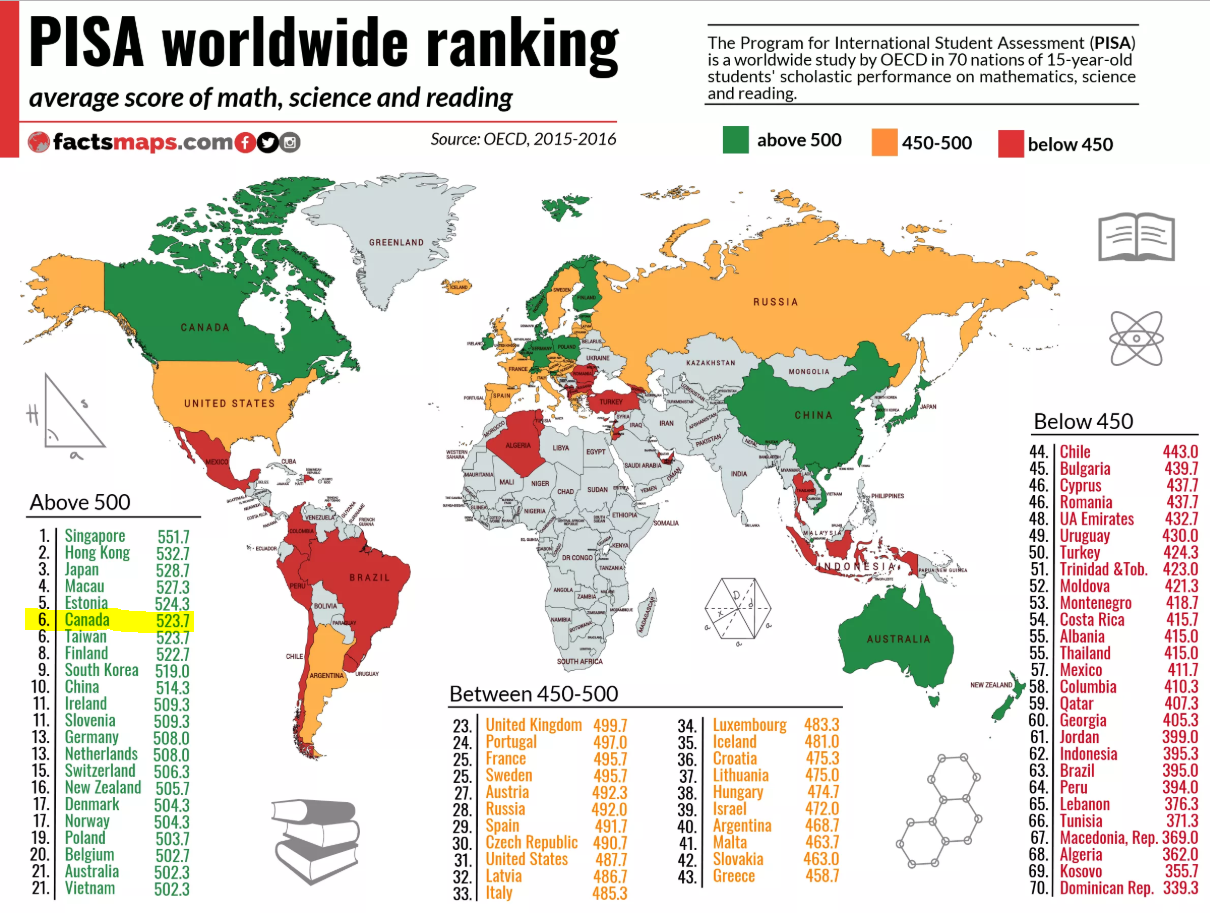
Just a reminder, Ontario is Canada's largest education system and Canada is consistently near the top of the world in terms of reading, science and maths.

But don't let those facts get in the way of your politics:
https://www.businessinsider.com/pisa-worldwide-ranking-of-math-science-reading-skills-2016-12
Ignore all the single-party authoritarian countries at the tops of those lists - they only put forward their top students for assessment. Western systems put their whole populations forward.

https://www.theguardian.com/us-news/2018/sep/07/us-education-spending-finland-south-korea
"In Ontario, which educates 40% of Canada’s students, nearly 30% of the province’s population are immigrants. According to the 2015 Pisa exam results, Ontario scored fifth in the world in reading. Children of immigrants perform compatibility with their peers with Canadian-born parents in educational achievement."

Ontario's education systems is one of our most successful exports, but you wouldn't know that from listening to the new government. Private schools around the world use the Ontario Curriculum that they just started dismantling. Ontario trained teachers are teaching across the planet because they are Ontario qualified. If our education system were a private enterprise it would be held up as a paragon of success. Remember that in the coming months.

Saturday, 22 September 2018

Media Literacy: Technical Challenges & Digital Ignorance

Last year I attended the FITC digital creatives conference in Toronto for the first time.  I teach a senior high school software engineering class where we focus on project management in terms of game design.  We use Unity to develop interactive 3d games, sometimes in virtual reality.  We use Blender to learn how to 3d model.  I attended FITC to try and get some perspective on how we can use current industry standards in our work, but this conference did much more than that.

I thought I was up at the pointy end of 3d computer generated imaging know-how, we do some exceptional work in class and many of our grads have gone on to work in the industry, but FITC floored me with how CGI 3d modelling has insinuated itself into marketing.  The first presentation that made me question everything I thought I knew was by The Mill and their Blackbird car.  This digital studio has revolutionized how automakers advertise.  The next time you're watching a car advertisement, ask yourself if you're actually seeing the car:


From a media literacy perspective, if you aren't aware that what you're watching isn't real, are you really media literate?  This can lead to all sorts of strange situations where all of us are media illiterate and at the mercy of the people who aren't:


Made this week by one of our new grade 11s.  Watching an
already talented artist take these digital tools and run with
them is one of the best parts of my job.
I'd originally attended FITC to make sure we were current on 3d technology.  I think we're doing a remarkably good job of that in our high school program, but what I was unaware of was just how many 3d modelling jobs there are beyond the film and video game industries.  There are a number of companies now that focus entirely on the very lucrative marketing industry with this technology.  I was able to bring that back to my students and offer up a new avenue for our talented digital artists to consider when they graduate.

I haven't touched on many of the other surprises from FITC.  Relatively new jobs like computer animation that I thought were secure are in doubt.  Other skills that I never considered (traditional visual arts skills, mime and creative thinking) might be much more valuable in our digital future than I thought they might.  This kind of information makes me want to diversify my software class and encourage greater artistic influence and experimentation.  Ideally, we should be learning these digital tools in order to amplify and express the creativity and complex thinking my students are capable of.  Technically proficiency isn't an end in itself, we learn the tools to make our thoughts tangible.


We've got one of the top 2d animators in Ontario in our
grade 12 software engineering class.  He's pretty handy
in 3d as well!
The media literacy side of it still bothers me.  I'm teaching computer engineering so my focus is there, but so few people are interested in learning how this technology works.  I have a pretty healthy program and I work with less than ten percent of our school population.  Many schools in Ontario don't offer any digital technologies at all.  In my senior programs I'm lucky to have one or two females in the class.  Tech tends to be male heavy and digital tech is no different.  That gender disparity means a digital literacy disparity too.

I see every person in the school using digital technology every day, yet its a curriculum afterthought.   I've long argued for digital technology to be a required fluency, especially if we're going to use it in every classroom and throughout our days.  If you don't understand the technology it will influence you in ways you won't even notice.  You'll also waste a lot of time not doing it properly.  My experiences at FITC this year have opened yet another angle on digital fluency in terms of media literacy.  If you're watching something you think is real but isn't, you're the sucker that PT Barnum and modern marketing dreams about.


If you're at ECOO #BIT18 this year I'll be presenting on the many surprises I found at FITC and how you might start to bring 3d modelling or at least an understanding of it into your classroom.  Hope to see you there.


Here's the presentation: