Showing posts with label millennials. Show all posts

Saturday, 31 December 2016

Institutionalizing Success and Teaching Millenials

This was shared online this week and it prompts some thinking about how we deal with the generation we teach.


Four social circumstances that have millennials struggling:

1) Failed parenting strategies include children being told they are special and can do whatever they want just because they want it.  They have won awards their entire lives for simply showing up.  This award inflation devalues excellence and embarrasses the failures these children experience.  They've learned not to strive for excellence because it doesn't matter.
2) Technology: Millennials are surrounded by filtered social media where everyone appears to have it figured out and puts on a good face.  On top of that they have the same relationship with social media as a gambling addict has with a casino, except this addiction is only ever a touch away.
3) Impatience:  They want to reach the summit and have a 'big impact' but are unaware that the summit lies at the top of a mountain.  Is this related to number one?
4) Environment:  Companies (and schools?) should be rebuilding the confidence and resilience of this generation by reconnecting them to personal relationships and long term goals.  This means stepping up to combat number 1, something that most school administration really isn't willing to do.


Now imagine standing in front of thirty one of them.
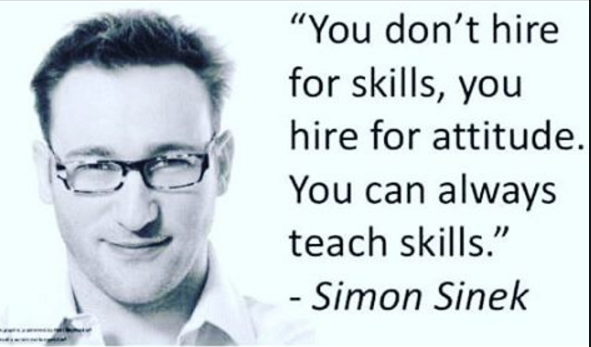
I've struggled with the vagaries of the millennial mindset in the classroom many times over the past few years.  From the grade inflation of risk averse learners and five-ohs to the complaints of industry, I'm familiar with the millennial challenges Sinek refers to in his interview above.

Battling these frankly bewildering and fictionally driven parenting strategies seems to be a lost cause for most educators.  Since banks and multi-nationals decided to burn the economy down and cause years of austerity, education (and governments in general) have taken on business-think in an unprecedented manner (some kind of Stockholm syndrome?).  The modern approach seems to be 'the customer is always right even if they have no idea what they're doing'.  Rather than expecting competence on the part of the student I often find myself defending a failing grade from a student who has never completed any work at grade level and has missed weeks and weeks of class.  Parents don't want to hear that their child is incapable and they certainly don't want to accept responsibility for that incompetence.  Their only goal seems to be finding ways to blame anything else.

We're not doing a lot of either these days.
Technology is another place where education has thrown in the towel.  Students can do whatever they want with their devices.  Any attempt to redirect a student away from inappropriate technology use is wasted as these devices are now considered to be a constitutional right.  It isn't uncommon for me to ask a student to focus on what we're doing and have them tell me they are in the middle of a text conversation with their parents which is obviously much more important than whatever's happening in class.  They're probably planning a two week absence from school for a holiday - another exciting new millennial parenting tactic that would have been foreign to my parent's way of thinking.  Sinek's no smartphones in a meeting rule wouldn't fly in a modern classroom.  You can't helicopter parent without the tether.


How education is becoming less able
to manage these dangers we face.
Patience isn't lost in all students but even the most capable are dwindling in attention duration.  At the beginning of our last unit I showed exemplars of previous projects done over the past few years.  The top student in my class asked, "are people getting dumber and dumber?"  Good question.  They certainly seem to be less and less capable of developing skills complex enough to tackle curriculum level theory and practice.  Perhaps if they weren't taking weeks of unexplained absences and holidays during the semester things would be better.  Perhaps if they were expected to attempt all course work to the best of their abilities skill-sets wouldn't be deteriorating.

In modern high schools students take the courses they want, not the ones they are capable of.  Students who fail advanced courses get a variety of options to regain the credit and are seen at the same level next year regardless of how little they've proven they can do.  Parents demand access to advanced classes for students who barely find time to attend school and are unwilling to actually do anything.  If I fail anyone I have to justify the failure, not so the absent, incompetent student.  Even trying to offer a range of courses doesn't work because everyone is an academic all-star who should be getting the most advanced credits.

The complaint from people in post secondary education and the work place is that we're producing graduates incapable of working effectively in the 'real world'.  Sinek's comments go straight to this.  Any absence or student failure isn't an administrative issue; the system won't even address it.  There used to be a limit on unexplained absences and then a student was kicked out of a course, that doesn't happen any more.  There used to be criteria for failing late work, that doesn't happen any more.  There used to be requirements for staying within an academic stream, now it's do whatever you want.  When a student is absent or obtuse teachers are told to contact the parents who caused the situation in the first place and work it out.  In Ontario this approach has been institutionalized using laws like school until eighteen no-matter-what.  By keeping students in school at all costs we've effectively removed anywhere to drop out to.  With no bottom to fall through, graduation rates are on the rise!  We've effectively institutionalized failed parenting strategy number one:  everyone is a winner!


The internet is full of memes that suggest the approach we're taking isn't helping.

Thursday, 7 January 2016

the end of comments in a flattening media-hierarchy

Oh the incivility!
Recently the Toronto Star turned off online comments on their website.  I beat them to it by about a year.  I was recently asked why I would do that.  Don't I want people to interact with my online content?

I sure do!  And if they want to they can share my blog and then comment on it to their heart's content.  What do I possibly get out of running a comments section on a blog?  Nothing!  If you ask for a login no one bothers to do it, if you allow open, anonymous comments you get buried in advertising and nastiness, the typical by-products of human interaction.

With the advent of pervasive social media the idea of needing a comments section within your online content has had its day.  Anyone reading online content has their own social media presence of some sort nowadays.  They are more than welcome to leverage that in order to comment on my content.  In doing so they share my content.  It's the least they can do if it prompted them to have an opinion on it that they want to share.


We've moved from stratified, traditional, paper based media delivery though early adopter online media delivery to a more mature, everyone-has-a-presence-online media delivery system (nicely explained in this essay lambasting education's inability to free the essay from its millennium of bondage).   Embedded comment sections are a hold-over from an earlier internet where online readers tended not to have their own online presence.

Digital technology is forcing an increasingly flat media-scape.  Millennials spend almost no time in traditional media.  They could barely pay attention to Star Wars in the theatre when I was there last week.  I've stopped showing videos in class because asking Millennials to watch media simultaneously is alien to them and frustrating for me.  In a world where people distrust and often ignore the patronizing nature of traditional media it's best not to fight the flow.

If you're determined to hang on to the comment section in your online content you're swimming against the current.  You're assuming that your content is somehow more established, more authentic, more valuable.  You are belittling your visitors' online presence by making them work in yours.  It's ultimately about you refusing to surrender control of your content in an increasingly democratic communication medium.  That idea of control is a holdover from traditional, paper-based media hierarchies, it isn't surprising that a newspaper struggled with this.  You've got to let it all go Neo.

If you want insipid examples of human nastiness and stupidity you'll find them online, especially in anonymous, internal comment sections.  I'd long stopped reading The Star's comment section for this very reason.  I also tend to blacklist those brave (often conservative) souls on twitter and other social media who hide behind anonymous or fake user names.  They feel very brave and are usually overly aggressive in their anonymity.

What's funnier are those people who create social media presences based on their real self and then proceed to advertise their ignorance to the world.  If someone is going to confuse Twitter with texting there isn't much we can do for their employment prospects.  People who are nasty online tend to get bitten though.   It's a self correcting process and it's happening less and less because we're getting better at it.


This flattening media-scape isn't just hurting traditional media, it's also snapping at people who don't realize that their reach has changed.  Democratizing media means empowering people who have no experience with publication, and make no mistake, every time you post on social media you're publishing to the entire planet.  People in Timbuktu can read your tweets if they are so inclined.

There will come a point when there have been enough cautionary tales and social experience with self-publication that people will learn best practices and the vast majority will realize just how empowered and potentially dangerous we've all become in our flat new world.

In the meantime, if people want to comment on my content they're welcome to share away, but I'm not providing a comments section because it belittles my reader's own online presence and dilutes my material with mean and often irrelevant comments.

Sunday, 14 December 2014

The Tyranny of Collaboration

I was talking to a digital native the other day in English class about Shakespeare.  This particular Millennial is a top 5%er who will go on to do great things.  She was wondering who the people who wrote Shakespeare were.  I was surprised at the question as I've always thought one person wrote Shakespeare.  I even have trouble with the classist conspiracy types who think an actor couldn't be that smart so a noble must have done it.  Having read a lot of Shakespeare (all of it actually) over decades, I know his voice, and it isn't a voice by committee; that kind of brilliance doesn't happen around a meeting table.

I thought it interesting that the Millennial mind assumes collaboration, infecting her own generation's constant interaction across history.  The internet has turned the digital natives who live in it into a hive mind.  They can't form an opinion without socializing or turning to the internet for information. Their waking lives are awash in constant communication.  They describe moments 'trapped' in their own mind when they are unplugged as boring.

The modern mind is open in a way that someone from 20 years ago, let alone 400 years ago, would find alarming. Our marvellous information revolution has not only made our data public, it is also changing what we think we are individually capable of.  Needless to say, if we start thinking that individual genius can't happen in the quiet of our own minds, it won't.


A smart, capable digital native can't conceive of a single mind being capable of producing great works, they must be the result of never ending communication and collaboration.  A couple of centuries from now people who have been immersed in digital communications for generations will wander around The Van Gogh Museum or read Macbeth and think that people from back then must have been mental giants to do these things alone, that or they'll reinvent history as each age does, in its own image, seeing collaboration and minds peeled open under a barrage of constant communication where none were.

Education hops on the back of this communication revolution (flood?) and has integrated collaboration into just about every aspect of learning.  Leveraging technology to find new and exciting ways of collaborating is one of the pillars of early Twenty-First Century education.  Students have lost the idea of personal mind-space thanks to current communications habits.  The classroom, one of the last places where a student might find privacy in their own heads has been crushed under the weight of expectations from this social shift.  Much of this is shrouded in talk of engagement and preparing students for the modern world.  I just hope that preparation has real advantages for the student in terms of personal development.  I'm starting to doubt that.


Brainstorming about the advantages of deep thinking in your own head - from an ENG3u class two years ago...