Sunday, 28 March 2021

Full Commitment

The opportunity to go 'all out' doesn't happen very often.  I've thought about this from a Rick & Morty perspective in 2018 and it comes up whenever I'm watching documentaries on extreme sports.  Dakar long distance race legend Simon Pavey, when asked why he puts himself through this kind of danger and torture, said it was just so he didn't have to do any dishes for a week.  There's a truth underneath the Rick & Morty Susan Sarandon counselor character's, "the thing about repairing, maintaining, and cleaning is it's not an adventure. There's no way to do it so wrong you might die. It's just work. And the bottom line is, some people are okay going to work, and some people well, some people would rather die" and what Pavey said that I'm trying to dig out.

The very odd film, Up In The Air (2009), has a scene in it where Clooney, whose job it is to fire people, attempts to spin this debilitating experience as an opportunity, but I think they have it wrong.  The problem with Bob's job isn't that it didn't follow his dreams, it's that it doesn't use him to his fullest, and in doing so engage him fully.  This only links to your dreams if you dream of challenge and growth - many people dream of ease and privilege; your dreams can be as big a trap as anything else.  In a job like that it's always going to turn into nine to five plod because the job doesn't ask enough of him.  Perhaps following his dreams and becoming a chef might have, but it's the minimalist demands of his work and the salary trap that makes it an existential dead end.

In most cases everyone begins a new job hoping it will become this kind of challenge and provide a life long sense of achievement and direction, and in many cases that dead-end job highlighted in Up In The Air is the result.  Most jobs don't want you to give your all, they want you to do what you're told.  You're a cog in an organization, not a human being that needs to be realized.

I was watching Moto2 motorcycle racing from last summer over the winter and came across a brilliant interview with John Hopkins, who is into coaching young riders these days.  In it John describes how he establishes trust through completely honest interactions and then, using that unpoliticised, transparent communication, creates clear step by step goals for younger riders to develop their confidence and tackle the seemingly impossible job of riding a modern race motorcycle at the limit.  There's no mystery to peak performance, but so many organizations struggle to find it.  It never seems to happen through committee.

Netflix's The Defiant Ones tells the story of music
producers Jimmy Iovine and Dr. Dre. 
This weekend we watched The Defiant Ones and the story of Jimmy Iovine sheds light on the job that becomes an all consuming passion.  Jimmy's a relatively uneducated fellow with an obvious ADHD spin to him, but he found a creative profession and threw himself into it completely.  Stevie Nicks ended up seeking him out because he was always in the studio; his commitment was absolute.

Many employers will say that they want to see this sort of commitment but it isn't actually the case.  The nature of management in a hierarchical organization means that this kind of full commitment is a threat rather than a usable commodity.  They're more interested in everyone supporting the corporate vision than they are in individual expression or differentiation.  Before you know it, even in a job where you think professionalism drives some kind of excellence, you're mailing in your job and eagerly looking forward to doing anything else when you clock out.

This came up in the show New Amsterdam as well.  The maverick new medical director discovers that there are people in the hospital with forgotten, dead-end jobs that have them doing next to nothing all day.  His argument is that the x-ray technician who is collecting a paycheque for doing nothing would rather have a job that means something and helps the hospital save lives ends up being naive.  The old guy just wants to sit in his empty office with the dust covered x-ray machine collecting a paycheque until he retires; meaning has nothing to do with it - it's all about the paycheque.  He has atrophied into the laziest version of himself in order to keep collecting the paycheque.  It's hard not to see this in education as people end their careers in an almost robotic trance, rolling out the same old lessons, doing no extracurriculars and inspiring no one while collecting the highest salary in the building.  If they're really crafty they've found a way into an administrative job that doesn't even have the demands of teaching in a classroom.

In a typical year of teaching I have frustrations but I'm usually given enough latitude that we can aim at awesome. These competitions give us a reason to step out of the 'good enough' of EQAO and provincial curriculum and apply ourselves more completely as human beings. I'm often asked how we're able to perform like we do against schools and systems with more money and resources. The short answer is because we throw ourselves into it completely. There is risk in this but what encourages students is that they know I'm as committed to them as they are to the contest. In that trust lies great performance.

This year has thrown extracurriculars into the weeds.  We've managed to place two teams in the national finals of CyberTitan this year, but even that isn't as easy as you'd think with students dropping out at the last minute and those left struggling to stay engaged in a schedule designed to run them into the ground.  Skills Ontario approaches and I'm still struggling to get students to commit to even minimal amounts of preparation.  This has been the year of shrug and walk away.

With competition erased or minimized and classwork crushed under unreasonable expectations, I'm finding teaching isn't the outlet for excellence that I usually try and make it.  I've been thinking about what I'd like to do if I weren't this deep into the teaching thing.  I've walked away from lucrative jobs before because they asked too little of me, but I never had a family to support when I was doing that.  In my final decade of teaching and with family support in mind, I'll have to find other outlets to go 'all out' because the classroom isn't the place for it any more in Ontario.  The last thing I want to do is mail in my job, it's too important for that, but I don't know what's left to do.

Just Hang On...

It has been another rough week of double cohort double class teaching.  Evidently I'm one of only 5 people in our school who have been waterboarded like this.  Everyone else has been teaching up to half the synchronous face to face instructional time that I have.  My employer is nowhere in sight and neither is my union in terms of providing qualified teachers to support my classes, so on I trudge alone.

While that is happening we're dealing with serious on-going health issues in my family and I managed to pull my back out so badly this week that I had trouble breathing.  I have no doubt that this is stress related, but no one will care or do anything until I'm broken, and then it will be the blame game.

On Monday we had a half day of PD that I was unaware of.  I couldn't find any details about it in email and when it rolled out over the Monday afternoon I sat there wondering what was going on.  The system has been wildly out of balance all year and PD has been desperately needed though none was forthcoming, then suddenly this.  Frankly, an afternoon not having to wear PPE three sizes too small all day again made this feel like a win.  It was nice not going home with rope burns on my face.

In a rushed one hour session a man in Alberta cut open the wounded emotional body of our staff and then left.  He was desperate to establish rapport and attempt psychic surgery on us through a one way sixty minute video chat.  He lost me when he attempted to use my lack of reproductive effectiveness as a joke (why aren't you people in Ontario pumping out more children?).  At that point I angrily started cleaning up my classroom, which is in tatters because I have been given no time to maintain it in the past year, and that's how I pulled my back out.

I'm sure that wasn't the intent of the half day invasive PD, though when you see that many superintendents and other senior admin in a meeting you have to wonder what the intent is.  Many people seemed to find it helpful, but many people aren't teaching all day every day all year like I am.

Tuesday and Wednesday I was in rough shape but continued to plan and oversee my class from home because you can't expect anyone covering to do it consistently when none of them are qualified to teach the subject, not that this matters in 2021.  I've not been given any qualified support for coverage or remote support (which is fully half of the reduced instructional time students are expected to spend in 'class' this year).  While my union throws a fit about elearning classes that would at least be taught by qualified teachers, they've been bragging about how unqualified teachers are the solution in schools all year.  It's this kind of political game playing and the inconsistencies that it produces that leave me wondering what the hell I'm a part of.

I would if I could sleep...
With my class split into morning and afternoon cohorts, one of my cohorts didn't see me on Monday.  Remote expectations have been vague and are only getting vaguer as you'd expect from a system that, if it does elearning at all, does it as poorly as it can.  At this point the remote work being done mustn't include new material, assessment or any kind of, um, teaching.  This puts even more pressure on those marathon 2.5 hour x 2 per day face to face learning sessions  The afternoon cohort ignored the instructions I left them online when our class was cancelled and I've spent the rest of the week trying to get most of them back on track; just what I needed this week.

Driving home Friday I was in tears.  Students are exhausted and even the strongest ones are just shrugging and walking away, and I don't have the energy or resources to stand against the education system while trying to make what we do appear credible.

Next week I'm supposed to culminate an entire course in four days while having ignored a key component of the course (the engineering design process) because there has simply been no time to address it in our drink-from-the-firehose quadmesters where I barely have time to cover basic concepts and skills.  I'm then doing that again the week after with the other class which is also a split section senior group so I need to arrange grade 11 and grade 12 face to face work along with simultaneous grade 11 and grade 12 remote/elearning work, and monitor it all while doing 2 things at once.  I keep telling myself I just have to get to the end of this quadmester alive.

I'm looking forward to next quadmester (where I'm teaching my sixth consecutive double cohort class) when I'm told I have to provide remote support for someone else's class that I'm not qualified to teach because that's a 'fair' distribution of work.  Fair doesn't mean anything any more.

I just have to make it to the end of my second double double (this time with an added double stacked class) quadmester... two more weeks.

Not yet...

I'm exhausted because I've been scheduled more than twice the instructional hours of other teachers in my board.  No one from union or board appears interested in addressing this wildly inequitable distribution of work.  Not one 'support' teacher has been qualified to cover my subject.  Remember that the next time OSSTF bleats on about how important it is to have qualified teachers teaching.


Saturday, 13 March 2021

Refocusing Ontario Education on Student Learning and Equity Through Artificial Intelligence

I've spent almost 20 years in public school classrooms fighting for better student learning outcomes, often while facing bureaucracy that pushes back in order to retain a status quo that supports their privilege. I don't have an office hang on to, my classroom is my office and my interests have always aligned with making that learning environment as effective as I can make it.

The pandemic has cast a harsh light on this lack of focus on pedagogy in our education system.  This past year could have been a huge step forward for Ontario education in terms of leveraging technology to produce better learning outcomes, but instead of a Bill Davis style, rational, progressive conservative clean up of an education system steeped in almost two decades of liberal 'vision', we got the Ford circus.  Ontario really deserves better politicians than it gets.

In my time in Ontario classrooms I've seen #edtech evolve at a fantastic rate and I've always kept up with it.  #Onted is a traditionalist organization with many stake holders (unions, boards, ministries, colleges and many other hangers-on too numerous to mention) who are more interested in playing politics in order to justify their role in an increasingly bloated and outdated system.  The pandemic has made it clear to me that most of these groups are focused on doing whatever it takes to keep their office jobs no matter how cruel or harmful to students the plan is.  My union just sent me another email about how we need to start another political fight over EQAO.  That this arrives in a year of historic workplace abuse in the system shows just how tone deaf my union has become.  No one seems to be focused on what matters anymore (student learning outcomes, remember?). 

Dr Sasha Noukhovitch, a fellow CyberTitan coach and colleague, shared an interesting while paper from The Canadian Commission for UNESCO on how artificial intelligence can revolutionize education.  This nuanced look at how AI could provide differentiation and support for all students regardless of their socio-economic situation (assuming we ever make a serious effort to permanently close the digital divide) represents a better understanding of the technology than that shown by the 'robots will take our jobs!' crowd and suggests a pathway toward a future where technology works to provide equity rather than what we're doing with it now.

In a year where everyone likes to talk about equity while doing the exact opposite setting up hugely inequitable pandemic learning schedules, the idea that a an apolitical, rational and student needs focused system could be brought to bear is thrilling.  It's an ongoing frustration that focusing our classrooms on pedagogy feels more and more alien; everyone in Ontario education has lost the plot and left it to exhausted and under-supported classroom teachers to make their inequitable planning work.

Artificial Intelligence offers the kind of individual support specific to student needs that the system has always struggled to provide.  I've been dreaming about it for ten years.  Our low-resolution bureaucracy does an adequate job of managing a mythically average student but doesn't like to treat students like people because that costs money.  AI could do a lot to address that inability to address equity, but rather than explore this emerging technology you can bet the privileged/political stake holders will do all they can to block it in order to maintain their status quo benefits.

This is about the UK but
the conservative playbook
looks the same everywhere.

The second article from The Guardian
about British schools offers some worrying details about how behind the curve they are in terms of technology adoption (lots of schools don't have wifi yet?  C'mon UKed!).  It also suggests a way to improve student learning outcomes that has become apparent from asynchronous online learning: "One way to tackle the achievement gap is surely in-school lessons followed by more personalised online learning, either at home or in after-school clubs."  Of course, in Ontario we rush to apply technology to force synchronous learning (recreating the inequities of the classroom) for political ends while further crushing students whose families can't provide the infrastructure.

Combine the concept of immanent personalized virtual learning AIs that will tirelessly support students right where they need it and the idea that school can happen both in class synchronously and out of class virtually and at the student's own pace and you have a recipe for a quality of pedagogy that we simply can't produce in our status-quo, politically charged bureaucracy intent on retaining all the infrastructure (schools, board offices, union offices, educational hangers-on...) and the jobs needed to run it.  A leaner burning Ontario education system focused on student learning might have a similar number of people working in it but almost all of them would be actually involved in teaching.

The thought of a rational, politics free AI focused entirely on maximizing learning outcomes has me dreaming of an education system free of messy human politics and the self-serving political organizations that feed off it.  Decisions would be data driven, transparent and then held to accountability through more transparent data collection that would be ongoing and everywhere rather than centred in a questionable and expensive organization run by a failed politician.

I'm in my final decade of teaching and I've lost faith in my union and doubt the intentions of educational management all the way through the system.  The 'support' organizations that also feed off the education system seem to have completely lost the plot in the political haze of education in 2021 Ontario.  Spending my final years in the system making student supported AI learning tools a reality and watching them burn the status quo to the ground would be a satisfying conclusion  to a career spent focused on student learning.  I've long hoped to leave the system in better shape than I found it.  I think the route to that goal is through adapting emerging artificial intelligence and other digital learning tools through a ruthlessly pedagogical focus.  If that burns our bloated bureaucracy to the ground in the process then I'll have achieved my goal of a more equitable and effective public education system that serves student needs first.


WANT TO DIG INTO AI IN EDUCATION FURTHER?


Read that UNESCO white paper on AI in education if you haven't yet, it's worth a read.

ISTE also has primers on AI and how it will change education here.

Sunday, 28 February 2021

Union Math

Them Unicorns looked up from the rocks and they cried
And the waters came down and sort of floated them away
And that's why you'll never seen a Unicorn... to this very day.


I'm showing my age here but there you go.  That song came out two years before I was born and it was played in our Norfolk sea-side house regularly when I was very little.  It was playing in my head as I read an astonishing email from our local union executive this week where they repeatedly congratulated themselves on the system they now claim to have had a hand in creating in response to the pandemic.  This is suprising as earlier they claimed that things were happening without their input or consent, but historical hind-sight lets you rewrite the narrative to make it look like you did something, I suppose.

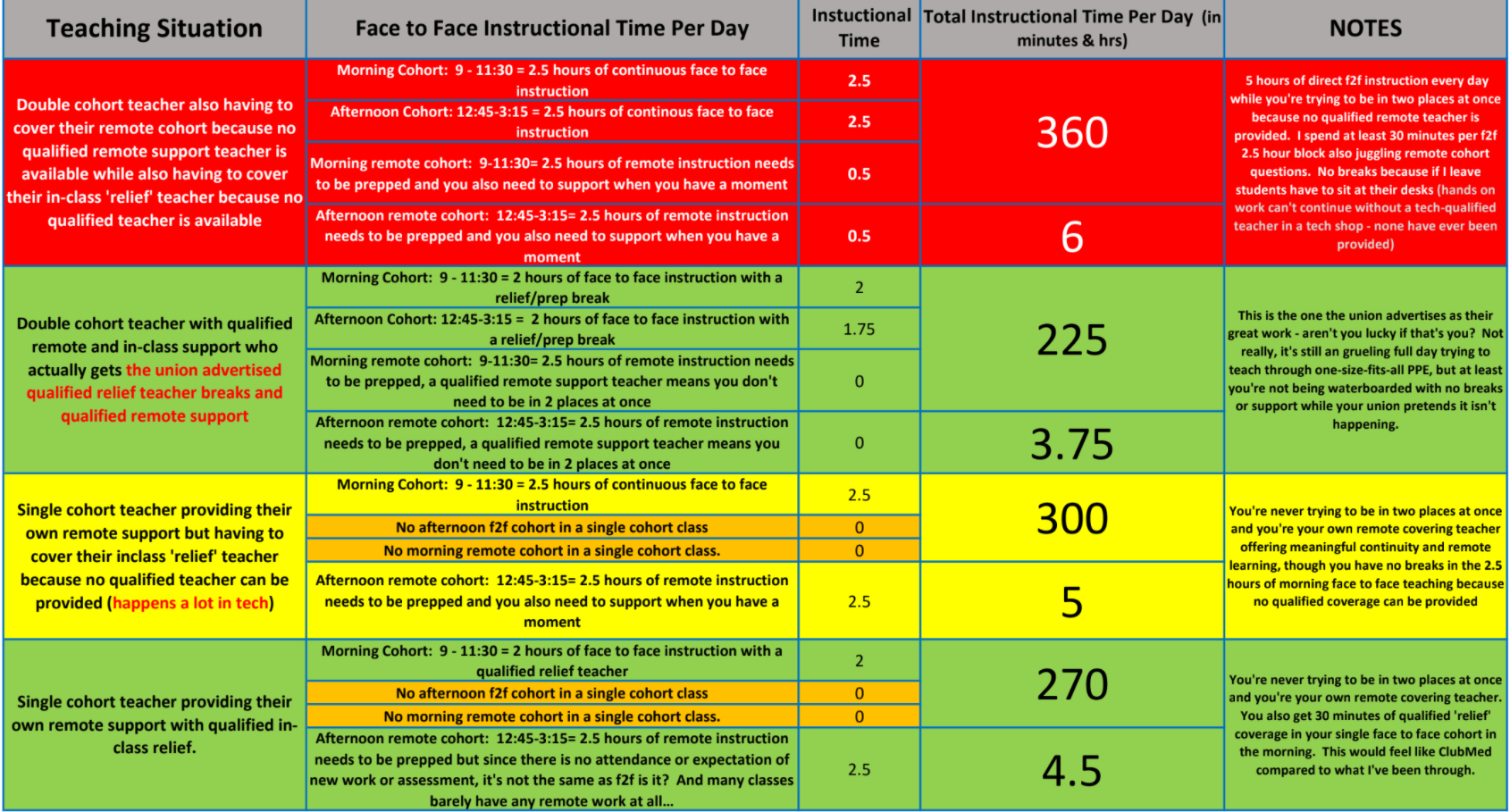
This self congratulatiory email went on to state that teachers should be assigned a maximum of 225 minutes of student instruction daily, and 75 mins of preparation time.  Having never been provided with these things I'm at a loss to explain the rhetoric in any rational terms.  So deaf has been our union that I've quit as our local CBC representative after numerous emails and calls for clarification and support went unanswered, even when I was advocating for other members.  I'm pro-union because I know what would happen if One Percenters had dictatorial control, but our union isn't particularly egalitarian either, though it likes to make noises like it is.  The longer I look at OSSTF the more classist it seems, so I shouldn't be surprised that their support only appears to apply to certain members. 

Our president says we're lucky we don't teach in other boards, which isn't very 'help one another' of him, but I've found that a sense of comraderie isn't very resonant in our small, white, privaleged district.  From throwing other districts under the bus while pandering to provinicial liberal bias to fighting for clear and transparent communication with members, I've found our local a difficult beast to deal with.  And this from a guy who was once mentoring under the district president and attended many weekend trainings.  A guy who regularly shows up to policial protests, tries to present our profession in an honest and postiive light to the public and has volunteered at the school and district level for over a decade in a number of roles.

The problem with the district's current belief in this fantastic schedule is that it conveniently ignores specific situations where the board doesn't have the resources it needs to make it happen.  I think the board made a good decision under no direction or leadership from a broken ministry of education in setting things up as they did, but we then needed a local union ready to work to protect its members when the specifics of the plan could not be met.  What we have instead are a group of self contratulatory district types with a strangle hold on control of our local who are more interested in putting out emails that sound like they were written by our employer than they are in making sure all of their members have access to the same plan in terms of work expected.

What we need, unless qualifications don't matter, is to agree that any teacher working in a classroom should be familiar with the curriculum and qualified to teach the subject they're teaching.  Ironically, in the same email we were told not to do any writing jobs for TVO's upcoming elearning program because there is no guarrantee that a qualified teacher will teach that material - that's exactly what's happening now in our district and we are waving a victory flag about it.

I did some maths this morning to try and work out who exactly is teaching 225 minutes a day as per our local cohorted covid teaching plan:

Someone ignorant to the job might read this as teachers only working 225 mintues a day, but that's 225 minutes of instruction.  You can't just walk in and do that.  You have to prepare what you're doing and also mark the results.  Teaching is more like presenting in media as a DJ or TV presenter - the part you see is only a small part of the job as a whole.  When you see radical differences in instructional time the 'under the water iceberg' part of the job is also magnified.  I'm having trouble sleeping and I'm often up at 4am marking or prepping for my red-all-year schedule because it's the only time available to do it.

You have to fall into a very specific catagory to luck out and get the union advertised 225 minutes of instruction.  The tricky thing about equity is that it needs to be equally distributed.  Having said that, even the 225 minutes of instruction is no cakewalk as you've got to create two sets of material (one remote and one face to face) and then deliver them in two places at once all day every day.  Re-writing and splitting the curriculum into a never-before-taught format on the fly is difficult enough but there are other political factors diminishing the effectiveness of that remote elearning half of our curriculum.

As you might guess, I've been given 6 double cohort sections this year and have never once been given a qualified face to face relief teacher.  Teaching technology means you need to have a tech qualified teacher or students have to stop hands on work for safety and liability reasons.  Hands-on work in class is at such a premium this year (we only have 52.5 hours of it compared to 110 hours in a regular class), that tech teachers are simply staying in class in order to protect what little tactile time students have - of course most tech teachers have small, single-cohort class sizes, but not me.  I get capped the same as a university bound calculus class.  Before this all kicked off admin said to us that they expected we'd all wave off relief support anyway in order to 'let our kids keep on learning'.  The worst thing you want to be in a pandemic is a unicorn, just as in the song, you can expect to get ignored, left behind and drown in the indifference shown to you by your union.

I'm the only person in my building qualified to teach what I teach and this isn't an academic subject that might be taught out of a text book.  Technology, like French or other skills based subjects, needs to be taught by people who know how to do the thing they're teaching; you can't fake it.  Usually the union is all over this, but they're evidently blind to it this year - unless you want to try and escape this nastiness by writing elearning courses for TVO (yes, I've applied).

The union has a long term hatred of elearning and have been dismissive of it outright.  Elearning is a challenge, and I've been involved it in since its germination, but if done right it could offer a differentiated approach to learning that could serve some student needs (that's what we're here for right?).  What you don't want to do (that this government is intent on) is Walmarting elearing into a cheap and pedagogically ineffective wedge that weakens the entire education system.  You don't stop that mean-spirited, self-serving narcisism (the Ontaro PC party has donors who are ready to leap in with charter school options) by refusing to participate in it.  What we need is a union researching best pedagogical practices in elearning including which students it actually works for, and then advocating for that.  The 'keep everything analogue' approach is dangerously out of touch and a sure way to make both the educaiton system and the union itself irrelevant.

Union footdragging on elearing pedagogical effectiveness has made a mess of half our 'class time' with our students.  Double cohorted teachers don't get to support their own class in elearning.  If you're one of the lucky ones you've got a collaborative, technically savvy, qualified colleague who is helping you manage that, though you're still responsible for all the planning, prep and review of work - though that gets hazzy too as we keep turning down exectations (no new content, no assessment and now no attendance) in our online cohorts.

We aren't turning off all these aspects of learning in elearning for pedagogical reasons, we're doing it to lessen the load on remote learning support teachers as per union direction.  This means we're now trying to pack a 110 hour course in 52.5 hours of face to face classroom learning in a dramatically accelerated schedule with little chance for review or differentiation.  This is difficult in any course but in tech courses that rely almost exclusively on tactile, hands-on learning and which have been instructed to allow NO HANDS ON WORK remotely for liability and safety reasons, it reduces pedagogical effectiveness to well under 50% just based on time alone, I won't get into how difficult it has been to get parts in as the pandemic has worn on.

Eleaarning could have been leveraged make this time-crunch work better from a pedagogical perspective.  The first (obvious) step would be to ensure that all tech classes or other specialist taught courses are single cohort in order to ensure both teacher familiarity but also provide qualifiied and meaningful remote support, but that would neccessitate a local union that is fighting for all members, even the ones who teach specialist courses.  It would also require a provincial union that isn't intent on belittling elearning as a tool in Ontario education's toolbox.  We've got dozens of teachers not teaching and providing toilet breaks for people in the building so the money and teaching talent was there, it has just lacked focus.

The result of this game of smoke and mirrors is a steady deterioration of remote learning expectations since this year of pandemic teaching began.  Every time we go fully remote we seem to lose leverage in the remote half of our regular in-school day.

This politically motivated intentional ignoring of remote elearning has resulted in many classes (I'm told by students) who have little or no remote elearning work at all.  There are single cohort teachers doing 120 minutes (2 hours) of face to face instruction in the morning and then simply walking away from the remote half of the course.  Students in that class are earning credits and grades based on less than half the normal class work and can't possibly be coming anywhere close to regular curriculum expectations, but when it suits the political angle the union wants to take on elearning, it's all good.

The other result of this wildly uneven scheduling of work is that some members are being waterboarded by a brutal workload that can include more than twice the instructional time (along with all the prep, marking and logitistical time required for it).  When I pointed this out after my first double cohort double class quadmester and suggested I should have lightened remote support expectations in the quadmester where my prep period resided (something we could have worked around with a more evenly distrubuted schedule instead of clinging to the old one), I was told by admin that wouldn't be fair and everyone has to do the same duties.  That's exactly the moment my union should have stepped in and shown how much extra work I'd already done, but they'd rather pat themselves on the back for a job well-done for a small percentage of their members.  The equity must be great if you're lucky enough to have it.

I don't think the current situation is a failure of the school board.  I think they made difficult choices as well as they could with no support or leadership from the ministry.  What we needed was our local union to show up and help mould that plan into something that is actually fair for everyone involved and differentiates based on availablity of qualifications.  More supported, credible and consistent elearning expectations should also have been developed and evolved over the course of this year, but our union's poltiics can't get out of its own way when it comes to elearning, even when it results in members being hurt by wildly unfair and inequitable work expectations.

I look forward to the next email that looks like an advertisement for my employer and shows no awareness or concern for member circumstances.  It's probably sitting in my inbox right now.  I'm pretty sure I pay the same dues as everyone else, too bad the support isn't equal.

You'll see green alligators and long necked geese
Some humpy-back camels and some chimpanzees
Some cats and rats and elephants, but sure as you're born
You're never gonna see no Unicorn.

This unicorn with his rare teaching qualifications isn't just dealing with another double cohort double class quadmester.  This time around it's double cohort double classes with stacked multi-grade senior classes, which means even more prep (grade 11 face to face work, grade 12 face to face work, grade 11 remote work, grade 12 remote work), and all packed into a single class capped at 31 students - like a university bound academic class, except my class of 31 includes 10% essential students, 35% applied students and over 50% of the class has an IEP (tech tends to attact students with special needs because it doesn't expect them to sit in rows reading out of the same textbook).  The unicorning going on here is starting to feel less like benign neglect and more like systemic bias intent on extinction, which any technology teacher in Ontario education can tell you is nothing new.

***

Here's another way to look at the wildly uneven work expectations many teachers are facing.  Aren't you lucky if you're in the green?  I wish we had a union to address it...


Yep, you may well be working more than twice as many face to face instructional hours as other teachers in the same board.  You'd think someone in an office somewhere would want to do something about that, but evidently not.

Someone might come back at me with "yeah, we'll I'm also teaching online!"  So am I, all day, every day while I'm also teaching face to face all day every day.  If you want to throw the simultaneous elearning/remote expectations on top of this it gets even less even.

Tuesday, 23 February 2021

Apps For Education That Aren't

Facebook, Google, whatever...

As we've been forced to shift online during the pandemic we've been placing demands on Google Apps for Education that it simply isn't capable of.  GAFE is, at best, a bunch of cheap software cobbled together by an advertising company in order to collect user data so they can sell things.

Trying to be productive in this environment is infuriating.  This cobbled together suite of software has atrocious UI (user interfaces) that my grade 11s could do a better job with.  Google has a rep as a software company but they're really an advertising company that buys software companies and then twists them to feed their primary business.

The other day I likened using GAFE as a productivity tool to trying to do the Tour de France on a bicycle made out of soap.  Anyone who tells you GAFE is great has probably capped their professional teaching designations with an advertising company's logo and is more interested in selling that than they are in providing you with a working edtech solution.  I'm willing to bet none of them have ever used other business based productivity suites and don't know what they're missing. 

***

Our edtech ecosystems aren't designed with pedagogy in mind and are entirely predicated on liability management at the cheapest possible price, even though they aren't particularly good at protecting privacy or providing a secure environment either.

While chasing this freemium software, education has tied itself to these questionable systems delivered by dodgy advertising companies that aren't designed for productivity.  This makes one of the greatest expenses in education (the professionals who provide it) less efficient than they otherwise could be.  How we got to this point where we hand teachers software that actually gets in the way of teaching is beyond me.

An example of how non-educational the apps-for-edu suite is can be found in the evolution of Google Sites.  What was once a relatively modifiable system that even let you write your own HTML has evolved into a drag and drop toy that lets people 'develop' websites without any understanding of what's going on behind the curtain.  As a means of teaching web development or even just graphic design, it's about as useful as a slideshow.  Google loves to automate things for you to make life easy, but it doesn't do much for you educationally or productively.

If we treated digital fluency, which is a system wide expectation in all aspects of education since the pandemic, in the same way that we treat literacy and numeracy (also expected in all aspects of education), we wouldn't be selecting tools that do things for us to replace our understanding.  We don't use tools in literacy and numeracy that just take the hard work out of your hands and do it for you - if we did no one would be able to read, write or do maths.

Our technology stance with digital fluency is the equivalent of teaching spelling by giving all students a word-processor that reads and writes for them while we pat ourselves on the back for a 100% literacy rate.  This laziness with digital fluency seeps into all aspects of education where automated digital tools are quickly coming to replace fundamental student skills instead of supporting their development.  There are neurologically tested negative results to this kind of digitization, like the inability to recall details when entering new learning digitally.  Of course, Google has no interest in you hand writing notes because they can't monetize that.  Reconsidering our educational digital technology would not only mean we could teach digital literacy like it mattered, we'd also protect pedagogy throughout the system from systems that have no interest in it.

I still dream of a day where we don't line up to spend tax payer's money on inefficient and questionable educational technology that has no interest in providing the best possible pedagogical experience for our students while maximising teacher productivity and focus on teaching.  Working from a credible basis like that, we could build our own open source educational technology (both hardware and software) and develop the kind of deep understanding of digital tools that would make our classrooms relevant and our students world leaders in terms of technology comprehension.

Sunday, 21 February 2021

Trudgery: teaching in COVID at the brittle edge

 I've been struggling to reflect my way out of another double cohorted double class semester with no breaks to plan, mark or otherwise manage a radical change in time tabling.  In the face of this I'm trying to describe the situation in the hopes that verbalizing it more clearly defines it for me and helps me figure out a way to survive another quadmester of maximum COVID-classroomness.


In order to keep face to face class sizes below 21 students we are running a split day where half the class is face to face and the other half is remote, then they switch.  This exhausting system has me trying to respond to remote student questions while teaching face to face all day every day.  It has all the challenges of a face to face technology classroom with all the headaches of remote teaching.

The term for it when you have two double cohort classes in a single quadmester is a double-double (ala Tim Hortons).  It basically means you're teaching in two places at once all day every day.

All of my classes this year are double cohort classes.  I appear to be a minority in this even though I'm one of few teachers in the school who has unique qualifications that no one else has or can teach.  This means any 'online support' teacher I get has no facility with what we're teaching, leaving me with the job of managing both cohorts simultaneously.  Piling on this lack of equity in the workplace are the covering teachers we're supplied with in class.  They are supposed to free us from the classroom so we have some prep time to completely re-write the curriculum to suit this new format, but none of those teachers are tech qualified which means if I leave students should be taken off hands-on work (only tech teachers are qualified to cover tech safety requirements in class).  Further cutting hands-on work in a year where we've already cut instructional time in half is problematic.

Because that's not enough, I'm also teaching a double-double with a senior stacked class of two different grades (a double-double-double?).  I'm currently unable to sleep very well and I'm frequently up at 3am, which is when I'm doing all my planning and marking because I have no other time to do it when I'm at work.

We're not given any data on our students so I dig it all up myself.  I've started this double-double-double with a stacked to maximum capacity of 31 students in two grades (20 in the maxed out morning cohort and the other 11 in the afternoon) senior class.  This is an 'M' level senior technology class.  In other places these are capped much lower, but my hands-on technology class is capped the same as a grade 12 university bound calculus or English class even though we're hands on with live electricity, power tools and 400 degree soldering irons.  Out of those 31 students, 26% are applied level students and 10% are essential level.  52% of students in the class have an individual education plan that demands differentiation of instruction (both online and f2f - simultaneously).

Ontario high school classes are supposed to be 110 hours long.  I only get 52.5 hours of face to face instruction with my students in our pandemic quadmesters.  The other 52.5 hours I'm unable to support them online because I'm face to face with the other cohort of the same class.  I suggested we use the empty room next door and spread out across two classes.  My non-shop regular classroom packed with technology makes six foot separation even in cohorts of 20 impossible, but spreading out across two classrooms would allow us to maintain social distancing while also providing a qualified instructor for online learning since we'd be a single cohort class (all 31 students in but spread across two classrooms means smaller cohorts in each room than with the class cut into morning and afternoon cohorts), and I'd be supporting my own students in the afternoon online.

This seemed like a reasonable ask but I got a hard "no" from above.  Evidently what I teach is too dangerous for  me to be able to manage students in two rooms at the same time.  Not too dangerous to stuff 31 students of every skill level into a stacked class, but too dangerous to work in two rooms at the same time.

Our media arts room and even our metal shop full of lathes and other metal cutting tools that can chop your fingers off operate in two spaces walled off into two separate rooms where the teachers have to be in two places at once, but evidently I'm a special case.  My students don't warrant qualified teachers for the remote half of their class, or a safely distanced space to work in.

While I was trying to sort out a pedagogically sensible and safer solution for my senior students I'm also juggling another double cohort of grade 9s in the other week.  That class is more academically leaning than my previous two classes but still rocks a 26% applied, 9% essential mix (including one DD student who is occupying almost all our in-class and remote support).  Over a quarter of that class has IEPs as well.

I'm trying to keep the hands-on aspects of the course alive but finding parts in a pandemic isn't getting any easier as we stagger through another quadmester.  I have only a few PCs left for grade 9s to learn building on and what I do have is in rough shape.  When I'm up at 4am I'm also contacting my usual suppliers to see if I can get any more parts in.  They're moving mountains for me but I'll have to drive down to Brampton to pick them up because I'm not allowed to charge for shipping suddenly.  Not sure when I'm going to do that.

I'm still left wearing the same mask as everyone else.  The other morning I was walking down the hallway with two colleagues.  If you put both of them together I'm still bigger, but we're all handed the same mask, though I half swallow mine because it's much too small for me.  Every day I finish with a cracking sinus headache from the constant pressure.  I offered to bring in my own PPE but I'm not allowed.

While all that's all going on I also helped a science teacher get the cables she needed to run her smartboard in class, helped another with speakers so they could play things out loud in class, explained to multiple people how to get tech working online and helped yet another whose VR pc we'd previous built for them stopped working.  It had stopped working because someone had gone into the PC and taken one of the memory sticks out of it - the other one was half hanging out of the motherboard (likely in the process of being stolen when someone walked in).  So I'm helping that teacher get the RAM they need to get the machine working again.

I've also got a coop student this semester, but I can't get her out into the school doing the usual IT repairs we do because there's a pandemic.  She's actually a life saver in terms of being an extra set of hands in the classroom because we've had a number of technical issues with our DIY lab because many of the grade 9s have never used a desktop computer before and have caused many intermittent crashes that we're trying to diagnose on the fly.

I'm one of the only teachers in the school to keep extracurriculars alive as many students depend on them, and I'm still trying to chase down awards and monetary support for our poor graduates who are trying to navigate this deepening crisis at a critical point in their lives.  Even that has come back to bite me.

Last Friday I discovered that my support of female students pushing back against sexism in technology pathways was so wrong that the higher ups who said no to a more socially distanced and qualified teacher supported classroom wanted me reprimanded.  Only local administration's focus on rebuilding relationships in our school prevented that from happening.  I guess I should be happy for the little things.

Last Tuesday we had a blizzard that shut down the area and caused a number of blackouts.  We don't live in an place with public transit or timely road clearing; weather can still stop things here, but that doesn't stop the always-more treadmill we seem to be running on.  Online the message was, "All students are to shift to remote learning for the day. Staff are not to report to their workplace and are to work remotely."  Meanwhile the telephone message from school said, " school is closed and all buses are cancelled. Students and staff should not report to school, thanks and have a great day."  This mixed messaging resulted in low online engagement.

I got to spend a day I would usually be catching up on the two weeks of marking I'm behind on or trying to recreate entire courses to suit a never-before-seen timetable babysitting students with the socio-economic advantage (who are predominantly 'academic' level students because we stream as much by privilege as we do intellectual ability) online.  The kids who didn't have the tech or connectivity or home life conducive to online learning, or were just unlucky enough to live in the parts of town where infrastructure failed all got to come to school Wednesday already a day behind.  I'm going to be the hammer for that kind of inequity any more.

I keep trying to find ways to make this work but the answer always seems to involve disrespecting the ever deepening difficulties we're drowning in.  I've quit being the school CBC rep because our local OSSTF district won't reply to any questions about working conditions, even when I'm asking on behalf of other members.  It's difficult to not take this personally and I know everyone is struggling to make things work under difficult circumstances, but I'd love to know just how much of a minority I am in terms of teaching load when I'm the only one in the building qualified to teach what I teach.  I'm beginning to see why unicorns died out; it's not easy being unique.

Talking to super-students who at any other time are the epitome of initiative and drive, they tell me that they are exhausted and just don't care any more.  If the go-getters are feeling that way then I'm sure the students without that resilience and drive are in tatters.  Parents of students with IEPs are asking me why their child's grades are falling in all their classes, but saying anything about systemic inequity got me a reprimand.  I'm no longer willing to be the hammer that grinds children into paste so that a broken system can pretend everything is business as usual.

If you're a teacher and you're reading this, everyone is exhausted.  Keeping up the fiction that schools are running as usual is hurting people.  Consider rewiring your classes so that you preserve and protect the children in your care.  You can't possibly expect to cover what you normally do in courses that are half the usual face to face instructional time, especially when that half is full of COVID paperwork, muzzled, frightened faces and demoralized, socially distanced lack of collaboration.  The people who claim that kids need to be face to face in class haven't been in a COVID classroom, no one is face to face.  Getting students through this is now my focus.  It's also how I'll get myself through this without ending up in hospital.