Showing posts with label equity. Show all posts

Saturday, 3 December 2022

How Cybersecurity Might Become More Diverse, Equitable and Inclusive

One of the benefits of working in the same home office as one of the top teacher librarians in the country is that we're able to bounce ideas off each other. Making cybersafety awareness a part of every educator's professional standard of practice isn't a nice idea in 2022, it's a necessity, but the industry continues to have trouble attracting talent and many teachers have little or no training in it.  Alanna has listened to me lamenting the lack of diversity and engagement in the field for many years but this week she offered a solution by linking the DEI research she has been doing to develop an inclusive information management system with the lack of diversity and engagement in cyber.

You might not think that creating a digital media cataloguing system would require much in the way of equity awareness, but it does. How we categorize and deliver data requires a working awareness of DEI or it quickly becomes another means of systemic discrimination. Having used it, Alanna suggested Building Movement Project's  Social Change Ecosystem Map as a tool for challenging some of the masculine cultural cues that usually define cybersecurity as a discipline.
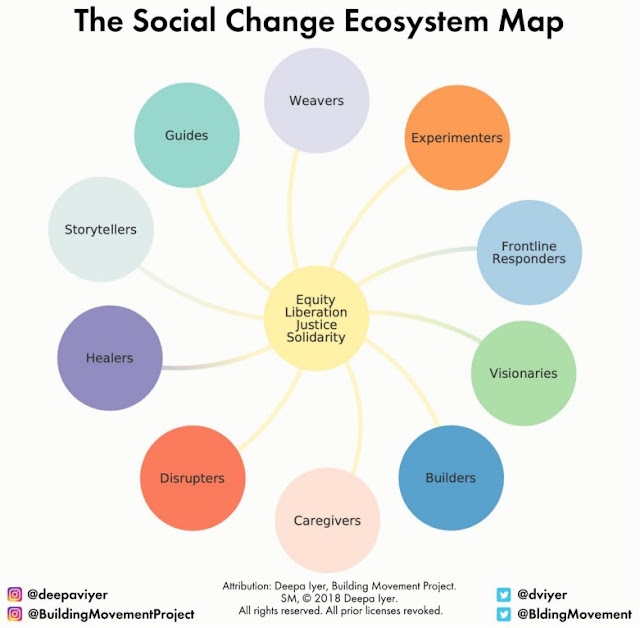
Considering diverse talents and motivations could work as a way to bring more diversity into the field of cybersecurity.

Characteristics of the Roles

Weavers: I see the through-lines of connectivity between people, places, organizations, ideas, and movements.
Experimenters: I innovate, pioneer, and invent. I take risks and course-correct as needed.
Frontline Responders: I address community crises by marshaling and organizing resources, networks, and messages.
Visionaries: I imagine and generate our boldest possibilities, hopes and dreams, and remind us of our direction.
Builders: I develop, organize, and implement ideas, practices, people, and resources in service of a collective vision.
Caregivers: I nurture and nourish the people around me by creating and sustaining a community of care, joy, and connection.
Disruptors: I take uncomfortable and risky actions to shake up the status quo, to raise awareness, and to build power.
Healers: I recognize and tend to the generational and current traumas caused by oppressive
systems, institutions, policies, and practices.
Storytellers: I craft and share our community stories, cultures, experiences, histories, and
possibilities through art, music, media, and movement.
Guides: I teach, counsel, and advise, using my gifts of well-earned discernment and wisdom.

Cybersecurity had strong ties to the military early in its development, which attracted the 'frontline responders' already working there. Military roles are traditionally male dominated and so cyber began as a predominantly male field, but applying these other roles would open cybersecurity to a more diverse range of interests, skills and motivations, but it requires a significant rethink of the assumptions that surround the subject. If you consider cybersecurity as a combination of security and computer science, both fields have a history of male dominance, though in the case of computer science the patriarchy was a recent event (it happened just as computer science was becoming profitable because that's how glass ceilings work).

The problem with clinging to this cultural predisposition in cybersecurity is that it continues to create a male focus in hiring. Women may struggle to see how they fit in a field that presents itself with such a masculine bias. Getting away from the military/first responder mindset might be a way to recast cybersecurity in a different light.

Looking at the less represented roles in the social change ecosystem, weavers would bring connectivity and communications to the field - something it currently lacks. Visionaries would bring the perspective and scope needed to move cybersecurity out of its often reactive stance, though that would also mean giving up the unquestioned control that accompanies emergency response; that may be the hardest ask of all.

Recasting cybersecurity in terms of caregiving and healing was where Alanna saw the most gains. Cybersafety is a foundational skill in an increasingly connected world, yet its treated (if it's acted on at all) as an emergency response after the fact, becoming a self fulfilling prophecy for the first-responder mindset. By finding a place for caregivers and healers on cybersecurity teams, the approach to user training and even post-breach response would be significantly different. Can you imagine cyber support that isn't emergency response defined? Neither can many of the people in the industry because they can only conceive of it through their own motivational approach which also happens to align with cyber-culture.

Digital skills remain poor and continue to represent
the most successful opportunity for cyberattackers.
Other atypical motivators also have a role in cybersecurity. Storytellers and guides are motivated by sharing narratives and teaching complexity and empathy rather than fixating on problem solving. The vast majority of cyber-incidents are the result of user ignorance and error. Most malware ends up on a network because a user mistakenly put it there, not because a 'super hacker' got in. If we hope to address this primary form of ingress (atrocious user digital literacy), we need to bring in people who can create meaningful narratives and engage with learning because it's their primary motivation.

Of course these roles aren't absolute, no one is just one of them, but by applying the social change ecosystem we identify biases implicit in cybersecurity culture that disclude anyone but those interested in heroic intervention or technical response. By valuing alternate motivations and the specialized skillsets that accompany them, hiring practices in cybersecurity would become more inclusive and the workforce more diverse. That inclusivity does more than check a DEI box. A diverse workforce offers a richer range of approaches to problem solving and prevents blind spots based on a privileged monocultural beliefs. This diversity would make the critically important discipline of cybersecurity more resilient, accessible and effective.


Resources


We're currently working on CYBERBYTES at ICTC & Knowledgeflow CyberSafety Foundation: www.cyberbytes.ca  We are creating easy to complete micro-credentials that provide educators with a working understanding of the technology that makes our networked world work, the key elements of CyberSafety and online privacy and how you can bring these important skills and understandings to your students so that they and their families can safely and effectively use the networked technology that surrounds us in 2022.

The Building Movement: https://buildingmovement.org/ supports and pushes the nonprofit sector to tackle the most significant social issues of our times by developing research, creating tools and training materials, providing guidance, and facilitating networks for social change.

THE SOCIAL CHANGE ECOSYSTEM MAP (2020): https://buildingmovement.org/wp-content/uploads/2022/04/Ecosystem-Guide-April-2022.pdf

A History of Cybersecurity: https://cyber-security.degree/resources/history-of-cyber-security/

Empowering women can help fix the cybersecurity staff shortage: https://www.weforum.org/agenda/2022/09/cybersecurity-women-stem/

Occupational digitalization trends in Canada, 2006-2021: https://fsc-ccf.ca/research/race-alongside-the-machines/

Global Digital Skills Index, 2022: https://public.tableau.com/app/profile/salesforceresearch/viz/shared/NNRKYDH37

Future Skills: https://temkblog.blogspot.com/2022/10/2022-tmc7-research-symposium-table.html
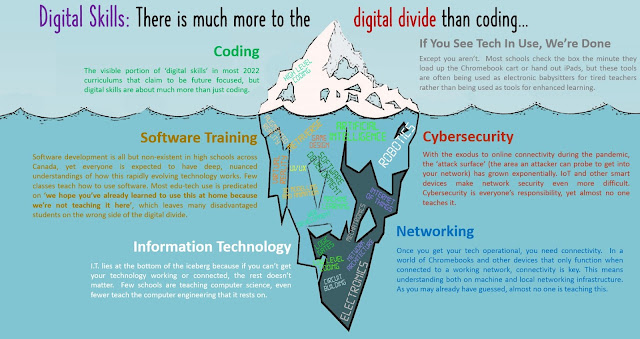
If we would redefine digital skills through a media literacy lens, we would also open up these pathways to a wider variety of learners. Defining digital skills as 'coding' is reductive, unhelpful and excludes a number of alternate learning motivations.


Monday, 20 May 2019

Privilege Masquerading as Superiority

Last year while at the CyberTitan National Finals in Fredericton I happened to be standing by Sandra Saric, ICTC's VP of talent innovation, during a photo opportunity where the fifty or so student competitors were all together on a long stairway.  Under her breath she wondered, "where are all the girls?"  There were maybe three or four female contestants.  Sandra's comment resonated with me and I became determined to put together a female team that would get their own points and where no one is 'just a sub'.

CyberTitan and Cyberpatriot have doubled down on this focus on bringing women into a cybersecurity industry that has only moved from 11% to 20% female participation in the past five years.  For the
2018-19 season any all-female teams had their costs waived.  For a program that isn't rolling in support, that made a big difference and enabled me to pursue this inequity.

Graduating girls into non-traditional careers is an ongoing challenge in education.  Pushing against social norms is never easy, particularly so in our conservative, rural school where gender expectations tend to be even more binary and specialized program support significantly lower than in urban environments.  I've managed to have one or two graduating female computer technology focused students each year, but even that small step has only come after massive effort, and it's not nearly enough.  Even with all that stacked against us, we still managed a 33% female participation rate in CyberTitan this year, and of our six Skills Ontario competitors, two were female.  We're aiming to raise that even higher next year.


This year CyberTitan made a point of trying to address the very one sided gender participation in the cybersecurity industry by making the national wildcard position open to all-female teams.  There were only 15 out of 190+ teams in the competition, and our Terabytches finished in top spot.  We were delighted to discover that one of our boy's teams actually finished one place out of the top four eastern teams.  A number of people (oddly all male)  grumbled about the all-female wildcard spot, but the irony is that we knocked ourselves out of the finals.

Taking an all-female team meant that I needed a female chaperone with us.  Fortunately, our board's head of dual credit programming is a triple threat.  Not only is she very tech focused (her student just won top secondary brick layer in Ontario!), but she's also computer science qualified and an absolute joy to travel with (I went to Skills Canada Nationals in Edmonton with her last year), so I quickly asked her to join us when the call came through to bring our girls to nationals.  Not only did she not need coverage herself, but she kindly covered mine so my school literally paid nothing for this trip.

I like to think I'm pretty sensitive to gender roles in the first place, but taking an all-female crew to this event had me constantly seeing micro-aggressions I might have otherwise missed.  Within five minutes of picking up the Toronto (all-male) teams on the bus ride to Ottawa, one of them had intimated that we were only there because we're a girl's team.  Another later said that it's not fair that girls are getting special attention.  It must be tough when everything isn't about you all the time.  These comments were a daily occurrence from all the other teams, even the two co-ed ones, one of the girls of which said that she was just the sub.

That same Toronto team was able to attentively listen to a male speaker during the visits to cybersecurity companies in the Ottawa area after the competition, but the moment a woman stepped up to speak they began a loud and rude conversation among themselves.  I wonder how often these little princes (who did ever so well in the competition) have had their gender superiority enforced to develop such outstanding habits.

Walking in to the competition, our team had all signed in but one and as she reached for the pen a boy from another team stepped in front of her like she wasn't there.  Talking to Joanne and the team about it after, they shrugged and said, "you get used to it."  By that point I'd been triggered by this so much that my already light grip on my aspie-ness was slipping and I was starting to get right angry, but even that anger response is couched in a male sense of privilege.  When a man gets angry it's seen as assertiveness, when a woman gets angry she's a bitch, which brings up yet another point.

After fighting to get a team together against overwhelmingly genderized expectations in our community, and encouraging that team to develop a representative sense of identity in an overwhelmingly male contest, and then having to push back when the powers that be didn't like the name, you'd think this was all starting to get too heavy, but it has only clarified my sense of purpose.

Wouldn't it be wonderful if girls didn't have to get used to being invisible and could self-identify without being told what they can and cannot be called?  Wouldn't it be wonderful if everyone could be what they are and explore what they could be without some small minded traditionalist trying to put them in a superficial box?  When you push back against that social apathy you get a surprising amount of kickback from the people it benefits.  Ontario's current political mess is entirely a result of that conservative push back.

You even get kick back from the people it subjugates.  At an ICT teacher's meeting earlier in the year, a teacher from an Ottawa school said she would never run an all female team because it isn't fair to her boys.  Were everything else level, I'd agree with her sentiment, but in the landslide of unfairness around us, you'd have to be wilfully blind to ignore historically integrated misogyny in order to be 'fair to your boys'.  This teacher taught at the local International Baccalaureate school, which brings up yet another side of competition and privilege.

Toronto, Winnipeg, Edmonton, Vancouver... Fergus.  Your
usual expected centres of digital excellence.
We're a rural composite school that spreads itself thin catering to our entire community.  The major industry in our region is farming, we recently had our annual Tractor Day.  Our school contains programs for developmentally delayed students and has a sizable special needs student population.  We also manage to run a number of successful academic programs, but these are by no means our sole purpose.  Tech exists in there somewhere.

As far as computer technology goes, our lab is a room full of ewaste we've re-purposed to teach ourselves technology.  Thanks to some board SHSM funding and an industry donation from AMD we got the cheapest CPUs and motherboards we could find and put them in ten year old ewasted board PC cases running on ancient hard drives and power supplies.  My students have never touched a new keyboard or mouse in our lab.  We have to clear away our practice networks built of garbage because we have the largest tech classes in our board and province and we have no room in the lab to leave those networks set up with classes of 31 coming in next period.  I don't imagine any of the other schools operate in a similar environment.

We returned the board desktops in our room to the school who redistributed that money into other departments because you can't teach digital skills on a locked down machine.  We've received no school funding for the current lab.  Looking into the backgrounds of who we were up against in this competition, every other school is a specialist school from an urban centre.  In many cases they only teach top academic stream students pulled from other schools, and yet they can't put together an all-female team for this competition?  One wonders if those competition focused, talent skimming schools inherently encourage gender imbalanced technology with their incessant focus on winning.


We're built on sweat and tears.  Our disadvantage is also
our strength, but when it comes to competition it
gets frustrating not getting to run the same race
as everyone else.
The socio-economic side of privilege is every bit as battering as the sexism.  One of the little princes from Toronto was telling a Terabytche about his parent free March Break touring Europe with his friends.  She replied, "Hmm, I spent the week playing video games in Fergus..."  Last year half of our CyberTitan team had never left Ontario before, let alone had a week in Europe with their buddies.  The students who attend these specialized schools tend to come from economically enabled backgrounds and have parents looking to leverage that advantage.  The amount of support those wealthy families rain down on these specialty programs is yet another advantage we can only dream of.

Think the privilege ends there?  Because we cater to the full spectrum of students in our community, my classes are huge in order to reserve smaller sections for high-needs students (even though many of them also take my courses).  In talking to other coaches, my class sizes were the largest by a range of 20% to a staggering 50%, and their operational budgets ranged from five to twenty times what mine are; I teach up to twice as many students with a fraction of the budget in a lab made out of garbage.

We were surprised to learn that we would be beginning the competition short-handed because one of the IB schools had exams some of their competitors had to write, so to keep it fair we'd all start short handed.  Right.  Gotta keep it fair.

That these urban, wealthy, gender empowered, privileged kids are flexing that privilege doesn't surprise me.  That they continually complained about special treatment for a group of underfunded, rural, girls busting through gender expectations in technology, and who fought their way to these nationals literally using ewaste, only underlines the expectation that comes with their privilege; the expectation of winning.

In spite of these society-deep gender inequities and our specific socio-economic circumstances, the quality of my students continues to shine through.  Finishing fifth last year with only four team members and two broken competition laptops was just the kind of awesomeness I've come to expect from our kids.  It didn't occur to me to have the whole competition changed to make it fair for them.


This year we managed a ninth place finish out of ten teams, only beating the intermediate team who can't really compete with older more experienced teams anyway.  That earned another round of, 'you're only here because you're girls' from other teams.  After careful consideration I think my response is: if you came from where we came from, I wonder where you would have finished.

Is winning more about how you perform, or how you are economically and socially engineered to succeed?  I'd love to give gender and social equity to those complaining about our presence.  Having those boys experience people talking over them and stepping in front of them like they aren't there would be good for them.  Facing down gender based prejudice in an industry where women are a small minority is an act of bravery, not special treatment.  Wouldn't it be nice to bring everyone up instead of holding people down?  To do that we need to recognize what winning is, and how privilege enables it.

Next year we have returning students for the first time in this competition.  I'm aiming to put a co-ed team of our fiercest veteran cyber-ninjas together, build tech out of garbage and then win anyway.  Nothing gets me going more than an underdog fight against privilege, especially when those with that privilege like to selectively ignore it.

I hope we'll be back with another all-female team too.  Many of the Terabytches are interested in returning, but I can understand their hesitancy.  Working through this competition has challenged them in ways that were unintended.  If it was just about technical skill, then we'd have been much further down the track, but when you have to fight to be noticed and are constantly talked down to, it's exhausting.  I get why they might think twice about going through the never-ending online and face to face sexism all over again.  It'd be nice if other schools would pick this up and run with it instead of rolling their eyes at it.

Last year was all about giving the haves a black eye, and it thrilled me.  We didn't return home with a trophy or a banner, but we were running a different race.  I'm not even sure how anyone could make this an even race.  Teaching technology is dependent upon access to it, and the digital divide is deep and wide.  This year it was about something even bigger.  Yet again we came home empty handed, but I think what we won was worth more than any of the prizes.  I hope the girls see that and come back to defend their title.


An amazing opportunity and a chance to begin to create balance in an industry that lacks it.  Great work ICTC!