I was listening to CBC radio the other day and
Ideas had a review of the repatriation of the Canadian Charter. One of the people pondering the politics of the day noted that modern politicians don't stand for anything. They remorselessly chase poll numbers, trying to place themselves in front of whatever the herd currently believes is worthwhile (itself dictated by big media interests).
McGuinty's shameless chasing of right wing votes while throwing teachers under the bus this summer is a fine example of that approach.
Don't look for moral standards, or even any kind of consistency in modern politicians. As the radio interviewer suggested, we look back on our political leaders as giants and see the modern ones as dwarfs. The old ones would push for a vision based on belief, even if it wasn't always rational. The current ones shamelessly chase data in hopes of power. It makes the business of politics very economical (and I don't mean that in a flattering way).
CTV is quite excited by this as ads for their
Powerplay political commentary show declare, they are all about watching how politicians get and keep power. I thought politics were about developing visionary leaders who take Canada toward a better version of itself. It's now all about holding power, and not standing for anything in the process other than a Machiavellian quest for control.
Last summer I was once again listening to CBC, this time
Matt Galloway interviewing the CEO of RIM. As the agonizing interview went on, it became clear that this
MBA wasn't put in charge of RIM to lead it, but rather to manage it into successful insolvency. He shrugged off a question about RIM failing by simply suggesting that investors will make money on the deal because he'll just cut the business into pieces and sell them off.
Can you imagine if Churchill had suggested that? Instead of
we will fight in the fields, we will never surrender, how about we give you Scotland and Wales and call it even? Everybody ends up happy, and so much more productive.
We value leaders because they stand for something, and never back off it, even (or especially) if it makes them difficult. Wired did a recent article on Steve Jobs as either angel or demon. The man was difficult, almost impossible to work with, and the result was market dominance. He took over from a bumbling committee of MBAs who had discussed Apple into insolvency and took the company from the brink of destruction to an enviable market position before his death. I have difficulty liking Apple products due to their closed nature and proprietary design, but I have to appreciate the power of a Steve Jobs. If you want to be a visionary you aren't looking for consensus, you're driving for the best vision even if it seems unattainable; Churchill would have approved.
It's a pity that RIM went to the MBA pool to find another finance monkey to further run the company into the ground. I'd much rather see a visionary, a true believer, attempt greatness rather than a controlled slide into insolvency all to benefit the moneyed class. This German jackass they've hired couldn't give a damn what will happen to Waterloo and the many RIM facilities that communities depend on around the world if he manages to successfully dissolve Research In Motion into the highest bidders.
John Ralston Saul talks about the death of leadership and the rise of management in his
The Collapse of Globalism. Using false economics (there is no other kind), Saul cuts apart the chop logic of globalism and how it is used to manage people into a massive mono-culture with no way out. Globalism comes complete with a data driven wrapper that is self justifying, and that desire to base leadership action on data driven decisions has been conditioned into us for decades now as the only credible justification for planning; it's scientific, logical!
In an age of computing it serves our current mindset to over value the potential of computed statistics
The MBA manager/priest uses incomplete/fictional statistics (
are there any other kind?) to manipulate belief, founding all decisions on the inherently logical and statistically valid benefits of globalization, all while ignoring simple truths. Those truths don't go away. When you found your system on the idea of an unlimited, limited resource (
cheap oil) the truth will make itself evident. The problem with globalism (and the politics, media, and education it has infected) is that we have all been conditioned to swallow statistics like they are Truth.
The last half century of post-modernism, globalism and mass media have weaned us from visionaries and simple truths. These things are now aberration s rather than a cause for celebration; panicky by-products of a lack of control in an era of false computational certainty.
 |
| I am NOT a committee! |
Next time your data-driven boss/principal/MP tries to base future plans on data that are obviously minimalist, fictional and/or fabricated (and what facts born of data aren't?), ask yourself where our sense of vision went.
I don't want to base my very important job on data. I'm not interested in grossly simplifying teaching to suit ease of management for MBAs looking for efficiency. What I'd like is a leader with vision, maybe even someone who asks for the impossible and leads us on a charge into it. Even a near miss in that case is better than the best laid plans of a data driven committee, and sometimes the results are revolutionary. Even the failures are more helpful than statistically supported fictions leading to more data that prove how right everything is; simplifications supporting simplifications.
I'd rather take the road less traveled and risk failure while attempting greatness. I'd rather fail trying to address hard truths than present false successes best seen in standardized test scores. Most importantly, I'd rather believe in what I'm doing rather than being told what to think by a spreadsheet.
I guess I'm a man out of my time.

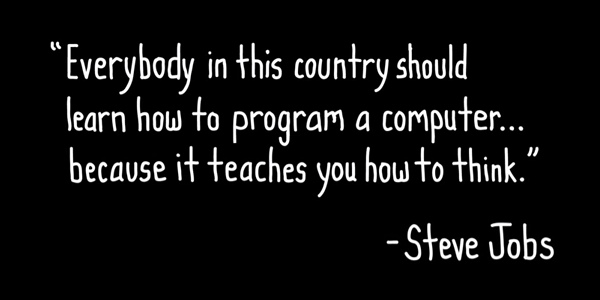
 I'm frustrated at how computer science seems to own coding. In Ontario it is now an orphaned subject unto itself. There is no way someone without a degree in computer science can teach coding, though coding isn't computer science any more than auto mechanics is theoretical physics.