Showing posts with label cybertitan. Show all posts

Sunday, 25 September 2022

CyberDay & CyberTitan: cybersecurity resources for cyberawareness month

The idea of bringing cybersecurity awareness into a public school classroom makes many people uneasy, but as I said in a recent interview, "Cyber is never as complicated as you think it is, don't let the lingo and media scare you off."   There are a couple of events happening in October, which is cybersecurity awareness month in Canada, that'll give you the resources and connections you need to explore cybersafety in your classroom safely and with confidence (!).


CyberDay is the gentle introduction to cybersafety, privacy and cybersecurity.  


It's happening on October 18th and the Knowledgeflow Cybersafety Foundation has been working like beavers to put together interactive resources and talks with experts that'll make cyber accessible to everyone.

CyberDay is all online and you can pick and choose what you want to use in your classroom.  It could be a short lesson, a longer activity or even a whole day event depending on how you want to use it.

Sign up is on the site and you can even do some preliminary learning with it by having students submit questions to experts.  If you don't think you have students in your class who are curious about hacking then you're not getting where they spend most of their time (it's online).  In this event students can ask white hat hackers and pentesters about their work.  That might lead more students to consider cybersecurity pathways which are in such high demand that Canada is looking overseas to bring people in because we're not producing this expertise at home.

As they say on the site, "Cybersafety is a team sport".  You're not alone in broaching this sometimes unnerving subject, you only need to connect to CyberDay to see how much help is on hand.

If ease of access isn't compelling for you perhaps the idea that using interconnecting education technology in our classrooms means we should all be covering cybersafety and privacy with our students is simply good practice.  I attended a conference last week where Michael Canuel from LearnQC trotted out current stats that should make you sit up and take notice:
  • (a staggering) 98% of data breaches are caused by user error or cyber-illiteracy. If we took steps to improve cybersafety awareness in education, we would all but solve the current wave of cyber-attacks on the education sector.
  • cyber-awareness is vital to protecting our critical infrastructure. Canada now considers information technology to be a critical infrastructure (because it also runs all the other ones)
  • cyber-skills are part of a collection of digital literacy skills that extend well beyond coding
The need for better cyber-awareness should be self evident, but what isn't (to me) is why public education seems to go out of its way to ignore it.  While listening to Michael's talk about the poor state of cyber-skills in Canadian education, I couldn't help wondering if it isn't intentional.  Many public education organizations have vested political interests in keeping the status quo.  From a professional perspective I was left desperately hoping that educators aren't intentionally ignoring privacy and cybersafety in order to sabotage eLearning.  CyberDay would be a great first step in proving that skepticism misplaced.
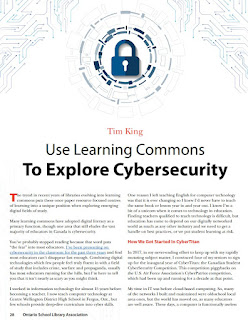
One of the angles I was considering for CyberDay was just how well suited it is as a library activity.  I did a piece for the Ontario Library Association's Teaching LIbrarian online magazine about how cybersecurity (as a digital literacy) makes a perfect connection with the role a modern learning commons plays in our schools.

Library learning commons are often the first point of contact for emerging technology.  Way back in middle school in 1982, I first laid hands on a computer in our school library when we set up Commodore PETs and I saw the neon green wonder of coding for the first time.

I'm hoping I can connect with the OSLA about reaching out to librarians over the next couple of weeks to drum up interest in taking on this latest in a long line of emerging digital literacies.  Cyber isn't as scary as you think it is, and when you do get into it you quickly realize that it's a great opportunity for iterative, genuine learning.


CYBERTITAN:  Canada's student cybersecurity competition


CyberTitan has been running since 2017/18 in Canada as part of CyberPatriot, the US Air Force Association's now international student competition.  If you've read Dusty World before you know that this contest has not only opened up pathways for my students, but also played a major role in my own professional development.  I'm a huge fan of the competition and would love to see more Canadian educators get on board with it.

CyberPatriot has a live map of registered teams on their site.  As you can see, compared to the United States, Canada's engagement with the competition has been... less.

I'm particularly focused on connecting under-represented groups to the competition.  When I coached the first ever top all-female team to the national finals in 2019, I became aware of just how toxically masculine cyber can be.  I'd move mountains to get more female (including non-binary and female identifying) students into it.  I'd move more mountains to get other under represented groups including indigenous students on board too.  The finalist teams all tend to come from major city specialist schools which tend to cater to socio-economically advantaged youth.  Cyber isn't exclusively and urban/wealthy course of study, it's an all-of-us discipline that rural communities, families and businesses are just as in need of.

You can see what the competition is about from this Prezi that the mighty @oksarge and I presented at ECOO summer camp in 2020.  Students learn hands-on defensive IT skills by fixing compromised WIndows and Linux operating systems in virtual machines.

Learning to wrangle virtual machines is a big part of CyberPatriot.  You'll find this technology to be an incredible tool for teaching computer technology. You can abuse VMs in all sorts of ways that'd make your IT department shudder, and when it all goes wrong?  Just close the window.

VMs are simulated computers that happen inside a window, so you could run Apple OSx in Windows, or Windows in Linux using a VM.  Because it's all virtual there is no chance of spreading malware from inside a VM, which is why they're used in cybersecurity.  Learning virtualization technology is really eye opening for students, and it's not nearly as tricky as you think it might be.


Our lab goes full disco during a CyberPatriot round.  It's a six-hour competition window.  Pizza is brought in and snacks are available.  Students dig right to the end, making a mockery of the idea that kids today have no attention span.

The competition is exciting and students genuinely enjoy it, usually returning year after year.  Live world wide scoring pits your team against others from around the world, so if they're competitive they can follow the scoreboard and dig for points, but CyberPatriot can also be played from a purely educational perspective where students still benefit from the teamwork, iterative problem solving and cyber-skills development.  Our junior teams are always reminded that this is a reconnaissance season with no expectation of winning: learn the ropes and have fun with it.  Many become competitive anyway because (here it comes again): cyber isn't as complicated as you think it is.

Sign up is due by October 5th, but no money is due then (fees are waived for non-male teams) and I've always found that SHSM and other student success initiatives are eager to help cover costs (which aren't due until mid-November).  The swag is excellent (t-shirts, medals!) and once students understand how it all works they always say the same thing (here it comes again), "it's not as hard as I thought it would be."

Libraries would be another great focus for CyberTitan, where students could access the technology they need and develop their library and librarian coach into a cyber-aware school-wide resource.  My students have used the skills learned in CyberPatriot to help our school with technical support and many went on to support local businesses as well.  Five years in I'm seeing former CyberTitans working overseas in technical contracts, joining the cyber-side of the Canadian Forces or exploring advanced post-secondary programs.  The benefits from this are many, we just need to get more Canadian educators to take that step and sign up a team. Once they do, their students will thanks them, and they'll be back!

It's still true!  If you'd like to talk about running a high school team, I've got lots of experience and would be thrilled to help you get going.  Krista ran a very successful middle-school team in her first year coaching and can talk you through what to expect in that division.


Monday, 24 May 2021

Do Or Do Not: 2021 Competition Season Reflection

The competition season is finally winding down.  Student competition is one of my favourite parts about being a teacher.  It allows for radical differentiation in a wide variety of directions, shines a light on my gotta-market-it-or-it'll-die program and helps guide our program development by clarifying what we're already covering and pointing us in the direction of emerging digital trends.

I got a good piece of advice from a prof at Nipissing teacher's college back in 2003.  We were all struggling to get through a dense curriculum when he suggested I leverage my computer skills to take a swing at Statistics Canada's yearly awards for post-secondary research (you might have noticed Stats-Can coming up in Dusty world a fair bit - that's why).  We were using Stats-Can to research the communities our practicums were in and I found the data gave me a better understanding of my teaching environment, but doing the contest seemed like more than I could manage at the time.

My professor, John Lundy, said, "you've almost talked yourself out of doing this but so has everyone else.  If you stay with it you might be surprised at the results.  You'd be amazed how often you can win things by sticking with it."  It was good advice.  I stuck it out and the award paid for my last semester at teacher's college.  You'd be amazed how often you can win things just but toughing it out and not giving up.

When I picked up teaching computer technology almost a decade ago we stumbled across a robotics competition at Conestoga College and gave it a shot - and medalled!  I'd been supporting students in media arts at Skills Ontario so I looked at all the digital competitions and started lining us up for them.  As a new teacher attempting to deliver a ridiculously far-reaching curriculum I found competition invaluable for directing our research and development.  Ontario covers IT, networking, electronics, robotics and low and high level programming in the computer technology curriculum.  All of those things would have their own program in any other subject.  No teacher has advanced expertise in all of them (my background is in IT), so Skills Ontario in particularly really helped us get our program into focus and allowed me to differentiate for students developing in those many diverse pathways.

Students almost always doubted their ability to participate let alone compete, even when we found ourselves at national finals, but I was always able to pass on that simple advice:  give it a shot, see what happens.  This consistent approach, though quite minimalist in appearance, has paid dividends.


I'd spent many years coaching various sports teams in school prior to shifting my focus to program based technical competitions.  For many students sports are the hook that keeps them in school but I found that it often ended up providing entertainment for the most privileged students (you don't have time for practices and games four days a week when you're working).  The technology competitions we participate in are accessible to all students and I've seen them raise kids out of difficult home lives and launch them into meaningful careers, so there is equity in this as well.

This year the show-up-when-everyone-else-is-looking-for-reasons-not-to approach has been greatly amplified.  While COVID has caused particular suffering in marginalized populations, it has also dampened the enthusiasm of privileged schools who leverage their socio-economic advantage to win competitions.  Those privileged schools haven't developed the resiliency needed to push back against disparities like those caused by the pandemic and have evaporated from competition, leaving opportunities for the rest of us.

At the Canadian Cyber Defence Challenge our two teams finished well into the top 10, in 6th and 7th place with our female team once again showing the value of communication skills in the field of cybersecurity.  I like CCDC for their multi-pronged approach to cyber defence.  They don't just run it like a hack-a-thon but place emphasis on the team's ability to communicate their technical findings to non-technical management, which is very much a real world aspect of cybersecurity that gets ignored elsewhere.

The girls finished behind the boys in technical scoring but overtook them in the communications round, once again emphasizing for me how important it is to have a gender diverse team that leverages the strengths inherent in different values and approaches.  I'm once again trying to figure out how to develop co-ed approaches to team competition that appreciate the value of diverse and complimentary skills - boys, especially high school boys, can be difficult to work with and present an on-going barrier to this approach.


We were gutted last year to see Skills Ontario vanish in the chaos of the first wave of COVID19.  We had the most finalists in our short history lined up for the 2020 provincial finals and several gold-medal prospects.  It was heart wrenching to see those opportunities borne from years of effort fade away.  A competitive Skills Ontario student takes years to develop so losing an opportunity to compete isn't the loss of a single year of effort.

Skills Ontario was still very much a
'hands on' competition, even in this
year of COVID remote schooling.
This year the organizers have done a spectacular job keeping as many competitions running as they could remotely.  This is especially challenging in a hands-on technical skills competition where many of the students are working with tools, live electricity and other safety challenges, but Skills Ontario pulled it off magnificently.

When our electronics competitor, Rhys, got a package in the mail for electronics engineering I was buoyed by the hope that these weren't going to be all screen based simulations.  We do well on tactile skills at Skills so seeing them retained was encouraging.

It didn't start well though.  Many students are struggling with work life balance in harsh and inequitable quadmestered hybrid scheduling.  Web development is a tricky competition as it's half technical/back-end coding and data management and half front-end graphic design, marketing and ergonomics.  We had one of the most ambidextrous technical and artistic students yet lined up to do it but she couldn't participate due to pandemic related stressors.  I had a graduating student who was already working as a web-developer in the summers.  He didn't have the graphic design skills but he was spectacular at back-end programming and would have been very competitive, but he ended up dropping out due to crushing homework loads that he thought, "should be illegal".  So, our first Skills competition of the 2021 season was also our first ever DNF.

This induced a great deal of anxiety in me.  I coach in these events to engage and enable students, not to make them feel like they're being run over, I shouldn't have worried though.  The next week Max and Russell cranked out our first run at Geography Information Systems (GIS).  We don't work with GIS and didn't know what it was two years ago, but last year we had two students leverage the digital skills we develop in class and figure out the software.  Max continued in it this year and when paired with the incredibly technically talented Russell, they both did a great job winning a bronze medal!

Two days later two of our top digital artists from last year's gamedev class took a run at 3d Character Animation.  This was another competition that we don't cover in our curriculum, though our game development class uses Blender 3d modelling and the Unity game engine, so I thought we might be able to bridge that gap.  Evan and Alexander worked away at their animation over the weekend and submitted the minimum six seconds of work by the due date.  They didn't medal but I hope they placed.

The next week we were in a three day marathon with our three core competitions:  electronics engineering on Tuesday, IT & Networking on Wednesday and Coding on Thursday.  Rhys volunteered to take a swing at electronics.  Being new to secondary competition and only in grade 9 I signed him up as a no-stress reconnaissance of the competition, but I've learned never to underestimate Rhys who astonished everyone with our first ever silver medal at Skills provincials!  Wyatt is one of our most talented IT technicians to date, and we've had many.  He was worried that he'd fumbled the competition in his first run at it online, but I suspected even a bad day for Wyatt was better than most people's good days.  That turned out to the be the case as Wyatt kept our string of five consecutive Skills Ontario medals in IT & Networking alive with a bronze medal.

On the final day the mighty Matteo, who was also still competing in the national finals of CCDC, did Skills Ontario's coding provincial finals.  I've thrown exceptional students at this previously and we'd broken into the top ten but with our school shuttering on-site computer science I've been left as the only teacher in the building covering coding, which seems incredible in 2021.  While juggling CCDC (I had to get him excused from Skills for twenty minutes to present to the judges in CCDC finals), Matteo battled to an astonishing silver medal finish in what is always a very crowded and competitive Skills Ontario competition.

Four out of six (it would have been five if we could have stuck the webdev) is a spectacular run for a program that had only previously cracked IT & Networking.  I'm hoping we can build on this momentum next year as every one of our medalists is returning.


With Skills Ontario behind us we turned to CyberTitan National Finals this past week where our senior co-ed, female captained team was potentially dangerous and our all-female top wild card team simply wanted to do their best and enjoy what would be the second and final national finals event for the senior Terabytches who started the team and changed the complexion of the event three years ago.

My son Max and I were watching the awards ceremony online on Wednesday afternoon.  This event feels like battling giants because the schools we're up against are specialists with access to resources we can only dream about.  I was eating pie and waiting to see who won when I was astonished to see FalconTech Plagueware being awarded the Cyber Defender Award.  I frantically started searching for my competition t-shirt so I could have it on as asked when we went live for an interview.

We've had more academically focused teams (our two 5th place finishing teams in 2018 and 2020 for example) in this competition, but Plagueware is by far the most diverse.  Our team captain (the webdev artist/technician) is a Cisco networking wizard who got some of the highest scores in Canada during CyberPatriot - and she's in grade 10!  Unfortunately, that network architecture skillset doesn't get any exercise at CyberTitan nationals.  Our Skills coding silver medalist is on the team as is our Skills GIS bronze medalist.  The team also contains one of the team members from last year's 5th place team who connected us to that team's skills and experience, along with our first ever grade 9 to get a perfect score in Windows 10 on CyberPatriot and the coop student who ran our award winning junior team last year.

Plagueware are an incredibly diverse and talented group.  A third of the team are applied stream students who couldn't even get into the schools we're up against.  A third of the team are autistic and the majority of the team have individual education plans due to special leaning needs.  From the academic streamist's point of view this team wouldn't rate, and yet they finished 4th in Canada beating most of the competition.  Their audacity and out-of-the-box thinking also won them the Defender of the Year award for the team the judges felt demonstrated the most innovative and team based approach.

That result has me thinking about how to remix teams for a wider range of skills and approaches.  As our first Terabytches graduate I'm thinking maybe it's time to work towards co-ed teams that offer a complimentary set of skills that make students not only competitive but also valued for their differences.

Convincing students to take the risk and compete against students from other boards and provinces gives me a barometer for how effective our program is and offers support and direction as we continue to develop skills in a wide variety of digital disciplines.  For students these experiences can be defining both in developing confidence and technical fluency.  This approach benefits students in all streams and offers both a tool for equity by providing enrichment for students who can't otherwise afford to participate in extracurriculars.

The most difficult part remains convincing students to give it a go, but when they do they often see great success just by giving it a shot.  If you are interested in developing digital fluency in your students there are a variety of competitions available that can help you make that happen for little or no cost.


COMPETITION LINKS

Skills Ontario:  These are the scopes for competition (they describe what each competition is about and how it will run): https://www.skillsontario.com/competitions/secondary/scopes
Whatever you teach, Skills will have a competition that aligns with your curriculum.

CyberTitan: National Student Cybersecurity Competition.  CyberTitan is the Canadian arm of the international U.S. based CyberPatriot competition.  It costs a couple of hundred dollars to participate but the students get a lot of cyber-swag and the competition is very well run and accessible.  The event runs from October to January in three rounds that can happen as an in-school field trip.

Canadian Cyber Defence Challenge:  CCDC runs out of Winnipeg and has good pickup in Western Canada, though I think we still may be the only team east of Winnipeg participating in it.  It is a very accessible and innovative competition with live drama student performances bringing the competition to life and a points assessment that includes quality of student understanding that prevents schools who are scripting their wins from doing well.

CanHack:  based on the PicoCTF U.S. based cyber competition.  It's very computer science/mathematics based and would work well as an enhancement for any comp-sci program.  With no local comp-sci at our school, we use this competition to help fill that hole.

ECOO Programming Contest:  another comp-sci/maths focused contest.  We haven't done it because the math department usually does it, or doesn't.


Tuesday, 26 January 2021

Like a Fish in Water

1) Would you like a big bowl of Anxiety Soup? 

We just finished the final round of this year's Cyberpatriot / CyberTitan Canadian Student Cybersecurity Competition.  To say this year has been a challenge would be a gross understatement.  We lost half our teams immediately thanks to COVID restrictions.  The cancelled teams were both the junior teams who have missed a vital year of apprenticing with the seniors as we prepare for competition.  Thanks to this break in our process we'll be seeing a reduction in the skills we've systemically developed over the past three years.  

With our two senior teams we limped through two rounds of the competition mask socially distanced to mask (because no one is face to face anymore) in our nerd lab at school.

The first round was shaky, especially on our senior co-ed team where our most experienced, senior students didn't show up mentally on competition day.  Some careful coaching and focusing got them on track for round two where both teams scored more like they're able.

We just completed the final round of competition last Friday, and (because things weren't already hard enough) this time it was fully remote thanks to Ontario's systemic mishandling of COVID19.  This had me up nights worrying about connectivity and tech at home for eleven competitors on two teams in eleven different home locations.  Our student built DIY lab means I can take care of the complex setup needed to do Cyberpatriot and let the students focus on the material itself, but not this time.

The competition uses virtual images (computers simulated inside a window) that give students hands on experience with infected and compromised computers.  When you open a virtual image and start working on it a timer starts and you've got six straight hours to maximize points by fixing the image.  If one of your images doesn't open or a student is having technical issues, you're still on the clock and losing time.  Doing IT support in a live environment with harsh consequences like that is very stressful, which is why I'd been anxious.

I delivered technology to students at home and did everything I could to ensure that they had what they needed.  I said repeatedly, "don't talk about what you're going to do, rehearse it!"  This was finally heard (after repeating it several times - teens don't like to practice things) and students didn't just think they were ready for Friday, they knew.

They sent me photos of their home setups, most of which were home made/DIY computers that we either made in our lab at school or they built at home using the skills they learned at school.  That produced a level of satisfaction I hadn't considered; this final round students were competing on technology they built themselves that they'd also done all the software setup on so they could then demonstrate advanced digital skills well beyond what Ontario's atrophied digital skills curriculum asks.

Put another way, I've been presenting on Cyberpatriot/CyberTitan for several years and a number of teachers have told me they'd do it but the technical setup is too complicated.  It wasn't for the grade 10s, 11s and 12s at home last week.  Maybe it's time to integrate digital fluency into Ontario's Teacher's Colleges if we're expecting every teacher in the province to be proficient in the medium.

2. Swimming with the Digital Fishes

I've talked about the power of authorship in understanding and developing a meaningful pedagogy around technology use many times, but this time we took things to a place where few dare to tread.  As we prepared for this seemingly insurmountable challenge I didn't tighten things into rote demands for compliance, I gave these students agency, and doing so gave me a peak into a world few teachers ever get to see.

Thanks to Heidi Siwak's suggestion, I watched My Octopus Teacher last week.  What I saw on Friday in competition is much like what Craig Foster saw when getting to know his octopus: a wild animal being brilliant in its native habitat.

When you see students operating in the restrictive, overly prescribed walled garden of your corporately provided educational technology you're seeing (in the ones that are actually digitally fluent because most aren't) a wild animal in a restrictive, unfamiliar and domesticated environment.  This produces a kind of reticence in the digitally fluent student that means you're not seeing them as they really are when they operate in digital spaces.  Even teachers with digitally literate students don't often get to see this natural behaviour, which is expressive, efficient and astonishingly rich.  It's also private and respective of personal space and how people choose to represent themselves online.  It's cool to use voice or share screens.  It may even be cool to use animated avatars, but what isn't cool is demanding visual access to a person when they're digital.  The wall we're running into with students not participating in video chats isn't just invasive, it's also counter-cultural to what they do when left to their own devices.  When you're digital you're something other than your physical self.  Our ageist demands for video capitulation ignore that generational truth.

One of the ways we came to terms with managing the many challenges of trying to compete in a technically challenging international cybersecurity competition while stuck at home in a lockdown was by letting the students self-select the tools they would need to do the job.  This started with making sure they were on technology that gave them the administrative privileges they needed to move freely.  Nothing we've ever been handed at school was that.  The other side of the equation is selecting the software we needed to be able to communicate quickly, privately and efficiently.

The students selected Discord as their communications medium of choice.  I've had a passing acquaintance with this software but hadn't been on it recently.  One of my jobs as Cyberpatriot Coach is to proctor the teams and ensure compliance with the rules; I'm judge as well as coach.  Cyberpatriot's minimum requirements for fully remote competition only asked for a single check in with competitors, but considering the circumstances (worldwide health emergency, remember?), I thought a bit more contact was in order.

The teams each set up private Discord chats focused on various areas of the competition.  They couldn't see each other, but I could quickly move between both groups and connect to live voice chats as well as screen sharing.  This was vital in our approach to the competition as we encourage and depend on collaborative team interaction when problem solving.  Other teams may like to do the loner hacker in a room by themselves, but we've never approached it that way.

One of the reasons for this is that I'm trying to raise digital skills in cybersecurity in a place where we started with nothing.  To do that senior students work with the juniors when we're practicing for competition (teams are physically and virtually contained during competition rounds).  Collaboration isn't just how we compete, it's also how we learn the material.

Discord's fluid and efficient communications environment not only allowed me to proctor the competition by easily moving between teams, it also let the teams design their own internal communications structures and then leverage them with astonishing effectiveness.  Because they are all fluent in the medium their use of it is emotive and staggeringly fast.

While we were waiting for the email from CPOC to start round three (it never arrived, I had to contact Maryland directly to get access - my best guess is it got blocked by my work email - sigh), I watched memes appear and morph in the group chat.  This was happening beneath continuous voice chats and screen shares.

Once competition began I was moving between the specialists on each team and then between the teams.  I would drop into an ongoing discussion about how to solve a problem and immediately get a, 'hey, King' from the people in the chat.  Discord has a little chime that goes off when you join a chat and the students are keyed to it.  There is a misconception that teens aren't engaged online but it's because of how we situate them in educational technology, not because they are incapable of rich, interactive online engagement.

Over the course of the six hour competition I was flitting between discussions, but Discord doesn't just make those discussions fluid and natural, it also lets you know what's going on in them.  At one point three students were in the senior team's Linux chat and our two operators were both sharing their screens so that all three people could see them.  What was next level in terms of UI (user interface) was that the menu down the side was showing me (in real time) how many verbal channels and screen shares were going on across all of the rooms.  That kind of clean, functional interface is a distant dream in GAFE.  This ability to easily share the live data streams that matter (talk, text and screen share - not invasive webcam footage) is precisely the kind of collaboration I feared we'd lose in a fully remote environment, but Discord made it possible for us to do what we normally do in a very difficult situation.

We must let go of the idea that we need to use digital communications to replicate the face to face classroom while we're remote through video.  It's a reflex based on (older) educators' need to get back to something familiar to them, but it's entirely alien to our students and ignores how digitally fluent students communicate live online.  The resulting lack of engagement and frustration on all sides is now in clear focus for me.  Glitchy, bandwidth heavy and privacy invasive video conferencing will never replace the classroom.  It was a misguided suggestion made by a man with no idea what he's talking about (both in terms of education and generational technology culture) that led us to this impasse.

What made this potential disaster a success was DIY technology at home on self-selected communications platforms.  We started and ended the day in a Google Meet on our board system and it managed to be both laggy and disengaging after Discord.  Students never turned on webcams in Discord but because they could quickly and easily screenshare and emote in written chat while verbally communicating, they created an immersive and powerful online communications experience.  On our stilted video chat at the end of the day I was left wondering why video chats are seen as the future.  Like telephone calls they're the fixation of a previous (Jetsons fan?) generation, but not the future ones.  If we weren't spending all our time pressing students' faces into their webcams on the bandwidth heavy, invasive and alien-to-everyone video platforms we've been told we have to use, we'd be able to see how the younger generation swim in their digital sea, and maybe go and meet them there instead.

Wednesday, 23 May 2018

Next Steps after Attending the CyberTitan Nationals

I just got back from the Canadian National cyber-security finals in Fredericton, NB. This was the first national championships in cybersec and it piggy backs on the the US/worldwide cyber-security contest called Cyberpatriot. Canada, and especially Ontario, is late to this party, but there is still time to catch up.

What got me thinking about cyber-security was an article WIRED did last year on the Russian attack on the Ukraine. Countries are now attacking each other using information technology infrastructure, yet we seem happily oblivious to this in Ontario. New Brunswick entered 10x more schools into this competition than Ontario did - New Brunswick has seven hundred and fifty thousand people in it. NB is also launching a number of provincial initiatives to place them at the front of a rapidly expanding and very under-served industry:
Homepage - CyberNB
Welcome - NBIF - FINB


1st time on a plane, 1st time out of the province for half
our team - they'll never forget this trip.
I'm going to be presenting on our participation in the Canadian CyberTitan arm of the US based Cyberpatriot competition at the OTF PB4Technology conference in August, and again at ECOO in November. If you're curious about how to get into CyberTitan, it runs as separate contests for middle schools and high schools. You do three 6 hour rounds during the school year, and depending on where you finish, you might find yourself on a fully funded trip to New Brunswick for the national finals in 2019.  What you're doing in the competition is searching for malware and exploits and removing them from the systems.  It's ICT technical work crossed with investigation.

You don't need to be techie or have previous experience to get into the competition. It's a small entry price ($200 last year) and you get 10x back in access to Cisco, Microsoft and other content. You also get a really nice set of team shirts, pins and challenge coins (Americans know how to do swag). Your students also get to brag about working off US government servers, because that's where the contest takes place virtually.

Cyber-sec is a field that is in high demand, it's exciting, ever changing and the requirements and pathways to get to it are rapidly evolving and improving. The Canadian Forces are launching a cyber-command that will offer high school graduates equivalent college level training in cyber-ops.

From military to government to industry, this is a rapidly expanding and diversifying field of study that isn't just about comp-sci degrees any more. Considering the fragility of our ICT infrastructure and the number of state and individual threats to it, I'm astonished that we haven't worked towards integrating cyber-security into our curriculum sooner. The US Department of Homeland Security has a great resource on cyber-sec education called NICE: National Initiative for Cybersecurity Education (NICE) | NIST

Hours in and hours to go - engagement was 100% through the whole thing even with technical failures and other frustrations.

Some links:

Links to next year's CyberTitan competition:
Register – CyberTitan – ICTC Canadian Youth Cyber Education Initiative

If you're curious about who the Information and Communication Technology Council of Canada (ICTC) are, you can learn more about them here: https://www.ictc-ctic.ca/about/

From Public Safety Canada: Critical Infrastructure... Critical Infrastructure 

A recent blog post on the competition and our lack of focus on vital, 21st Century infrastructure: Dusty World: Cyber Security and Critical Infrastructure Ignorance

Not covering the skills and knowledge needed to maintain our critical infrastructure in Ontario Classrooms is a glaring oversight (IMO)...