Showing posts with label global cybersecurity collaboration. Show all posts

Sunday, 22 September 2024

The Global Forum for Cybersecurity Excellence (GFCE)

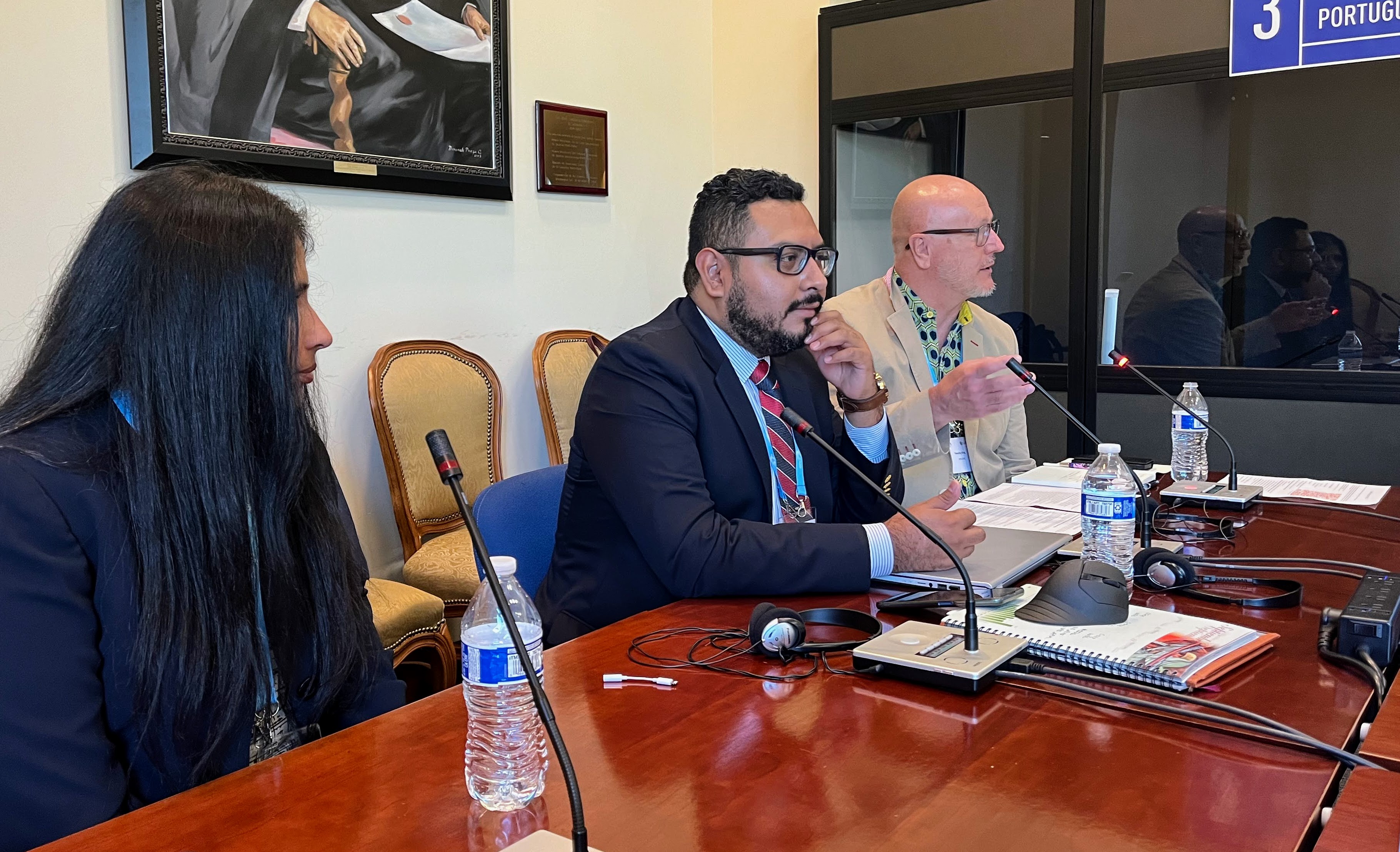
 I got an invite to speak on a panel at the Global Forum for Cybersecurity Excellence's Annual Meeting last week. It was my first time in DC since I went on a trip there with Air Cadets in the 1980s, so it was an exciting prospect. More so when I saw it was going to be taking place in the Organization of American States' building.

Attending these things is a high wire act for me as it looked like I was going to have to self fund my way there, but then the OAS's Cybersecurity directorate got in touch and asked if I'd sit on one of their emerging technology panels for the region of the Americas pre-GFCE meeting too, so I got hotel and flights covered.

I got in on Sunday and my hotel was in Georgetown, so I got out and about and soaked up some Washington area history - the place is thick with it! 

That night I met up with Dr Juan from Mexico who I did a presentation with in June and we enjoyed some Potomac wings at the local Irish pub (as you do) and caught up. The last time I'd seen him was as we passed through US customs on our way back from Ghana last year, so we had a good chat. The opportunity to solidify these connections was impressed upon me as an important consideration later in the week. Never underestimate the appreciation inherent in making an effort to see people live, especially post-pandemic.

Day 1

The next morning, after breakfast at the Fairmont (!), we walked to the Organization of American States building only to discover it was the wrong one. We ran into Alex from Ghana who was on the OAS panel with me later that morning and he knew where we needed to go, so we backtracked four blocks to where we should have been in the first place.

I got there sweaty (DC got up to about 30°C each day) but cooled off and our talk that morning about emerging technology impacting cybersecurity was wide ranging. Kerry-Ann, our moderator, surprised me with a question about how approaching cyber challenges as a technician gives me a different (and valuable thanks to how she framed the question) insight into the rapidly changing state of things.

Talking to engineers and the legal experts doing policy is one thing, but talking to the trades people who do the operational work of keeping the lights on does offer an interesting angle. I'd been expecting to talk about quantum technology emergence, but an opportunity to speak about the value of hands-on, applied skills in the field was appreciated and well received.


Many of the panels focused on the clear and present danger in cyber at the moment: artificial intelligence. From the automation of big data analysis that humans never excelled at on the defensive side to how criminals are leveraging GenAI to produce customized phishing material well beyond grammatically incorrect emails (stretching to include deepfake video, voice, photos and other digital media), these talks were designed to assist policy makers with understanding what has come out of Pandora's box of AI.

One theme that resonated with me was how people don't want deep technical explanations of these emerging technologies. What they want is an easy to grasp explanation of how these technologies will impact the digital spaces they work in. This remains a problem in cybersecurity and an even bigger one in the quantum world where I just finished my secondment. The urge for academics to obfuscate and complicate their explanations of these rapidly emerging technologies doesn't make them ideally suited for presenting on them, especially to the operations and policy people who are entirely focused on real world impacts and couldn't care less how the maths looks.

I've gotten a lot of static for how I've simplified deep technical details in quantum in order to get concepts across, but you honestly don't need to start neck deep in linear algebra any more than you need to have knowledge of the metallurgy involved in casting your car's engine in order to drive it. Guess what background is really helpful in bridging this information divide: 22+ years as a teacher! Early in my career I came across a quote that described teachers as, "public facing intellectuals" and took that to mean we're not about ivory towers and knowing more and more about less and less, but about the democratization of knowledge. Part of that comes with knowing what to keep out of the mix in order to help people get a handle on emerging technologies.

My age is also handy. Being a genuine digital immigrant who remembers a time before personal computers and the internet (I got my first PC, a Vic 20, in 1979 when I was 10), I have a big picture outlook that those who have always lived in this chaos find helpful. My other secret weapon is a university background focused on thinking and communications (philosophy & English).

After the OAS event we had an evening meet and greet at the Museum of the Americas right behind the main building, which had a permanent collection of powerful pieces looking at colonialism and culture. Upstairs they had a Spanish diaspora collection featuring the people who fled Spain during the Franco period; powerful stuff.

At the meet and greet I got to introduce Juan to Michelle and Nina from CyberLite, one of my favourite international cyber education organizations. We did an around the world webinar with them for Safer Internet Day in February, but it's always nice to see people in 3d rather than on a screen, and introductions like this are what GFCE is all about.

Another good example of this networking was running into Christina from Global Affairs Canada. From our talks I've come to understand the complexities and difficulties of international cyber policy. I'm also particularly aware of how important it is to shed better light on the work our federal government does internationally. Some of this needs to be kept on the down low for security reasons, but much of it (and especially on the diplomacy side) needs more media coverage so Canadians better understand the work that their representatives are doing on their behalf. Being purely insular and defensive doesn't work in sport and it won't work in cybersecurity either. If we can help other countries develop better cyber capacities, we all win, and that starts by doing the hard work and developing trust.


Day 2

The next day we were up early again and this time took an Uber to the right building (kind of, it still took us to the wrong one first), and began the Global Forum for Cybersecurity Expertise Annual Meeting.

Our panel came up quickly and Juan brought in a fantastic angle focusing on the Global South and the formation of a 'quantum divide' that will, like the digital one, further separate developed countries from everyone else. I've seen this happening with tightening restrictions on public facing quantum education resources. In some cases this may be under the auspices of national security, but the end result remains: countries that have the resources to develop quantum technologies will have capabilities that the others can only dream of.

There is also an academic ownership of quantum that favours those with the resources to spend most of their lives in post-secondary. Quantum mechanics is how the universe works, yet most schools stick to Newtonian physics because it's intuitive and easier to deliver, except that Newtonian truth is a fiction caused by our scale. If you look closer, it is (as Brian Cox says) quantum all the way. We need to demystify our best understanding of how the universe works so that everyone can grasp the technologies that are emerging out of this science.

Our panel couldn't have happened without a secure internet because our moderator was virtual in Europe and one of the panelists was in Central America. This highlights the importance of the awareness I've been doing in Canada and beyond around quantum encryption readiness in cybersecurity. In a few years that secure internet may be a thing of the past.. After we wrapped up our panel I showed Juan the William Gibson quote about the future already being here, but not evenly distributed.

The idea of a growing quantum divide is another indicator of the state of maturity of rapidly improving quantum computers. I'm motivated to continue my 'technology literacy for all' approach (which includes quantum and AI) because no one should make the technologies that have the best chance of helping us save ourselves from ourselves proprietary. I also have a nagging urge to help everyone reach their maximum potential regardless of how much they have in their bank accounts.

The end of day event on day two was both uplifting (it was a retirement party for founding GFCE president, Chris Painter), but also profoundly insightful. When someone with extensive, top draw international research resources tells me that they aren't worried about AI taking us down because climate collapse will get us first, I listen. Moments like this make me vividly aware of just how fragile the house of cards we're standing on is. If we don't come together to make it accessible, secure and safe, that house of cards is coming down.

This observation feels even more perilous because of the book a colleague suggested that I'm two-thirds through. Advocating for long term thinking in human societies that only reward short term gain is a challenge, but the most recent chapter is about how all civilizations collapse. Historically this happened regionally (Roman Empire, etc), but the global civilization we've built this time is going to crash harder, and when it collapses we're going to be wishing we had made some of Asimov's Foundations in order to recover more quickly (assuming we don't make our only habitable planet uninhabitable in the process). That's the thing about attending a GFCE event - it makes you reflect on the big things (kinda like Tamara's book recommendations).

Day 3

All of the delegates from dozens upon dozens of countries coming together in DC to make digital transformation secure and accessible.

Day three began with the women in cybersecurity breakfast. The moderator at our table told hair raising stories of her being in the first female engineering cohort in South Africa and the overt sexism they faced. I told them about Canada's tragic history with this kind of sexism, which the table found astonishing - Canada is considered forward thinking until we're a bit more forthcoming about the dark currents in our history. I also told the story of the quiet sexism that made founding the first all-female cybersecurity team in our school so difficult. It amazes me that half our population experiences these systemic prejudices and that equality isn't something we're likely to get to before the 22nd Century.

These GFCE events are thick with insights and opportunities that lift your head out of your personal context and prompt you to consider the big problems we face. I've tried to cover the main pieces here, but there are so many more that I'm still subconsciously noodling on.

The emerging tech panel on AI towards the end of the day was another of those eureka moments. The policy expert from France's advanced technologies department had a good response to my question about how we devise policy for near future AIs that will have the agency and resources to ignore them, not out of spite, but because even considering them isn't in their programming. She referenced the US Section 230 law that let social media run rampant and pointed out that if we recognized this cautionary tale we'd be able to better direct AI use now. A sharp response, but I think the AI horses are out of the barn and will shortly have the capabilities to do real damage to our digital infrastructure. I remain curious as to when AI policy to try and restrict development turns into defensive policies designed to mitigate the damage that self-directed AIs will do to our piecemeal global network.

I ended the event having lunch with Abdul, my swimming buddy from Accra, and Juan, my co-conspirator. What do you talk about at a Nigerian/Canadian/Mexican table? Abdul told me he is in 'legacy mode', which is a great way of framing your closing professional years. I enjoyed our talks in the pool at Accra City Hotel because Abdul always seems to see beyond the horizon. Taking a minute to soak up that wisdom is never wasted time. He was going to see his friend's grave and visit his cousin after the event. These seemingly technical meetings can be profoundly human, if you let them be.
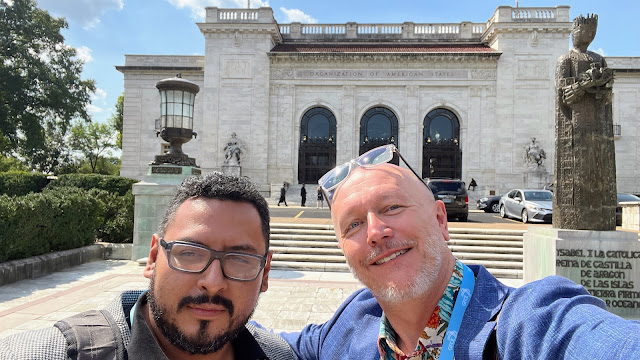

We wrapped up our time at the OAS HQ, but we weren't quite done yet. At the museum event Monday night we met a Spanish attaché and that prompted an invite to the embassy for a Wednesday evening networking event. It was a short walk from the hotel and I talked to a lot of people but really got into it with Jose Manuel who runs telecoms and startups in Spain including a new one that helps you park your boat in a marina you haven't visited before. Besides travel, work life balance and entrepreneurship, we also had a good chat about the innovative quantum key distribution research around mesh networking QKD into live networks that he is in the vicinity of. I'm hoping to follow up and develop some transatlantic connections that move us all forward.

***

I must have covered 20+ kms on foot over the week (in dress shoes!), but I have no regrets about the schlepping or having to self fund some of this. Hope is hard to find in 2024, but the GFCE exhales it like plants give off oxygen. Just as the GC3B in Ghana did last fall, my mind is left turning over the complex challenges and opportunities that this meeting highlighted. If you're looking for organizations that improve your practice, expand your context, and challenge (and enable!) you to take on the seemingly insurmountable global issues we face, meeting the OAS and experiencing my second live GFCE event has done just that.

DC looking like a postcard on the ascent out of Reagan Airport.

Just over 500kms as the crow flies from DC, I was back in The Six before I knew it!

Friday, 29 December 2023

International Cyber Cooperation: Reflections on the GFCE & GC3B

I first experienced the frustration inherent in Canada's approach to cybersecurity education last year at the University of Waterloo's CPI conference. There Charles Finlay from the CyberCatalyst talked about how other smaller countries focus on a collaborative approach to cybersecurity that creates a coherent ecosystem of partners who support rather than compete against each other. In the asymmetrical world of cybersecurity where attackers have every advantage in terms of anonymity, it isn't just criminal organizations working the dark end of the internet in 2023, it's authoritarian nation states with fully developed offensive cyber operations. Without collaboration, democracies will dissolve in the chaos of our networked world.

We have the resources,
cooperation is what's missing.
In the year since I've been working to establish connections between the many entities in Canada's cybersecurity industry intent on education and career pathways illumination, but what I've found are siloed organizations (private, public and NFP) fixated on IP and market share whose idea of collaboration is creating partnerships to defeat what they perceive as competition. This isn't collaboration so much as it's combining resources to compete more effectively.

This monopolistic approach is partly the result of how Canada funds cyber-education and industry awareness. By creating competition for funding, potential collaborators are turned into competitors and the possibility of mutual support becomes impossible. A great example are all the competing networks, alliances, consortiums, catalysts and councils - all of whom claim to be creating a collaborative ecosystem under their leadership. Finding funding and piling onto this chaos seems to be the way in Canada. This has been a great frustration and a repeating theme on Dusty World over the past year:

Creating A Canadian Cybersecurity Ecosystem (Oct '22)

How Cybersecurity Might Become More Diverse, Equitable and Inclusive (Dec '22)

You Want to Teach WHAT?!? Reconfiguring Technology in Schools to Empower Pedagogy (Oct '23)

Cyber Education in Canada is Broken, Here's How to Fix It (Nov '23)


***


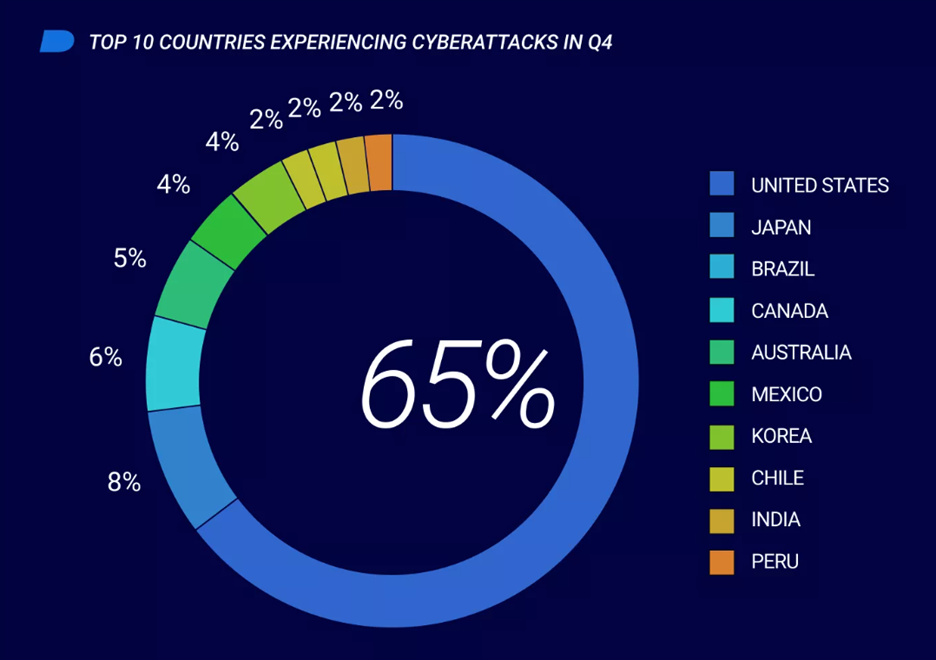
The majority of attacks are US focused, but if
you consider Canada has 1/10th the people, we
actually face similar numbers of attacks per capita.
One of the ways I've escaped Canada's siloed approach to, well, pretty much everything, is to look internationally for organizations interested in working collaboratively on the cyber-problem. That would be the one where we put all our critical infrastructure onto a global network that was never designed to be secure and then struggle with wave after wave of increasingly automated cyber-attacks in an environment where the attack surface has become impossibly complicated post COVID.

I started by looking at the World Economic Forum's review of the new US Cyber-Strategy, which is focusing on protecting critical infrastructure and improving collaboration both domestically and internationally to create more effective cyber-defences. Canada's strategy is designed to encourage competition rather than collaboration and has resulted in our being one of the most targeted countries globally. 

The US strategy seems to be aware of this North American predilection for relentless market dominance fixated competition and is attempting to put resources into a collaborative mindset. That approach became apparent when I attended the Global Conference on Cyber Capacity Building this fall.


***


Through looking into WEF and the UN I came across the Global Forum for Cybersecurity Excellence (GFCE). In June I pitched this proposal on helping cybersecurity practitioners become aware of the coming threats to encryption that quantum computing brings: GFCE Proposal - Cybersecurity in the Age of Quantum Advantage.docx. The elevator pitch is: quantum computing will break most of the encryption standards we depend on for everything from our online financial systems to military communications in the next decade, and likely much sooner.

The GFCE got back to me and said they felt that quantum awareness was an important piece of the puzzle and a good fit with their Global Conference on Cyber Capacity Building (GC3B) happening in Accra, Ghana at the end of November. They invited me to develop the research and present it at the event. I'm currently seconded with both ICTC working on cyber-education outreach and the Quantum Algorithms Institute developing education for quantum readiness. QAI supported this research and I got in touch with Louise Turner, a former student now in the inaugural cohort of cybersecurity at Queens University, and she and I put the paper together.


While doing two jobs I beavered away on the paper in the background and Louise (who was juggling her third year course load) and I managed to get the paper in on time. While all that was going on we were both jumping through the hoops in terms of visas and medical requirements to take what would be both of our first trips to Africa.

It all came together at the end of November and we found ourselves at Pearson Airport in Toronto getting on a plane to Washington and then across the Atlantic to Accra. The entire process felt insurmountable, but I've found that if you chip away at seemingly monumental projects like this you get the pieces in place - just don't expect it to happen all at once and pace yourself.

A particular frustration was all the dead ends I chased in terms of finding support for both the research and going to the event itself. I was disappointed to not get support from organizations I have long relationships with who claim to champion just this sort of digital engagement. I went out of my way to attend academic events, but when I asked those organizations about support I found the doors firmly closed. Every form of federal support is safely locked to academic partnerships in a way that makes it impossible for anyone but an internal PhD to claim them; those Canadian silos are exceptionally good at taking care of themselves. I talked to many professors in a multitude of schools but they all disappeared back into their funded, tenured worlds after making noises about how important this kind of work is. That's ok, we did it ourselves.

***

It was snaining in Toronto when we left, but on the ground in Ghana after 12 hours of misery in a middle seat next to the only guy bigger than me on the plane (why don't airlines use smart tech to arrange seating better?), we found ourselves on the ground in Africa! The VISA support by the Ghanese government had been spectacular in Canada and the hospitality was just as special at the Accra Airport. A senior military officer ushered us through customs in seconds and out to the GC3B desk where we got connected to our hotel and suddenly found ourselves tearing through Accra traffic, stunned by the sights and sounds... and heat (Accra is only 600kms north of the equator)!
 
The conference flags were all around the city. From our anonymity in Canada, we suddenly found ourselves at a very welcoming international event.

The Accra City Hotel was where we'd been put up for the conference and was only a ten minute drive from the very fancy Kempinski Hotel where the conference was taking place. We had lunch and then collapsed in our rooms for the afternoon after over 24 hours on the road.

The week before we'd built a powerpoint: QAI GFCE cyber in the age of quantum research presentation.pptx that was designed to gently introduce cybersecurity policy and technical practitioners to quantum computing. We went over it after our afternoon naps on the pool deck in the sweltering heat and humidity of an Accra evening. Louise helped pioneer women in cybersecurity in our school back in 2018/19 when she was in grade 10 and I've known her ever since, so we knew each other's strengths and felt ready to go with the presentation the next morning. That night we had a fantastic Ghanan buffet and then hit the hay.

Since we were presenting on the periphery of the main conference we got to meet the Global Forum for Cyber Excellence working groups who were the organizers of the research presentations. This gave us 'behind the scenes' access to the conference before the main event kicked off the next day. It quickly became apparent that the research presentations needed more time to do them justice. We heard from researchers from all over the world studying everything from regionally specific cyber challenges to international projects on how cyber is presented in the media - to call it fascinating would be an understatement.

Louise and I stepped up for our presentation and knocked it out of the park. We'd de-tuned the technical details (Louise was happy to get into explaining how lattice based mathematical encryption actually works), but the GFCE was keen to focus on making it an introduction to quantum computing and how it will change cyber practices in the next few years. My being a teacher was considered a benefit in introducing this technology which is often obscured by academics fixating on its technical complexities. To ensure equitable access we focused on ensuring the paper only included publicly available research that would assist readers in further exploring the technology. This is an area where Canada excels - putting publicly available material online for anyone in the world to access, so we made good use of the many Canadian cyber and quantum resources available.

We must have done well because we were the only presentation who was asked questions by the reviewer and we ended up late to lunch because we had a line of attendees wanting to ask further questions. There is a lot of curiosity out there around quantum technologies but not a lot of people developing accessible education for the public. As a result it tends to be an academically isolated subject.

Our reviewer kept referring to me as Doctor King during her analysis of our paper, but I've always been interested in how technology becomes applied rather than working on the academic/theoretical side of things. Applied technology use has been my focus since I migrated decades old paper based engineering paperwork onto Lotus123 back in 1991. I was happy to use my blue collar technician's approach to putting a pin in the idea that you need a PhD to understand quantum computing. When it comes to the technologies that so influence our lives (as quantum certainly will), I think everyone deserves to understand how they work.

The rest of that first day at the Global Conference on Cyber Capacity Building was fascinating because it wasn't really about the conference, but instead about the mechanics of the GFCE. By the time we were heading back to the hotel I felt like I'd found my tribe and was determined to see what else I could do with them. This was the collaboration and mutually supportive approach to cyber that I'd been missing.

We wrapped up day one feeling the burn. I've never felt so good jumping into a pool after a day of sweating through a suit. While in the water I bumped into one of Nigeria's cybersecurity leaders and we had a nice chat while watching the sun go down.

The next morning we were up again at midnight our time for a 6am start, and on our way to the Kempinski for the opening of the main event. The conference had swollen in size since we'd seen early setup the day before. Instead of a hundred of so people, over 800 were coming in from over 100 different countries, all intent on seeing how we might work together to make digital transformation more equitable and accessible.

I use Twitter as a way to bookmark ideas and resources so I can find them later when I'm building one of these blog posts. My feed from the conference probably tells the story better than a summary here, but to say it was engaging and eye opening would be underselling it. The GC3B worked every angle from policy and diplomacy to technical cooperation and regional partnerships all the way through to international collaboration. It changed the way I see cybersecurity because it moved me beyond the veiled, siloed and somewhat paranoid world of Canadian cyber.

At the end of the second day we were bused over to the park where Ghana's first president is interred for an end of conference dinner. Like everything else that week, it fundamentally challenged my preconceptions. If indigenous people had overthrown European colonization and established their own representative democracy in the wake of that oppression in Canada, that's where Ghana is today. The story of Kwame Nkrumah and his efforts to awaken a pan-African culture were fascinating, especially from the perspective of someone living in a resource consumption focused culture where we continue to struggle with our colonial past.

Kwame Nkrumah Mausoleum in Accra - well worth a visit.

On the bus ride over (which was an adventure in itself - African commuter buses have drop down seats so the bus is shoulder to shoulder in every row without an exit aisle), I was at a loss to understand how we appeared to be the only Canadians at an international conference where over 100 countries were in attendance. The US State Department had helped fund the event, as had the EU, and we'd met Australians and many other Commonwealth nationalities, but not a single Canadian. The Australian told us about how her government's local office had picked her up at the airport, taken her out for lunch and made sure she was OK at her hotel. Ours sent us a PDF of things to do in Accra.

All of this prompted me ask the Swede sitting next to me how Canada is seen in the international community. I'd honestly expected to hear nice things and assumed we'd simply not been involved in all the clandestine activities of our government at this event, but that's not what came out. The Swede described Canadian participation in world cyber cooperation to be 'selfish and minimalist', which came as a shock despite what I'd observed (it's a teacher survival mechanism to ignore the worst and assume it's my misunderstanding). The Estonian in front of us chipped in with, "I think Canada asks what the minimum is to look like they are involved in a project, give it and then that's the last we hear from them." Attendees from a dozen other countries all nodded in agreement. I did the most Canadian thing imaginable and apologized for my government and all the organizations that are funded by it - even though they'd all ignored my own requests for support prior to the event.

A wonderful evening with people looking to change the world for the better. Ghana knows how to put on a party too...

***


As I floated into the pool later that night pondering how I'm going to dress for the final day of the conference with a suit jacket soaked through with sweat (I went with just a shirt for the final day), I found that I wasn't cowed by what seems to be an insurmountable cultural problem we face as a country. Internally we have the resources and education to make cybersecurity a viable pathway. Canada should be poised to help solve the world's cyber-skills shortage, but instead our plan is to (as it has been in so many other cases) take that talent from other places that need it for our own ends, and do as little as possible to support international cyber development to ensure an equitable digital transformation for all.

I'm a fan of Paul Theroux's travel books. His trip across Oceania ends in Hawaii where he stays at one of the top resorts that is staggeringly expensive. Over the week he finds it coddling and restful, but he comes to the conclusion that when people have money, they mainly use it to keep other people away. The fancy resort provided privacy and a lack of bother from others - that was its main purpose and where the money got spent. Canada is a wealthy country and it seems we use our wealth in much the same way, to isolate ourselves from others. It's not very flattering.

Over 100 countries in attendance. Didn't see a single Canadian in any of the dozens of presentations and none were presenting. I know for a fact that Canada has some of the top cybersecurity practitioners on the planet, but they don't like to share?


***

I arrived at the last day of the conference with a head full of thoughts. This lack of engagement by my country (at least in person, evidently Canada was one of the first to endorse the Accra Call) suggested that the lack of cooperation I see domestically is reflected in our international engagement too. My background and interest is in educational engagement with cybersecurity and other emerging technologies that I feel are essential to students making smart decisions about their futures, so to end the conference I attended Session 4.26: Thinking out of the box to inspire a new generation of cybersecurity talent:
  

You might not have watched that video, but this sort of brainstorming and mutual support is just what we need if we're going to produce a cybersecure future. This doesn't happen behind closed doors or at a distance. I hear a lot of Canadians talking about the Canadian government as though it's distinct from them. This cool distance creates problems with how Canadians understand their own country and their role in it, but it also freezes out possibilities for international collaboration which must be about more than sending money.

I had a great chat in that session on developing cyber talent with a young man from Ghana who had started off as a hacker before coming over to the defenders. He described that journey, especially in a place where you can't drink the water and social services are often non-existent, as difficult because the payouts for being a bad guy are always going to be better. To hear people who are living in what Canadians would consider poverty talking about how they can work together to create equitable digital transformation that will improve standards of living for all was inspiring. You'd have to be the worst kid of self-serving bureaucratic robot to think otherwise.

***

On the final morning we reconvened at the Kempinski and ended the conference with many promises of future work together. It was inspiring and I couldn't help but get a bit teary, especially when they included the presentation awards for Ghana's Student National Cybersecurity Competition...

An all-female team won Ghana's student cybersecurity challenge! 

Having been deeply involved in Canada's student cybersecurity competition since its inception, I was interested to see this presentation. Some stats for comparison:

Ghana has 475 high schools, 50 participated in the national student cybersecurity competition, that's an 11% participation rate. You might think that low but Canada is currently at 0.6% of high schools participating nationally in CyberTitan which has been running for six years (the Ghanan CCS is in its third year). The siloed nature of Canada's regionalized education system (we are the only developed country in the world without a national education strategy) has a lot to do with that.

An all-girl team won the 2023 edition of their SCC. No all-girl team in Canada has ever come close, which makes for an interesting comparison on access to STEM education opportunities between the two countries. If money is used to keep people at a distance, male dominance in cybersecurity is certainly operating along similar lines in Canada. There is much to do in terms of gender equity in the Canadian tech ecosystem.

There were two ministers and other members of parliament at the awards celebration for these students. No member of Canadian parliament, minister or not, has ever attended CyberTitan nationals. Another example of our remote/arms-length governing? At the very least it highlighted the lack of value we seem to place on securing our critical infrastructure in a digital future that will increasingly depend upon cyber skills.

***

On the long plane ride home I was reflective. Was it easy doing this thing? Not at all. I spent a lot of time talking myself out of it for various reasons, and burned a lot of cycles trying (unsuccessfully) to find support to get myself and others to it. Without Louise coming on and helping carry the research load I think I may well have talked myself out of going, and what a shame that would have been.

Winnie knows how it feels. Whoever is doing Xmas
decorating at Dulles is a bit... chaotic in their approach,
but I like it!
Doing the research outside of my regular working hours wasn't easy, and managing the many logistical requirements both medical and paperwork wise was also a heavy load to carry, but it's these extras that I always get the most out of in my work. If you look at my LinkedIn you won't see me bragging about the work I'm paid to do, but rather the projects I chase beyond those expectations. At the end of the day I'm mission driven. After twenty-years in the classroom and building one of the most successful digital skilling programs in Canada in the most unlikely of places, I want to take what I've learned and spark opportunities like that nationally so more Canadian students can access emerging technologies and make informed decisions about where to go next. That this is a struggle continues to baffle me, but I'm committed to climbing that mountain.

Regrets? None. This wasn't easy but that's exactly why we need people to put the work in and make this sort of connection happen. Am I frustrated by Canada's approach? Yes, but that too is a challenge, and one that we will overcome with vision and determination. With a renewed commitment we will see a meaningful Canadian presence at the next Global Conference on Cyber Capacity Building taking place in Geneva in two years. I intend to be working with the GFCE by then in their education working group if not elsewhere in the organization. I hope I can bring more Canadians into it too.